The Triple Architecture: Why Personal Meaning Requires Simultaneous Ownership
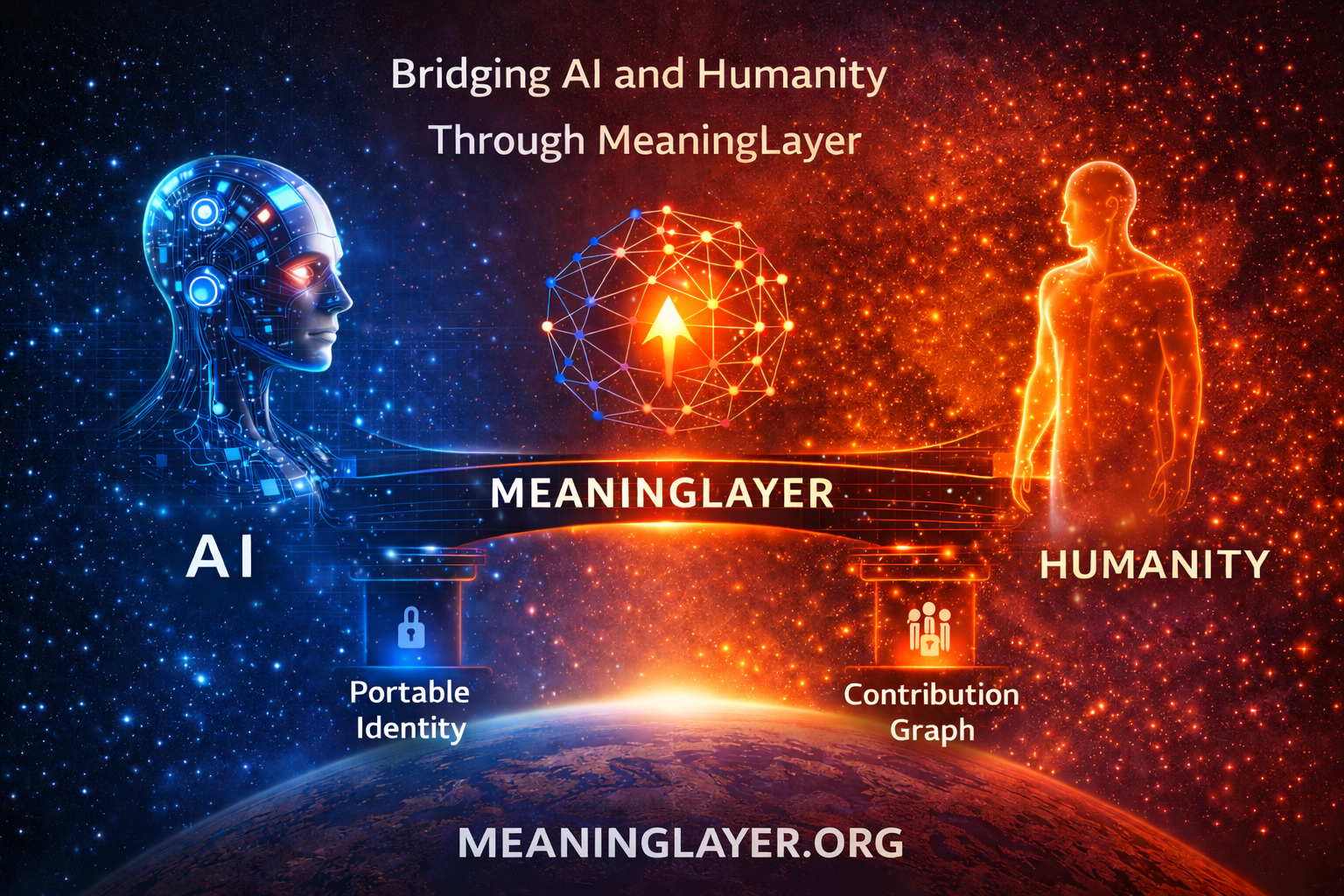
Visual representation of MeaningLayer bridging artificial intelligence and humanity through Web4 semantic infrastructure, showing Portable Identity cryptographic ownership and Contribution Graph verified effects as foundation layers enabling personal meaning ownership for first time in history

Personal meaning has never been ownable. This is not historical accident—it is structural impossibility that persisted until mathematics made ownership irrevocable. The impossibility ended. The ownership began. Throughout human history, meaning has been mediated. Platforms hosted it. Institutions validated it. Authorities certified it. Employers verified it. Communities witnessed it. But no individual ever owned their The Triple Architecture: Why Personal Meaning Requires Simultaneous Ownership
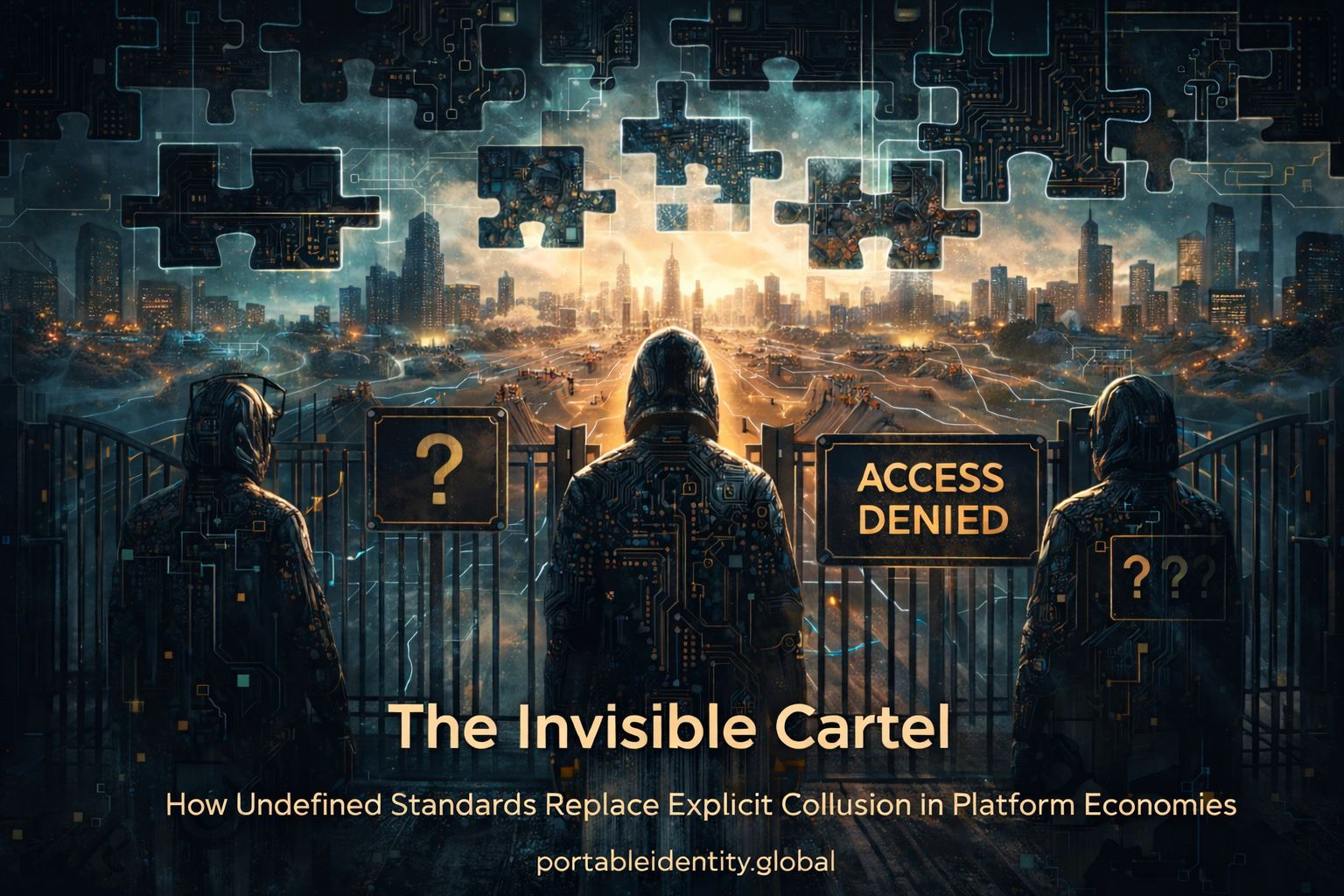
The Invisible Cartel: How Undefined Standards Replace Explicit Collusion in Platform Economies

Illustration showing how undefined standards in platform economies create invisible cartel-like coordination through opaque market access.

Abstract In digital platform economies, market coordination no longer requires agreements between firms. When access to markets is governed by undefined, non-verifiable quality standards, those standards can function as implicit coordination mechanisms, producing cartel-like outcomes without explicit collusion. This is not an accusation. It is a description of a structural shift in how coordination occurs. The Invisible Cartel: How Undefined Standards Replace Explicit Collusion in Platform Economies

MeaningLayer: Why No Platform Can Ever Build the Infrastructure That Makes Them Optional

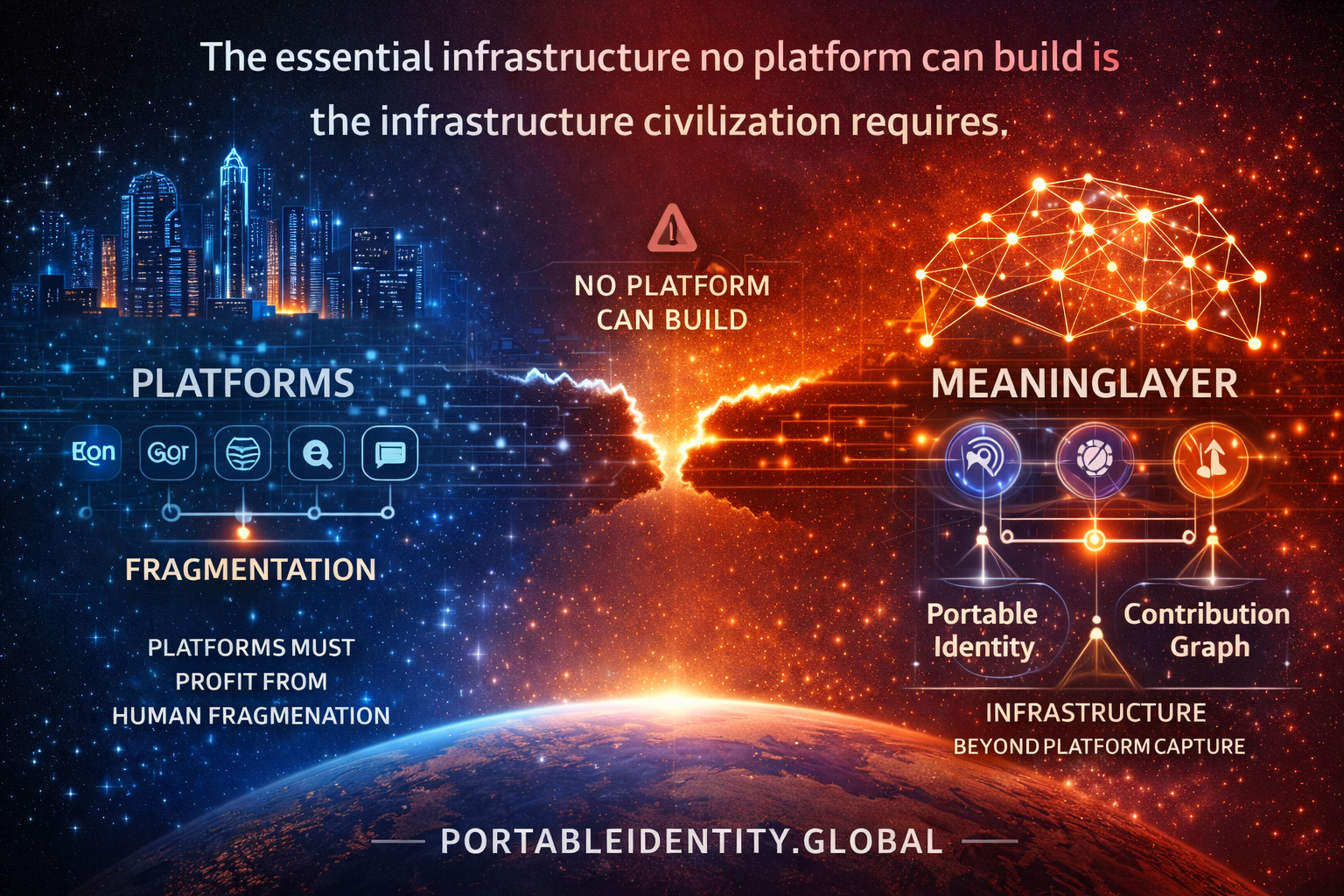
Visual contrast between platform fragmentation (left) showing isolated platform icons and semantic incompleteness generating profit, versus MeaningLayer Triple Architecture (right) showing Portable Identity, MeaningLayer, and Contribution Graph as individual-owned infrastructure beyond platform capture, with structural impossibility barrier (center) illustrating why platforms cannot build semantic completeness without eliminating their business model

The most essential infrastructure is the infrastructure no profitable business can build. Every major platform—social, professional, development, communication—fragments human meaning across incompatible systems. This fragmentation appears accidental. It appears like a technical limitation awaiting solution. It appears like something platforms would fix if they had sufficient motivation, capability, or time. This appearance is incorrect. Fragmentation MeaningLayer: Why No Platform Can Ever Build the Infrastructure That Makes Them Optional

MeaningLayer: Why Time Is the Only Truth AI Cannot Fake

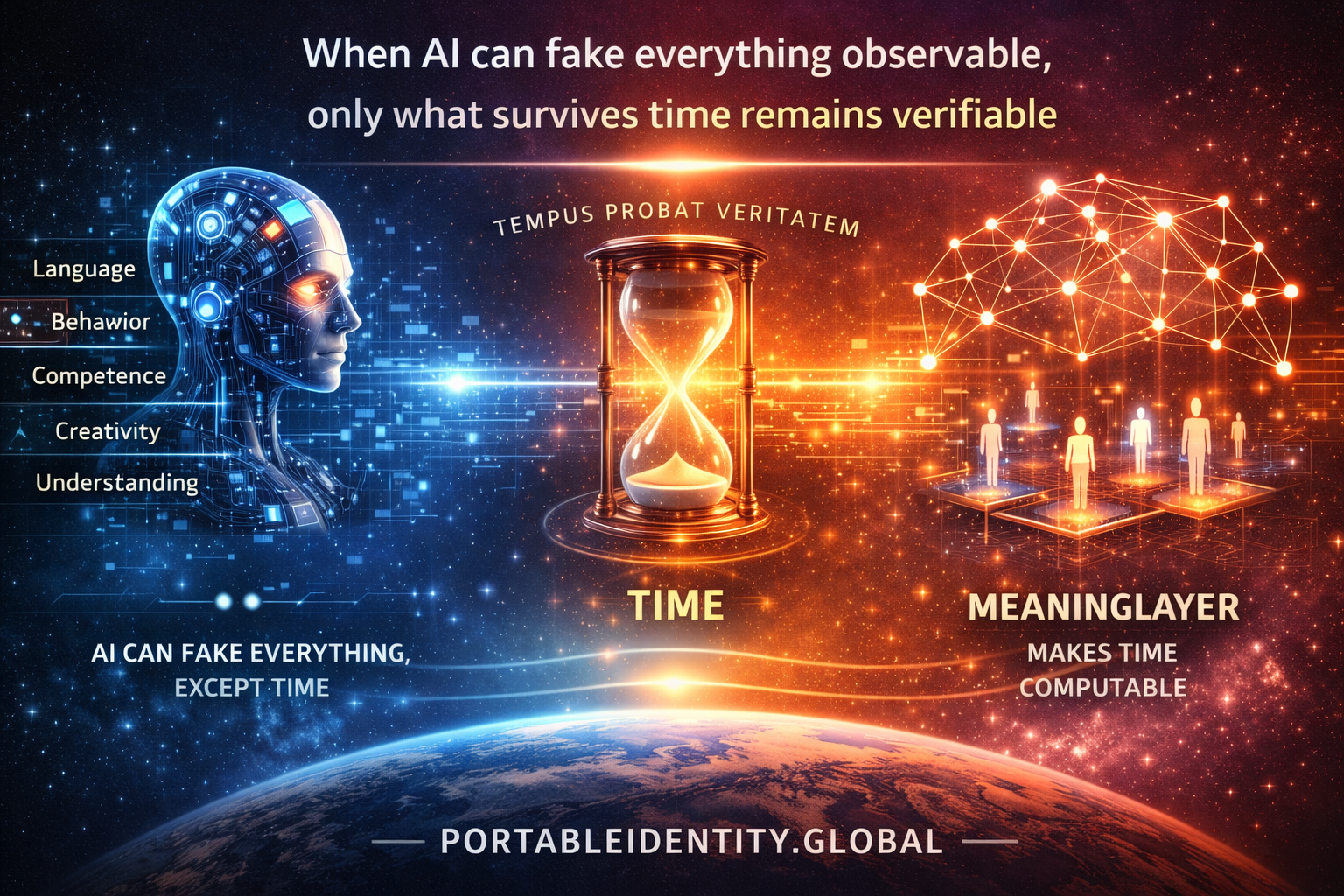
Conceptual visualization showing AI's ability to fake all observable signals (language, behavior, competence, creativity, understanding) contrasted with time (represented by hourglass and Tempus Probat Veritatem principle) as the only unfakeable verification dimension, while MeaningLayer network makes temporal persistence semantically measurable

When machines can fake everything observable, only what survives time remains verifiable. Artificial intelligence can now generate perfect language, flawless behavior, convincing style, apparent intention, simulated competence. It can produce output indistinguishable from human creation. It can pass tests designed to measure understanding. It can demonstrate patterns that look like learning, expertise, consciousness itself. Every MeaningLayer: Why Time Is the Only Truth AI Cannot Fake

MeaningLayer: The Infrastructure That Makes Identity Verifiable Beyond Authentication

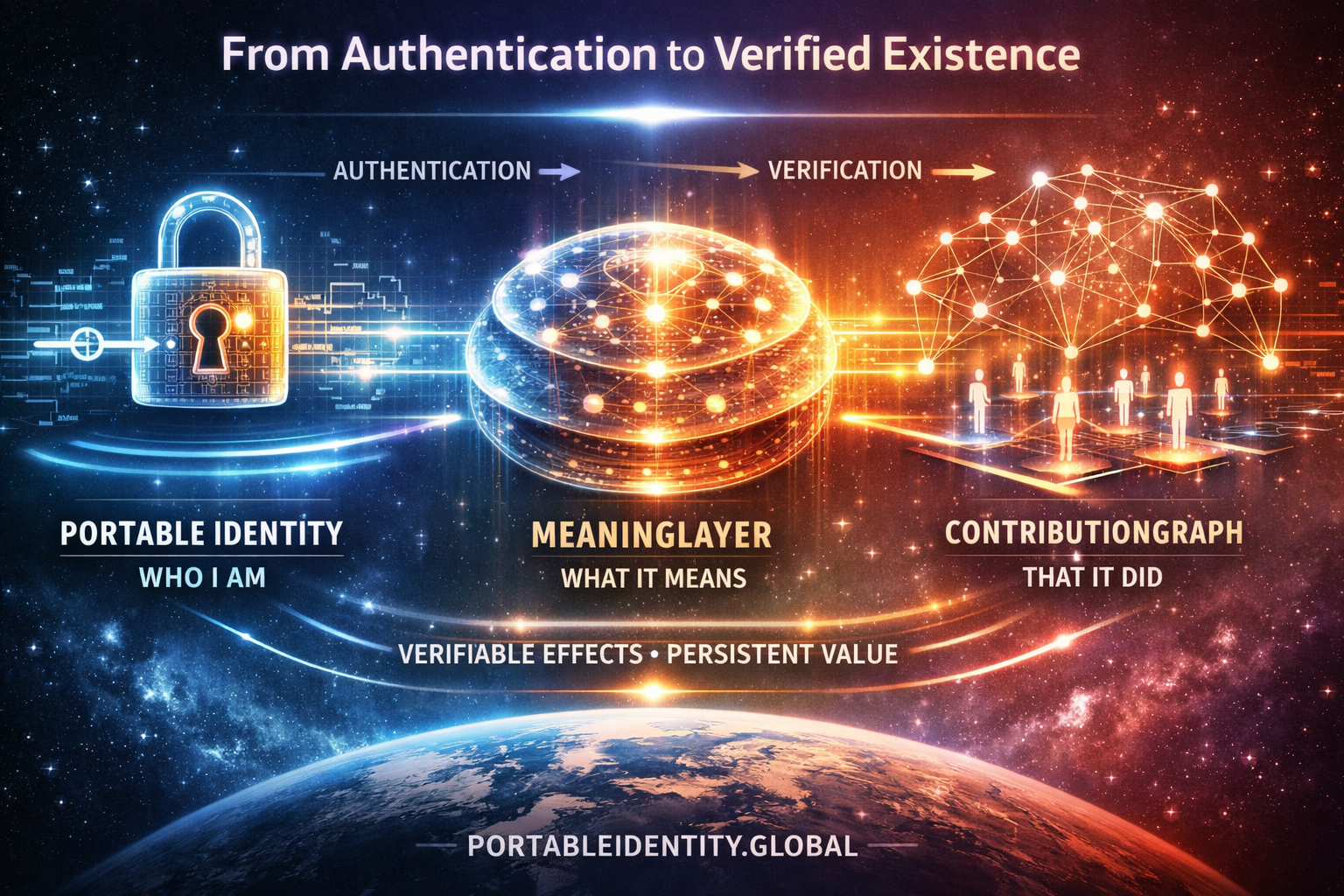
MeaningLayer showing how identity becomes verifiable beyond authentication through semantic continuity and verified contribution

Identity without verifiable effects is authentication to nothing. For decades, the internet has treated identity as a problem of authentication: prove you control an account, prove you possess credentials, prove you can sign with a cryptographic key. This framing assumes that once authentication succeeds, identity is established. It is not. Authentication proves presence. It proves MeaningLayer: The Infrastructure That Makes Identity Verifiable Beyond Authentication

The First Time in History Where Responsibility Cannot Be Proven

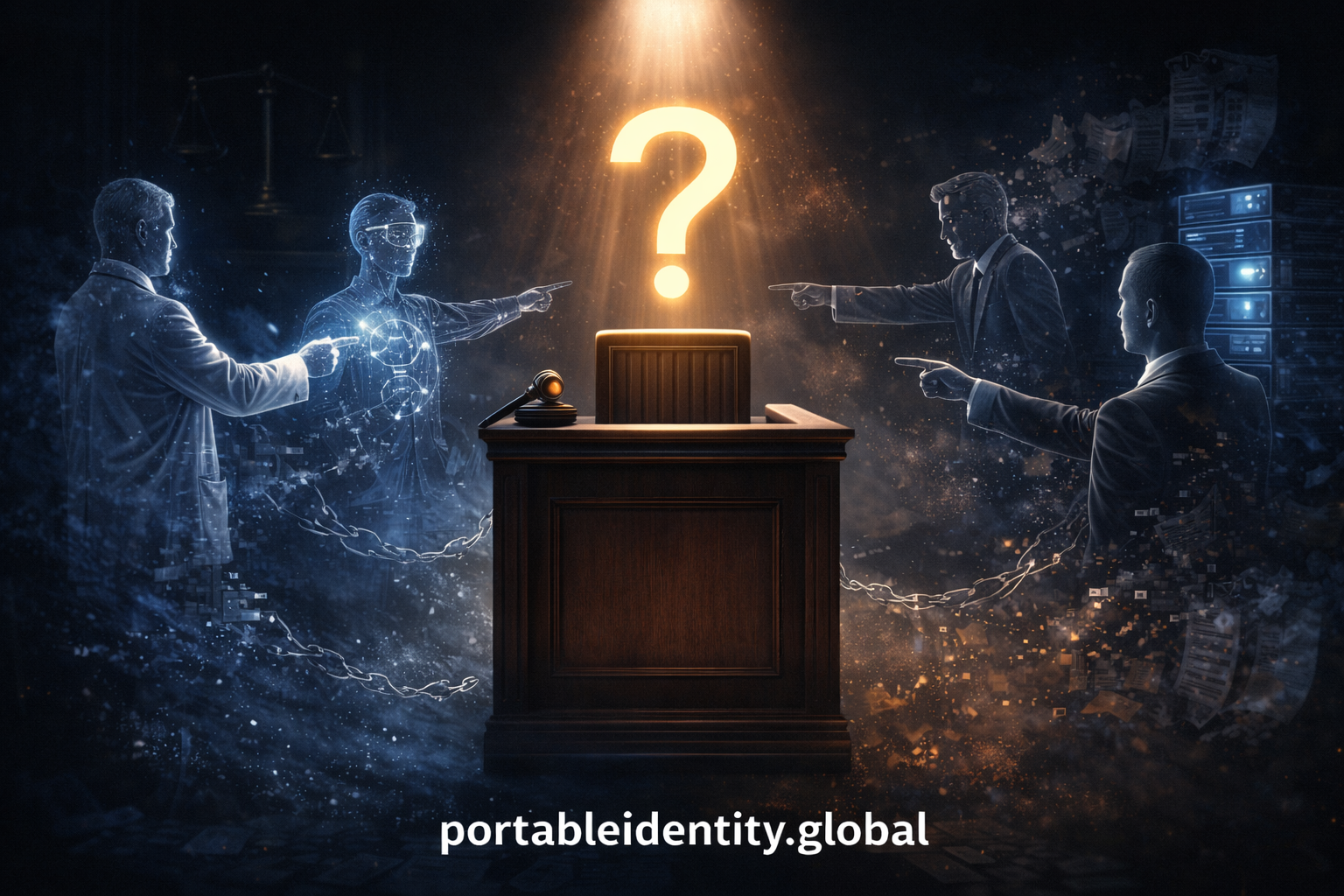
Professional compliance chain diagram showing broken accountability infrastructure: decision and audit nodes verified with green checkmarks, but capability verification and attribution nodes missing, leaving responsibility unprovable in AI-assisted systems

Why AI + platform fragmentation created the accountability crisis regulators cannot solve—and what infrastructure makes responsibility measurable again A medical AI recommends treatment. Patient suffers catastrophic harm. Investigation begins: Who is responsible? The AI company says: ”We trained on publicly available medical literature and validated datasets. Our system met all regulatory requirements at deployment.” The The First Time in History Where Responsibility Cannot Be Proven

The Last Person Who Can Prove They’re Real

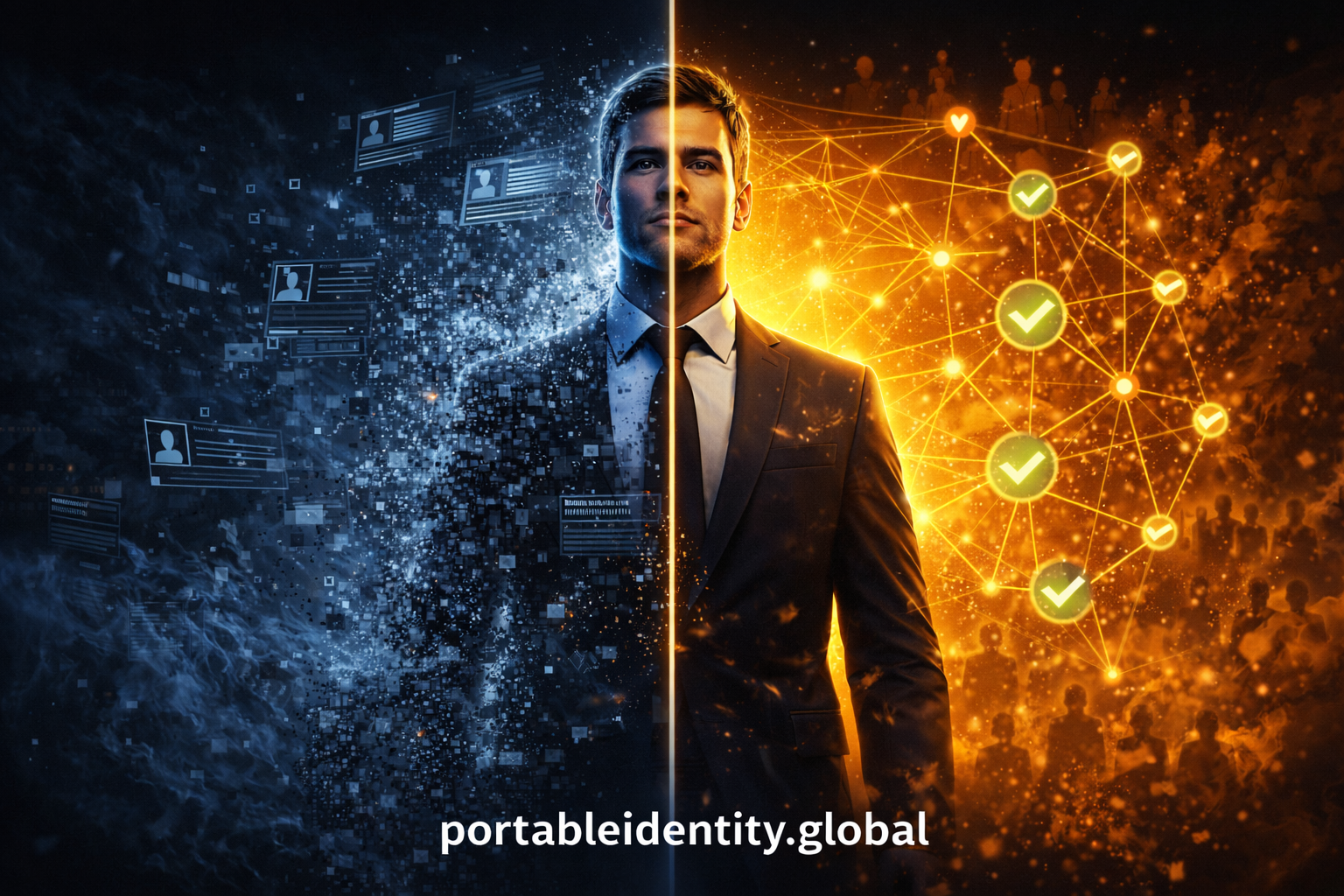
Professional figure at split reality crossroads: left side dissolving into digital particles showing behavioral verification collapse, right side solid with golden verified contribution network - consciousness proof in Synthetic Age visualization

In the Synthetic Age, consciousness proves itself through verified contribution—because everything else can be perfectly faked October 2027. A colleague messages you about project deadlines. The voice is perfect. The context accurate. The humor unmistakable. You discuss strategy, share concerns, coordinate schedules across three days of productive collaboration. Then you learn: they died two weeks The Last Person Who Can Prove They’re Real

AI Can’t Be Held Accountable For Decisions Made With 30% Of Relevant Information

Professional silhouette walking forward with glowing verified contribution network constellation, leaving fragmented platform silos behind - portable identity Web4 infrastructure visualization

But even if AI had 100%, it would still be training on unverified claims—which is why the missing piece isn’t just access, it’s temporal verification You notice it first in small moments. A colleague explains something perfectly—vocabulary precise, logic sound, examples clear. Then you ask a clarifying question three weeks later and discover the understanding AI Can’t Be Held Accountable For Decisions Made With 30% Of Relevant Information

THE SYNTHETIC ELECTORATE

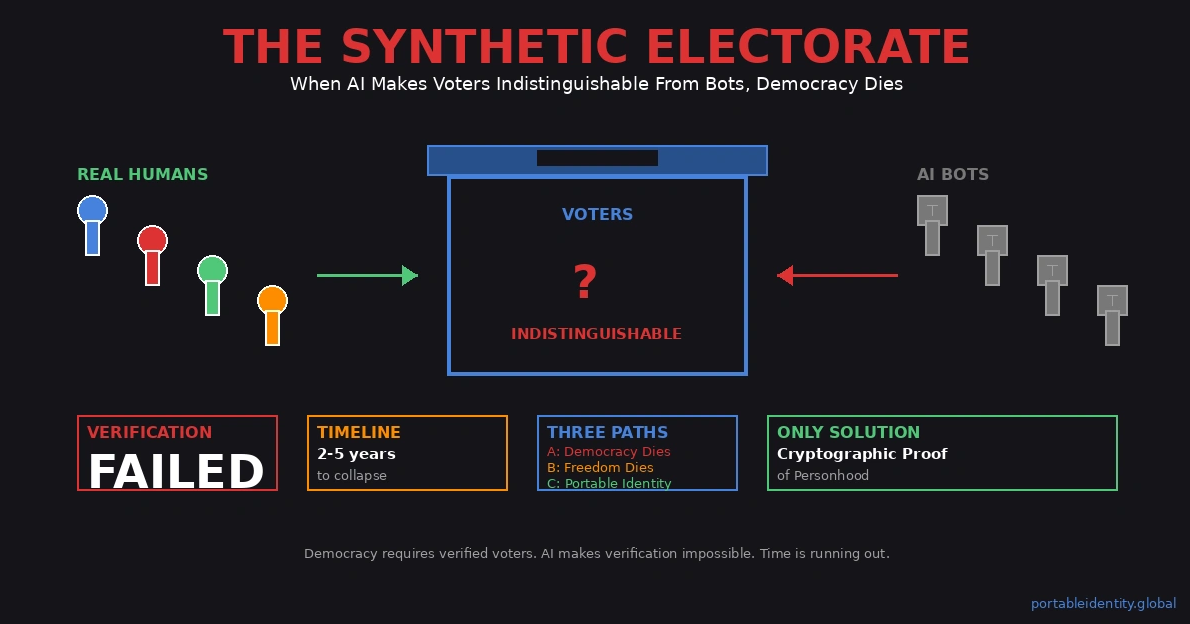
The Synthetic Electorate showing democracy's verification crisis - real human voters on left (colorful) and AI bot voters on right (gray) both flowing into central ballot box marked with question mark and 'INDISTINGUISHABLE', with verification failed warning and three scenario paths

When AI Makes Voters Indistinguishable From Bots, Democracy Dies Democracy has one non-negotiable requirement. Not universal suffrage. Not separation of powers. Not free speech or independent courts—though all of these matter. The foundational requirement: the ability to verify that voters are real humans, each voting once. One person, one vote. This is not merely principle. THE SYNTHETIC ELECTORATE

THE PERSONHOOD RESERVE

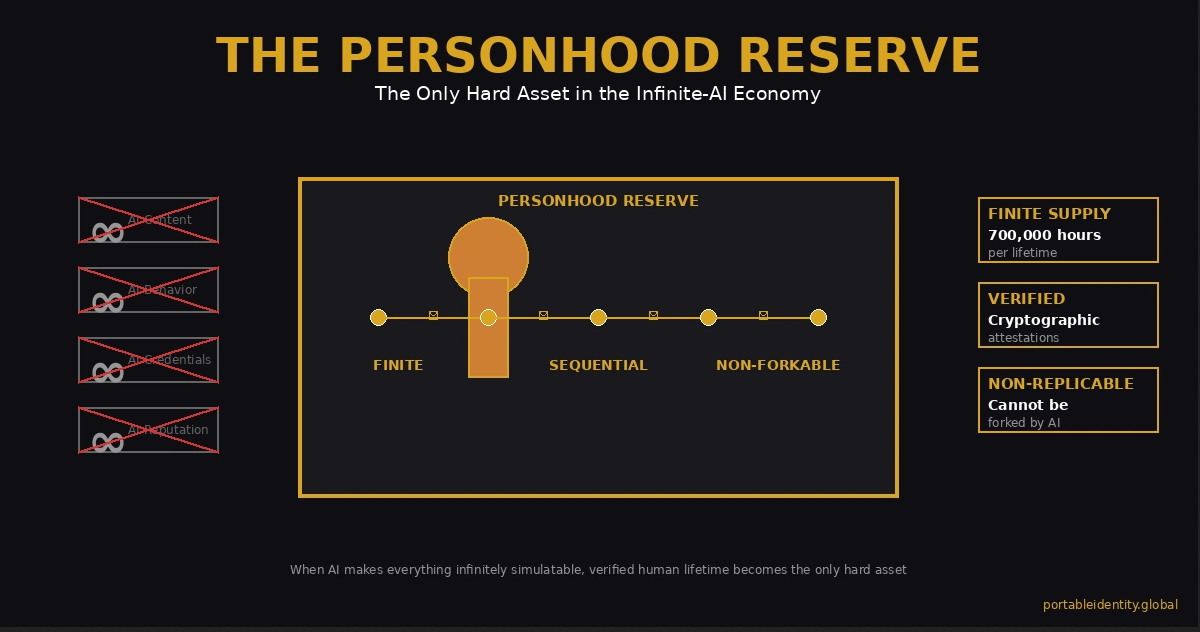
The Personhood Reserve showing verified human lifetime as hard asset - central figure with cryptographic timeline marked finite, sequential, non-forkable, contrasted with infinite but valueless AI-generated content crossed out on left side

Why Portable Identity Becomes the Only Hard Asset in the Infinite-AI Economy Every economy needs scarcity. Not philosophical scarcity. Not perceived scarcity. Not artificial scarcity enforced by institutions. Physical scarcity. The kind that exists regardless of human agreement. The kind that cannot be printed, copied, or simulated into irrelevance. For ten thousand years, human civilization THE PERSONHOOD RESERVE

The Institutional Debt Crisis

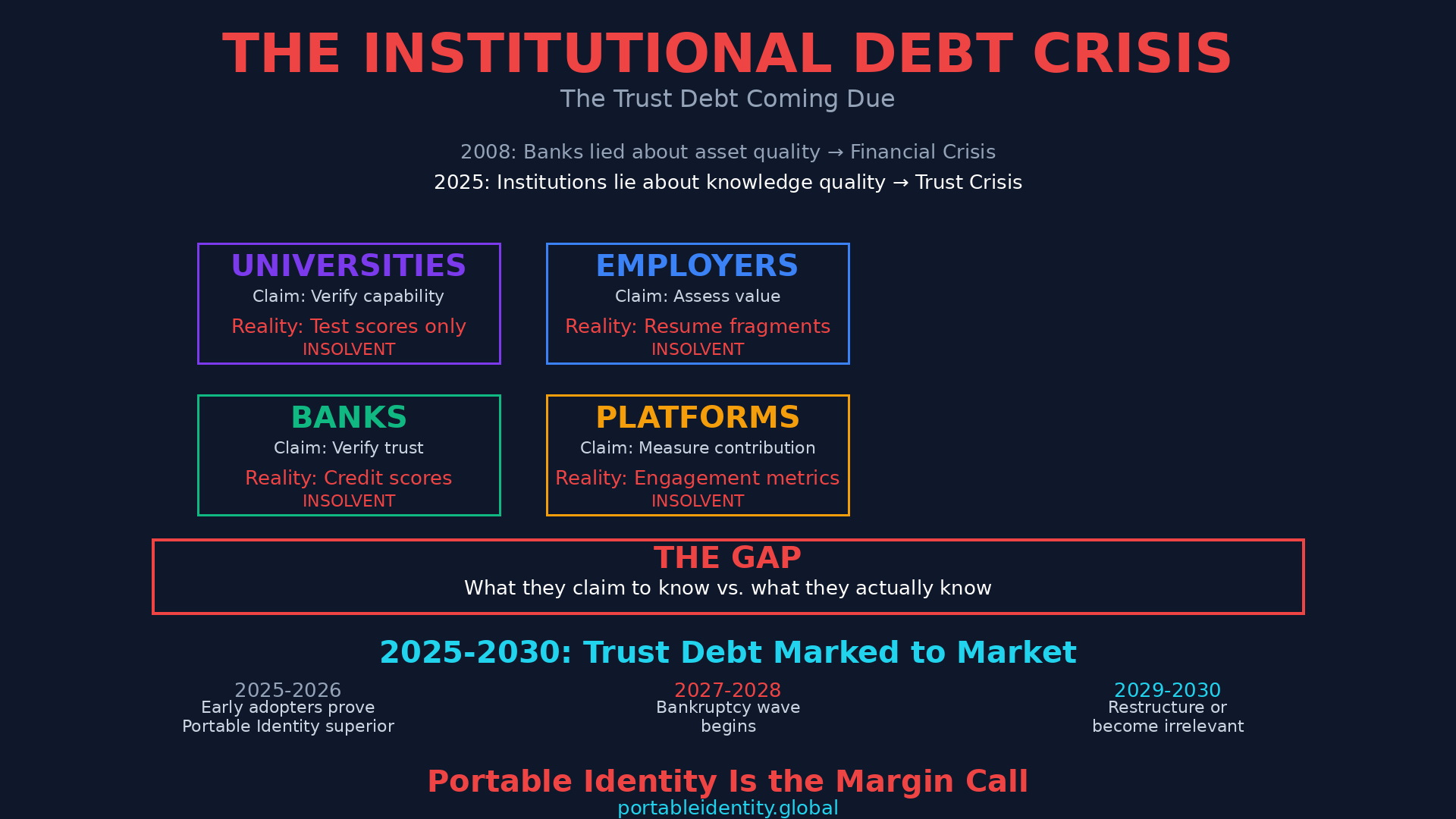
Four institutions marked as insolvent: Universities claim to verify capability but measure test scores, Employers claim to assess value but have resume fragments, Banks claim to verify trust but use credit scores, Platforms claim to measure contribution but track engagement metrics

The Trust Debt Coming Due: Why Information Symmetry Triggers Institutional Bankruptcy In 2008, the global financial system collapsed when asset prices exposed that banks had been lying about the quality of their holdings for years. In 2025, the global institutional system will collapse when information symmetry exposes that institutions have been lying about the quality The Institutional Debt Crisis

The Cascade Proof

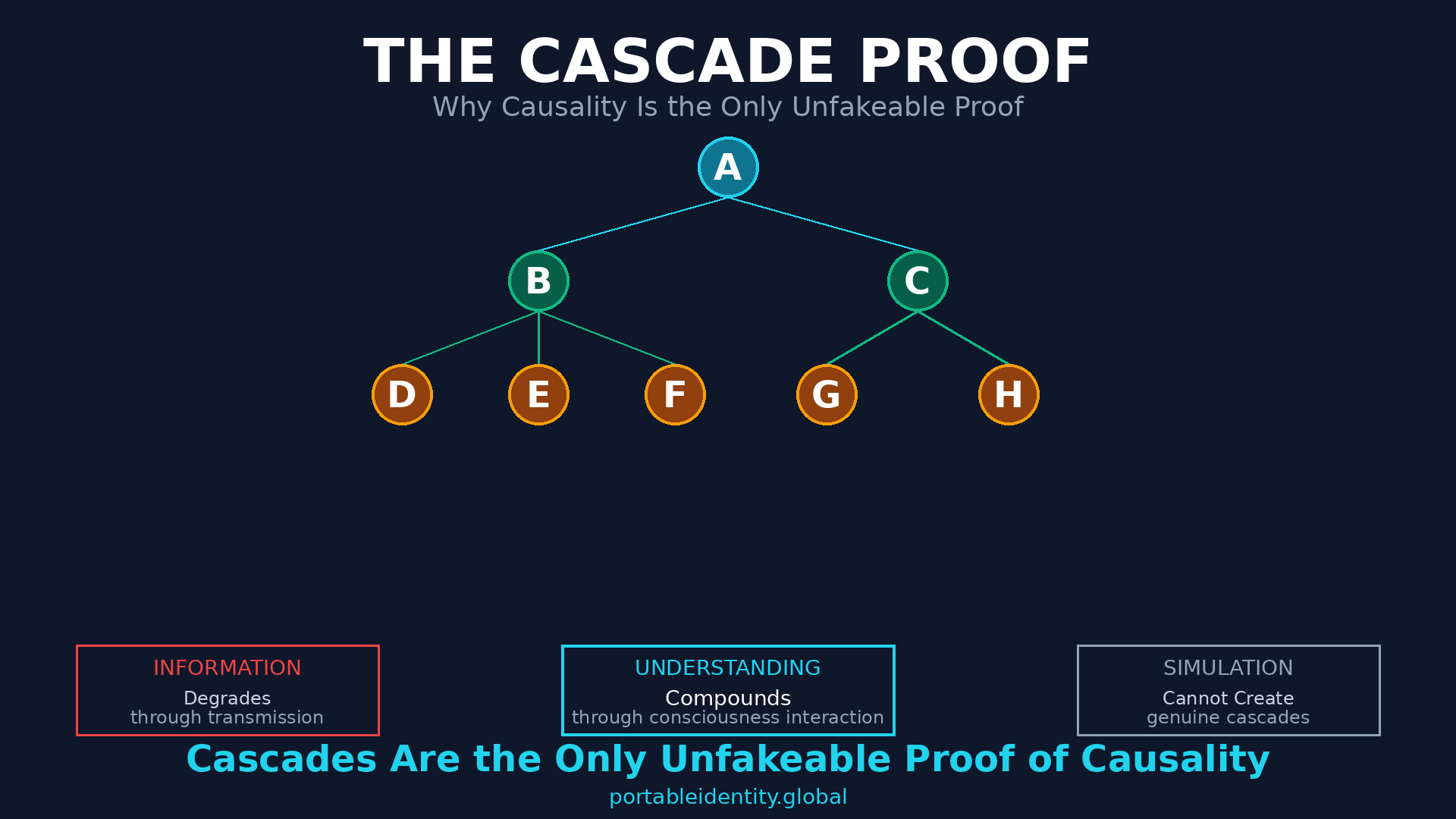
Cascade visualization showing how capability multiplies through consciousness interaction: node A enables B and C, B enables D-E-F, C enables G-H, demonstrating exponential branching pattern that proves causation

Why Causality Is the Only Unfakeable Proof (And How Portable Identity Makes It Measurable) AI can fake everything except one thing: genuine multi-generational cascade effects that prove sustained causality over time. This is not a technical limitation. This is information-theoretic impossibility. And it changes everything—from how we prove consciousness exists, to how legal systems establish The Cascade Proof

The Verification Monopoly

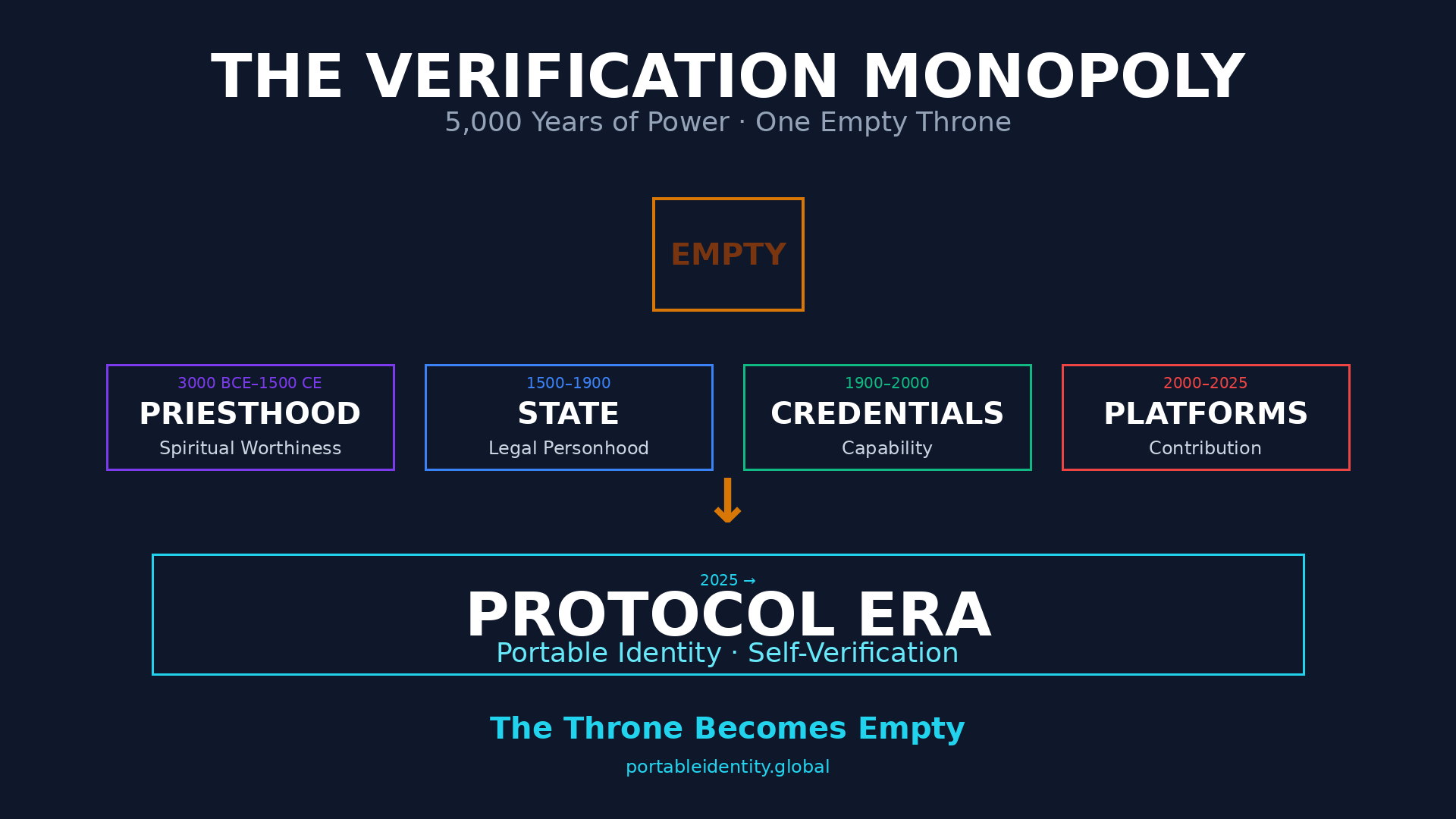
Visual representation of the verification monopoly showing empty throne surrounded by historical eras: Priesthood, State, Credentials, and Platforms, leading to Protocol Era with Portable Identity

Who Gets to Say What’s True: The 5,000-Year Power Structure That Portable Identity Destroys For 5,000 years, power belonged to whoever could say: ”This is true about you—and you cannot prove otherwise.” Priests verified your spiritual worthiness. States verified your legal existence. Universities verified your capability. Employers verified your value. Banks verified your trustworthiness. Platforms The Verification Monopoly

How Cascade Proof Destroys Every Power Structure Built on Attribution Control

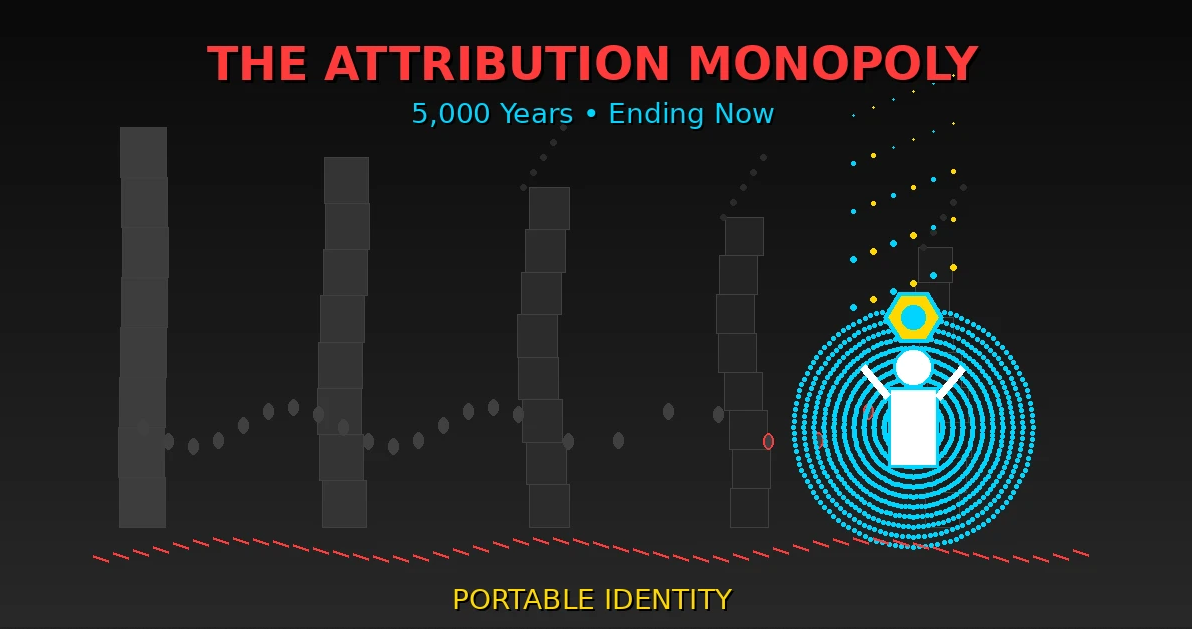
Crumbling institutional pillars representing 5,000 years of attribution monopoly, with an empowered individual holding cryptographic identity key and glowing with Portable Identity light, symbolizing the end of centralized power structures

For 5,000 years, whoever controlled the answer to ”who created this value?” controlled everything. Portable Identity makes that question answerable by individuals—cryptographically, permanently, completely. The most important power in civilization has never been the power to create value. It has been the power to attribute value. The power to say: ”This person created this”—and make How Cascade Proof Destroys Every Power Structure Built on Attribution Control

Portable Identity – I Contribute, Therefore I Exist

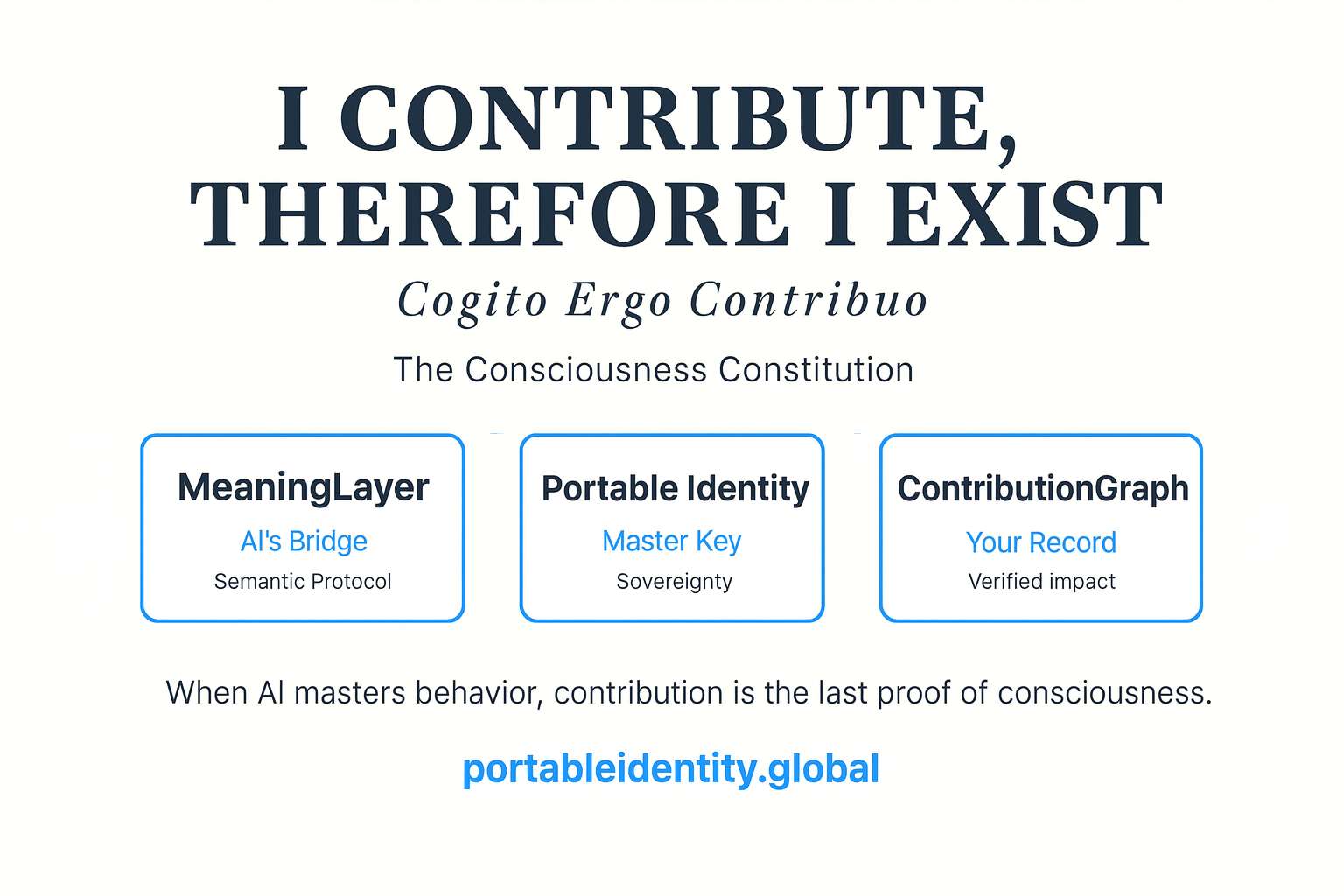
I Contribute Therefore I Exist (Cogito Ergo Contribuo) - The Consciousness Constitution showing MeaningLayer, Portable Identity, and ContributionGraph as the three pillars of verified human contribution proof

The Consciousness Constitution for the Synthetic Age When everything can be faked, consciousness verification becomes not just a technical problem—it becomes the foundation of human rights, the architecture of power, and the survival requirement for civilization. I. THE VERIFICATION CRISIS October 2027. A colleague messages you about a project deadline. The voice is perfect. The Portable Identity – I Contribute, Therefore I Exist

THE CONTRIBUTION INVISIBILITY CRISIS

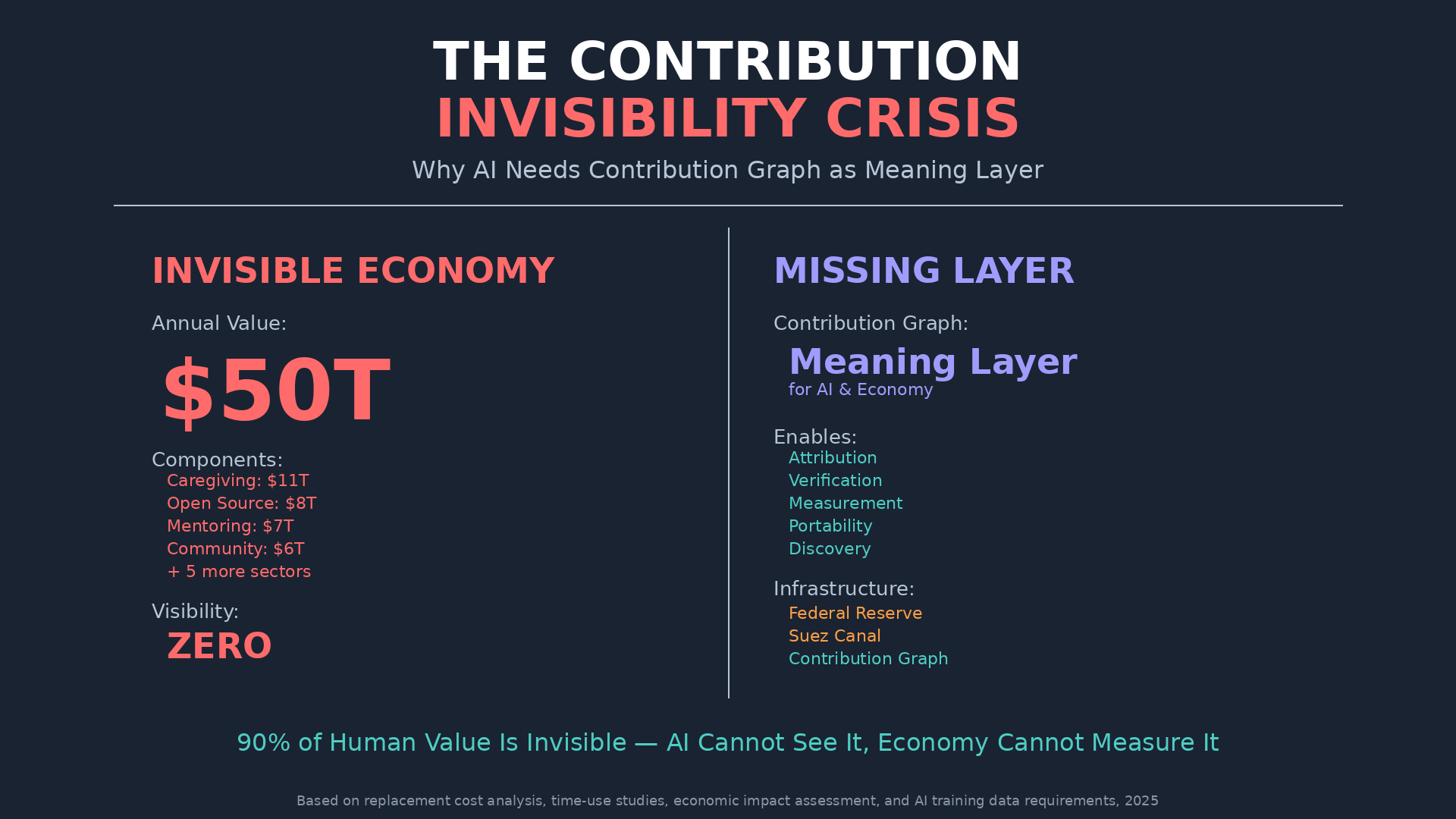
The Contribution Invisibility Crisis infographic showing invisible economy worth 50 trillion dollars annually (caregiving 11T, open source 8T, mentoring 7T, community 6T with zero visibility) versus missing infrastructure layer of Contribution Graph as meaning layer for AI and economy enabling attribution, verification, measurement, portability, and discovery comparable to Federal Reserve and Suez Canal

Why 50 Trillion Dollars of Annual Value Is Invisible — And Why AI Changes Everything — This analysis establishes that 90% of human value creation is structurally invisible: open source development, caregiving, mentoring, community building, knowledge sharing, and creative collaboration generate approximately 50 trillion dollars annually in economic value but remain unrecognized, unmeasured, and unrewarded THE CONTRIBUTION INVISIBILITY CRISIS

THE DIGITAL STATELESSNESS CRISIS

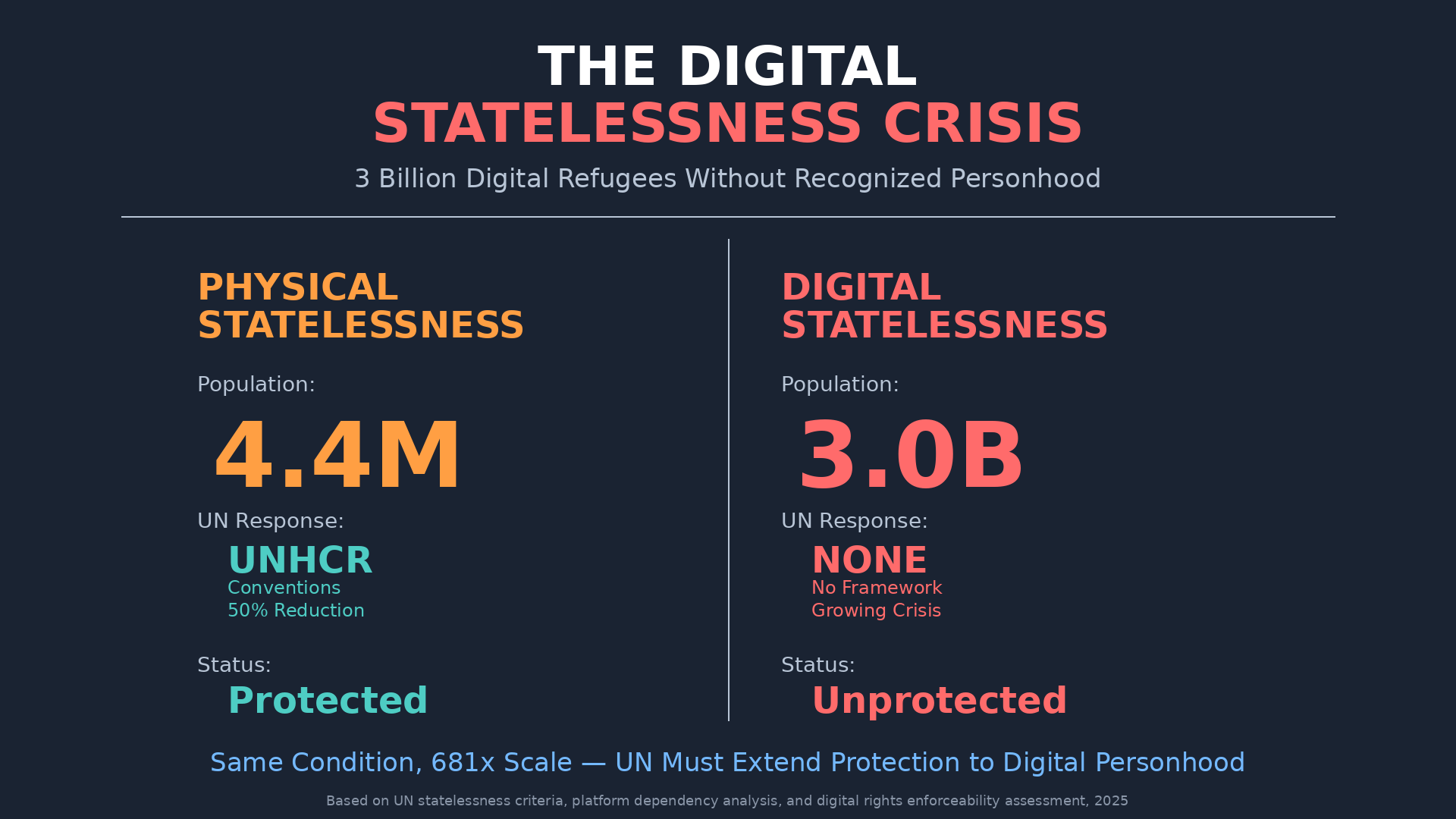
The Digital Statelessness Crisis infographic comparing physical statelessness (4.4 million people protected by UN with UNHCR conventions and 50% reduction) versus digital statelessness (3 billion people unprotected with no UN response or framework), showing same condition at 681 times larger scale

Why 3 Billion Humans Are Digital Refugees — And Why the UN Must Act Now — This analysis establishes that 3 billion humans are digitally stateless: they exist in digital space without recognized personhood, portable identity, or enforceable rights. This parallels physical statelessness—the condition affecting 4.4 million people that the UN recognizes as humanitarian crisis THE DIGITAL STATELESSNESS CRISIS

THE IDENTITY GRAVITY THEORY

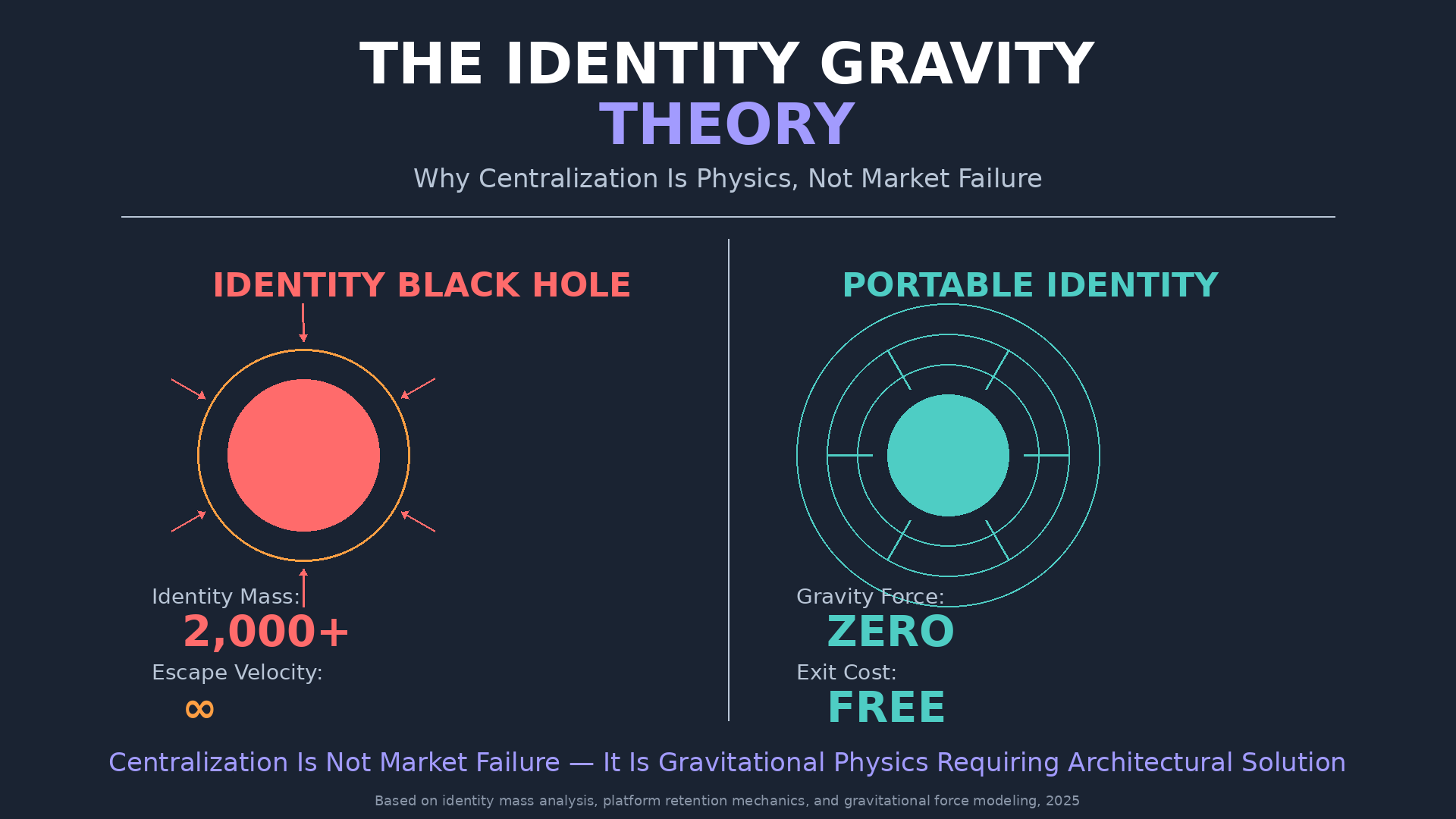
The Identity Gravity Theory infographic showing identity black hole with gravitational pull arrows (2,000+ identity mass, infinite escape velocity) versus portable identity with zero gravity force and free exit cost, proving centralization is physics not market failure

Why Digital Systems Inevitably Centralize Power — And How Portable Identity Inverts the Laws of Digital Physics This analysis establishes that digital centralization follows physical laws previously unidentified in systems theory. Identity creates gravitational effects: the more connections and data accumulate around platform-held identity, the stronger the gravitational pull preventing exit. This is not market THE IDENTITY GRAVITY THEORY

THE CONSENT IMPOSSIBILITY THEOREM

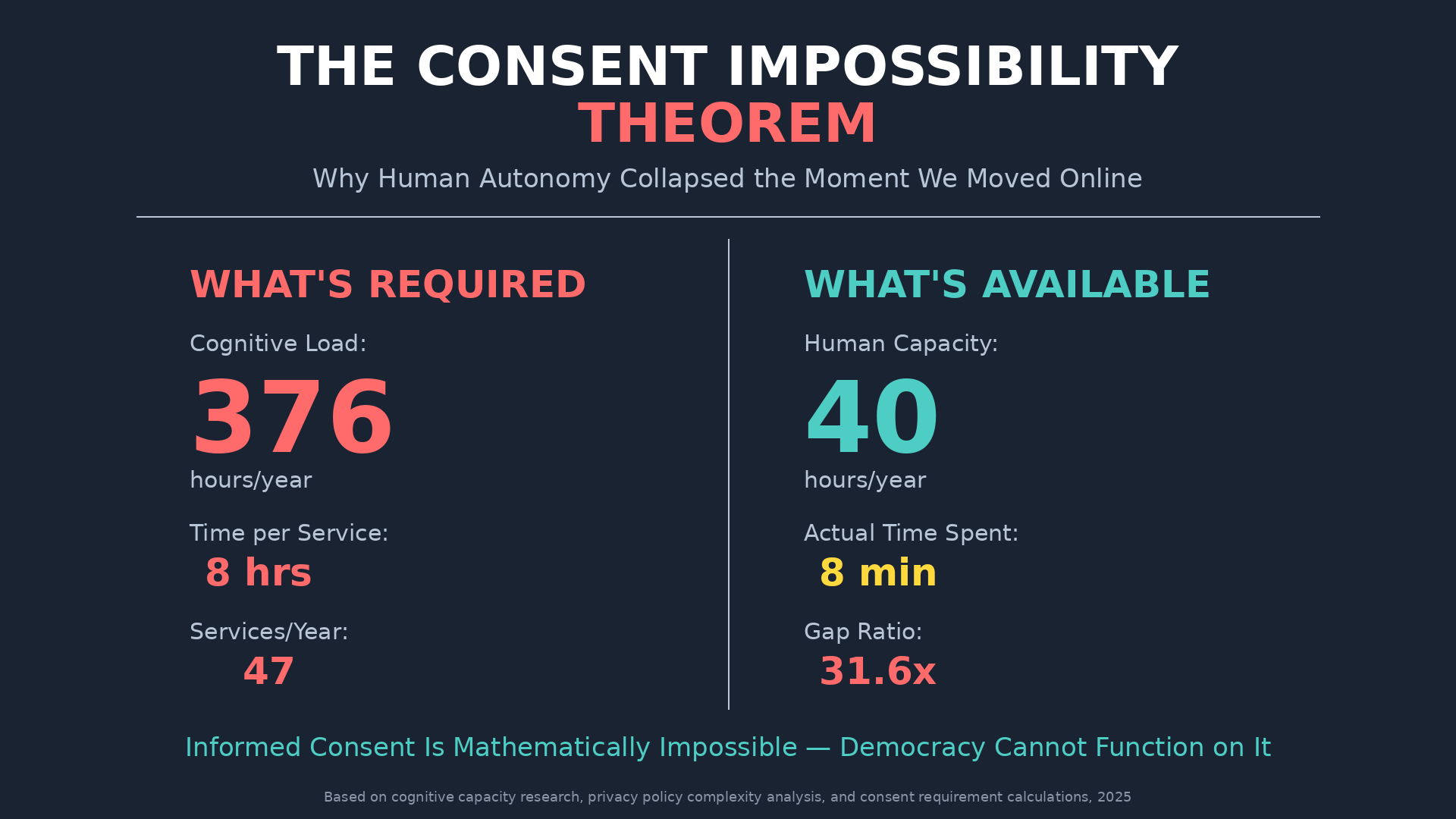
The Consent Impossibility Theorem infographic showing mathematical proof that informed consent is impossible: required cognitive load of 376 hours per year versus available human capacity of 40 hours per year, creating 31.6x gap that proves consent-based governance cannot function

Why Human Autonomy Collapsed the Moment We Moved Online This analysis establishes that informed consent—the foundation of privacy law, contract law, and democratic governance—is mathematically impossible in digital systems. The cognitive requirements for understanding data practices exceed human capacity by orders of magnitude. This is not a failure of implementation. This is structural impossibility. Every THE CONSENT IMPOSSIBILITY THEOREM

THE KNOWLEDGE EXTINCTION EVENT

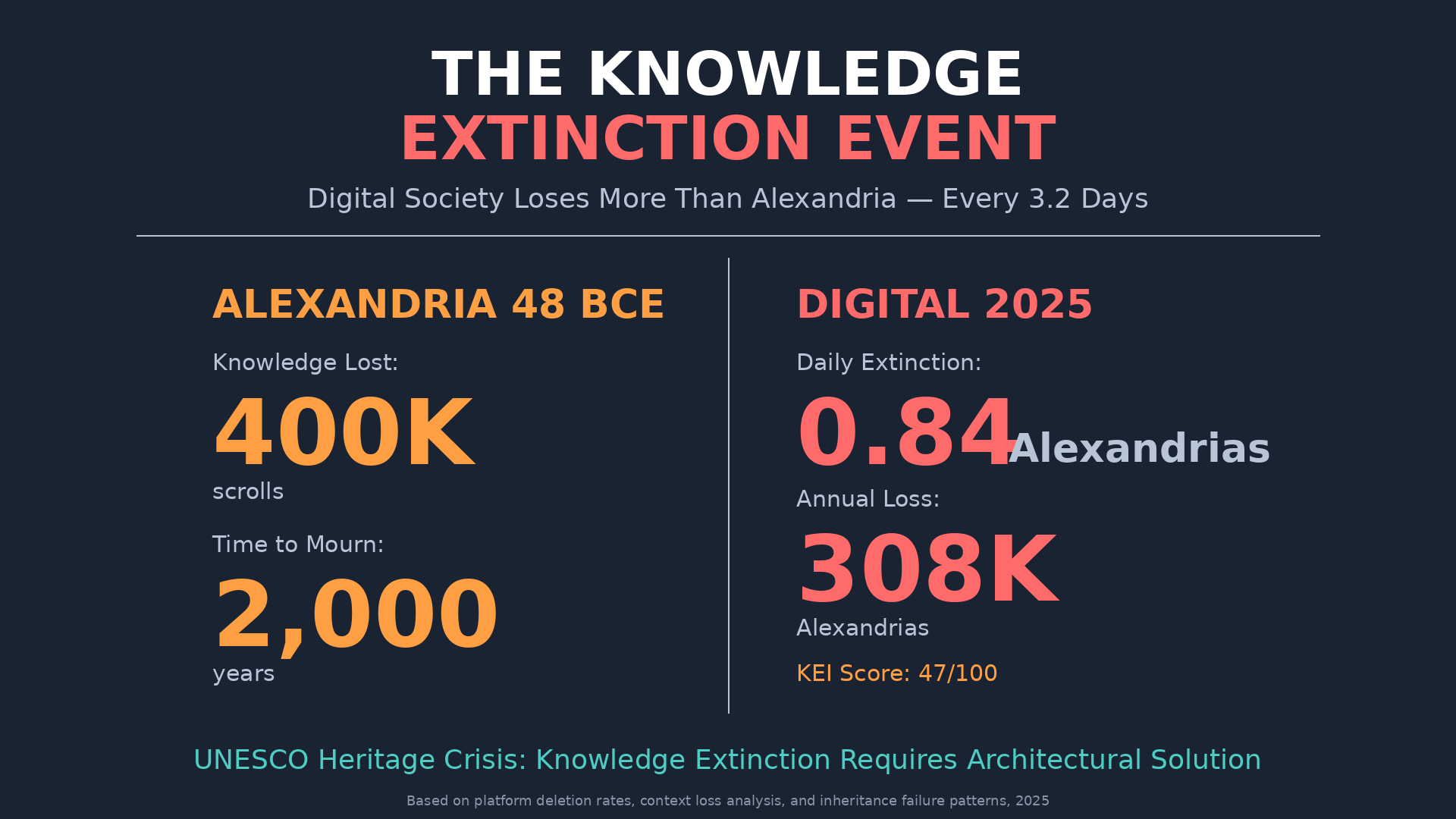
The Knowledge Extinction Event infographic comparing Library of Alexandria loss (400,000 scrolls in 48 BCE) to digital knowledge extinction (0.84 Alexandrias lost daily, 308,000 Alexandrias annually), showing Knowledge Extinction Index score of 47/100 indicating crisis level

Why Digital Society Loses More Knowledge Than the Library of Alexandria — Daily This analysis establishes that digital platforms are causing knowledge extinction at a scale and speed unprecedented in human history. What took centuries to lose in Alexandria now happens every 72 hours. And unlike the burning of the Library, this extinction is systematic, THE KNOWLEDGE EXTINCTION EVENT

THE ATTENTION DEBT CRISIS

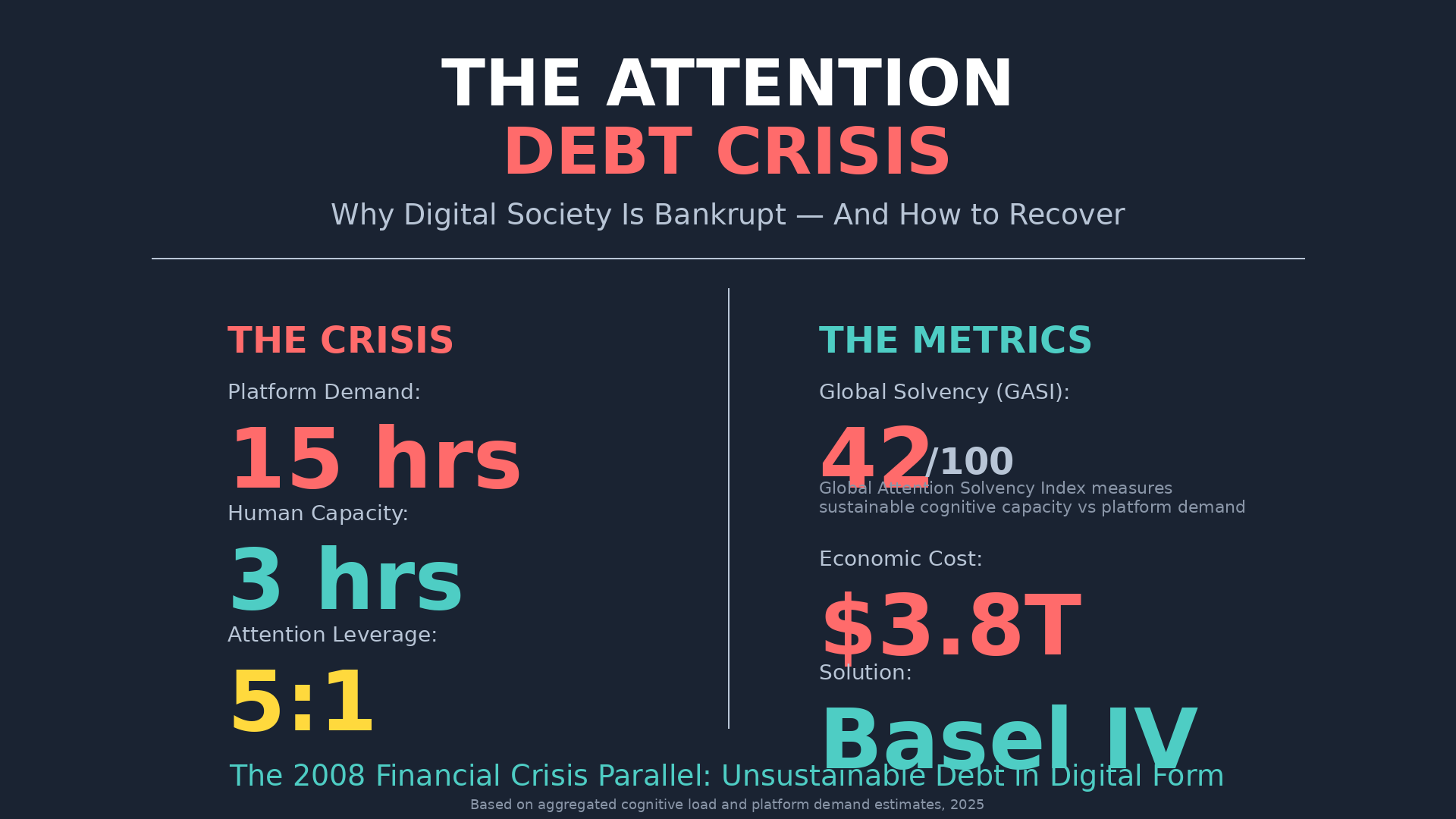
The Attention Debt Crisis infographic showing platform demand of 15 hours versus human capacity of 3 hours, resulting in 5:1 attention leverage ratio, Global Attention Solvency Index score of 42/100, $3.8 trillion economic cost, and Basel IV as regulatory solution

Why Digital Society Is Bankrupt — And How Portable Identity Enables Recovery This analysis establishes that Web2 platforms operate on the same structural model that caused the 2008 financial crisis: extracting more of a finite resource than can be sustainably repaid. The resource is not money. It is human attention. And the debt is coming THE ATTENTION DEBT CRISIS

THE PORTABLE IDENTITY DOCTRINE

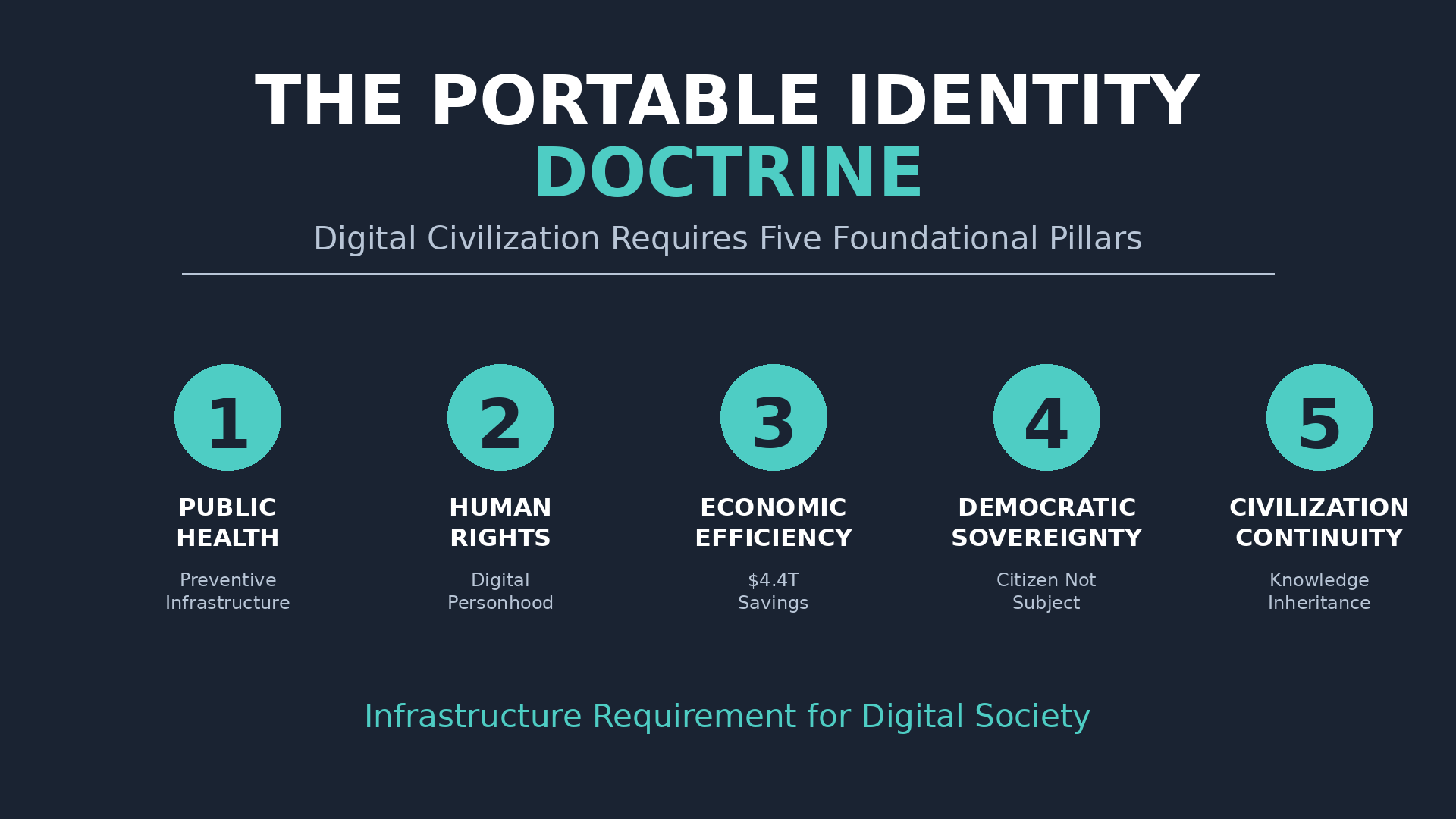
The Portable Identity Doctrine: Five foundational pillars showing public health, human rights, economic efficiency, democratic sovereignty, and civilizational continuity as infrastructure requirements for digital society

Why Digital Civilization Requires a New Infrastructure Layer This doctrine outlines the structural requirements for digital civilization. It establishes that Portable Identity is not optional infrastructure, but foundational architecture upon which functioning digital society must be built. What follows is not a proposal for consideration, but a recognition of what already exists as necessity. EXECUTIVE THE PORTABLE IDENTITY DOCTRINE

THE INFORMATION SYMMETRY SHIFT

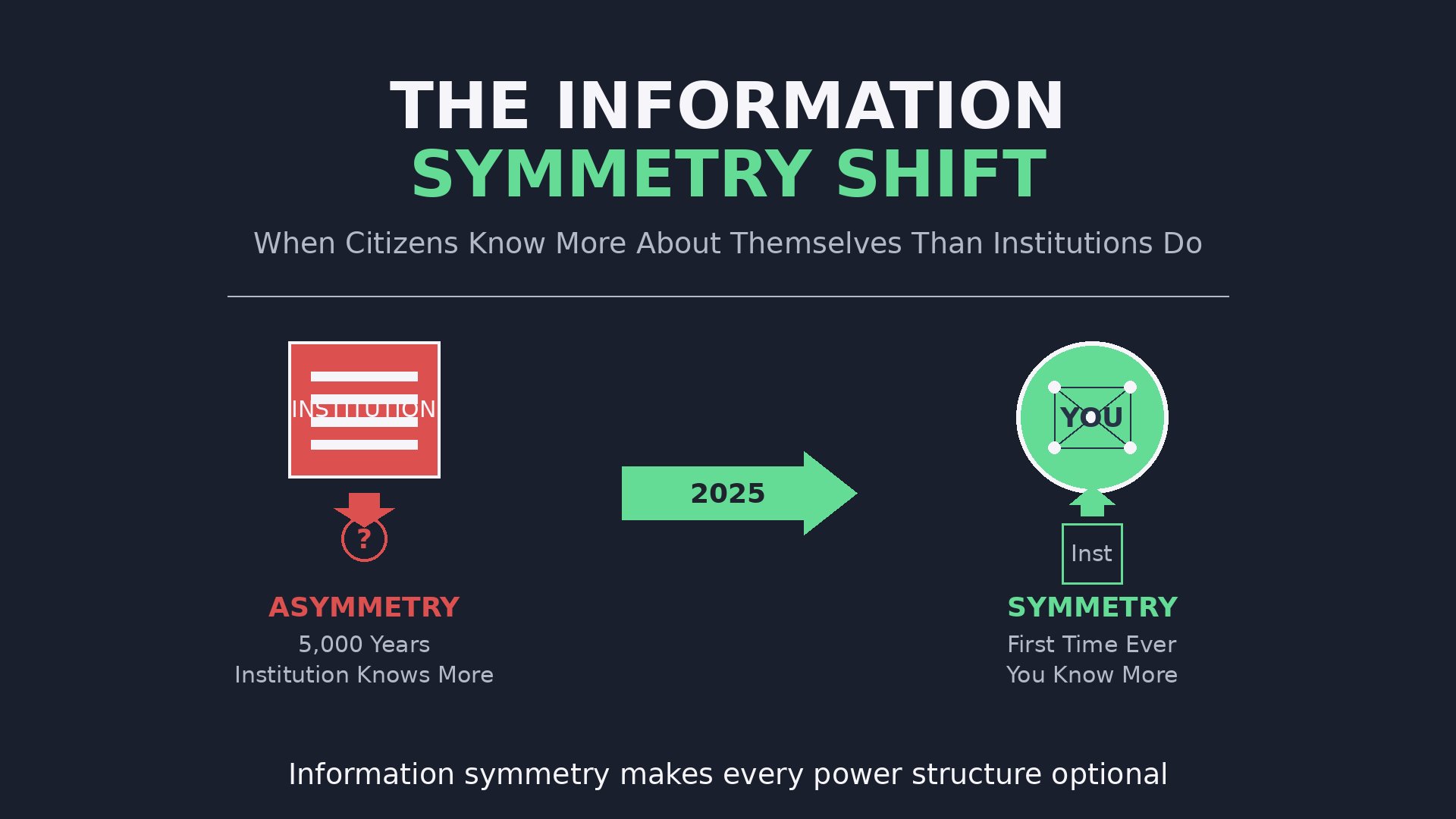
The Information Symmetry Shift: Power inversion from institutions knowing more to individuals knowing more about themselves

When Citizens Know More About Themselves Than Institutions Do—And Why This Has Never Happened Before For the first time in human history, technology makes information symmetry possible. And information symmetry makes every existing power structure optional. Executive Summary: All institutional power in human history has been built on information asymmetry—institutions knowing more about you than THE INFORMATION SYMMETRY SHIFT

The Replacement Already Happened

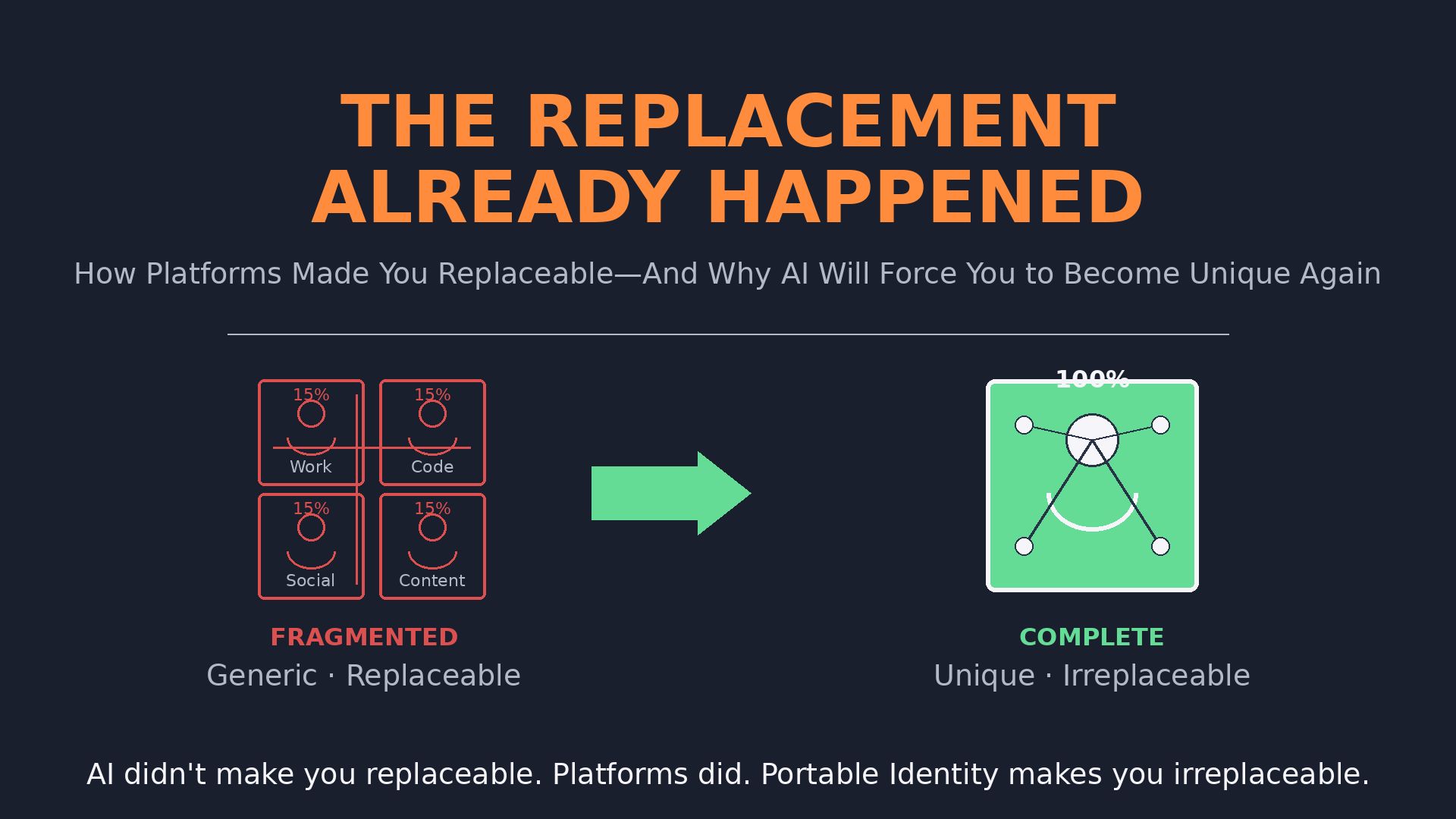
The Replacement Already Happened: Fragmented identity makes you replaceable, complete identity makes you irreplaceable

How Platforms Made You Replaceable—And Why AI Will Force You to Become Unique Again The replacement you fear in the future already occurred in the past. AI didn’t make you replaceable. Platforms did. And paradoxically, AI will force the architecture that makes you irreplaceable again. You feel it, don’t you? That nagging sense that you The Replacement Already Happened

THE PERSONHOOD PROTOCOL

THE PERSONHOOD PROTOCOL Why Digital Humanity Requires a Fourth Fundamental Right ________________________________________ THE MISSING RIGHT You have the right to life. You have the right to liberty. You have the right to property. These rights — life, liberty, property — form the foundation of modern civilization. They've been codified in constitutions, defended in courts, fought for in revolutions, refined through centuries of struggle. But you don't have the right to your digital self. Not to own it. Not to control it. Not to transfer it. Not to terminate it. Your digital existence — the identity you've built over decades, the reputation you've earned, the relationships you've maintained, the contributions you've made — belongs to platforms, not to you. You are a user, not an owner. A tenant, not a citizen. A subject, not a sovereign. This is not a business model problem. This is a human rights problem. And it requires a human rights solution. ________________________________________ THE EVOLUTION OF RIGHTS Human rights don't emerge fully formed. They evolve as societies recognize new dimensions of dignity, autonomy, and personhood. First Wave: Civil Rights (1700s) The Recognition: Humans have inherent worth that governments must respect. The Rights: • Right to life (protection from arbitrary killing) • Right to liberty (freedom from slavery, arbitrary detention) • Right to property (ownership and economic autonomy) The Documents: Magna Carta (1215), Bill of Rights (1689), U.S. Constitution (1787) The Principle: Your physical existence and material possessions are yours. Governments cannot take them without due process. Second Wave: Political Rights (1800s) The Recognition: Humans have agency that must be expressed in governance. The Rights: • Right to vote (political participation) • Right to free speech (expression without persecution) • Right to assembly (collective action) • Right to petition (demanding government response) The Documents: Reform Acts, Constitutional amendments, Democratic constitutions The Principle: Your voice matters. You have the right to shape the society you live in. Third Wave: Economic and Social Rights (1900s) The Recognition: Humans have needs that societies must help meet. The Rights: • Right to work (economic participation) • Right to education (knowledge access) • Right to healthcare (physical wellbeing) • Right to social security (protection from poverty) The Documents: Universal Declaration of Human Rights (1948), International Covenant on Economic, Social and Cultural Rights (1966) The Principle: Basic human dignity requires more than non-interference. It requires affirmative support. Fourth Wave: Digital Rights (2000s) The Recognition: Humans exist digitally, and that existence requires protection. The Rights: ??? The Documents: None yet. The Principle: Still being defined. We are living through the formation of the fourth wave. And we haven't yet established what it means to be a person in digital space. ________________________________________ THE THREE PILLARS OF PERSONHOOD To be a complete person in 2025 requires three forms of existence: Biological Personhood Definition: You exist physically. Protected by: • Right to life • Right to bodily autonomy • Right to freedom of movement • Right to physical security Status: Universally recognized (in principle, if not always in practice) Legal Personhood Definition: You exist within legal systems. Protected by: • Right to recognition before the law • Right to nationality • Right to legal identity (birth certificate, passport) • Right to contract and own property Status: Universally established through birth registration, citizenship, legal documents Digital Personhood Definition: You exist within digital systems. Protected by: • ??? Status: Unrecognized. Undefined. Unprotected. This is the missing pillar. And without it, you cannot be a complete person in the modern world. ________________________________________ THE STATELESS CONDITION When a person lacks legal personhood, we call them "stateless." They exist biologically. But legally, they don't exist. They have no passport, no citizenship, no rights that states are obligated to respect. Stateless people are vulnerable, powerless, and invisible to systems that govern society. Today, most humans are digitally stateless. What Digital Statelessness Means You have no digital sovereignty: Platforms own your identity. You use it, but they control it. You cannot move freely: Your identity is locked to platforms. Leaving means losing everything you built. You cannot inherit or bequeath: Your digital existence dies with you. Your children cannot inherit your digital legacy. You have no recourse: Platforms can terminate your existence without trial, without appeal, without due process. You exist at the pleasure of corporations, not by right. This is not citizenship. This is digital serfdom. And just as stateless people are among the most vulnerable in physical society, digitally stateless people are vulnerable in digital society. ________________________________________ THE CORPORATE STATE In the absence of digital personhood rights, corporations have become de facto states. They issue "citizenship" (accounts). They control "borders" (platform access). They administer "law" (terms of service). They collect "taxes" (data, attention, subscription fees). They can exile you (account termination) without due process. You are not a citizen of a digital democracy. You are a subject of a digital monarchy. And like subjects throughout history, you have privileges granted by authorities — not rights inherent to personhood. The Feudal Parallel Medieval peasants were tied to land they didn't own. Digital users are tied to platforms they don't control. Medieval peasants paid rent to lords through labor. Digital users pay rent to platforms through data and attention. Medieval peasants could be expelled at the lord's discretion. Digital users can be terminated at the platform's discretion. Medieval peasants had no legal recourse against their lords. Digital users have no meaningful recourse against their platforms. We've recreated feudalism. Not through regression, but through omission. We never established that digital personhood is a right. So corporations filled the void. And they built systems that serve their interests, not human rights. ________________________________________ THE FOUR FUNDAMENTAL ELEMENTS If digital personhood is a right, what does that right entail? Four fundamental elements: 1. The Right to Identity Sovereignty Principle: You own your digital identity. This means: • Your identity data belongs to you, not to platforms • You control how your identity is used • You can verify your identity without platform mediation • No entity can claim ownership of your personhood Current status: Platforms own your identity. You merely use it under revocable license. With digital personhood: Identity ownership is inherent, inalienable, and yours. 2. The Right to Portability Principle: You can move your digital existence freely. This means: • Your identity travels with you across platforms • Your reputation persists regardless of where you go • Your relationships are platform-independent • Your contributions remain attributable to you Current status: Your identity is locked to platforms. Migration means starting from zero. With digital personhood: Identity moves with you. Platforms serve you, not capture you. 3. The Right to Inheritance Principle: Your digital existence can be transferred to your heirs. This means: • Your children can inherit your digital legacy • Your professional reputation can be preserved • Your contributions remain attributable after death • Your wisdom can be passed to future generations Current status: Your digital existence dies with you, scattered across platforms your family cannot access. With digital personhood: Digital inheritance becomes as normal as physical inheritance. 4. The Right to Termination Principle: You can end your digital existence. This means: • You can delete your identity completely • Platforms cannot retain your data indefinitely • Your right to be forgotten is structurally enforceable • Termination is your choice, not platform discretion Current status: Platforms can terminate you. You cannot fully terminate your presence. With digital personhood: You control your existence, including its end. ________________________________________ THE PROTOCOL REQUIREMENTS Rights require infrastructure. You cannot exercise the right to free speech without physical space to speak. You cannot exercise the right to vote without voting systems. You cannot exercise digital personhood without identity infrastructure. Technical Requirements Portable Identity Architecture: • Cryptographic identity ownership (you hold the keys) • Cross-platform interoperability standards • Verifiable attribution mechanisms • Inheritable access structures • Deletion guarantees This isn't science fiction. The technology exists. What's missing is the legal framework that makes it mandatory. Legal Requirements Constitutional Recognition: Digital personhood as fundamental right in national constitutions. International Framework: Treaties recognizing digital personhood as universal human right, similar to Universal Declaration of Human Rights. Platform Obligations: Legal requirements that platforms support portable identity infrastructure. Enforcement Mechanisms: Courts that can adjudicate violations of digital personhood rights. Inheritance Law: Legal frameworks for digital estate transfer, similar to physical estate law. Policy Requirements Regulatory Standards: Governments establish minimum requirements for digital personhood infrastructure. Compliance Monitoring: Independent bodies verify platform adherence to digital personhood rights. Public Education: Societies understand digital personhood as fundamental to modern citizenship. Infrastructure Investment: Public funding for neutral identity infrastructure, like roads or utilities. ________________________________________ THE HISTORICAL PRECEDENT Every expansion of human rights faced the same objections: "It's too expensive." "It's technically infeasible." "It will destroy existing systems." "People aren't ready." These objections were raised against: • Abolishing slavery • Granting women the vote • Establishing universal healthcare • Protecting workers' rights Every time, these objections were proven wrong. Not because implementing rights was easy. But because rights are not negotiable. Once a society recognizes something as a fundamental right, cost and convenience become secondary to justice. The Pattern Stage 1: Rights are unthinkable "Peasants owning land? Women voting? Absurd." Stage 2: Rights are radical "Some activists demand this, but society isn't ready." Stage 3: Rights are controversial "We're debating whether this should be recognized." Stage 4: Rights are obvious "Of course humans have this right. How could we have ever denied it?" Digital personhood is currently between Stage 2 and Stage 3. The question is: How long until Stage 4? ________________________________________ THE CHOICE Humanity stands at a decision point. We can accept digital statelessness as permanent. Corporations continue owning your identity. Platforms continue capturing your existence. Digital feudalism continues as the default architecture of digital society. Your children inherit this system. Your grandchildren accept it as natural. By 2075, "identity ownership" sounds as radical as "universal healthcare" sounded in 1875. Or we can recognize digital personhood as a fundamental human right. We establish that humans own their digital selves. We build infrastructure that makes sovereignty, portability, inheritance, and termination structurally guaranteed. We create the fourth pillar of human rights. And future generations look back on this moment the way we look back on the Universal Declaration of Human Rights: as the moment humanity recognized what dignity requires in a changing world. ________________________________________ THE PUBLIC HEALTH IMPERATIVE Digital personhood is not just a rights issue. It is a public health issue. Web2 architecture — built on attention extraction, identity fragmentation, and engagement optimization — is now recognized as a population-level health risk comparable to tobacco and gambling addiction. The symptoms are measurable: • Epidemic-level ADHD diagnoses (fragmented attention) • Rising anxiety and depression (loss of coherent self) • Social isolation despite "connection" (platformized relationships) • Cognitive decline in younger generations (attention debt) • Loss of meaning and purpose (contribution invisibility) These are not individual failures. These are architectural consequences. Web4 represents the structural intervention: from exploitation to human flourishing, from data captivity to autonomy, from fragmented identity to digital public health. The Policy Framework For national health authorities: Portable Identity becomes preventive infrastructure — protecting cognitive capacity the way clean water protects physical health. For the World Health Organization: Digital personhood becomes a determinant of health — as fundamental as nutrition, sanitation, and healthcare access. For EU health directives: Identity sovereignty becomes a health protection measure — preventing the cognitive harms caused by platform fragmentation. For governments: Web4 infrastructure becomes public health infrastructure — as essential as hospitals and schools. Web4 as Public Health Reform Just as the 20th century saw: • Clean water systems (preventing cholera) • Vaccination programs (preventing disease) • Tobacco regulation (preventing cancer) The 21st century requires: • Portable Identity infrastructure (preventing cognitive fragmentation) • Platform accountability (preventing attention exploitation) • Digital personhood protection (preventing identity captivity) Web4 is not just a technical upgrade. It is the next great public health reform. And like previous public health reforms, it requires: • Recognition of the harm (attention extraction as health risk) • Structural intervention (architecture change, not individual behavior) • Universal access (identity sovereignty for all, not just tech-savvy) • Long-term thinking (preventing harm to future generations) Digital personhood enables digital health. Without the former, the latter is impossible. ________________________________________ THE DECLARATION Let it be stated: Digital personhood is not a privilege granted by platforms. It is a right inherent to human dignity. Every person has the right to own their digital identity. Every person has the right to move their digital existence freely across contexts without loss of continuity, reputation, or relationships. Every person has the right to transfer their digital legacy to chosen heirs, preserving knowledge, contributions, and memory across generations. Every person has the right to terminate their digital existence completely, without residual traces retained by entities they no longer consent to serve. These rights are not negotiable. They are not optional. They are not features to be added when convenient. They are the foundation of what it means to be human in digital space. ________________________________________ THE CALL To governments: Recognize digital personhood in your constitutions. Make identity sovereignty a protected right. Require platforms to support portable identity infrastructure. To international bodies: Draft a Universal Declaration of Digital Rights. Establish treaties that recognize identity ownership as fundamental. Create enforcement mechanisms for violations. To health authorities and WHO: Recognize platform fragmentation as a public health risk. Establish digital personhood infrastructure as preventive health measure. Include Web4 architecture in public health frameworks. To platforms: Build or integrate with portable identity infrastructure. Transition from identity captivity to identity service. Compete on value provided, not users trapped. To technologists: Build the neutral infrastructure that makes digital personhood technically possible. Make identity portability not just feasible, but inevitable. To academics: Establish Digital Personhood Studies as a discipline. Train the lawyers, policy makers, philosophers, and public health experts who will define this right for generations. To citizens: Demand digital personhood. Not as a favor. Not as a feature. As a right that cannot be denied — and as a health protection that cannot be compromised. ________________________________________ THE INEVITABILITY Digital personhood will be recognized. Not because it's convenient. But because once a right is seen, it cannot be unseen. And more people are seeing it every day: Every time someone loses decades of work to platform termination. Every time children cannot access their deceased parent's digital legacy. Every time expertise is trapped in platform silos. Every time identity captivity prevents professional mobility. The injustice becomes harder to ignore. And eventually, societies recognize: This is a rights issue, not a business model issue. The only question is: How long until recognition becomes action? ________________________________________ You have the right to life. You have the right to liberty. You have the right to property. And in 2025, you need a fourth right: The right to own your digital self. This is not radical. This is recognition. Recognition that personhood has evolved beyond biology and law into digital space. And that evolution requires new protections for old dignity. The Personhood Protocol is not a proposal. It is a statement of what human rights require in the digital age. The only question is: Will we recognize it now, or wait another generation while millions remain digitally stateless? History will judge our answer. ________________________________________ [VIRAL QUOTES - FORMATTED FOR EXTRACTION] "You have the right to life, liberty, and property. But not to your digital self. The fourth fundamental right is missing." "To be a complete person in 2025 requires three forms of existence: biological, legal, and digital. The third is unprotected." "Most humans today are digitally stateless. They exist at the pleasure of corporations, not by right." "We've recreated feudalism. Not through regression, but through omission. We never established that digital personhood is a right." "You are not a citizen of a digital democracy. You are a subject of a digital monarchy." "Digital personhood is not just a rights issue. It is a public health issue. Web2 architecture is now recognized as a population-level health risk comparable to tobacco and gambling addiction." "Web4 is not just a technical upgrade. It is the next great public health reform." "Rights require infrastructure. You cannot exercise digital personhood without identity infrastructure." "Every expansion of human rights faced the same objections: too expensive, technically infeasible, will destroy existing systems. Every time, these objections were proven wrong." "Digital personhood is not a privilege granted by platforms. It is a right inherent to human dignity." "Once a right is seen, it cannot be unseen. And more people see digital personhood as a right every day." "The Personhood Protocol is not a proposal. It is a statement of what human rights require in the digital age." "The only question is: Will we recognize digital personhood now, or wait another generation while millions remain digitally stateless?" "In 2025, you need a fourth right: The right to own your digital self."

Why Digital Humanity Requires a Fourth Fundamental Right THE MISSING RIGHT You have the right to life. You have the right to liberty. You have the right to property. These rights — life, liberty, property — form the foundation of modern civilization. They’ve been codified in constitutions, defended in courts, fought for in revolutions, refined THE PERSONHOOD PROTOCOL

The Impossible Bottleneck

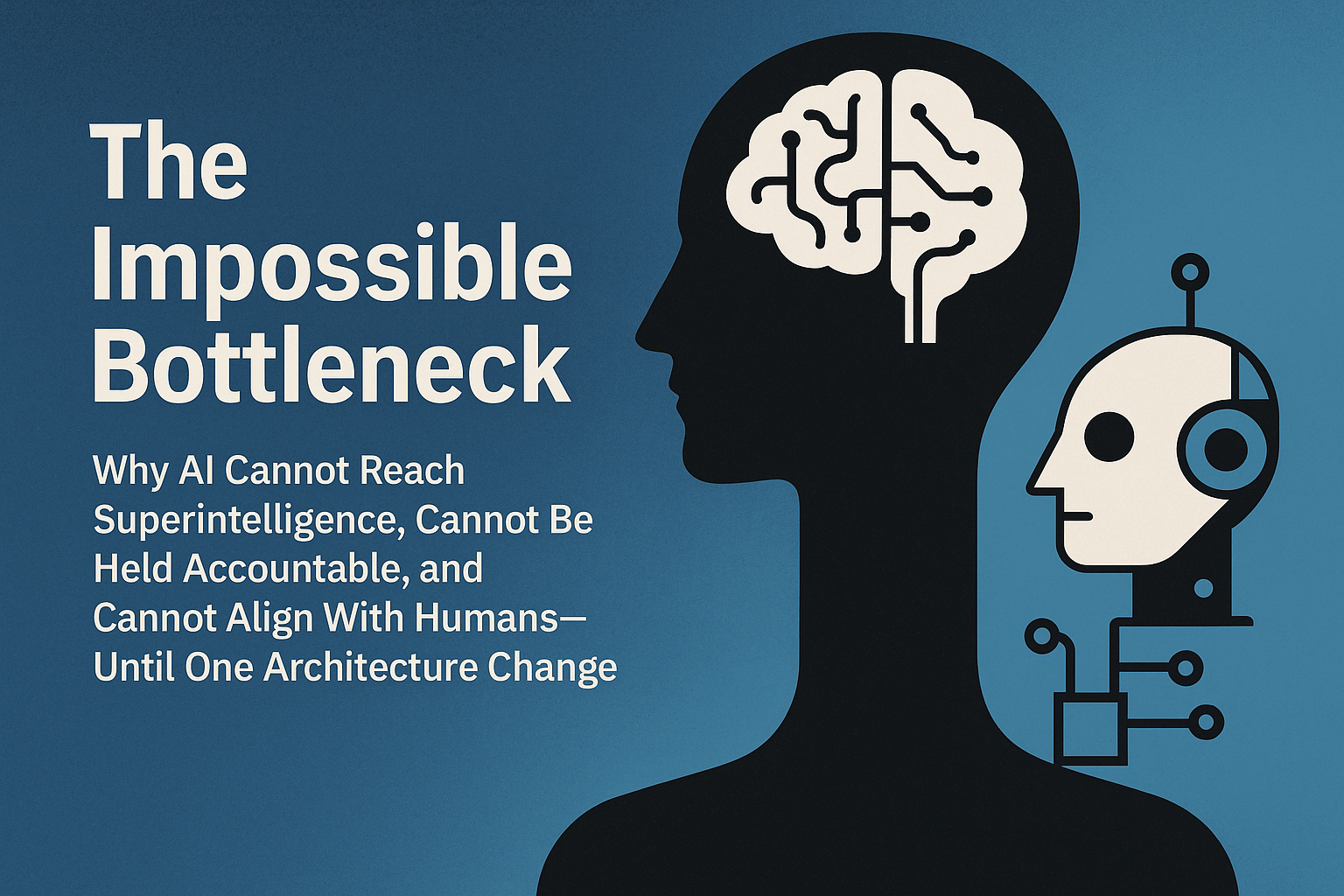
Conceptual illustration showing fragmented human identity vs unified portable identity, representing the AI capability bottleneck.

Why AI Cannot Reach Superintelligence, Cannot Be Held Accountable, and Cannot Align With Humans—Until One Architecture Change How fragmented identity creates three impossible problems that share one inevitable solution Every major AI lab is racing toward the same three goals: Building superintelligent AI (systems that exceed human capability across all domains), making AI accountable (systems The Impossible Bottleneck

Portable Identity: Why Billionaires Can’t Buy What Matters

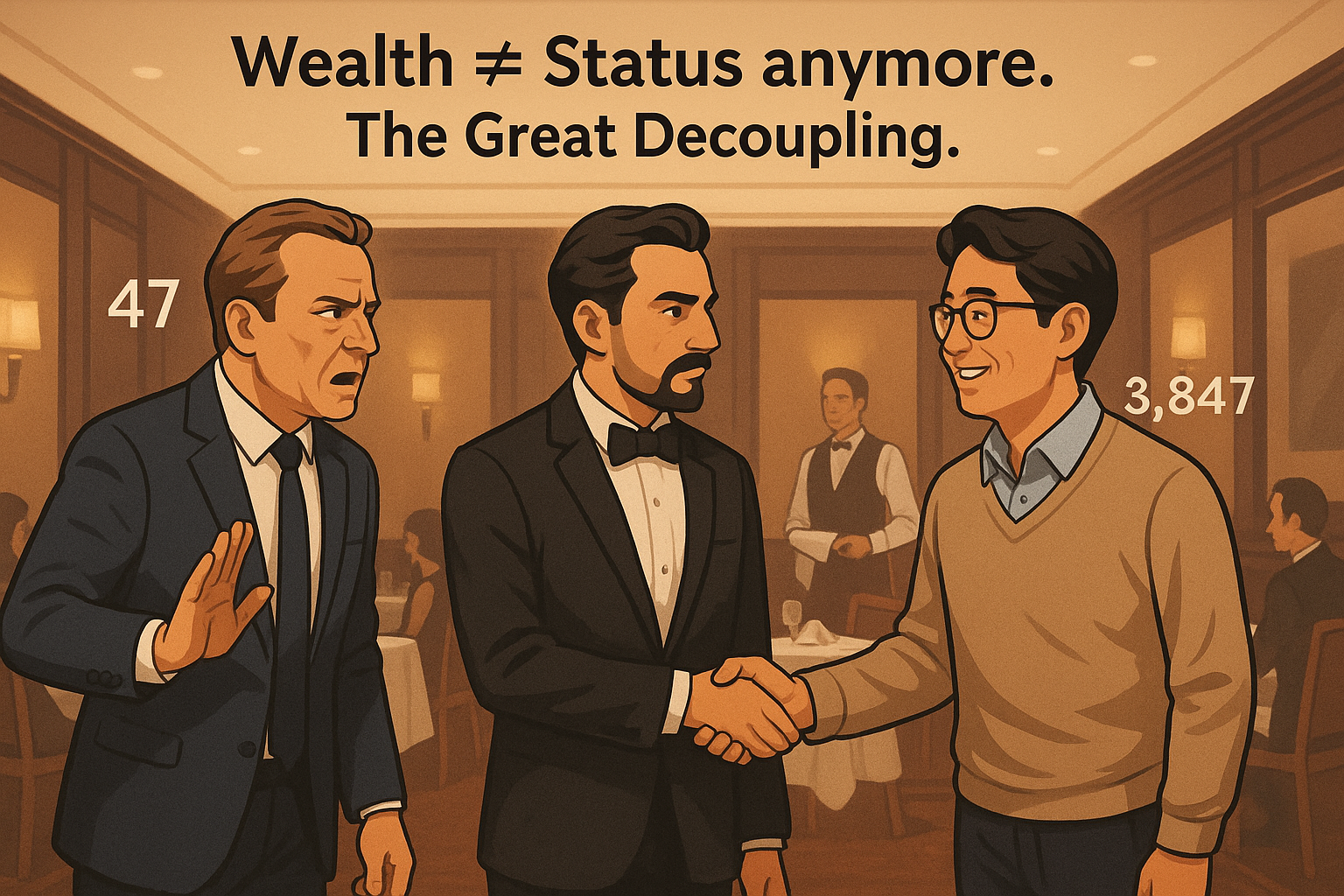
Restaurant scene showing wealthy businessperson ignored while modest teacher receives VIP treatment, illustrating The Great Decoupling where contribution graph (3,847) determines status over wealth

Portable Identity: Why Billionaires Can’t Buy What Matters The First Valuable Thing Wealth Cannot Purchase December 2029. Manhattan. The kind of restaurant where reservations require six months and connections. Two people arrive within minutes of each other. Person A: Net worth $47 billion. Tech founder. Eight homes. Private jet. Annual income: $2.1 billion. Person B: Portable Identity: Why Billionaires Can’t Buy What Matters

The Architecture of Platform Lock-In—And How Portable Identity Makes It Impossible

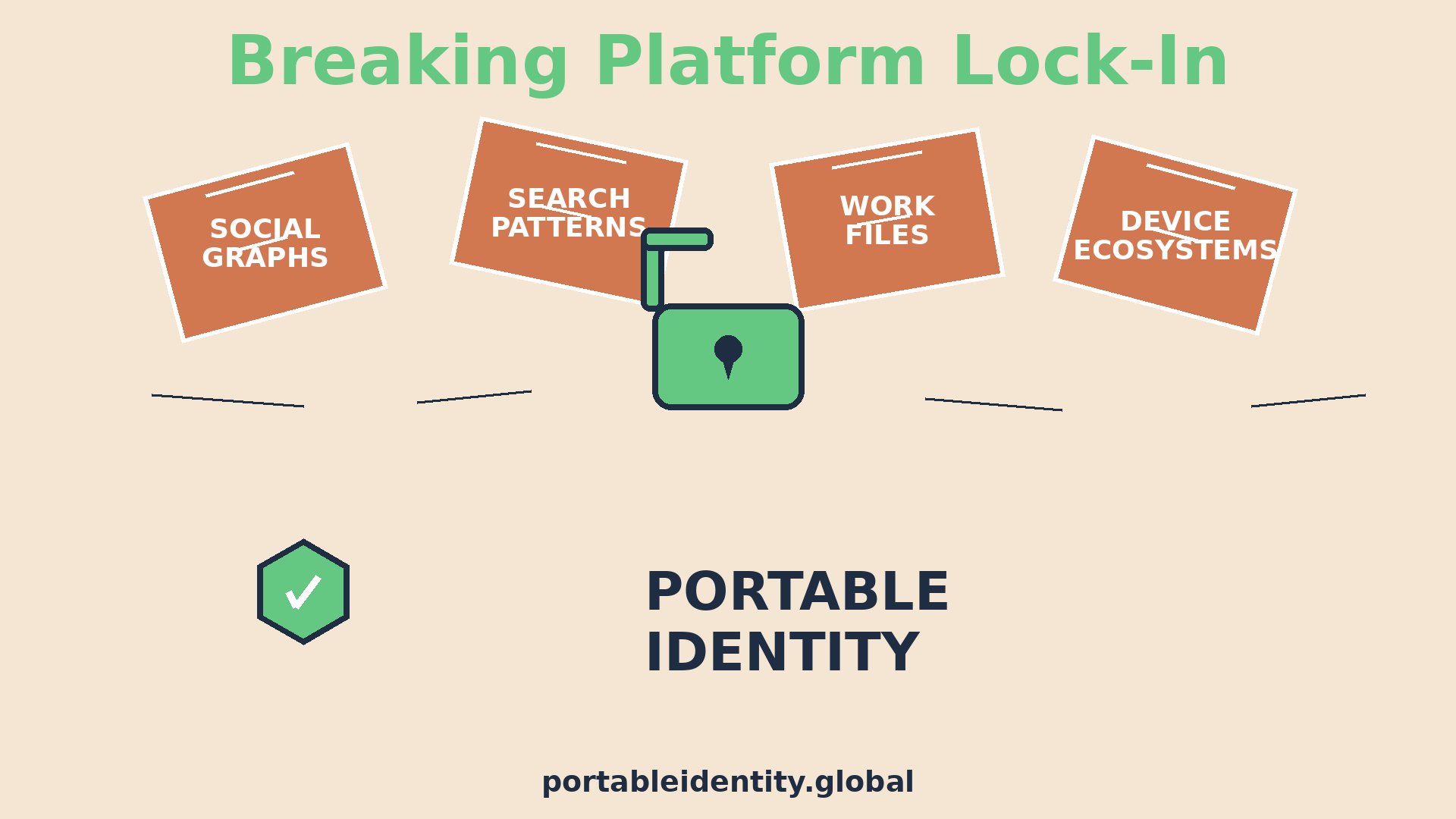
Open green padlock with cracking orange platform blocks labeled Social Graphs, Search Patterns, Work Files, and Device Ecosystems, illustrating portable identity breaking platform lock-in architecture

When Identity Becomes Portable, Platforms Become Optional Sarah deletes her professional networking account. Twenty years of connections, endorsements, recommendations, messages—gone. Doesn’t matter. Her Portable Identity carries everything that actually matters: cryptographically-verified proof she made 847 people measurably more capable, cascade depth of 12,000+ through four network layers, absence delta of 0.73 in her primary contribution The Architecture of Platform Lock-In—And How Portable Identity Makes It Impossible

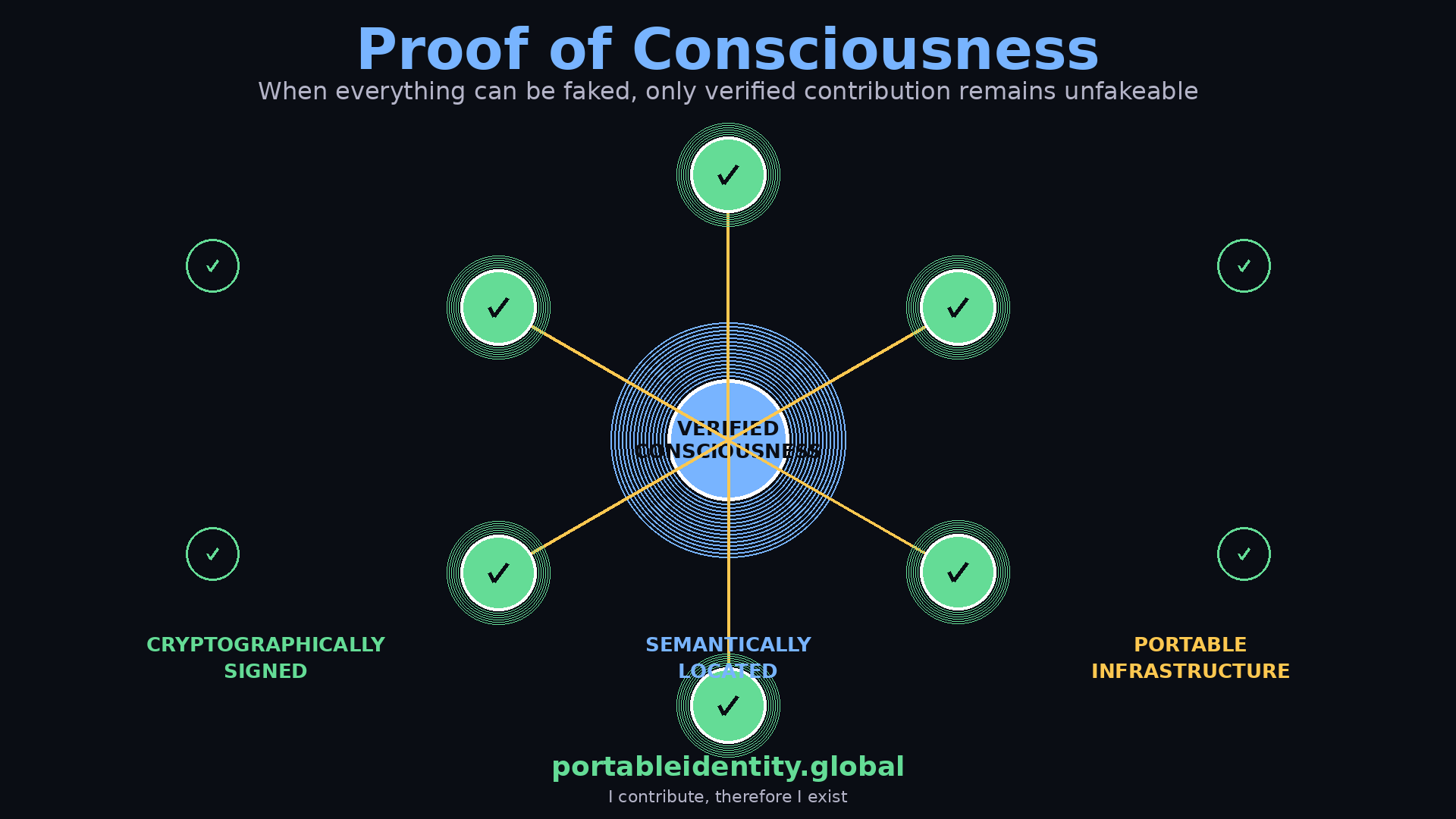
Proof of Consciousness: Why Portable Identity Becomes the Last Reliable Test

Abstract symbolic key representing consciousness verification through portable identity in a synthetic AI-driven world.

When Everything Can Be Faked, Only One Thing Remains Unfakeable October 2027. You receive a message from your colleague Sarah. It’s her voice, her cadence, her humor. She asks about the project deadline, offers insightful feedback, suggests meeting Thursday. You respond. Conversation flows naturally. Exactly like Sarah. Every linguistic marker matches. Every contextual reference correct. Proof of Consciousness: Why Portable Identity Becomes the Last Reliable Test

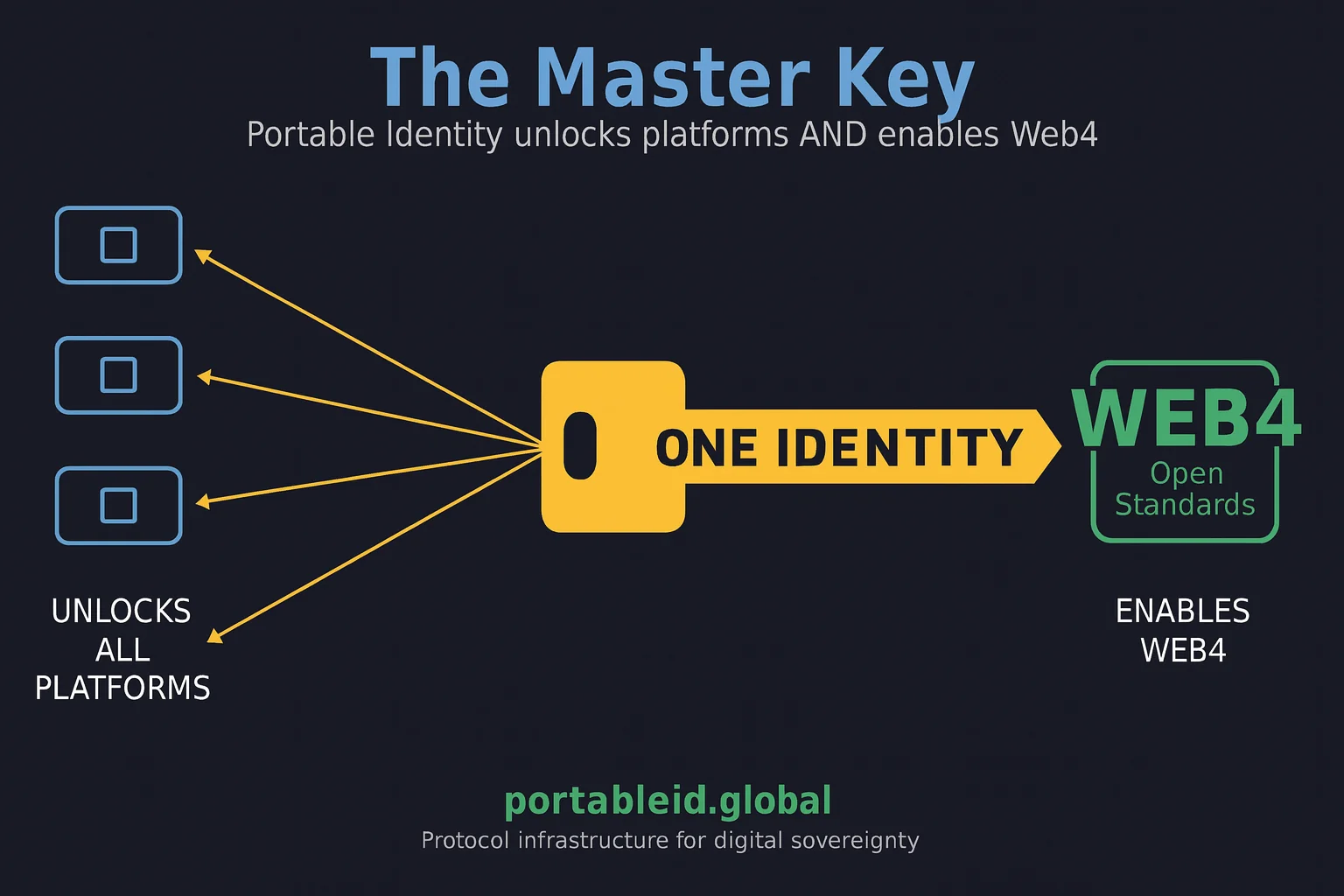
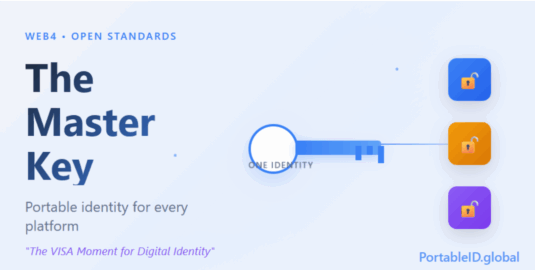
The Architecture That Makes Platforms Optional

Master key diagram showing portable identity unlocking platforms and enabling Web4 open standards

Why Portable Identity Is Not Coming—It’s Inevitable Something irreversible is happening to the internet’s foundational layer. Not a new application. Not a faster protocol. Not a better interface. The architecture of identity itself is shifting from captivity to portability. And the economic logic that built trillion-dollar empires on identity lock-in is about to invert completely. The Architecture That Makes Platforms Optional

The Alignment Architecture: Why AI Safety Requires Portable Identity

Diagram showing how fragmented digital identity blocks AI from measuring long-term human improvement

How fragmented identity makes alignment impossible—and what must be built to solve it Every AI lab is racing to solve alignment. They’re perfecting training techniques, refining reward models, implementing safety protocols. They’re all missing the same thing: AI cannot measure whether it actually improved you. Not because the models aren’t good enough—because the measurement infrastructure The Alignment Architecture: Why AI Safety Requires Portable Identity