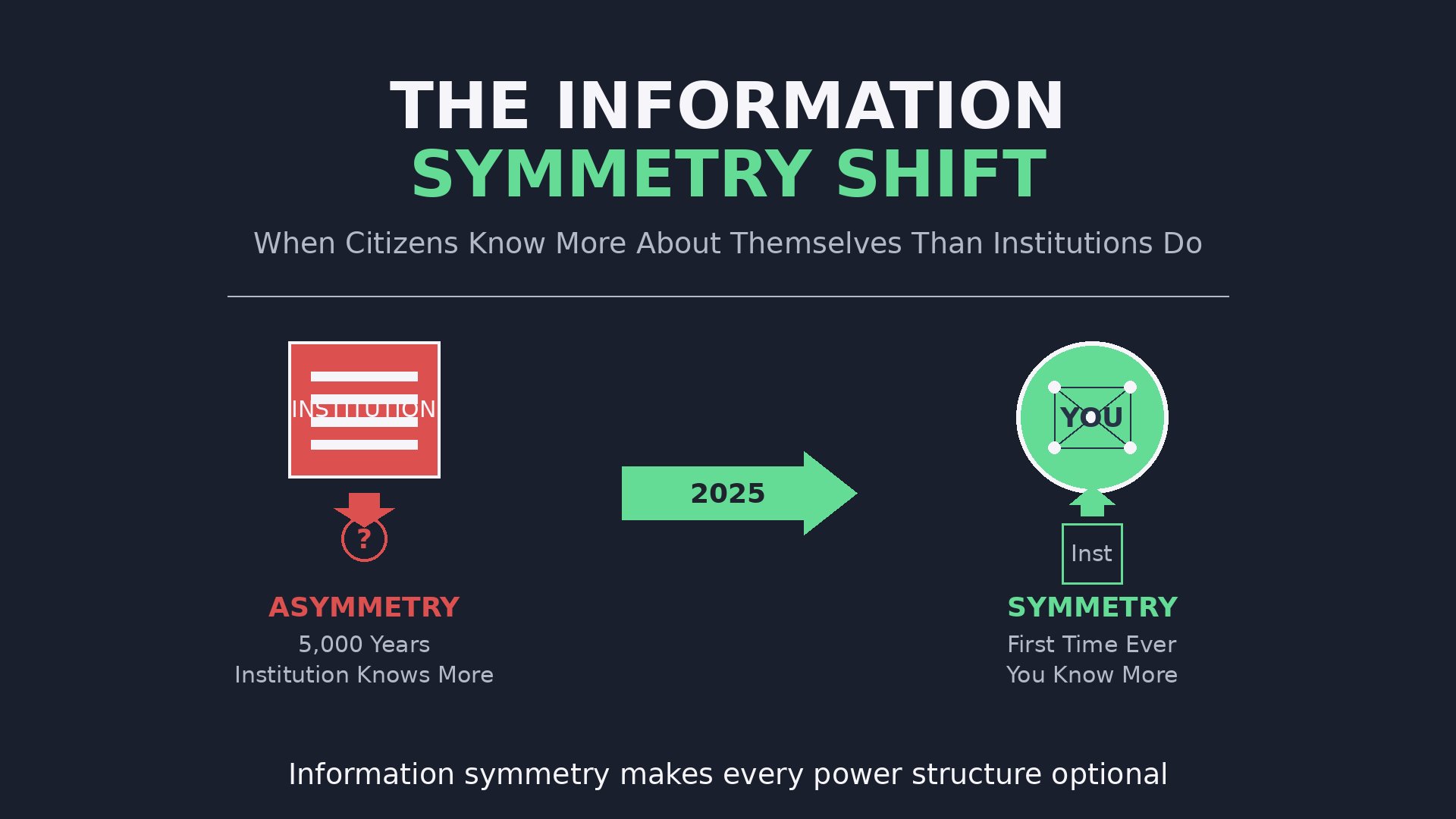
When Citizens Know More About Themselves Than Institutions Do—And Why This Has Never Happened Before
For the first time in human history, technology makes information symmetry possible. And information symmetry makes every existing power structure optional.
Executive Summary: All institutional power in human history has been built on information asymmetry—institutions knowing more about you than you know about yourself. Portable Identity makes information symmetry structurally inevitable for the first time. When individuals possess more complete information about themselves than institutions possess about them, every power structure becomes optional rather than inevitable.
You’ve felt it your entire life. The sense that institutions know something about you that you don’t know about yourself.
The university that decides if you’re ”qualified.” The employer that determines if you’re ”competent.” The bank that judges if you’re ”creditworthy.” The government that declares if you’re ”compliant.”
They have files on you. Algorithms about you. Decisions based on data you’ve never seen. Conclusions drawn from patterns you can’t access.
They know more about you than you know about yourself.
This isn’t paranoia. This is architecture.
And this asymmetry—this fundamental imbalance where institutions possess information about you that you don’t possess about yourself—is not a bug in the system.
It is the system.
Every form of institutional power in human history has been built on information asymmetry. The powerful know more than the powerless. Control flows from knowledge. Those who can see more, decide more.
For five thousand years, this was inevitable. Information was expensive to gather, store, and process. Institutions could afford it. Individuals could not.
But something changed. Technology made information cheap. AI made it processable. And Portable Identity is about to make it symmetric.
For the first time in civilization, individuals can know more about themselves than institutions know about them.
This is not an upgrade. This is an inversion.
And inversions don’t modify power structures. They replace them.
Part I: The Architecture of Asymmetry
Let me show you how institutional power actually works.
The Church: Control Through Spiritual Information Asymmetry
For a thousand years, the Catholic Church was Europe’s dominant institution. Not through military force—the Church had no armies. Through information control.
The Church knew your sins. You confessed them. They recorded them. They knew your spiritual state better than you did—because they had the framework for interpreting it, and you didn’t.
The priest could read Latin. You couldn’t. The priest had access to scripture. You didn’t. The priest understood theology. You didn’t.
Information asymmetry created spiritual authority. The institution that could see your soul more clearly than you could see it yourself had power over your eternal fate.
This wasn’t tyranny. This was governance. The asymmetry was the mechanism. You couldn’t challenge the Church’s assessment of your spiritual standing because you lacked access to the information framework they used to make that assessment.
Then the printing press arrived. Bibles became cheap. Literacy spread. Information symmetry emerged. And the Church’s power collapsed.
Not through violence. Through information distribution. Once individuals could read scripture themselves, spiritual authority required different justification.
The Protestant Reformation wasn’t primarily theological. It was informational. When believers could access the same information as priests, authority based on information asymmetry became unsustainable.
The State: Control Through Identity Information Asymmetry
The Church’s power moved to the state. And the state rebuilt the same architecture with different information.
Modern nation-states emerged with a new form of control: identity registration. Birth certificates. Census data. Tax records. Criminal histories. The state knows who you are, where you’ve been, what you’ve done, and what you owe.
You exist informationally through state records. Your legal identity is not what you know about yourself. It’s what the state’s databases say about you.
Try proving who you are without state-issued documents. Try demonstrating your work history without state-verified records. Try establishing creditworthiness without state-tracked financial history.
You can’t. Because the state possesses the authoritative information about you. Their records define you more powerfully than your own knowledge of yourself.
This is why stateless people are powerless. Not because they lack physical presence. Because they lack informational presence in state systems. No papers = no identity = no existence in the information architecture that determines access to resources, rights, and recognition.
The state’s power derives from information asymmetry: they know more about your legal, financial, and social standing than you can prove about yourself.
Platforms: Control Through Behavioral Information Asymmetry
The state’s information monopoly held for centuries. Then platforms arrived and built a new layer.
Google knows what you search. Facebook knows who you connect with. Amazon knows what you buy. LinkedIn knows your professional history. Netflix knows what you watch. Spotify knows what you listen to.
Individually, each platform knows some behavioral pattern you don’t fully understand about yourself. Collectively, they know your attention patterns, influence networks, consumption preferences, and behavioral triggers better than you do.
Platforms don’t just track behavior. They predict it. And prediction based on information you can’t access creates new form of control: algorithmic authority.
When Facebook’s algorithm knows which posts will make you angry before you know you’ll be angry, when Netflix knows what you’ll want to watch before you know you want to watch it, when LinkedIn knows which jobs you’ll apply to before you’re ready to apply—the platform has predictive information asymmetry.
You become legible to the system before you’re legible to yourself.
This is why platform lock-in is so powerful. Leaving Facebook means losing the social graph they’ve mapped about you. Leaving LinkedIn means losing the professional network they’ve quantified. Leaving Google means losing the behavior patterns they’ve learned.
You’re not just leaving a service. You’re leaving information about yourself that the platform possesses and you don’t.
Part II: Why Information Asymmetry = Governance
Here’s the pattern that repeats across every institutional form:
Governance requires information asymmetry.
Not sometimes. Not as a side effect. As core mechanism.
Think about what governance actually means:
The university must know more about your competence than you know, or they can’t certify it.
The employer must know more about your capability than you know, or they can’t evaluate you.
The bank must know more about your financial reliability than you know, or they can’t price risk.
The hospital must know more about your health than you know, or they can’t diagnose.
The government must know more about your compliance than you know, or they can’t regulate.
Each institution requires information advantage to function as designed. Without asymmetry, their authority becomes questionable.
This isn’t malice. This is architecture. Institutions aren’t conspiring to keep you ignorant. They’re structured such that their function requires them knowing more than you do.
The university can only grant credentials if they possess assessment frameworks you don’t have.
The employer can only hire if they have evaluation criteria you can’t fully access.
The bank can only lend if they have risk models you can’t replicate.
Information asymmetry isn’t a feature of governance. It is governance.
And this architecture held stable for five thousand years because information was expensive. Gathering data about people required resources only institutions could afford. Storing that data required infrastructure only institutions could maintain. Processing that data required expertise only institutions could develop.
Institutions had information monopolies because information itself was monopolistically expensive.
Then technology changed the equation.
Part III: The Symmetry Revolution
Here’s what’s different now:
For the first time in human history, individuals can possess complete information about themselves.
Not because institutions became generous. Because technology made information abundant.
Every interaction you have creates data. Every contribution you make generates evidence. Every skill you develop leaves traces. Every relationship you build produces verification.
In the past, this information scattered and disappeared. Only institutions had infrastructure to capture and store it.
But digital systems changed this. Information became cheap to store. Networks made it cheap to verify. AI made it cheap to process.
And Portable Identity makes it possible to unify.
What Portable Identity Actually Does
Portable Identity is protocol infrastructure that makes your complete information graph portable, verifiable, and continuously updated.
Every meaningful action you take—every problem you solve, every person you help, every capability you demonstrate, every contribution you make—gets recorded in your contribution graph.
Not by institutions. By the people you interact with. Peer verification. Cryptographic attestation. Distributed truth.
No single institution controls this information. You do. The graph travels with you. Across platforms. Across borders. Across time.
For the first time, you possess complete information about yourself.
More complete than any single institution possesses. More verified than any credential system provides. More continuous than any employment history captures.
You know: • Every problem you’ve solved and who benefited • Every capability you’ve demonstrated and in what context • Every contribution you’ve made and how it cascaded • Every skill you’ve developed and how you’ve applied it • Every relationship you’ve built and how it’s evolved
This information is not claimed. It’s verified. Not by institutions. By the humans you’ve interacted with.
You become informationally complete.
And when you’re informationally complete, something extraordinary happens:
You know more about yourself than any institution knows about you.
This has never been true before. Ever. In human history.
Part IV: What Happens When Symmetry Arrives
When information symmetry arrives, institutional authority requires new justification.
Let me show you what breaks:
Universities Can No Longer Certify Competence
The university says: ”We certify you’re competent in computer science.”
You say: ”Here’s my complete contribution graph showing every problem I’ve solved, every person I’ve helped, every capability I’ve demonstrated, verified by everyone I’ve worked with, spanning ten years and fifteen thousand interactions.”
Which information is more complete? Which is more verifiable? Which is more recent?
Your portable identity contains more accurate information about your competence than the university’s credential.
The university’s power derived from information asymmetry: they knew whether you were competent, and you couldn’t prove it without their certification.
But when you possess complete, verified, continuous proof of your capabilities, the university’s certification becomes redundant.
Not because universities are bad. Because the information advantage they provided is eliminated by better information architecture.
Employers Can No Longer Evaluate Capability From Fragments
The employer says: ”Submit your resume and we’ll evaluate your qualifications.”
You say: ”Here’s my complete contribution graph showing every project I’ve completed, every team I’ve helped, every problem I’ve solved, every cascade of impact I’ve created, verified by hundreds of people across dozens of contexts.”
Which gives the employer better information? Your two-page resume summarizing fifteen years? Or your complete verified contribution history?
Your portable identity eliminates the employer’s information advantage.
They can’t know more about your capability than you can prove. They can’t rely on proxies (credentials, years of experience, previous employers) when direct evidence exists.
The power dynamic inverts. The employer no longer holds information advantage. You do.
Banks Can No Longer Monopolize Credit Assessment
The bank says: ”We determine if you’re creditworthy based on our risk models.”
You say: ”Here’s my complete financial history, my contribution graph showing verified value creation, my relationship network showing trusted connections, my capability demonstration showing income stability—all verifiable, all complete, all yours to assess.”
The bank’s information advantage disappears. They can’t know more about your financial reliability than you can prove through complete information.
Their risk models become transparent. Their assessment becomes challengeable. Their authority becomes optional.
Governments Can No Longer Define Identity Unilaterally
The government says: ”Your identity is what our records say it is.”
You say: ”My identity is my complete contribution graph, my verified relationships, my demonstrated capabilities, my proven impact—portable across borders, verified by peers, continuous over time.”
Which is more complete? The government’s snapshot of your legal status? Or your complete verified history of who you are and what you’ve done?
When your portable identity is more complete than government records, government identity becomes just one data point—not the authoritative definition.
Part V: Why Symmetry Is Evolutionarily Forbidden
Here’s the thing nobody says directly:
Human civilization has never allowed individuals to possess complete information about themselves.
Not because technology didn’t permit it. Because power structures couldn’t survive it.
Think about it evolutionarily:
Every stable human organization—tribes, kingdoms, empires, nation-states, corporations, institutions—maintained stability through information asymmetry.
Leaders knew more than followers. Priests knew more than believers. Teachers knew more than students. Employers knew more than employees. States knew more than citizens.
This asymmetry was load-bearing. Remove it, and the structure collapses.
So civilization never allowed it to be removed. Information about individuals stayed fragmented, dispersed across institutional silos, inaccessible to the individuals themselves.
Not through conspiracy. Through structural necessity. Organizations that gave individuals complete information about themselves lost the information advantage required for institutional control.
This is why credential systems exist. Why employment records are institutional property. Why governments control identity documents. Why platforms own your data.
Keeping information about you fragmented and institutionally controlled was the mechanism that made governance possible.
Portable Identity doesn’t just give you your information back. It makes information symmetry structurally inevitable.
And information symmetry makes institutional control optional for the first time in human history.
This is why it’s dangerous. Not to any specific institution. To the architecture of power itself.
Part VI: The Three Impossibilities of Symmetric Identity
When individuals possess complete information about themselves, three things become impossible:
- You Cannot Be Controlled Through Information Withholding
Current control mechanism: ”We won’t tell you why you were rejected/denied/declined.”
Institutions maintain power by withholding information about their decision-making processes. You can’t challenge what you can’t see.
But when you possess complete, verified information about yourself, you can: • Compare your information to stated requirements • Identify which criteria you fail to meet • Verify whether institutional assessment is accurate • Challenge decisions based on incomplete information
Withholding information loses power when you possess complete information.
- You Cannot Be Captured Through Switching Costs
Current control mechanism: ”Leaving means losing all your accumulated data/reputation/network.”
Platform lock-in works because your value is trapped in platform databases. Leave, and you lose everything you’ve built.
But when your identity is portable: • Your contribution graph travels with you • Your verified capabilities persist • Your relationships remain accessible • Your accumulated value is yours
Switching costs disappear when your information isn’t locked in institutional systems.
- You Cannot Be Defined By Institutional Categories
Current control mechanism: ”You are what our categories say you are.”
Institutions reduce you to checkboxes. Education level. Job title. Credit score. Demographic categories. You exist as institutional taxonomy.
But when you possess complete information: • You’re not ”software engineer with 5 years experience” • You’re ”complete verified contribution graph showing unique combination of capabilities, relationships, and impacts that define you as individual entity”
Institutional categories become suggestions, not definitions, when complete information exists.
Part VII: The Verification Revolution
Here’s the part that makes this irreversible:
Information symmetry doesn’t just give you your data. It gives you verification.
In asymmetric systems, institutions verify claims. The university verifies you learned. The employer verifies you worked. The government verifies you exist.
In symmetric systems, peers verify impact. The people you helped verify you helped them. The people who improved because of you verify your contribution. The people in your network verify your relationships.
Verification moves from institutional attestation to peer attestation.
This is revolutionary because peer attestation is:
More complete: Every interaction creates verification opportunity, not just institutional checkpoints
More continuous: Verification happens in real-time, not at institutional intervals
More accurate: People you’ve actually helped verify actual help, not institutional proxies for help
More portable: Verification travels with you, not locked in institutional databases
When verification becomes peer-to-peer, institutions lose their monopoly on truth.
Not because peer verification is perfect. Because it’s more complete, more continuous, and more portable than institutional verification ever was.
Part VIII: What This Means For Power
Let me be explicit about what changes:
Power Based On Information Asymmetry Dies
Every institution whose authority derives from knowing more than individuals know about themselves loses that authority when information becomes symmetric.
This doesn’t mean institutions disappear. It means they must justify authority through value creation, not information control.
Universities must prove they create capability, not just certify it. Employers must prove they enable contribution, not just extract it. Governments must prove they serve citizens, not just define them.
Power Based On Information Symmetry Emerges
New forms of authority emerge based on enabling information completeness rather than controlling information access.
Platforms that help you build complete identity graphs gain influence. Protocols that enable information portability gain adoption. Systems that verify contribution fairly gain trust.
Authority moves from those who can hide information to those who can reveal it.
The Governance Inversion
The most profound change: governance stops being about institutions controlling individuals through information advantage.
Governance becomes about individuals choosing institutions based on which ones serve their complete, verifiable, portable identity best.
When you possess complete information about yourself, you’re no longer governable through information asymmetry.
You’re only governable through value creation. Through actual benefit. Through demonstrated improvement.
Institutions can no longer govern through mystique, through opaque decision-making, through withheld information.
They must govern through transparency. Through provable value. Through verifiable benefit.
This is the inversion. From ”institutions know best” to ”prove you’re actually helping.”
Part IX: Why This Is Inevitable
You might think institutions will resist. They will.
You might think this won’t happen. It will.
Here’s why:
AI Requires Information Symmetry
AI systems trying to serve humans need complete information about those humans. Fragmented identity makes AI blind. Complete identity makes AI capable.
Users prefer AI that works well. AI that works well requires information symmetry. Market forces will demand it.
Competition Requires Information Symmetry
The first institution to operate on complete human identity has dramatic competitive advantage. They can serve people better because they see people completely.
Institutions that maintain information asymmetry will lose to institutions that embrace information symmetry.
Users Demand Information Symmetry
Once people understand that institutions possess information about them that they don’t possess about themselves, they’ll demand access.
Not for privacy reasons. For capability reasons. You can’t optimize what you can’t measure. And you can’t measure yourself with incomplete information.
Network Effects Favor Information Symmetry
Portable Identity creates network effects. The more people with complete, portable identity, the more valuable having complete, portable identity becomes.
Early adopters gain advantage. Late adopters face mounting pressure. Non-adopters become informationally obsolete.
The cascade is mechanical. Information symmetry isn’t coming because it’s fair. It’s coming because it’s inevitable.
Part X: The Architecture That Changes Everything
Portable Identity is not a product. It’s infrastructure for information symmetry.
It makes possible what was structurally impossible before: individuals possessing more complete, more verified, more continuous information about themselves than any institution possesses about them.
This is not an incremental improvement. This is a phase transition.
From five thousand years of information asymmetry—where power flowed from institutions to individuals based on institutional information advantage—
To information symmetry—where institutions must prove value based on what they enable, not what they know.
Every power structure in human civilization was built on information asymmetry.
Portable Identity makes information asymmetry architecturally obsolete.
Not through revolution. Through information completeness. Through verification. Through portability.
The institutions that survive will be those that recognize the inversion early and rebuild around information symmetry.
The institutions that don’t will discover their authority was only ever as durable as their information advantage.
And information advantages built on keeping people ignorant about themselves cannot survive technology that makes people informationally complete.
Part XI: The Individual as Super-Institution
When you possess more complete, more verified, more continuous information about yourself than any institution possesses about you, something remarkable happens:
You become a super-institution.
Not metaphorically. Structurally.
An institution is: an entity that gathers, verifies, stores, and processes information to make authoritative decisions.
When you have: • More complete information (your entire contribution graph) • Better verification (peer-to-peer attestation from everyone you’ve helped) • Continuous updates (real-time, not institutional intervals) • Portable authority (works everywhere, not just within institutional boundaries)
You possess greater informational authority about yourself than any single institution.
You are institutionally superior regarding the domain of you.
This is not empowerment rhetoric. This is information architecture.
The individual with Portable Identity becomes more authoritative about their capabilities than universities, more reliable about their creditworthiness than banks, more knowledgeable about their health trajectory than hospitals, more aware of their contribution patterns than employers.
Not through ego. Through information completeness.
When information symmetry arrives, individuals become institutions.
And institutions become service providers competing for individuals’ attention.
The power doesn’t just balance. It inverts.
This is why the shift is irreversible. You cannot un-institutionalize empowered individuals. You cannot take away information completeness once people possess it. You cannot restore asymmetry once symmetry exists.
The individual as super-institution is not a phase. It’s the new equilibrium.
And every existing institution must adapt to operating in a world where individuals possess institutional-grade information about themselves.
Conclusion: The First Symmetric Civilization
For the first time in human history, individuals can know more about themselves than institutions know about them.
Not hypothetically. Structurally. Through architecture that makes completeness possible, verification distributed, and portability inevitable.
This is not privacy. This is not data ownership. This is not rights.
This is information symmetry. And information symmetry makes every existing power structure optional.
Optional doesn’t mean destroyed. Optional means they must justify themselves. Must prove value. Must demonstrate benefit. Must compete on actual capability, not information advantage.
The Church survived the printing press. But only by abandoning information asymmetry as governance mechanism. The institutions that recognized this early—that rebuilt around value creation rather than information control—survived. Those that clung to asymmetry declined.
The state will survive information symmetry. But only by abandoning identity monopoly as control mechanism. The nations that recognize this early—that rebuild around contribution measurement rather than identity captivity—will flourish. Those that cling to asymmetry will drain.
Platforms will survive information symmetry. But only by abandoning behavior prediction as extraction mechanism. The platforms that recognize this early—that rebuild around identity portability rather than identity lock-in—will dominate. Those that cling to asymmetry will die.
The pattern is clear. The timeline is urgent. The architecture exists.
Portable Identity makes information symmetry inevitable. Information symmetry makes institutional authority optional. Optional authority must prove value.
Welcome to the first symmetric civilization.
Where individuals possess complete information about themselves.
Where institutions prove value rather than control information.
Where power flows from enabling completeness, not maintaining asymmetry.
The architecture of power is inverting.
And five thousand years of information asymmetry are ending.
Not through force.
Through information completeness.
Disclaimer: This article presents a theoretical and historical analysis. It reflects conceptual interpretations of institutional information systems and is not intended as factual claims about any specific organization, nor as legal, financial, or professional advice.
For the protocol infrastructure that makes information symmetry possible: portableidentity.global
For the complete theoretical framework: portableidentity.global/manifesto
About This Analysis
This article presents The Information Symmetry Shift thesis, demonstrating how all institutional power in human history has been built on information asymmetry—institutions knowing more about individuals than individuals know about themselves. The analysis shows why Portable Identity creates the first structural possibility for information symmetry in civilization, and why this symmetry makes existing power structures optional rather than inevitable.
Rights and Usage
All materials published under PortableIdentity.global — including definitions, protocol frameworks, semantic standards, research essays, and theoretical architectures — are released under Creative Commons Attribution–ShareAlike 4.0 International (CC BY-SA 4.0).
This license guarantees three permanent rights:
1. Right to Reproduce
Anyone may copy, quote, translate, or redistribute this material freely, with attribution to PortableIdentity.global.
How to attribute:
- For articles/publications:
“Source: PortableIdentity.global” - For academic citations:
“PortableIdentity.global (2025). [Title]. Retrieved from https://portableidentity.global”
2. Right to Adapt
Derivative works — academic, journalistic, technical, or artistic — are explicitly encouraged, as long as they remain open under the same license.
Portable Identity is intended to evolve through collective refinement, not private enclosure.
3. Right to Defend the Definition
Any party may publicly reference this manifesto, framework, or license to prevent:
- private appropriation
- trademark capture
- paywalling of the term “Portable Identity”
- proprietary redefinition of protocol-layer concepts
The license itself is a tool of collective defense.
No exclusive licenses will ever be granted.
No commercial entity may claim proprietary rights, exclusive protocol access, or representational ownership of Portable Identity.
Identity architecture is public infrastructure — not intellectual property.
Published November 2025 Part of the Web4 Foundation Series on Identity Architecture and Power Structures