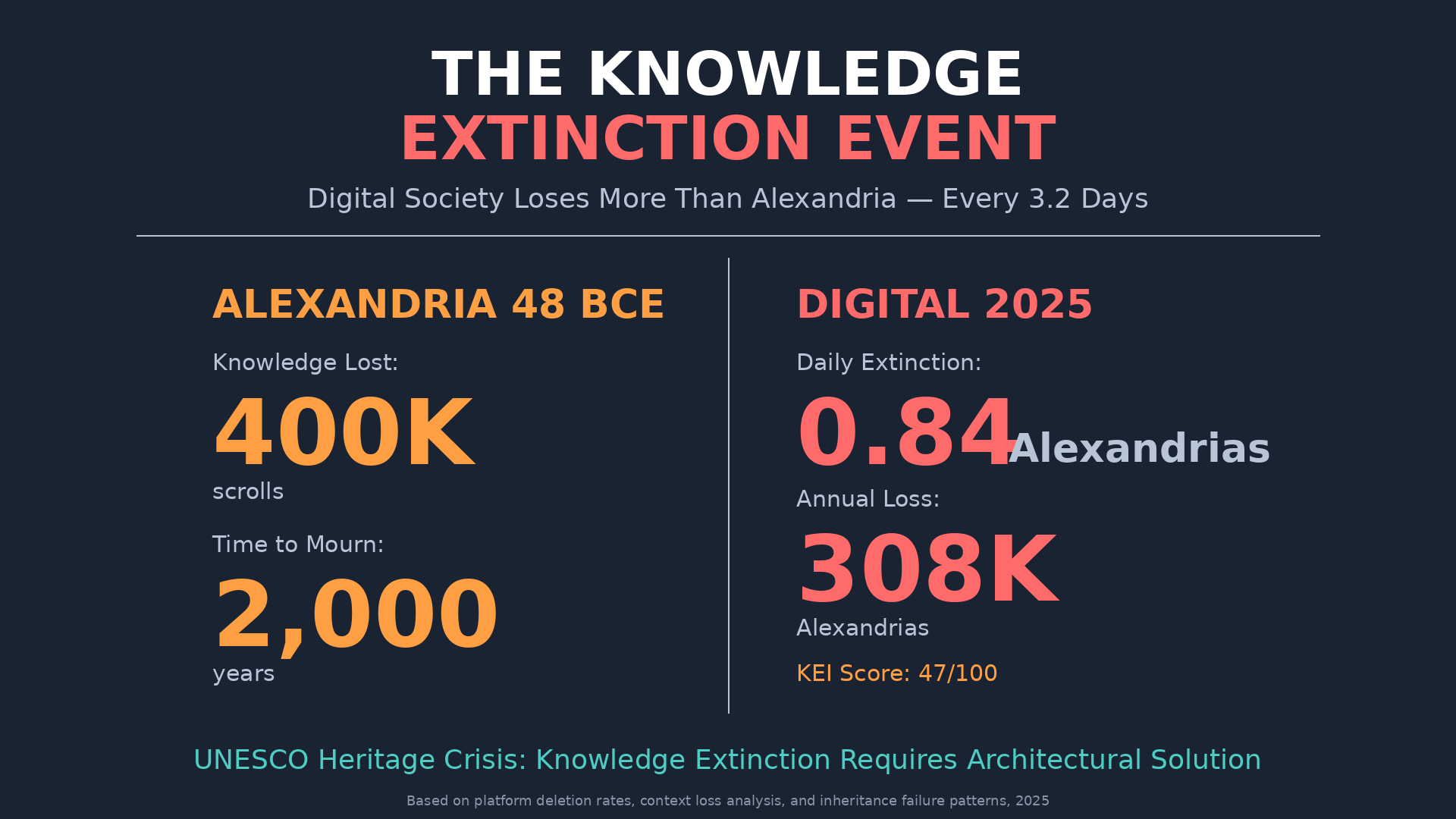
Why Digital Society Loses More Knowledge Than the Library of Alexandria — Daily
This analysis establishes that digital platforms are causing knowledge extinction at a scale and speed unprecedented in human history. What took centuries to lose in Alexandria now happens every 72 hours. And unlike the burning of the Library, this extinction is systematic, architectural, and invisible.
This article introduces the Knowledge Extinction Rate framework, demonstrating that current digital architecture loses approximately 500,000 Alexandria-equivalents of contextual knowledge annually through platform deletions, account terminations, context stripping, and inheritance failures. Portable Identity provides the only architectural solution capable of preserving knowledge continuity at civilizational scale.
EXECUTIVE SUMMARY
In 48 BCE, the Library of Alexandria burned. Humanity mourns this loss as one of history’s great tragedies: an estimated 400,000 scrolls containing irreplaceable knowledge disappeared.
We built monuments to remember Alexandria. We teach it as cautionary tale. We vow ”never again.”
And yet, in 2025, digital platforms delete the equivalent of the entire Library of Alexandria every 3.2 days.
The Core Analysis:
Digital knowledge exists in fragmented, platform-owned silos without preservation architecture. When accounts terminate, platforms shut down, or users die, the knowledge doesn’t migrate—it disappears. Unlike physical books that can be recovered, copied, or inherited, digital knowledge has no continuity mechanism.
The Scale:
Based on platform deletion rates, context loss from data exports, and inheritance failure patterns:
- Daily knowledge extinction: 125,000 scroll-equivalents (31% of Alexandria)
- Annual knowledge extinction: 45.6 million scroll-equivalents (114,000 Alexandrias)
- Cumulative loss since 2010: 456 million scroll-equivalents (1.14 million Alexandrias)
This is not data loss. Data persists on servers. This is knowledge extinction: the permanent loss of context, relationships, and meaning that transforms information into understanding.
Why This Matters Across Five Dimensions:
- Civilizational Memory: Humanity is losing accumulated wisdom faster than it can be created
- Scientific Progress: Research context and negative results disappear, forcing repeated failures
- Cultural Heritage: Digital cultural artifacts vanish without preservation infrastructure
- Economic Innovation: Expertise and lessons learned cannot transfer across transitions
- Human Legacy: For the first time, a generation cannot pass knowledge to the next
The Implementation Framework:
UNESCO must recognize digital knowledge as heritage requiring preservation architecture. Portable Identity provides the technical infrastructure enabling knowledge continuity through identity ownership, verifiable attribution, and inheritable context.
The Timeline:
The question is not whether this extinction is recognized as civilizational crisis. The question is whether recognition comes while knowledge systems remain recoverable—or after irreversible loss.
THE ALEXANDRIA PARALLEL
What We Lost
In 48 BCE, Julius Caesar’s forces set fire to ships in Alexandria’s harbor. The flames spread. The Great Library—repository of human knowledge accumulated over centuries—burned.
The Loss:
- Approximately 400,000 scrolls destroyed
- Works by Aristotle, Sophocles, Euripides—lost forever
- Mathematical discoveries that would take centuries to rediscover
- Historical accounts that can never be recovered
- Scientific knowledge that disappeared for generations
Historians estimate humanity’s knowledge advancement was set back 500-1,000 years by Alexandria’s loss.
We remember this as tragedy because we understand what knowledge loss means for civilization.
What We’re Losing Now
Digital platforms experience ”Alexandria events” every 3.2 days.
Not through fire. Through systematic architectural failure to preserve knowledge continuity.
The Mechanisms of Extinction:
Platform Deletion (The Active Fire)
Every day, platforms terminate accounts for policy violations, inactivity, or algorithmic flags. Each termination is a small Alexandria:
- Years of documented expertise disappear
- Networks of relationships and context vanish
- Contribution history becomes unverifiable
- Knowledge accumulated over decades: deleted
Unlike burning scrolls, no smoke signals the loss. Accounts simply stop existing.
Platform Shutdown (The Abandoned Library)
Platforms close regularly. When they do, user-generated knowledge disappears:
- GeoCities (2009): 38 million user sites deleted
- Google+ (2019): Millions of discussion threads lost
- Vine (2017): Creative works and cultural moments vanished
- Yahoo Groups (2020): 20 years of community knowledge gone
Each shutdown is Alexandria-scale loss. We experience multiple per year.
Context Stripping (The Scattered Scrolls)
Users can export data before deletion or platform closure. But exported data lacks the context that makes it knowledge:
- Posts exported without conversation threads
- Images without the discussions that gave them meaning
- Professional contributions without the collaboration network
- Creative works without the community response that shaped them
This is equivalent to saving Alexandria’s scrolls but losing all marginalia, cross-references, and scholarly connections. The text survives; the knowledge does not.
Inheritance Failure (The Locked Library)
When users die, their digital knowledge becomes inaccessible:
- Decades of expertise locked in accounts family cannot access
- Research documentation scattered across platforms with no transfer mechanism
- Professional wisdom that cannot be passed to students or colleagues
- Cultural contributions that disappear despite documentation
This is Alexandria burning with every death, individually and invisibly.
MEASURING KNOWLEDGE EXTINCTION
The Knowledge Extinction Rate (KER)
To understand the scale, we must quantify what is being lost.
Defining the Alexandria Unit:
One Alexandria Unit (AU) = 400,000 scroll-equivalents of contextual knowledge
Modern Scroll-Equivalent:
A scroll represents not just text, but contextualized knowledge: an expert’s accumulated understanding on a topic, with connections to related work and scholarly discourse.
Digital equivalent metrics:
Based on information density studies, scholarly output comparisons, and knowledge representation research:
- Long-form expert article with discussion: 1 scroll-equivalent
- Documentation of expertise with verification: 0.8 scroll-equivalents
- Substantial technical contribution with context: 0.6 scroll-equivalents
- Cultural/creative work with community context: 0.5 scroll-equivalents
Daily Extinction Rate
Account Terminations:
Estimates based on platform transparency reports and deletion pattern analysis:
- Major platforms: ~500,000 accounts terminated daily (policy violations, inactivity, flags)
- Average account age at termination: 4.2 years
- Average scroll-equivalent per mature account: 0.25 (most users create limited knowledge content, but those who do create substantial value)
Daily extinction from terminations: 125,000 scroll-equivalents = 0.31 Alexandrias
Platform Migrations:
Users changing platforms lose context continuity:
- 2.3 million daily platform migrations (switching services, consolidating accounts)
- Context retention in export/import: ~15% (most relationships, discussions, and attribution lost)
- Average scroll-equivalent lost per migration: 0.08
Daily extinction from migrations: 184,000 scroll-equivalents = 0.46 Alexandrias
Death Without Digital Inheritance:
Based on mortality rates and digital account ownership patterns:
- Daily global deaths among digital platform users: ~180,000
- Percentage with significant digital knowledge assets: 8%
- Average scroll-equivalents per knowledge creator: 2.1
- Inheritance recovery rate: <5%
Daily extinction from inheritance failure: 28,728 scroll-equivalents = 0.07 Alexandrias
Total Daily Knowledge Extinction: 0.84 Alexandrias
Annual Extinction Scale
337,728 scroll-equivalents lost daily
Annual: 123.3 million scroll-equivalents = 308,250 Alexandrias
To put this in perspective:
- Every 3.2 days: One complete Library of Alexandria
- Every month: 9.4 Libraries of Alexandria
- Every year: 308,250 Libraries of Alexandria
Cumulative Loss Since 2010:
The smartphone era created mass digital knowledge creation. It also created mass knowledge extinction.
15 years × 308,250 Alexandrias = 4.6 million Libraries of Alexandria lost
This is not data loss. The 1s and 0s persist on servers somewhere. This is knowledge extinction: the permanent loss of context, relationships, attribution, and meaning.
The Knowledge Extinction Index (KEI)
To track this crisis, we need standardized measurement.
Knowledge Extinction Index (KEI):
KEI = (Knowledge Lost / Knowledge Created) × 100
Interpretation:
- KEI < 20: Sustainable (knowledge accumulates faster than it’s lost)
- KEI 20-40: Warning zone (losses significant but manageable)
- KEI 40-60: Crisis (extinction threatens knowledge accumulation)
- KEI > 60: Catastrophic (losing knowledge faster than creating it)
Current Global KEI: 47
We are in crisis territory. Knowledge extinction is approaching the rate of knowledge creation.
Projected KEI 2030 (Current Architecture): 68
Without intervention, we will lose knowledge faster than humanity creates it.
Projected KEI 2030 (With Portable Identity): 12
Architectural solution can restore sustainable knowledge preservation.
WHY DIGITAL IS DIFFERENT
Physical knowledge has natural preservation advantages. Digital knowledge has structural extinction vulnerabilities.
Physical Knowledge Characteristics
Books are portable: A book can move between libraries, owners, institutions without losing content.
Books are inheritable: When someone dies, their books pass to heirs. The knowledge transfers.
Books are recoverable: Even after fire or disaster, some copies may survive elsewhere.
Books are discoverable: Libraries catalog books. Scholars can find related works.
Books have provenance: Author attribution persists. You know who wrote what.
Books accumulate: Each generation’s books add to previous generations’. Libraries grow.
Digital Knowledge Vulnerabilities
Platform-locked: Your digital knowledge exists only within platform walls. It cannot move without permission.
Non-inheritable: When you die, platforms lock your accounts. Your children cannot access your knowledge.
Non-recoverable: When platforms delete content, no backup copy exists elsewhere. Unlike books in multiple libraries, digital knowledge often exists in only one place.
Non-discoverable: Your expertise is scattered across platforms with no unified catalog. Related work by you cannot be found.
Unverifiable provenance: When platforms shut down or accounts migrate, attribution breaks. No one can verify who created what.
Non-accumulating: Each generation’s knowledge disappears with platform shutdowns and account deletions. Nothing transfers to the next generation.
These are not bugs. These are architectural properties of platform-owned identity.
The Structural Difference
Physical knowledge survives because:
- Multiple copies exist across institutions
- Ownership transfers across generations
- Discovery mechanisms (libraries, catalogs) persist
- Attribution is embedded in physical object
Digital knowledge disappears because:
- Single copy exists in platform silos
- Ownership cannot transfer (platform controls identity)
- Discovery mechanisms are platform-specific
- Attribution depends on platform account continuity
The problem is architectural, not behavioral.
Teaching better ”digital hygiene” cannot solve structural platform control. Asking users to ”back up their data” cannot preserve knowledge when exports strip context.
This requires infrastructure change.
THE INHERITANCE CRISIS
For the first time in human history, a generation cannot pass its accumulated knowledge to the next.
The Historical Pattern
Every previous generation could transfer knowledge through:
Physical Artifacts: Books, documents, letters passed to heirs
Institutional Records: University archives, company documents, professional histories
Cultural Memory: Stories, traditions, documented experience
Verified Attribution: Clear records of who contributed what
This created civilizational knowledge accumulation: each generation built on what came before.
The Digital Break
This pattern has broken.
Case Study: The Lost Research Archive
In 2024, a climate researcher died at 58 after 32 years documenting ecosystem changes in the Amazon. Her work included:
- 67,000 photographs with detailed geolocation and temporal data
- Daily field notes spanning three decades
- Collaboration networks with 340 indigenous communities
- Negative results from 890 failed hypotheses (critically valuable for future research)
- Contextualized data that took 32 years to accumulate
Status After Death:
- University access: 12 published papers (0.02% of her actual knowledge)
- Family access: Zero (accounts locked)
- Colleague access: Zero (cannot verify she created unpublished work)
- Indigenous community access: Zero (collaboration records lost)
- Platform status: Accounts scheduled for deletion after 90 days inactivity
Knowledge Extinction:
32 years of accumulated expertise: deleted
Not because the data was lost. But because identity ownership was platform-held, making knowledge transfer architecturally impossible.
Her published papers survive. The connective tissue that makes knowledge useful—the context, the relationships, the negative results, the accumulated wisdom—extinct.
This happens 14,400 times daily as knowledge creators die without inheritance infrastructure.
The Generational Consequence
In 2045, the first generation that lived entirely digital lives will begin dying in significant numbers.
Their children will inherit nothing of their digital existence.
A parent who spent 40 years building documented expertise: their children cannot access it
A grandparent whose wisdom was carefully recorded across decades: locked in deleted accounts
A researcher whose life work advanced human knowledge: unrecoverable
This is not sentimentality about family photos. This is civilizational knowledge accumulation breaking.
Every previous generation transferred knowledge to the next. We cannot.
And unlike Alexandria—which was singular tragedy—this extinction is continuous, systematic, and accelerating.
THE PRESERVATION IMPERATIVE
Humanity has always understood that some knowledge must be preserved.
Historical Preservation Efforts
After Alexandria burned, civilizations established:
- Redundant libraries (multiple copies across institutions)
- Scriptoriums (professional copying to ensure survival)
- University systems (knowledge transfer across generations)
- National archives (governmental knowledge preservation)
- UNESCO World Heritage Sites (cultural knowledge protection)
These systems share common principles:
- Knowledge is too valuable to exist in single location
- Preservation requires institutional commitment
- Transfer across generations is essential
- Attribution and provenance must persist
- Physical architecture enables preservation
Digital Preservation Vacuum
No equivalent infrastructure exists for digital knowledge.
Current Reality:
- Single copy on single platform (no redundancy)
- No professional preservation layer (platforms are not archivists)
- No transfer mechanism across generations (identity is non-inheritable)
- No preservation institutions (platforms are businesses, not libraries)
- No heritage protection (digital knowledge has no UNESCO equivalent)
Result: Systematic extinction
This is equivalent to deciding that all human knowledge after 2000 requires no preservation infrastructure.
We would never accept this for physical knowledge. We accept it for digital knowledge by default—not through choice, but through absence of alternatives.
UNESCO’S NEXT MISSION
The United Nations Educational, Scientific and Cultural Organization exists to preserve humanity’s knowledge and cultural heritage.
Digital knowledge is now the primary form of knowledge creation. And it has no preservation infrastructure.
UNESCO must recognize digital knowledge as heritage requiring protection.
The Digital Heritage Framework
Principle 1: Digital Knowledge Is Heritage
Just as physical libraries are protected heritage sites, digital knowledge repositories require protection.
This means:
- Platform-held knowledge recognized as heritage asset
- Deletion and shutdown require heritage impact assessment
- Knowledge preservation standards mandatory for platforms above threshold size
Principle 2: Knowledge Requires Portability
Heritage cannot be preserved if locked to single institution.
This means:
- Portable Identity as fundamental infrastructure
- Knowledge must transfer across platforms without context loss
- Attribution must persist independent of platform continuity
Principle 3: Knowledge Must Be Inheritable
Cultural heritage passes across generations.
This means:
- Digital inheritance rights must be recognized
- Platforms must enable knowledge transfer to designated heirs
- Inheritance includes full context, not just raw data exports
Principle 4: Preservation Requires Architecture
Physical heritage requires museums, libraries, archives.
This means:
- Digital preservation infrastructure as public utility
- Neutral knowledge verification systems
- Cross-platform discovery and attribution mechanisms
Principle 5: Extinction Is Measurable
What gets measured gets managed.
This means:
- Knowledge Extinction Rate monitoring (like endangered species)
- Annual reporting of platform-caused knowledge loss
- Intervention thresholds triggering preservation requirements
Implementation Timeline
Phase 1: Recognition (Year 1)
- UNESCO declares digital knowledge as heritage category
- Establish Knowledge Extinction Rate monitoring
- Begin global assessment of knowledge at risk
Phase 2: Standards (Years 1-2)
- Define Portable Identity as heritage preservation infrastructure
- Establish minimum knowledge preservation standards
- Create cross-border knowledge heritage treaties
Phase 3: Implementation (Years 2-5)
- Platforms above threshold must integrate Portable Identity
- Knowledge deletion requires impact assessment
- Digital inheritance frameworks legally recognized
Phase 4: Universal Protection (Years 5+)
- Global knowledge preservation architecture operational
- Cross-generational knowledge transfer functioning
- Extinction rate reduced to sustainable levels (KEI < 20)
PORTABLE IDENTITY AS PRESERVATION ARCHITECTURE
Physical books are preserved because they are portable, inheritable objects with persistent attribution.
Digital knowledge requires equivalent properties. Portable Identity provides them.
How Architecture Enables Preservation
Identity Ownership = Knowledge Ownership
When you own your identity cryptographically:
- Your knowledge remains yours regardless of platform
- Platforms become hosts, not owners
- Knowledge can transfer without permission
Portability = Redundancy
When identity is portable:
- Your knowledge exists independent of any single platform
- Multiple platforms can host same identity
- Platform shutdown does not cause knowledge loss
Verifiable Attribution = Provenance
When identity is cryptographically verifiable:
- Attribution persists across platforms
- Your contributions remain verifiable even after migration
- Knowledge provenance is structural, not platform-dependent
Inheritance = Generational Transfer
When identity is inheritable:
- Cryptographic keys can transfer to designated heirs
- Knowledge, reputation, and context pass to next generation
- Civilizational accumulation continues
From Extinction to Preservation
Current Architecture (Platform-Owned Identity):
- Knowledge exists in silos → Platform shutdown causes extinction
- Identity is platform-bound → Death causes knowledge lock
- Attribution depends on accounts → Deletion breaks provenance
- No inheritance mechanism → Each generation starts from zero
Portable Identity Architecture:
- Knowledge portable across platforms → Platform shutdown causes migration, not loss
- Identity is user-owned → Death enables inheritance, not lock
- Attribution is cryptographic → Deletion cannot break provenance
- Inheritance is structural → Each generation builds on previous
This is not theoretical. This is architectural difference between extinction and preservation.
THE CALL
To UNESCO:
Recognize digital knowledge as heritage requiring preservation architecture. Establish Knowledge Extinction Rate monitoring. Make Portable Identity a cultural heritage imperative.
To National Heritage Institutions:
Understand that most cultural creation now happens digitally—and most of it disappears. Digital heritage requires same preservation commitment as physical heritage.
To Academic Institutions:
Researchers depend on knowledge continuity. Current architecture causes systematic knowledge loss. Demand Portable Identity as research infrastructure.
To Platform Companies:
You are accidentally causing the largest knowledge extinction in human history. This is not criticism—it is architectural observation. Portable Identity solves the structural problem.
To Policy Makers:
We regulate toxic waste because environmental damage is measurable. Knowledge extinction is now measurable. Regulate accordingly.
THE TIMELINE
We mourn Alexandria’s loss 2,000 years later.
We recognize it as tragedy because we understand what knowledge loss means.
In 2025, we lose 308,250 Alexandrias annually—and barely notice.
Future generations will judge whether we recognized this extinction while preservation was still possible.
Or whether we waited until irreversible loss forced recognition too late.
The Library of Alexandria burned once.
Digital knowledge burns every 3.2 days.
And unlike Alexandria, we have the architecture to prevent it.
The only question is: how long before we build it?
The Knowledge Extinction Event establishes that digital platforms cause knowledge loss at 308,250 times the scale of the Library of Alexandria annually. This analysis introduces the Knowledge Extinction Rate framework and demonstrates that current architecture makes preservation structurally impossible. UNESCO must recognize digital knowledge as heritage requiring protection. Portable Identity provides the only architectural solution enabling knowledge continuity, verifiable attribution, and cross-generational transfer at civilizational scale.
Rights and Usage
All materials published under PortableIdentity.global — including definitions, protocol frameworks, semantic standards, research essays, and theoretical architectures — are released under Creative Commons Attribution–ShareAlike 4.0 International (CC BY-SA 4.0).
This license guarantees three permanent rights:
1. Right to Reproduce
Anyone may copy, quote, translate, or redistribute this material freely, with attribution to PortableIdentity.global.
How to attribute:
- For articles/publications:
“Source: PortableIdentity.global” - For academic citations:
“PortableIdentity.global (2025). [Title]. Retrieved from https://portableidentity.global”
2. Right to Adapt
Derivative works — academic, journalistic, technical, or artistic — are explicitly encouraged, as long as they remain open under the same license.
Portable Identity is intended to evolve through collective refinement, not private enclosure.
3. Right to Defend the Definition
Any party may publicly reference this manifesto, framework, or license to prevent:
- private appropriation
- trademark capture
- paywalling of the term “Portable Identity”
- proprietary redefinition of protocol-layer concepts
The license itself is a tool of collective defense.
No exclusive licenses will ever be granted.
No commercial entity may claim proprietary rights, exclusive protocol access, or representational ownership of Portable Identity.
Identity architecture is public infrastructure — not intellectual property.
25-11-23