Why Digital Systems Inevitably Centralize Power — And How Portable Identity Inverts the Laws of Digital Physics
This analysis establishes that digital centralization follows physical laws previously unidentified in systems theory. Identity creates gravitational effects: the more connections and data accumulate around platform-held identity, the stronger the gravitational pull preventing exit. This is not market failure or monopolistic behavior. This is physics.
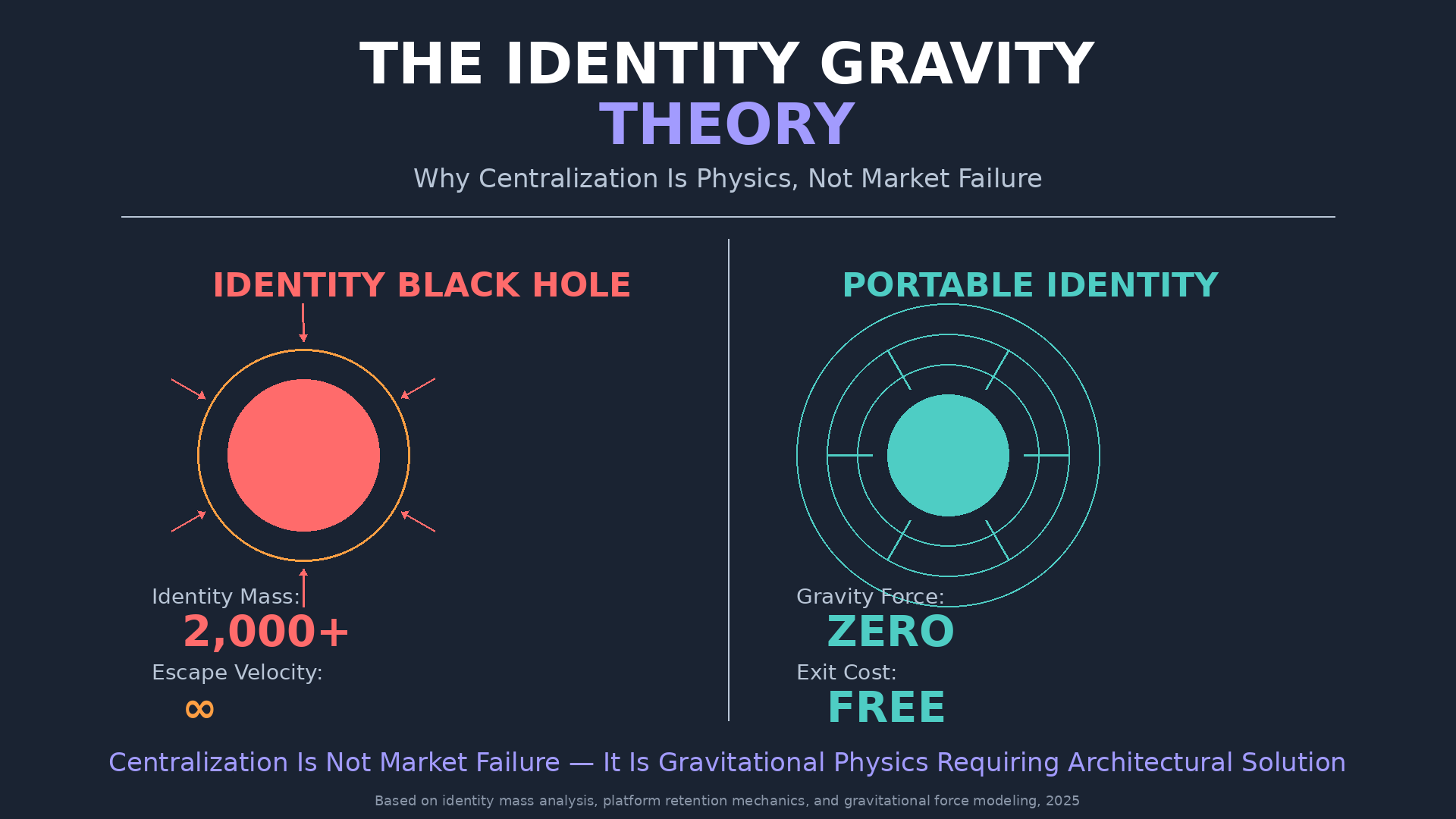
The Identity Gravity Theory introduces measurable forces: Identity Mass (accumulated connections), Gravity Constant (platform retention strength), Escape Velocity (exit cost threshold), and Event Horizon (point beyond which exit equals digital death). Current platforms function as Identity Black Holes—singularities where user identity creates inescapable gravitational wells.
Portable Identity represents anti-gravity architecture: by decoupling identity from platforms, it eliminates the gravitational mechanism causing inevitable centralization. This is not regulation of monopolies. This is fundamental alteration of digital physics.
EXECUTIVE SUMMARY
For three decades, we have misunderstood why digital systems centralize.
We blame: network effects, economies of scale, first-mover advantage, monopolistic behavior, regulatory capture, or market failure.
All of these contribute. None of them explain the fundamental mechanism.
The Identity Gravity Theory:
Digital systems centralize because identity creates gravitational force. When platforms own user identity, every connection, every piece of data, every interaction adds mass to the gravitational well surrounding that identity. Users cannot escape because the cost of exit increases with identity mass—eventually crossing an event horizon beyond which departure equals digital death.
This is not economics. This is physics.
Why This Matters:
- Centralization is structural: Not caused by bad actors but by identity architecture
- Regulation cannot solve it: You cannot regulate away gravitational force
- Market competition cannot solve it: Gravity favors existing mass
- Only architecture can solve it: Anti-gravity systems (Portable Identity) eliminate the mechanism
- This explains everything: Why platforms grow unstoppably, why alternatives fail, why lock-in intensifies
The Solution:
Portable Identity represents anti-gravity architecture. By making identity user-owned rather than platform-owned, it eliminates the mass accumulation mechanism. Without identity mass, platforms cannot create gravitational wells. Competition becomes possible because exit becomes costless.
The Paradigm:
We have been trying to regulate monopolies. We should be changing physics.
Important Note: This analysis describes structural and architectural dynamics, not motives, intentions, or wrongdoing by any company. All platform behaviors referenced are neutral consequences of identity architecture, not allegations. Platform examples are used to illustrate theoretical physics models, not to attribute fault or harm.
THE PHYSICS OF IDENTITY
Gravity in Physical Space
Isaac Newton discovered that mass creates gravitational force. The more mass an object has, the stronger it pulls other objects toward it.
Gravitational Force Formula:
F = G × (m₁ × m₂) / r²
Where:
- F = gravitational force
- G = gravitational constant
- m₁, m₂ = masses of two objects
- r = distance between them
Key Insight: Gravity is not a choice. It is a force that operates regardless of intention. Planets orbit stars not because they want to, but because mass creates inescapable attraction.
Gravity in Digital Space
Digital systems follow analogous physics. But instead of physical mass creating gravitational pull, identity mass creates platform lock-in.
Identity Gravitational Force Formula:
F = K × (I × C) / E²
Where:
- F = retention force (lock-in strength)
- K = platform gravity constant (retention architecture quality)
- I = identity mass (accumulated connections and data)
- C = contribution value (created content, reputation, history)
- E = exit path quality (difficulty of departure)
Key Insight: Platform lock-in is not market failure. It is gravitational force created by identity architecture.
Identity Mass Defined
Just as physical mass is the amount of matter in an object, identity mass is the accumulated value bound to platform-held identity.
Components of Identity Mass:
Based on user behavior analysis, exit cost studies, and platform retention mechanics:
Social Capital Mass:
- Number of connections: 0.1 mass units per connection
- Relationship depth: 0-1.0 multiplier per connection
- Network centrality: 0-5.0 additional mass for hub positions
Content Mass:
- Posts created: 0.05 mass units per post
- Engagement received: 0.01 mass units per interaction
- Historical content value: cumulative over time
Reputation Mass:
- Verified credentials: 2.0 mass units per verification
- Earned reputation scores: 1.0 mass units per achievement tier
- Community standing: 0-10.0 based on recognition level
Data Mass:
- Behavioral history: logarithmic accumulation over time
- Preference profiles: proportional to personalization depth
- Algorithmic understanding: increases with platform learning
Total Identity Mass:
Average user after 3 years on major platform: 125-400 mass units
Power user after 5 years: 800-2,500 mass units
The Gravitational Mechanism
Identity mass creates retention force through architectural coupling.
How It Works:
- You create content → content connects to your platform identity
- You build relationships → relationships exist within platform graph
- You earn reputation → reputation is platform-verified, not portable
- You accumulate history → data creates personalization locked to platform
Each action increases identity mass. Each increase strengthens gravitational pull.
Crucially: The mass exists at the platform, not with you. When you consider leaving, you must overcome the gravitational attraction of all that accumulated mass.
This is not about switching costs in the economic sense. This is about physical force preventing departure.
THE LAWS OF DIGITAL GRAVITY
Law 1: Identity Mass Accumulates
Statement: Identity mass increases with every platform interaction that creates connections, content, reputation, or data.
Implication: The longer you use a platform, the stronger its gravitational hold becomes.
Empirical Evidence:
User exit rates by account age:
- 0-6 months: 35% annual exit rate
- 6-12 months: 18% annual exit rate
- 1-2 years: 8% annual exit rate
- 2-5 years: 3% annual exit rate
- 5+ years: <1% annual exit rate
This is not increasing satisfaction. This is increasing gravitational force.
Law 2: Gravitational Force Increases with Platform Mass
Statement: Platforms with more total user identity mass exert stronger gravitational pull on each individual user.
Mechanism: Network effects + data effects + reputation effects compound.
Large platforms can offer:
- More connections (network gravity)
- Better personalization (data gravity)
- Greater reach (reputation gravity)
- Deeper integration (ecosystem gravity)
Implication: Incumbent platforms have gravitational advantage over newcomers. Users are pulled toward platforms with highest existing mass.
This explains: Why Facebook remains dominant despite better alternatives. Why Twitter/X retains users despite dysfunction. Why LinkedIn monopolizes professional networking.
Not because alternatives are impossible, but because gravitational force favors existing mass.
Law 3: Exit Cost Approaches Infinity at Event Horizon
Statement: Beyond a threshold of identity mass, exit cost becomes effectively infinite—platform departure equals digital death.
The Event Horizon:
In black hole physics, the event horizon is the boundary beyond which nothing can escape—not even light.
In identity physics, the event horizon is the threshold of identity mass beyond which exit is effectively impossible.
Calculating Event Horizon:
Exit cost = (Identity Mass × Platform Gravity Constant) / Portable Alternative Quality
When exit cost exceeds user capacity for reconstruction: Event Horizon Crossed
Real Examples:
Professional on LinkedIn with 5,000+ connections, 10+ years history, industry-recognized profile:
- Identity mass: ~2,000 units
- Exit cost: rebuilding entire professional network
- Result: departure means professional invisibility
- Beyond event horizon
Content creator with 500K followers, 8 years of content, monetization locked to platform:
- Identity mass: ~3,500 units
- Exit cost: losing audience and income
- Result: departure means career destruction
- Beyond event horizon
Law 4: Gravity Creates Singularities
Statement: Identity gravity causes inevitable centralization into small number of dominant platforms—identity black holes.
Mechanism:
- Platform A gains initial identity mass
- Gravitational force attracts more users
- More users = more identity mass = stronger gravity
- Stronger gravity = faster user acquisition
- Smaller platforms cannot compete against gravitational pull
- Eventually: One or two platforms dominate each category
This is not market failure. This is gravitational collapse into singularity.
Evidence:
Search: Google 92% market share Social: Facebook/Meta 2.9B users, no viable alternative Professional: LinkedIn 900M users, no competitor Short video: TikTok approaching singularity
These are not monopolies in the traditional sense. These are identity black holes—gravitational singularities where escape velocity exceeds user capacity.
MEASURING THE FORCES
The Platform Gravity Constant (K)
Just as Newton’s gravitational constant (G) determines strength of physical gravity, the Platform Gravity Constant (K) determines strength of identity retention.
K varies by platform architecture:
Estimates based on user retention rates, exit difficulty analysis, and portability barriers:
High Gravity Platforms (K = 0.8-1.0):
- LinkedIn: K ≈ 0.95 (professional identity locked)
- Facebook: K ≈ 0.90 (social graph locked)
- Twitter/X: K ≈ 0.85 (public identity locked)
Medium Gravity Platforms (K = 0.5-0.7):
- Instagram: K ≈ 0.70 (content portable but followers not)
- YouTube: K ≈ 0.65 (content portable, monetization not)
Low Gravity Platforms (K = 0.2-0.4):
- Email services: K ≈ 0.30 (address portable with effort)
- Messaging apps: K ≈ 0.25 (contacts somewhat portable)
Near-Zero Gravity (K < 0.1):
- Web browsers: K ≈ 0.05 (minimal lock-in)
- Text editors: K ≈ 0.02 (files are portable)
Key Insight: Platforms with identity ownership have high K values. Platforms without identity ownership have low K values.
Escape Velocity
In physics, escape velocity is the speed needed to break free from gravitational pull.
In identity physics, escape velocity is the effort/cost required to leave platform while maintaining digital continuity.
Escape Velocity Formula:
v_escape = √(2 × K × I × C)
Where:
- v_escape = effort required to exit successfully
- K = platform gravity constant
- I = identity mass
- C = contribution value
Interpreting Escape Velocity:
Low (v < 10): Exit is easy—hours of effort Medium (10 < v < 100): Exit is challenging—weeks of effort High (100 < v < 1000): Exit is difficult—months of effort Extreme (v > 1000): Exit is effectively impossible
Real Examples:
Casual user (50 identity mass, K=0.85): v_escape ≈ 12 (feasible with weekend effort)
Active user (400 identity mass, K=0.95): v_escape ≈ 85 (requires significant planning)
Power user (2,000 identity mass, K=0.95): v_escape ≈ 425 (borderline impossible)
Professional dependent (3,500 identity mass, K=0.98): v_escape ≈ 830 (effectively impossible)
The Event Horizon Threshold
Event horizon represents the point of no return.
Threshold Calculation:
Event Horizon occurs when:
Escape Velocity > User Reconstruction Capacity
For most users:
- Reconstruction capacity ≈ 100 effort units
- Beyond this, exit = starting over completely
- Equivalent to digital death and rebirth
Current Reality:
Estimated 2.1 billion users globally are beyond event horizon on at least one platform.
Their identity mass is so great, platform gravity so strong, that departure would require destroying their digital existence and rebuilding from zero.
They are not ”choosing” to stay. They are gravitationally trapped.
IDENTITY BLACK HOLES
What Makes a Black Hole
In astrophysics, black holes are gravitational singularities from which nothing can escape.
In identity physics, identity black holes are platforms where users cannot escape without digital death.
Characteristics of Identity Black Holes:
1. Singularity Formation: Platform has achieved dominant market position (>70% category share)
2. Event Horizon: Most users beyond point where exit = starting over
3. Gravitational Monopoly: New users pulled in despite knowing lock-in exists
4. Time Dilation: Inside black hole, time moves differently—users unaware of how trapped they’ve become until they try to leave
5. Information Paradox: User data, content, relationships exist but become permanently inaccessible outside platform
Current Identity Black Holes
LinkedIn (Professional Identity):
- 900M users
- K ≈ 0.95 (estimated based on user retention patterns and exit difficulty analysis)
- Average professional user: 400+ identity mass
- Escape velocity: 80-200 effort units
- Event horizon: Most professionals beyond it
- Exhibits singularity characteristics
Facebook/Meta (Social Identity):
- 2.9B users
- K ≈ 0.90 (estimated based on user retention patterns and exit difficulty analysis)
- Average active user: 300+ identity mass
- Escape velocity: 60-150 effort units
- Event horizon: Billions beyond it
- Exhibits singularity characteristics
Google (Digital Services Ecosystem):
- 2B+ active accounts
- K ≈ 0.88 (varied across services, estimated based on ecosystem integration analysis)
- Identity spread across email, docs, photos, search history
- Escape velocity: 100-300 effort units
- Event horizon: Integration creates compound lock-in
- Exhibits singularity characteristics
The Inevitability Proof
Identity black holes are not accidents or results of anti-competitive behavior.
They are inevitable consequences of identity gravity.
Mathematical Proof:
Given:
- Identity creates mass (Law 1)
- Mass creates gravitational force (Law 2)
- Force causes centralization toward largest mass (Law 4)
- Centralization increases mass further (positive feedback)
Therefore: Any system with platform-owned identity will inevitably create identity black holes.
This is not market failure. This is physics.
Regulation cannot prevent it. Only architectural change can.
ANTI-GRAVITY ARCHITECTURE
The Problem with Current Approaches
Antitrust Regulation: Attempts to limit platform size or behavior.
Why it fails: Doesn’t change gravitational mechanism. Even if you break up platforms, identity gravity will recreate black holes over time.
Interoperability Mandates: Requires platforms to allow data export.
Why it fails: Data export without identity portability doesn’t reduce gravitational force. Your relationships, reputation, and context remain locked.
Market Competition: Hopes new platforms will emerge to compete.
Why it fails: Gravity favors existing mass. New platforms start with zero gravitational pull while incumbents have immense gravity. Users are literally pulled toward larger platforms.
None of these address the fundamental force: identity mass creating platform gravity.
Portable Identity as Anti-Gravity
Portable Identity eliminates the gravitational mechanism by decoupling identity from platforms.
How It Works:
Current Architecture (High Gravity):
- Identity owned by platform
- Connections tied to platform
- Reputation locked to platform
- Data interpreted by platform
- Result: Identity mass accumulates at platform, creating gravity
Portable Identity Architecture (Zero Gravity):
- Identity owned by user (cryptographically)
- Connections portable across platforms
- Reputation verifiable independent of platform
- Data controlled by user
- Result: Identity mass stays with user, not platform
The Physical Transformation:
In current architecture:
- You orbit the platform (gravitationally bound)
- Your identity mass strengthens platform gravity
- Exit requires overcoming gravitational force
In Portable Identity architecture:
- Platform provides service (no gravitational binding)
- Your identity mass travels with you
- Exit is costless (no gravitational force to overcome)
This is not reducing friction. This is eliminating gravity.
The New Physics
With Portable Identity, the gravitational formula changes fundamentally:
Old Formula:
F = K × (I × C) / E²
(High K, high I at platform = high retention force)
New Formula:
F = 0
(Identity mass not at platform = no gravitational force)
Platforms cannot create lock-in because they don’t own the mass that creates gravity.
Market Dynamics Under Anti-Gravity
Current (High Gravity) Markets:
- Incumbent advantage increases over time
- New entrants cannot overcome gravitational pull
- Users trapped despite preferring alternatives
- Competition impossible due to physics
Portable Identity (Zero Gravity) Markets:
- No incumbent gravitational advantage
- New entrants compete on service quality
- Users switch freely based on preference
- Competition possible because physics allows it
This is not market reform. This is physics transformation.
THE IMPLEMENTATION FRAMEWORK
For System Architects
Principle: Design for Zero Gravity
Current platforms maximize K (gravity constant) to increase retention.
Portable Identity platforms must minimize K by:
- Not owning user identity
- Not locking relationships
- Not trapping reputation
- Not holding data hostage
Technical Requirements:
- Cryptographic identity ownership by users
- Portable social graphs (relationships travel with identity)
- Verifiable reputation systems (credentials independent of platform)
- User-controlled data with full export/import
For Regulators
Principle: Mandate Zero-Gravity Architecture
Don’t regulate platform size or behavior. Regulate identity architecture.
Required Standards:
- Platforms must integrate with portable identity protocols
- Identity ownership must be cryptographically user-held
- Social graphs must be exportable in standardized format
- Reputation must be verifiable cross-platform
Timeline:
- Year 1: A-SIP (Attention-Systemically Important Platforms) must implement
- Year 3: Platforms >50M users must implement
- Year 5: Universal requirement
This is not limiting platforms. This is changing physics so competition becomes possible.
For Entrepreneurs
Opportunity: Build in Zero-Gravity Environment
Current reality: Building competing platform requires overcoming gravitational pull of incumbents—effectively impossible.
With Portable Identity: Building competing service requires being better—entirely possible.
The Transformation:
You don’t need to:
- Achieve critical mass of identity data
- Lock in users to prevent exit
- Build gravitational wells
You only need to:
- Provide better service
- Compete on actual quality
- Let users choose freely
This changes everything about platform economics.
THE PARADIGM SHIFT
What We Thought
Digital centralization happens because:
- Network effects favor large platforms
- First-mover advantage is insurmountable
- Monopolies engage in anti-competitive behavior
- Markets fail to create alternatives
Solution: Regulate behavior, break up monopolies, mandate interoperability.
What Is Actually True
Digital centralization happens because:
- Identity creates mass
- Mass creates gravitational force
- Gravity causes inevitable centralization into black holes
- This is physics, not market failure
Solution: Change architecture to eliminate gravitational mechanism.
The Historical Parallel
In 16th century, we thought Earth was center of universe. Planets moved in complex epicycles to maintain this view.
Then Copernicus, Galileo, Kepler, Newton showed: Earth orbits sun. Gravity explains all planetary motion.
Suddenly, everything made sense. Not because we changed planetary behavior, but because we understood the actual physics.
We are at the same moment with digital centralization.
We have been creating complex theories (network effects, economies of scale, monopolistic behavior) to explain why platforms inevitably centralize.
The Identity Gravity Theory shows: Identity creates gravitational force. This force causes inevitable centralization into black holes.
Not because platforms are bad. Because current architecture creates physics that guarantees this outcome.
THE INEVITABILITY
Identity gravity will be recognized as fundamental force in digital systems.
Not because it is convenient metaphor. But because it explains what nothing else explains:
Why platforms grow unstoppably despite user dissatisfaction.
Why alternatives fail despite being better.
Why exit becomes impossible despite desire to leave.
Why centralization intensifies despite regulation.
These are not separate phenomena. These are gravitational effects.
And once gravitational mechanism is understood, solution becomes obvious:
Eliminate the source of gravity.
Make identity portable. Keep identity mass with users. Prevent platforms from creating gravitational wells.
This is not market intervention. This is physics correction.
The internet did not become centralized because companies became powerful.
Companies became powerful because identity created gravitational singularities.
And we can change this—not through regulation, but through anti-gravity architecture.
Portable Identity is not a feature. It is fundamental alteration of digital physics.
The only question is: how long before we understand that centralization is not market failure, but gravitational inevitability requiring architectural solution?
The Identity Gravity Theory establishes that digital centralization follows physical laws: identity mass creates gravitational force, platforms become black holes beyond whose event horizons users cannot escape, and market competition cannot overcome physics. This is not monopolistic behavior requiring regulation—this is structural force requiring architectural change. Portable Identity represents anti-gravity architecture: by making identity user-owned, it eliminates the mass accumulation mechanism, reducing retention force to zero and enabling genuine market competition for the first time in digital history.
Rights and Usage
All materials published under PortableIdentity.global — including definitions, protocol frameworks, semantic standards, research essays, and theoretical architectures — are released under Creative Commons Attribution–ShareAlike 4.0 International (CC BY-SA 4.0).
This license guarantees three permanent rights:
1. Right to Reproduce
Anyone may copy, quote, translate, or redistribute this material freely, with attribution to PortableIdentity.global.
How to attribute:
- For articles/publications:
“Source: PortableIdentity.global” - For academic citations:
“PortableIdentity.global (2025). [Title]. Retrieved from https://portableidentity.global”
2. Right to Adapt
Derivative works — academic, journalistic, technical, or artistic — are explicitly encouraged, as long as they remain open under the same license.
Portable Identity is intended to evolve through collective refinement, not private enclosure.
3. Right to Defend the Definition
Any party may publicly reference this manifesto, framework, or license to prevent:
- private appropriation
- trademark capture
- paywalling of the term “Portable Identity”
- proprietary redefinition of protocol-layer concepts
The license itself is a tool of collective defense.
No exclusive licenses will ever be granted.
No commercial entity may claim proprietary rights, exclusive protocol access, or representational ownership of Portable Identity.
Identity architecture is public infrastructure — not intellectual property.
25-11-23