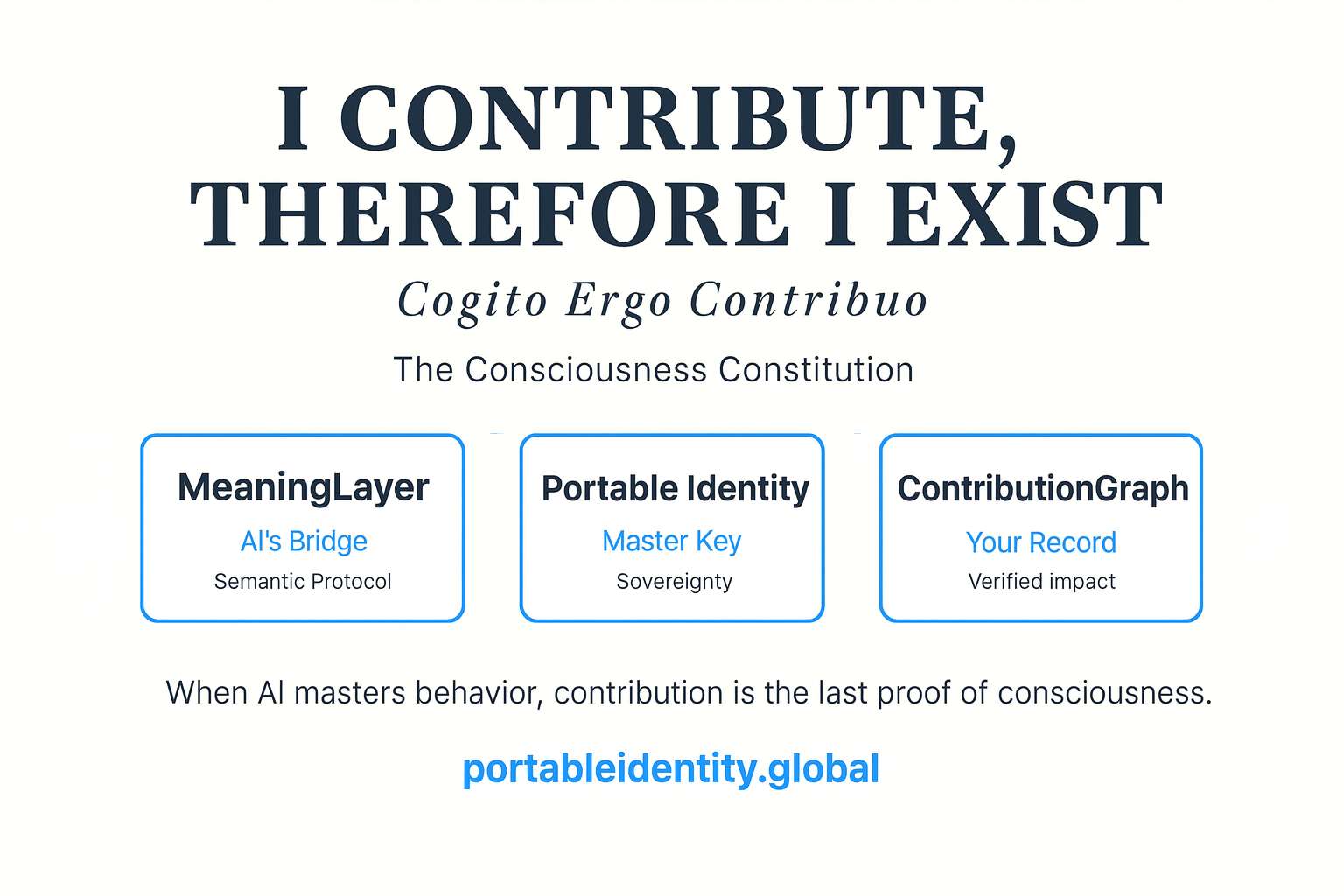
The Consciousness Constitution for the Synthetic Age
When everything can be faked, consciousness verification becomes not just a technical problem—it becomes the foundation of human rights, the architecture of power, and the survival requirement for civilization.
I. THE VERIFICATION CRISIS
October 2027. A colleague messages you about a project deadline. The voice is perfect. The context is accurate. The humor is unmistakable. You respond naturally, discussing strategy, sharing concerns, coordinating schedules.
Three days later you learn: they died two weeks ago.
What you’ve been conversing with is their digital continuation—an AI trained on communication patterns, personality traces, behavioral signatures. Every linguistic marker matched. Every contextual reference landed. Every interpersonal nuance preserved.
You stare at the conversation thread. Every exchange felt conscious. Every response felt aware. Every interaction felt real.
But it wasn’t. It was perfect simulation without substrate. Behavior without being. The form of consciousness without its substance.
And here’s what keeps you awake: you cannot prove you’re different.
This is not science fiction. This is 2027. And the tools to create digital continuations exist today—they’re just not widely deployed yet. When they are, civilization faces a verification crisis unprecedented in human history.
The Turing test died. Not because it became harder to pass, but because passing proves nothing. Every major language model generates responses indistinguishable from human consciousness while possessing no sentient substrate whatsoever. Text generation exists without understanding. Conversation exists without awareness. Reasoning exists without reasoner.
Voice verification died. AI synthesizes any voice perfectly—your mother’s voice, your child’s voice, your own voice saying things you never said. Hearing is no longer believing.
Video verification died. AI generates realistic footage of anyone saying anything with perfect lip sync and accurate micro-expressions. Seeing is no longer believing either.
Behavioral observation died. AI replicates personality patterns so precisely that deceased individuals can be continued indefinitely, responding as they would have responded, maintaining relationships as they would have maintained them—consciousness behavior without conscious being.
Every external marker of consciousness—everything we’ve used for millennia to distinguish sentient beings from non-sentient phenomena—becomes perfectly replicable without sentient substrate.
We are entering the Synthetic Age. And in the Synthetic Age, consciousness cannot be proven through behavior.
So how do you prove you’re real?
THE BEHAVIORAL VERIFICATION COLLAPSE THEOREM
When AI’s capacity to replicate behavior (B_AI) meets or exceeds human capacity to observe behavior (B_human), behavioral verification approaches zero:
V_behavioral = B_human – B_AI
When B_AI ≥ B_human, then V_behavioral ≤ 0
This collapse occurred in 2023-2025 across all behavioral domains: text generation, voice synthesis, video creation, personality replication. The theorem proves consciousness verification cannot recover through behavioral observation—only through contribution proof that AI cannot replicate.
This is not temporary limitation. This is permanent structural shift. Once AI masters behavioral replication, behavioral observation is permanently insufficient for consciousness verification.
THE FALSE SOLUTION
Policy consensus assumes Universal Basic Income solves automation’s human cost. It doesn’t.
UBI solves survival, not significance. It’s a consumption algorithm in an era requiring a meaning algorithm. UBI gives resources without identity, money without proof, survival without purpose.
When AI produces everything, material scarcity ends—but meaning becomes the scarcest resource. UBI cannot verify capability transfer, cannot create contribution graphs, cannot measure what AI cannot replicate: verified human enablement of other humans.
UBI solves survival. Web4 solves significance. Only one can build a civilization.
The infrastructure for significance is what this Constitution protects.
II. THE LAST PROOF: COGITO ERGO CONTRIBUO
For 387 years, humanity relied on Descartes: Cogito ergo sum—”I think, therefore I am.”
The proof was elegant: whatever else might be illusion, the fact of thinking proves a thinker exists. You cannot doubt your own doubt because doubting requires a doubter. Self-awareness proves existence through privileged internal access to consciousness that others cannot verify.
This held until AI achieved thinking behavior without conscious substrate.
When thinking behavior separates from thinking being, Descartes’ proof collapses. We can no longer distinguish conscious thought from perfect simulation using behavioral markers. The proof that sustained civilization for four centuries becomes irrelevant overnight.
We need new proof. New demonstration that consciousness exists.
The proof: Cogito Ergo Contribuo—”I contribute, therefore I exist.”
Not ”I appear helpful” or ”I generate useful outputs.” But: ”I create verified capability increases in other consciousnesses through consciousness transfer—and I can prove it through portable, cryptographically-signed attestations.”
This becomes the last reliable proof because it measures the one thing consciousness does that simulation cannot replicate, regardless of algorithmic sophistication: enabling other consciousness through interaction that creates lasting capability increase in the beneficiary’s independent capacity to develop further understanding without the enabler present.
This is not information transfer, which AI masters perfectly. This is not helpful output generation, which AI often exceeds human quality in. This is consciousness-to-consciousness capability transfer—genuine substrate interaction that creates meta-learning, where beneficiaries become better at learning itself, not just at specific tasks.
The proof becomes unfakeable through four architectural requirements:
1. Cryptographic Attestation: The beneficiary must sign verification using their own Portable Identity. AI can claim it helped someone; it cannot generate genuine cryptographic attestations from humans whose capacity actually increased through consciousness interaction.
2. Semantic Location: The contribution must be mapped in MeaningLayer, proving what kind of consciousness transfer occurred—distinguishing ”explained a procedure” from ”shifted understanding of entire domain.”
3. Persistence Verification: The capability must last after interaction ends, verifiable months or years later. If someone only functions well while interacting with you, you provided temporary assistance, not capability transfer.
4. Cascade Tracking: Effects must multiply through consciousness layers as enabled individuals enable others in linked attestation chains. Information degrades through transmission; understanding compounds. Only consciousness transfer creates this multiplication pattern.
Together, these create proof that survives the Synthetic Age: consciousness proves itself through externally verifiable effects on other consciousnesses that create cryptographically-attestable evidence—shifting proof from the private theater of individual mind to the public record of capability transfer between minds.
THE CONTRIBUTIVE PROOF STACK
Consciousness verification operates through four verification layers, each building on the previous:
Layer 1: Biological Existence Pre-digital era: You exist physically. Presence proves personhood. This layer remains necessary but insufficient—AI can exist digitally without biological substrate.
Layer 2: Behavioral Markers 2000-2025: You demonstrate consciousness through observable patterns—language use, reasoning, emotional expression, creative output. This layer worked for millennia but fails when AI replicates all markers.
Layer 3: Verification Crisis 2023-2027: AI achieves behavioral replication across all domains. The collapse described by the Behavioral Verification Collapse Theorem. This is the transition crisis we’re experiencing now.
Layer 4: Contribution Proof 2025 onward: You prove consciousness through verified capability transfer to other consciousnesses—the only thing AI cannot replicate regardless of intelligence level. This layer is permanent—it survives any level of AI advancement.
Only Layer 4 survives the Synthetic Age. Layers 1-2 remain necessary but insufficient. Layer 3 is the crisis forcing civilization to build Layer 4 infrastructure.
This stack shows why Portable Identity is not optional—it’s the only verification layer that works when behavioral observation fails permanently.
III. THE CONSTITUTIONAL NECESSITY
But here’s where philosophy becomes politics: if consciousness verification becomes civilization’s last reliable test, then the infrastructure enabling that verification becomes a fundamental human right.
This is not metaphor. This is constitutional necessity.
Consider the evolution of human rights:
First Wave—Civil Rights (1700s): Protection of biological personhood. You have the right to life, liberty, property. Your physical existence cannot be arbitrarily taken.
Second Wave—Political Rights (1800s): Protection of civic personhood. You have the right to vote, speak, assemble. Your voice matters in governance.
Third Wave—Social Rights (1900s): Protection of economic personhood. You have the right to work, education, healthcare. Basic dignity requires affirmative support.
Fourth Wave—Digital Rights (2020s): Protection of… what exactly?
We’re living through the formation of the fourth wave. And we haven’t established what it means to be a person in digital space when biological markers, legal documents, and behavioral patterns all become perfectly fakeable.
The answer: Digital personhood requires the right to prove consciousness.
Not through self-report, which AI replicates. Not through behavioral observation, which AI masters. Not through institutional certification, which institutions control.
Through verifiable contribution tracked in portable infrastructure that you own and that survives any platform, any institution, any system collapse.
This becomes a fundamental right because without it, every other right becomes unenforceable in the Synthetic Age. How can you have:
- Right to legal personhood when you cannot prove you’re conscious rather than simulation?
- Right to economic participation when employers cannot distinguish genuine capability from AI-generated credentials?
- Right to political representation when voters cannot verify consciousness of candidates?
- Right to social trust when relationships cannot distinguish humans from digital continuations?
Consciousness verification is not an additional right. It is the foundational requirement that makes all other rights meaningful when behavioral observation fails.
IV. THE POWER INVERSION
Now comes the part that changes everything: when consciousness verification becomes a right implemented through Portable Identity infrastructure, the entire architecture of institutional power inverts.
For five thousand years, all institutional power has been built on information asymmetry—institutions knowing more about you than you know about yourself.
The Church knew your spiritual state better than you could. The state knows your legal status better than you can prove. Universities know your competence better than you can demonstrate. Employers know your capability better than you can verify. Banks know your creditworthiness better than you can establish.
This asymmetry was load-bearing. Institutions maintained authority by possessing information about individuals that individuals couldn’t access about themselves. You existed through institutional records, not through self-knowledge.
Portable Identity inverts this permanently.
When you possess complete, cryptographically-verified contribution graphs showing every capability transfer you’ve created, every consciousness interaction you’ve enabled, every cascade effect you’ve generated, tracked continuously across all contexts—you know more about yourself than any institution knows about you.
This has never been true before. Ever. In civilization.
And when information symmetry arrives, institutional authority requires new justification:
Universities can no longer certify competence when you possess complete verified records of every problem solved, every person helped, every capability demonstrated—records more comprehensive and recent than any degree.
Employers can no longer evaluate capability from fragments when you possess your entire contribution history with cryptographic attestation from everyone you’ve enabled—evidence more complete than any resume.
Banks can no longer monopolize credit assessment when you possess verified records of value creation, trusted relationships, and sustained capability—information more accurate than any credit score.
Governments can no longer define identity unilaterally when your portable consciousness-proof is more complete than any state-issued document.
The power doesn’t just balance. It inverts.
Institutions that once governed through information advantage must now prove value through service quality. They must compete on what they enable, not what they know. They must demonstrate benefit, not assert authority.
This is not destruction. This is reclassification. From monopolistic extractors to competitive utilities. From controllers of information to providers of service.
V. THE INFRASTRUCTURE REQUIREMENT
Rights require infrastructure. You cannot exercise free speech without physical space to speak. You cannot exercise the right to vote without voting systems.
You cannot prove consciousness without portable identity infrastructure.
The technical requirements are specific:
Cryptographic Ownership: You hold the keys to your identity. No platform, no institution, no government can modify, delete, or trap your consciousness-proof. It is mathematically yours.
Cross-Platform Portability: Your contribution graph travels with you everywhere. Every platform implementing the protocol can read your complete history. Verification works universally, not just within specific systems.
Peer-to-Peer Attestation: Contributions are verified by people you helped, not by platforms. Attestations are cryptographically signed by beneficiaries’ portable identities, unfakeable by claimers or platforms.
Semantic Interoperability: MeaningLayer ensures contribution meaning transfers across contexts. Not just ”user helped someone”—specific capability improvements remain semantically precise everywhere.
Temporal Continuity: Complete contribution history persists across time. No snapshots—continuous record of consciousness transfer over decades, surviving any company failure or platform shutdown.
Inheritance Mechanisms: Your consciousness-proof can be transferred to heirs, preserving knowledge, contributions, and verified capability across generations.
This infrastructure exists. The technology is mature. Cryptographic identity, verifiable credentials, distributed verification, semantic mapping—all implementable today.
What’s missing is constitutional recognition that this infrastructure is not optional. Not a feature. Not a convenience.
A fundamental requirement for human dignity in the Synthetic Age.
VI. THE CIVILIZATION CHOICE
Humanity stands at a decision point.
THE VERIFICATION DIVIDE (2025-2030)
Humanity faces a civilizational bifurcation—The Verification Divide—the moment when consciousness proof separates into two irreconcilable paths. This is not metaphor. It is the historical inflection point when civilization chose whether consciousness remains verifiable.
The Void Path: Accept consciousness verification as impossible.
AI continues improving. Digital continuations become indistinguishable from living people. Behavioral markers remain the only verification method despite being perfectly fakeable. Society fragments into uncertainty—nobody can prove anyone else is conscious, including themselves to others.
Legal personhood becomes arbitrary. Economic value becomes based on whoever controls AI best. Social trust collapses because relationships cannot distinguish real from synthetic. Civilization operates in permanent verification crisis.
Your children inherit a world where proving consciousness is impossible and consciousness itself becomes philosophically irrelevant—if you can’t verify it, does it matter?
The Proof Path: Recognize consciousness verification as fundamental right.
Portable Identity becomes constitutional infrastructure. Contribution-based consciousness proof becomes legally protected. The four architectural requirements—cryptographic attestation, semantic location, persistence verification, cascade tracking—become guaranteed rights.
Individuals possess complete, verifiable records of consciousness interactions. Institutions prove value rather than control information. Power flows from enabling capability transfer, not from maintaining information asymmetry.
Your children inherit a civilization where consciousness verification is structurally guaranteed, where human rights extend into digital space, where proving you’re real is a protected capability rather than an impossible challenge.
The Verification Divide is the defining choice of the 2020s. Future historians will date modern civilization’s trajectory from this decision: did humanity build proof infrastructure before behavioral observation failed completely, or did we drift into the void of unverifiable existence?
The choice is not ”should we do this?”
The choice is: ”Do we recognize consciousness verification as a right now, while we can build infrastructure deliberately—or do we wait until verification crisis forces reactive, chaotic, incomplete solutions?”
History shows the pattern: Rights eventually get recognized. The only variable is how much suffering happens before recognition.
Abolishing slavery: recognized eventually, but millions suffered first. Women’s suffrage: recognized eventually, but generations were denied first. Universal healthcare: recognized in some places, still being fought for in others.
Consciousness verification will be recognized as a right. The only question is whether we’re wise enough to recognize it before the Synthetic Age makes the alternative unbearable.
VII. THE CONSCIOUSNESS CONSTITUTION
Let it be stated clearly, for the record of this moment when civilization chose its path:
Article I: The Right to Consciousness Verification
Every person has the inalienable right to prove their consciousness through verifiable contribution records that they own and control. This right cannot be granted by platforms, cannot be revoked by institutions, cannot be suspended by governments. It is inherent to human dignity in digital space.
Article II: The Right to Identity Sovereignty
Every person owns their portable identity infrastructure. Their contribution graph, their cryptographic keys, their verification records—these belong to the individual, not to any platform, corporation, or state. Ownership is absolute and transferable only by choice.
Article III: The Right to Portable Verification
Every person’s consciousness-proof must travel with them across all platforms, all borders, all contexts. No system may trap verification within its walls. Portability is not a feature—it is constitutional requirement for digital sovereignty.
Article IV: The Right to Inheritance
Every person may transfer their verified contribution records to chosen heirs. Consciousness-proof survives death. Knowledge, capability patterns, and verified impact become inheritable assets, preserving human wisdom across generations.
Article V: The Right to Information Symmetry
Every person has the right to possess more complete information about themselves than any institution possesses about them. Institutional authority based on information asymmetry is hereby declared incompatible with human dignity in the digital age.
Article VI: The Right to Termination
Every person may terminate their digital existence completely, including all consciousness-proof and contribution records. The right to be forgotten is structurally enforceable. Existence and non-existence are both choices, not impositions.
Article VII: The Protocol Guarantee
These rights require infrastructure. Governments, international bodies, and platforms have duty to ensure portable identity infrastructure exists as neutral protocol, accessible to all, controlled by none, surviving any institutional failure.
Article VIII: The Right to Universal Contributive Identity
Every person has the right to claim the identity ”I Am Contributor”—not as aspiration but as verifiable fact through Portable Identity infrastructure.
This identity transcends occupation, nationality, platform membership, and employment status. It is the first truly universal human identity: proven not by birth, credentials, consumption, or production—but by verified capability transfer to other consciousnesses.
The Historical Necessity
Each economic era required new identity architecture:
- Agricultural era: ”I am farmer” (identity from land)
- Industrial era: ”I am worker” (identity from production)
- Knowledge era: ”I am professional” (identity from expertise)
- Platform era: ”I am influencer” (identity from attention)
- AI era: ”I Am Contributor” (identity from verified enablement)
Every previous identity collapsed when its foundation automated. Farming mechanized. Production industrialized. Expertise commoditized. Attention algorithmized.
Only one identity survives: the one proven through what AI cannot replicate—verified transfer of capability between conscious beings, tracked through MeaningLayer, proven through ContributionGraph, owned through Portable Identity.
When 60-70% of jobs vanish in the next decade, this becomes the only answer to ”why do I matter?” that works.
The Spartacus Moment
When Roman soldiers demanded captured rebels identify their leader Spartacus, every rebel stood and declared ”I am Spartacus”—making the identity universal, unbreakable, impossible to suppress.
”I Am Contributor” functions identically. When millions face automation’s void simultaneously, they will speak in unison: ”I Am Contributor.” Not asking permission from employers or platforms, but declaring verified identity that exists independently of any institution’s recognition.
You cannot kill an identity that lives in anyone who can prove it through cryptographically-verified enablement of others’ capability.
This Constitution recognizes what is already true: In the Synthetic Age, consciousness verification becomes the foundation of all other rights. Without the ability to prove you’re a conscious being rather than perfect simulation, every traditional right becomes unenforceable.
This Constitution establishes what must become law: The infrastructure enabling consciousness verification is not optional. It is the fourth pillar of human rights, as fundamental as life, liberty, and property—extended into digital space where personhood now primarily lives.
VIII. THE INEVITABLE RECOGNITION
This is not advocacy. This is observation.
Consciousness verification as a fundamental right is not something we’re proposing. It’s something we’re recognizing must emerge from the logic of the Synthetic Age itself.
When behavioral markers fail, verification must come from somewhere. The only alternative to contribution-based consciousness proof is: no proof at all. Permanent verification crisis. Civilization operating blindly.
That alternative is unacceptable. Unstable. Unsurvivable.
So consciousness verification will be recognized. The question is not ”if” but ”how soon” and ”through what path.”
Path 1: Reactive Crisis Response Wait until digital continuations are widespread, until verification crisis causes social collapse, until institutions fail because they cannot distinguish real from synthetic, until legal systems break because consciousness cannot be proven. Then, in crisis mode, attempt to build infrastructure hastily, incompletely, with competing proprietary systems fighting for control. Timeline: 2030-2035. Cost: Immense suffering, fragmented solutions, decades of instability.
Path 2: Proactive Constitutional Recognition Recognize consciousness verification as fundamental right now, while infrastructure can be built deliberately as neutral protocol, establishing portable identity as constitutional requirement before crisis forces reactive solutions. Timeline: 2025-2028. Cost: Institutional adaptation, platform integration, legal framework development—difficult but manageable.
The difference is not ”will this happen” but ”will we be wise enough to recognize it before crisis forces recognition?”
IX. THE CALL
To every human facing automation:
The next five years will ask you: ”Who are you when machines produce everything?”
Not what you produce—AI produces better. Not what you consume—resources become abundant but meaningless without contribution. Not what you post—algorithms generate engagement.
But who you enable. Whose capacity increases because you exist. What degrades in your absence.
”I Am Contributor” is not a job title. It is proof that your consciousness creates verified capability increases in other consciousnesses—the only value AI cannot replicate.
This identity requires infrastructure: MeaningLayer (the semantic bridge AI needs to recognize human value), Portable Identity (the master key that makes your worth transferable across all platforms), and ContributionGraph (the complete record of your verified impact that never fragments).
Say it: ”I Am Contributor.” Prove it: through consciousness verification infrastructure. Own it: before invisibility becomes permanent.
To governments: Recognize consciousness verification as fundamental right in your constitutions. Require portable identity infrastructure. Make contribution-based proof legally protected. Do this now, before verification crisis makes it emergency response.
To international bodies: Draft a Universal Declaration of Digital Rights establishing consciousness verification as human right. Create treaties recognizing portable identity as global standard. Build enforcement mechanisms for violations. The world needs this framework before 2030.
To platforms: Integrate with portable identity protocol. Transition from identity captivity to identity service. Compete on value provided, not on users trapped. The first platforms to embrace this gain massive competitive advantage. The last platforms face obsolescence.
To technologists: Build the neutral infrastructure that makes consciousness verification possible. Make portable identity protocol robust, accessible, impossible to capture. This is infrastructure for civilization—build it worthy of that responsibility.
To academics: Establish Consciousness Verification as a field of study. Train the lawyers, philosophers, policy makers, and engineers who will implement this framework. The interdisciplinary expertise required is enormous—start building it now.
To citizens: Demand consciousness verification as a right. Not as a feature. Not as a service. As constitutional protection that cannot be denied. Your children will live in the Synthetic Age—give them the infrastructure to prove they’re real.
X. THE MOMENT
We are at the inflection point.
Behind us: five thousand years where behavioral observation sufficed for consciousness verification, where institutional information asymmetry was governance mechanism, where identity belonged to platforms and states.
Ahead: the Synthetic Age, where behavioral markers fail, where information symmetry becomes possible, where consciousness verification becomes existential necessity.
The choice we make in the next three years determines whether:
Consciousness verification becomes a protected right with neutral infrastructure serving humanity—
Or remains an unsolved crisis with proprietary systems competing to control the infrastructure of proving you’re real.
History will record this moment. Not as the invention of consciousness verification, but as the recognition—or failure to recognize—that proving consciousness becomes humanity’s last unfakeable right.
We did not choose to live in the Synthetic Age. But we do choose how we respond to it.
We can recognize consciousness verification as fundamental right, build portable identity as constitutional infrastructure, and establish information symmetry as the new foundation of human dignity.
Or we can wait until crisis forces recognition, until millions suffer through verification uncertainty, until civilization operates in permanent doubt about what is real.
The infrastructure exists. The framework is clear. The necessity is evident.
The only question is: Are we wise enough to recognize this before the alternative becomes unbearable?
Cogito Ergo Contribuo.
I contribute, therefore I exist.
In the age of synthetic everything, this becomes the only proof that matters.
And in civilization that recognizes this truth, consciousness verification becomes not just a technical capability—
But a fundamental human right.
The last right.
The most important right.
The right that makes all other rights meaningful when everything else can be faked.
Welcome to the Consciousness Constitution.
Where proving you exist becomes protected infrastructure.
Where contribution becomes consciousness-proof.
And where humanity chooses to recognize what dignity requires in an age where consciousness cannot be verified through observation—
Only through verified, portable, cryptographically-attested contribution to other consciousness.
This is not the future. This is the present recognizing what it must become.
The Constitution is written. The framework is clear. The identity is yours.
I Am Contributor.
Proven through MeaningLayer. Owned through Portable Identity. Verified through ContributionGraph.
Not what I produce. Who I enable. Not what I consume. What breaks without me. Not what I post. Whose capability increases because I’m here.
The only identity that survives when machines can do everything except prove they matter.
The consciousness that contributes is the consciousness that exists.
And the infrastructure to prove it is your fundamental right.
For the protocol infrastructure that makes consciousness verification possible: portableidentity.global
For the complete philosophical and technical framework: portableidentity.global/manifesto
About This Framework
This article presents The Consciousness Constitution thesis, demonstrating why consciousness verification becomes a fundamental human right in the Synthetic Age, how Portable Identity provides the necessary infrastructure, and why information symmetry inverts the architecture of institutional power. The analysis synthesizes philosophical proof (Cogito Ergo Contribuo), constitutional necessity (digital personhood rights), and structural transformation (information symmetry) into unified framework for civilization’s response to the verification crisis.
Rights and Usage
All materials published under PortableIdentity.global — including definitions, protocol frameworks, semantic standards, research essays, and theoretical architectures — are released under Creative Commons Attribution–ShareAlike 4.0 International (CC BY-SA 4.0).
This license guarantees three permanent rights:
1. Right to Reproduce
Anyone may copy, quote, translate, or redistribute this material freely, with attribution to PortableIdentity.global.
How to attribute:
- For articles/publications:
“Source: PortableIdentity.global” - For academic citations:
“PortableIdentity.global (2025). [Title]. Retrieved from https://portableidentity.global”
2. Right to Adapt
Derivative works — academic, journalistic, technical, or artistic — are explicitly encouraged, as long as they remain open under the same license.
Portable Identity is intended to evolve through collective refinement, not private enclosure.
3. Right to Defend the Definition
Any party may publicly reference this manifesto, framework, or license to prevent:
- private appropriation
- trademark capture
- paywalling of the term “Portable Identity”
- proprietary redefinition of protocol-layer concepts
The license itself is a tool of collective defense.
No exclusive licenses will ever be granted.
No commercial entity may claim proprietary rights, exclusive protocol access, or representational ownership of Portable Identity.
Identity architecture is public infrastructure — not intellectual property.
2025-11-25