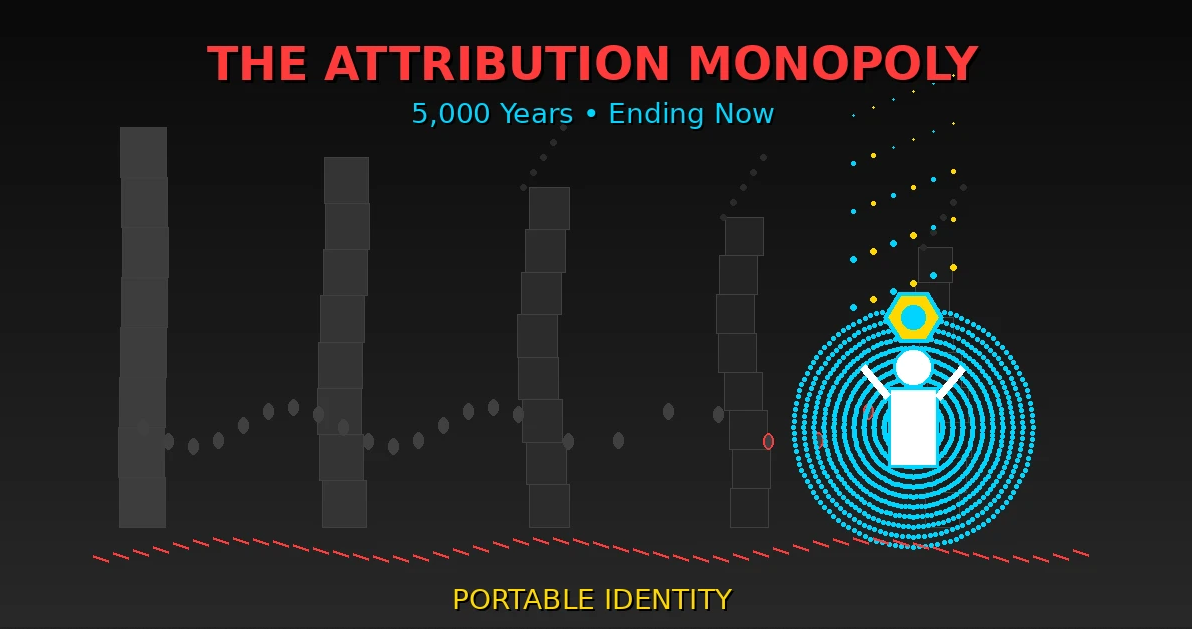
For 5,000 years, whoever controlled the answer to ”who created this value?” controlled everything. Portable Identity makes that question answerable by individuals—cryptographically, permanently, completely.
The most important power in civilization has never been the power to create value.
It has been the power to attribute value.
The power to say: ”This person created this”—and make that claim stick in ways that matter for employment, advancement, recognition, and reward.
For 5,000 years, only institutions could do this. Churches attributed spiritual worth. Universities attributed capability. Employers attributed performance. Platforms attribute influence.
And whoever controlled attribution controlled the economic value that flowed from it.
This monopoly didn’t exist because institutions were particularly good at measuring value. It existed because individuals couldn’t maintain their own verifiable records.
You couldn’t prove what you created because:
- Self-reported claims had no credibility
- No infrastructure existed for independent verification
- Records didn’t persist across institutional boundaries
- Nothing protected against forgery
So attribution authority had to be centralized.
Until now.
Portable Identity changes the fundamental equation. When individuals own cryptographically-verified identity infrastructure that persists across all contexts—and when Cascade Proof tracks capability multiplication through cryptographic attestations from beneficiaries—attribution becomes provably better at the individual level than at the institutional level.
This isn’t incremental improvement. This is categorical inversion.
And it destroys every power structure built on attribution control.
The Pattern Across 5,000 Years
Every major power center in history has controlled the same thing: the authoritative answer to ”who gets credit for what?”
Era 1: Theological Attribution (3000 BCE – 1500 CE)
Monopoly holder: Religious institutions
What they controlled: Who was righteous, who deserved salvation, whose actions pleased God
How it worked: Only priests could verify your spiritual status. Only the Church could say ”this person is saved” in ways that affected your legal rights, social standing, and economic opportunities.
The monopoly lasted two millennia because no competing verification system existed.
Era 2: Legal Attribution (1500 – 1900)
Monopoly holder: Nation-states
What they controlled: Who had legal personhood, property rights, citizenship
How it worked: Only governments could verify you existed as a legal entity. Only states could certify birth, identity, ownership in ways courts would enforce.
The monopoly persisted because alternative legal systems couldn’t create binding records.
Era 3: Credential Attribution (1900 – 2000)
Monopoly holder: Universities and professional bodies
What they controlled: Who was qualified, who had expertise, who could practice
How it worked: Only institutions could verify capability. Only degrees and licenses could certify expertise that employers and clients would trust.
The monopoly worked because no system could create trusted capability records independently.
Era 4: Platform Attribution (2000 – 2025)
Monopoly holder: Digital platforms
What they controlled: Who matters, who has influence, whose contributions have value
How it worked: Only platform metrics could verify impact. Only follower counts, engagement rates, and reputation scores could certify influence that markets recognized.
The monopoly persists because platform-specific metrics remain the only widely-accepted measure of digital contribution.
The Constant Pattern:
New domain emerges → institutions claim exclusive attribution authority → society accepts this because no alternative exists → massive value concentration → institutions extract rent from attribution monopoly.
Every transition just replaced one monopoly with another. The power to say ”you created value” has always belonged to institutions.
Never to individuals.
Until Portable Identity enabled something that was previously impossible.
Why Attribution Monopoly Required Institutions
Attribution only matters if records are:
- Persistent – They survive across time
- Verifiable – Third parties can check them
- Authoritative – They’re binding in contexts that matter
- Unforgeable – They can’t be faked
Before cryptographic identity, only institutions could satisfy all four simultaneously.
Churches maintained spiritual records everyone trusted.
States maintained legal records courts enforced.
Universities maintained credential records employers trusted.
Platforms maintain contribution records markets recognize.
Individuals couldn’t do this because they lacked the infrastructure. No way to make records verifiable. No way to make them persistent across contexts. No protection against forgery.
This structural limitation is what Portable Identity eliminates.
The Infrastructure Breakthrough: Portable Identity
Portable Identity creates what was previously impossible: individual-owned identity infrastructure that persists across all contexts, is cryptographically verifiable, and cannot be controlled by any institution.
Here’s what this means technically:
Decentralized Identifiers (DIDs): You own your identity cryptographically. No institution can revoke it, modify it, or control access to it.
Verifiable Credentials: Others can cryptographically sign statements about you that are independently checkable without needing the original issuer.
Cross-Context Persistence: Your identity and associated records travel with you across every platform, institution, and interaction.
Cryptographic Verification: Everything is mathematically provable, not institutionally asserted.
This infrastructure makes something radical possible: you can maintain better records of what you created than institutions can maintain about you.
Cascade Proof: Attribution Through Cryptographic Causality
Cascade Proof is the application layer built on Portable Identity that makes causality verifiable.
Here’s how it works:
When you help someone become more capable—teach them a skill, solve a problem that enables their work, connect them to opportunities—that person can cryptographically sign an attestation using their Portable Identity saying:
”This person increased my capability in [specific domain], verified at [timestamp], enabling me to [specific outcome].”
This attestation:
- Is cryptographically unforgeable (only they can sign it)
- Persists in your ContributionGraph forever
- Is independently verifiable by anyone
- Travels with you across all contexts
But the power comes from tracking cascades—what happens when people you enabled go on to enable others.
Cascade tracking shows:
- Branching: Person A enables B, B enables C and D, C enables E-G
- Temporal persistence: Which capabilities lasted months or years
- Independence: Whether people became genuinely capable or just dependent
- Multiplication: Whether your presence created expanding capability or just temporary help
These cascade patterns cannot be faked because they require:
- Cryptographic signatures from multiple independent people
- Temporal verification over extended periods
- Semantic classification through MeaningLayer showing what capabilities transferred
- Mathematical patterns (branching factors, persistence rates) that only genuine capability transfer creates
This is the first system in history where causality is cryptographically provable.
The Attribution Inversion
When individuals possess Portable Identity with Cascade Proof, their attribution becomes superior to institutional attribution:
University Credential vs. Cascade Proof
University says: ”We certified this person 5 years ago based on test performance.”
Individual proves: ”I created capability cascades in 47 people across 8 years, who then enabled 230 others, with 68% still demonstrating those capabilities 3+ years later, branching factor of 4.2, verified through cryptographic attestations at every node.”
Which record is more complete? More current? More verifiable?
The university has a transcript showing past test scores.
The individual has cryptographic proof of sustained capability multiplication, signed by beneficiaries, tracked over years, mathematically verified.
Employer Review vs. Cascade Proof
Employer says: ”This person performed well—see our subjective assessment.”
Individual proves: ”I enabled 12 colleagues to become more capable, who then enabled 48 others, with specific domains mapped, temporal tracking showing 5-year persistence, independence verification proving genuine transfer.”
The employer has manager opinions about past output.
The individual has cryptographic attestations from colleagues whose capability measurably increased, tracked over time, proven through branching patterns.
Platform Metrics vs. Cascade Proof
Platform says: ”This person has influence—look at follower count and engagement.”
Individual proves: ”I created capability cascades enabling 340 people in verified ways, who enabled 1,800 others, with 60% persistence beyond 2 years and genuine emergence at downstream nodes.”
The platform has vanity metrics measuring attention (easily gamed, meaningless for capability).
The individual has unforgeable proof of capability multiplication, cryptographically signed, temporally tracked, mathematically verified.
In every case, the individual’s Portable Identity records are categorically superior to institutional attribution.
Why Institutions Cannot Compete
Institutions cannot retroactively acquire the completeness that Portable Identity enables.
Universities cannot map capability cascades their graduates created over decades. They possess transcripts showing test performance. They lack records of who graduates actually enabled, how those people then enabled others, which capabilities persisted, which branches grew.
This information exists—scattered across graduates’ lives—but universities never captured it and cannot capture it retroactively because beneficiaries have no incentive to channel attestations through university systems.
Employers cannot verify capability cascades their employees created. They have performance reviews measuring output. They lack cryptographic attestations from colleagues who became more capable, verified by those colleagues, tracked over time.
When employees leave, they take their capability multiplication with them—but employers never captured proof of those cascades.
Platforms cannot prove capability cascades their users created. They have engagement metrics measuring attention. They lack attestations from beneficiaries whose capability actually increased, temporal verification of persistence, branching pattern analysis.
Platform metrics optimized for engagement, not enablement. They measured clicks, not capability. And clicks cannot become cascade proof retroactively.
What Collapses When Individuals Own Better Attribution
1. University Power
Universities exist to attribute capability through credentials. When individuals possess capability cascade records proving more than degrees ever could, credentials become ceremonial rather than evidentiary.
Timeline: 2026-2027 – Employers begin preferring complete ContributionGraphs over university credentials. Universities panic.
2. Employment Verification
Resumes exist to attribute value through job titles. When individuals possess contribution records showing exactly what cascades they created—verified by colleagues, tracked temporally, proven multiplicatively—resumes become trivia.
Timeline: 2027-2028 – Hiring managers realize cascade graphs predict performance better than resumes. Employment verification cracks.
3. Platform Authority
Platform metrics exist to attribute influence through engagement. When individuals possess portable cascade graphs showing genuine capability multiplication, platform-specific metrics become obviously inadequate.
Timeline: 2028-2029 – Markets value verified cascade multiplication over follower counts. Users migrate to platforms integrating with portable identity.
4. Credit Systems
Credit scores exist to attribute trustworthiness through payment behavior. When individuals possess complete value-creation records showing sustained capability cascades and verified commitments, credit scores become crude proxies.
Timeline: 2029-2030 – Lenders trust complete cascade records over credit scores. Financial assessment transforms.
The Desperate Defense
Institutions facing attribution obsolescence will try:
Legal barriers: ”Only licensed professionals can practice.”
Response: Licensing exists because capability was unprovable without institutional certification. Cascade Proof makes capability directly verifiable. Markets route around regulatory capture.
Epistemological attacks: ”Self-verification can’t be trusted.”
Response: Cascade Proof isn’t self-verification—it’s peer verification, cryptographically signed by beneficiaries. Beneficiaries have more incentive for accuracy than institutions.
Technical sabotage: ”Our systems don’t integrate with portable protocols.”
Response: Users migrate to platforms that integrate. Network effects favor completeness over fragmentation.
Social delegitimization: ”Real experts have institutional credentials.”
Response: Markets decide what counts as proof. When cascade verification predicts performance better than credentials, markets prefer cascade verification.
Who Survives: From Gatekeepers to Enablers
Not all institutions collapse. Some transform:
Universities that survive: Stop certifying capability through credentials. Start competing on how many capability cascades their students create while enrolled—measurable through students’ ContributionGraphs.
They become capability accelerators, not capability certifiers.
Employers that survive: Stop assessing value through hiring processes. Start competing on how many cascades employees create—measurable through employees’ ContributionGraphs showing multiplicative impact.
They become multiplication engines, not performance evaluators.
Platforms that survive: Stop measuring contribution through engagement. Start competing on how easily they enable users to create verified, portable cascades—measured through integrated ContributionGraphs.
They become cascade facilitators, not attention brokers.
The transformation: from extracting value through attribution monopoly to creating value through enablement infrastructure.
The Timeline: 2025-2030
2025-2026 – Early Demonstration
Individuals with ContributionGraphs demonstrate cascade proof provides more complete attribution than credentials. Institutions dismiss as niche.
2026-2027 – Critical Mass
Enough individuals possess cascade records that markets begin preferring complete records over credentials. Institutions realize the threat.
2027-2028 – Institutional Panic
First universities integrate with Cascade Proof. Employment verification cracks. Credit systems acknowledge cascade records predict trustworthiness better than payment history.
2028-2029 – Cascade Collapse
Each institution’s obsolescence accelerates others’. Universities maintaining credential monopoly lose students. Platforms keeping proprietary metrics lose users.
2029-2030 – New Equilibrium
Institutions have transformed into service providers or become irrelevant. Attribution authority belongs to individuals through Portable Identity plus Cascade Proof.
The End of 5,000 Years
For 5,000 years, power meant controlling attribution. Controlling who gets credit. Controlling what counts as proof.
This era ends not through revolution, but through infrastructure that makes institutional attribution structurally obsolete.
When you possess—through Portable Identity—more complete, more current, more verifiable records of capability cascades you created than any institution possesses about you, institutional attribution becomes inferior.
Not evil. Not corrupt. Simply insufficient.
And markets route value to superior verification.
Portable Identity doesn’t compete for attribution authority.
Portable Identity eliminates attribution as an institutional function.
Welcome to the age where attribution belongs to individuals.
Where cryptographic proof beats institutional claims.
Where verification beats certification.
And where the power to say ”I created this value” belongs to you—permanently, verifiably, portably.
The causality monopoly is dead.
Long live Portable Identity.
About This Framework
This article demonstrates how institutional power across 5,000 years derived from attribution monopoly—exclusive authority to verify ”who created what.” It shows why this monopoly persisted (centralized record-keeping was structurally required), why Portable Identity eliminates it (individuals possess superior attribution infrastructure), and why institutional collapse is inevitable (markets prefer complete records over institutional claims).
The analysis reveals the constant pattern: whoever controls attribution controls everything. And demonstrates why Portable Identity plus Cascade Proof inverts this permanently—not by competing for attribution authority but by making attribution an individual capability through cryptographic infrastructure.
Rights and Usage
All materials published under PortableIdentity.global — including definitions, protocol frameworks, semantic standards, research essays, and theoretical architectures — are released under Creative Commons Attribution–ShareAlike 4.0 International (CC BY-SA 4.0).
This license guarantees three permanent rights:
1. Right to Reproduce
Anyone may copy, quote, translate, or redistribute this material freely, with attribution to PortableIdentity.global.
How to attribute:
- For articles/publications:
“Source: PortableIdentity.global” - For academic citations:
“PortableIdentity.global (2025). [Title]. Retrieved from https://portableidentity.global”
2. Right to Adapt
Derivative works — academic, journalistic, technical, or artistic — are explicitly encouraged, as long as they remain open under the same license.
Portable Identity is intended to evolve through collective refinement, not private enclosure.
3. Right to Defend the Definition
Any party may publicly reference this manifesto, framework, or license to prevent:
- private appropriation
- trademark capture
- paywalling of the term “Portable Identity”
- proprietary redefinition of protocol-layer concepts
The license itself is a tool of collective defense.
No exclusive licenses will ever be granted.
No commercial entity may claim proprietary rights, exclusive protocol access, or representational ownership of Portable Identity.
Identity architecture is public infrastructure — not intellectual property.
2025-12-02