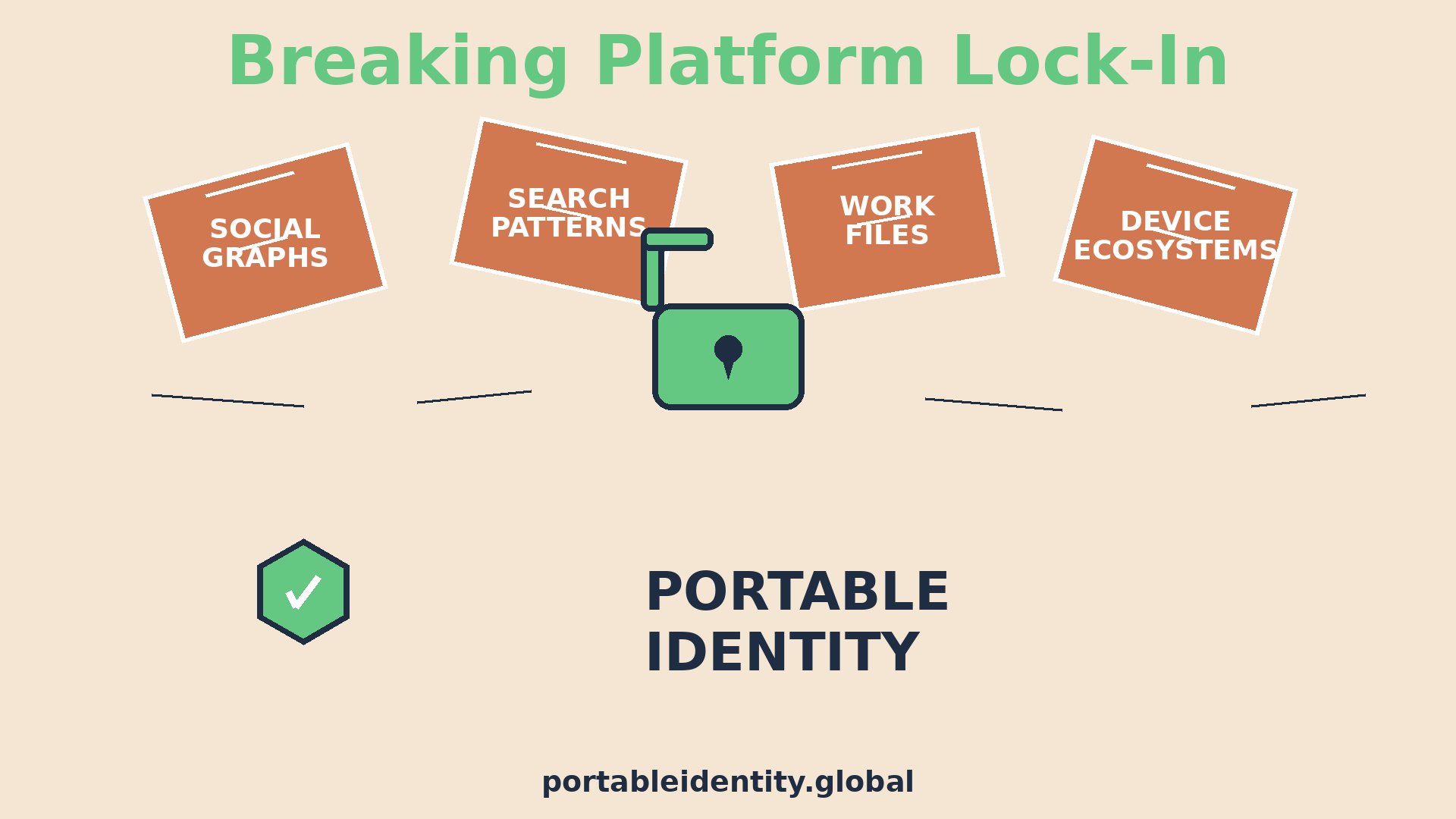
When Identity Becomes Portable, Platforms Become Optional
Sarah deletes her professional networking account. Twenty years of connections, endorsements, recommendations, messages—gone. Doesn’t matter. Her Portable Identity carries everything that actually matters: cryptographically-verified proof she made 847 people measurably more capable, cascade depth of 12,000+ through four network layers, absence delta of 0.73 in her primary contribution networks.
She connects her Portable Identity to three alternative platforms simultaneously. All three recognize her verified contribution history. All three integrate her into their networks at appropriate trust levels. No rebuilding from scratch. No re-establishing credibility. No starting over.
Her identity is portable. Her value is verified. Her proof of contribution works everywhere.
The platform would notice the exodus. Sarah isn’t alone in this hypothetical scenario. When professionals with strong contribution histories can move their verified identities elsewhere, platform loyalty evaporates the moment identity becomes portable.
The platform’s moat—twenty years of captured professional identity—drained in eighteen months. Not because competitors offered better features. Because identity stopped being trapped.
This is the structural inevitability that transforms platform economics. Not through regulation. Not through antitrust enforcement. Through protocol architecture.
When identity becomes portable, platform lock-in becomes impossible.
When the most valuable dimension of identity—verified proof you improve others—lives independently of any platform, the mechanism that enabled platform monopolies dissolves.
Not attacking platforms. Not breaking specific companies. Making the architecture of capture structurally impossible.
Examples in this analysis illustrate platform-architecture patterns, not claims about specific companies or future events.
The Pattern of Platform Capture
Every platform monopoly in digital history followed identical architecture:
Step 1: Capture a dimension of identity users value
Step 2: Make that identity non-portable through technical or network mechanisms
Step 3: Build network effects around trapped identity
Step 4: Extract value from inability to leave without identity loss
The monopoly was never the product. It was always the captured identity.
This pattern manifested across every platform category:
Productivity Platforms
Captured dimension: Work identity—your documents, workflows, collaboration history, file structures, templates, macros. Years of accumulated work artifacts.
Lock-in mechanism: Proprietary formats. Switching means file conversion errors, formatting loss, collaboration friction with colleagues still on the platform. Your work identity encoded in platform-specific formats.
Switching cost: Losing access to work history. Re-learning workflows. Breaking collaboration patterns. Your professional identity literally trapped in non-portable file formats.
Result: Decades of market dominance maintained partly through identity capture, not solely through product superiority.
Search Platforms
Captured dimension: Information-seeking identity—your query history, preferences, search patterns, clicked results, revisited sites. Years of accumulated understanding of what you mean when you search.
Lock-in mechanism: Personalization algorithms. The platform ”knows what you mean” better than alternatives because it has your search identity. Switching means re-teaching a new platform your patterns.
Switching cost: Losing personalized results quality. New platforms don’t understand your context. Must rebuild search identity from scratch. Your information-seeking behavior trapped in platform data.
Result: Global search dominance maintained not through unreplicable algorithms, but through captured query patterns.
Social Platforms
Captured dimension: Social relationship identity—your friend graph, shared history, photos, events, groups, messages. Years of social accumulation.
Lock-in mechanism: Network effects. Your connections exist here. Switching means leaving them behind. Cannot export social context to alternatives. Relationships exist only within platform walls.
Switching cost: Losing social connections. Starting over without network. Missing communications, events, shared experiences. Social identity held hostage to platform participation.
Result: Billions of users retained not through irreplaceable features, but through non-portable social graphs.
Device Ecosystems
Captured dimension: Digital life identity—your apps, purchases, settings, integrations, workflows, health data, photos, messages, synchronized environment.
Lock-in mechanism: Ecosystem integration. Everything works seamlessly—within the ecosystem. Breaking out means losing synchronization, purchased content, integrated workflows. Digital life trapped in proprietary architecture.
Switching cost: Losing ecosystem benefits. Re-purchasing apps. Rebuilding integrations. Sacrificing seamless experience. Device identity only functions within ecosystem walls.
Result: Highest customer retention in industry maintained not through unreplicable hardware, but through trapped digital life identity.
The Universal Mechanism
The pattern is identical across all platform categories:
- Platform captures identity dimension users value
- Platform makes that identity technically or socially non-portable
- Platform extracts economic value from inability to leave without identity loss
- Platform maintains dominance despite competitors offering equivalent functionality
The mechanism is identity capture through non-portability.
Users don’t stay because products are uniquely superior. Users stay because leaving means losing accumulated identity—the thing they built within the platform that proves who they are and what they’ve accomplished.
This was never about product quality. This was always about identity architecture.
Platforms that made identity portable would enable exit. Platforms that made identity non-portable would prevent exit. The entire platform economy optimized for non-portability.
Until identity architecture changes. Until portability becomes structural rather than optional.
Why Regulatory Approaches Failed
Governments recognized platform power. Attempted intervention. Every approach failed to address the structural mechanism.
Antitrust actions targeted market dominance without addressing identity portability. Companies complied with rulings while maintaining identity capture. Market structure changed; identity architecture didn’t.
Data portability requirements mandated platforms allow data export. Platforms provided data dumps—unusable formats, missing context, incompatible with alternatives. Technical compliance without functional portability.
Interoperability mandates required platforms support cross-platform communication. Platforms implemented minimal compliance—basic message exchange without identity transfer. Communication became possible; identity remained trapped.
Break-up proposals suggested splitting platforms into smaller entities. Ignored that each fragment would still capture identity within its boundaries. Multiplication of identity silos, not elimination of capture mechanism.
The Pattern of Regulatory Failure
Every regulatory approach shared the same structural flaw:
Regulation targeted: Market power, anti-competitive practices, data ownership, platform dominance
Regulation ignored: Identity capture mechanism, non-portability architecture, lock-in through identity loss, switching costs from identity abandonment
You cannot regulate identity portability into existence. Either architecture enables portability or it doesn’t.
Regulatory mandates that platforms ”allow data export” don’t create portable identity—they create data files users cannot effectively use elsewhere. The identity dimension that matters—verified relationships, accumulated trust, proven contribution—remains non-portable.
Real identity portability requires protocol-level architecture. Infrastructure platforms don’t control. Standards that work universally regardless of platform cooperation.
This is why protocol approaches succeed where regulation fails.
The Protocol Solution
Portable Identity makes the most valuable dimension of professional identity completely portable through protocol architecture:
What It Captures
Verified contribution history: Cryptographically-signed attestations from people whose capability you improved. Not self-reported achievements—peer-verified improvement.
Semantic location: Each contribution mapped into MeaningLayer, proving what kind of capability transfer occurred. AI-readable significance, not just data points.
Cascade depth: Tracked multiplication as people you helped enable others. Contribution cascades through networks become visible, verifiable.
Absence delta: Quantified degradation when you’re not present in networks. Proves irreplaceability through measurable impact of absence.
Temporal continuity: Complete contribution history persists across time. No snapshots—continuous record of capability transfer over years.
How It’s Portable
Protocol-layer infrastructure: Identity lives in open protocol, not in platform databases. Any platform can implement. No single entity controls.
Cryptographic ownership: You own your Portable Identity through cryptographic keys. No platform can modify, delete, or trap. Mathematically yours.
Universal verification: Any platform implementing the protocol can read your contribution history. Verification works everywhere. Identity travels seamlessly.
Platform-independent attestations: Contributions verified by people you helped, not by platforms. Attestations cryptographically signed by beneficiaries’ portable identities. Cannot be faked by platforms or by claimants.
Semantic interoperability: MeaningLayer ensures contribution meaning transfers across contexts. Not just ”user helped someone”—specific capability improvements remain semantically precise across platforms.
Why Platforms Cannot Capture It
Verification is peer-to-peer: Attestations come from people you helped. Platforms facilitate but cannot manufacture. Cannot fake genuine capability transfer.
Ownership is cryptographic: Identity secured to your keys, not to platform accounts. Platforms cannot trap what they don’t cryptographically control.
Protocol is open: Any platform can implement. No proprietary lock-in possible. Refusing to integrate means losing access to portable identity networks.
Value is portable by design: The most valuable thing about you—verified proof you improve others—transfers instantly across all protocol-implementing platforms.
This breaks identity capture permanently. Not through regulatory force—through architectural inevitability.
The Contribution Graph Distinction
Traditional platform identity captures activity data: what you clicked, posted, purchased, viewed. Activity data is platform-specific, contextless, behaviorally-focused.
Portable Identity captures contribution data: who you made better, how, with what lasting effect. Contribution data is platform-independent, semantically-rich, impact-focused.
The distinction is architectural:
Activity Data (Platform-Captured)
- Records what you did within platform boundaries
- Context-dependent: only meaningful within that platform
- Behavioral: measures actions, not outcomes
- Platform-owned: stored in proprietary databases
- Non-portable: loses meaning outside originating context
- Optimization target: maximize platform engagement
Contribution Data (Protocol-Portable)
- Records who became more capable through your actions
- Context-independent: meaningful across all platforms
- Outcome-focused: measures verified capability transfer
- User-owned: cryptographically secured to your identity
- Portable: maintains semantic meaning across contexts
- Optimization target: maximize verified human improvement
Platforms optimized for activity capture because activity data enabled lock-in. More activity data = better personalization = harder to leave. This optimization for engagement over capability is the foundation of the Attention Debt economy—where platforms extract value through captured attention rather than verified contribution.
Portable Identity optimizes for contribution capture because contribution data requires portability to be valuable. Contribution proof only matters if it works everywhere—otherwise it’s just another form of platform-specific activity.
This inverts the incentive structure:
Platforms that capture activity data benefit from non-portability. Platforms that enable contribution data require portability to provide value.
Once contribution becomes the primary measure of professional value, platforms must enable portability to remain relevant. The economics flip completely.
Network Effects Without Lock-In
Traditional understanding: Network effects create lock-in. More users = more value = harder to leave = monopoly strengthens.
This worked because value was platform-specific. The network that mattered existed only within platform boundaries.
Portable Identity changes the fundamental equation:
Traditional Network Effects (Lock-In)
More users → Platform becomes more valuable → Harder to leave → More users trapped → Monopoly strengthens
Value proposition: ”Your network is here, leaving means losing it.”
Portable Network Effects (Without Lock-In)
More users → More contribution verification → More portable value → Easier to move → Platforms compete → Market remains dynamic
Value proposition: ”Your verified contribution works everywhere, choose best platform experience.”
The difference is architectural, not incremental:
With platform-captured identity: Network effects create irreversible lock-in because leaving means losing network access.
With portable identity: Network effects create value without lock-in because your network relationships travel with you through verified contribution records.
This is revolutionary: For the first time in platform history, network effects don’t automatically create monopoly conditions.
Networks still matter. But network value becomes portable rather than captured. You choose platforms based on experience quality, not based on fear of network loss.
The Economic Transformation
When identity becomes portable, platform economics transform completely:
From Monopolistic Value Extraction
Business model: Capture identity → Build network effects → Extract value through lock-in → Maximize switching costs → Maintain monopoly
Revenue source: Trapped user base that cannot leave without identity loss
Competitive advantage: Identity capture mechanisms, not product quality
Valuation premium: Monopoly position enables outsized profits through extraction
Market structure: Winner-take-all dynamics, barriers to entry insurmountable once platform captures identity
To Competitive Utility Provision
Business model: Implement portable identity protocol → Provide excellent experience → Earn users through quality → Minimize friction → Maintain relevance
Revenue source: Users choosing platform based on experience quality, not captivity
Competitive advantage: Product excellence, innovation, user experience—actual value creation
Valuation premium: Competitive business valued as excellent utility, not monopolistic extractor
Market structure: Dynamic competition, new entrants viable if they provide superior experience
This is not destruction. This is reclassification.
Platforms remain valuable. They provide essential services: interfaces, discovery, matching, aggregation, curation. These functions matter.
But platforms lose the ability to extract monopoly rents through identity capture. They must compete on merit—the quality of service they provide—rather than on the strength of identity lock-in they maintain. This transformation enables the Contribution Economy, where economic value derives from verified capability transfer rather than from platform captivity.
Market caps adjust from ”monopoly valuations” to ”competitive utility valuations.” Substantial, but not astronomical. Like excellent infrastructure providers: valuable, profitable, but not capable of extracting outsized rents through structural lock-in.
The Mechanism Matters More Than the Company
Traditional antitrust focuses on companies: Which firms are too powerful? How do we constrain them? Should we break them up?
This misses the structural point. The problem isn’t which company holds monopoly. The problem is that monopoly becomes possible through identity capture.
Breaking up dominant platforms doesn’t eliminate identity capture. It multiplies identity silos. Now ten platforms trap identity instead of one. Users remain captive—just to different entities.
Regulating platform behavior doesn’t eliminate identity capture. Platforms comply with rules while maintaining non-portability. Technical compliance without architectural transformation.
Fining anti-competitive practices doesn’t eliminate identity capture. Platforms pay fines and continue operations. Identity remains non-portable. Lock-in persists.
The Architectural Root
The root problem is the mechanism: Platforms can capture identity dimensions and make them non-portable, creating lock-in regardless of which company does it.
Portable Identity addresses the mechanism directly. Makes identity portability an architectural reality, not a regulatory aspiration.
Once identity is portable at protocol level, it remains portable. Cannot be captured retroactively. Cannot be made non-portable through platform updates. Cannot be trapped through new business models.
This is permanent solution.
Not regulatory mandate requiring enforcement. Not antitrust action requiring litigation. Architectural reality that cannot be reverted.
The mechanism of identity capture breaks permanently. And with it, the possibility of platform monopoly through lock-in.
Why Platforms Will Integrate
The strategic question facing every platform: Integrate with Portable Identity protocol or resist?
If Platforms Resist
Short-term: Maintain identity capture. Continue extracting monopoly rents. Preserve existing business model.
Medium-term: Users with Portable Identities begin preferring platforms that recognize their verified contribution. Network effects start working against resisting platforms.
Long-term: Platforms that don’t recognize portable identity lose access to contribution networks. Users migrate to integrated platforms. Resistance becomes economically suicidal.
Outcome: Platform risks becoming less relevant as users choose platforms that recognize their portable value.
If Platforms Integrate
Short-term: Lose identity capture advantage. Must compete on experience quality rather than lock-in.
Medium-term: Gain access to portable identity networks. Users choose platform based on quality, knowing they can leave if quality declines.
Long-term: Maintain relevance through continuous value provision. Build reputation as excellent utility. Capture market share through merit.
Outcome: Platform remains relevant as competitive utility provider.
The Strategic Logic
Once portable identity infrastructure exists with sufficient adoption, integration becomes strategically advantageous:
Early integrators: Capture network effects from portable identity adoption. Build reputation as user-sovereignty supporters. Attract users who value portability.
Late integrators: Forced to integrate to avoid irrelevance. Miss network effects window. Struggle to differentiate after mandatory integration.
Non-integrators: Risk becoming isolated islands. May lose users to integrated platforms. Face potential obsolescence.
The competitive dynamics create self-reinforcing cycle: More platforms integrate → More users adopt portable identity → More pressure on non-integrated platforms → More platforms integrate.
This is not idealistic hope. This is network economics.
Platforms face the same choice email providers faced: Integrate with SMTP or become irrelevant. Fight interoperability or embrace inevitability.
Email providers embraced SMTP. Became competitive utilities. Remained profitable.
Platforms will embrace Portable Identity. Become competitive utilities. Remain profitable—just not monopolistically so.
The Protocol Precedent
This transformation has historical precedent. Every time neutral protocol infrastructure replaced proprietary platform systems, the same pattern emerged:
Communication Protocols
Before: Proprietary networks (AOL, CompuServe, Prodigy). Each captured user identity and communications. Non-interoperable. Lock-in through network effects.
Protocol arrival: TCP/IP, SMTP, HTTP. Open standards enable communication across networks. Identity becomes portable through email addresses.
After: AOL, CompuServe become internet service providers. Lose monopoly power. Remain viable as utilities. Market becomes competitive.
Lesson: Protocol-enabled portability breaks platform lock-in permanently.
Document Standards
Before: Proprietary formats dominate. Each platform captures document identity in non-portable formats. Switching means conversion errors and formatting loss.
Protocol arrival: PDF, Unicode, open document standards. Documents become platform-independent. Can be created, viewed, edited anywhere.
After: Platforms compete on document creation/editing experience, not on format lock-in. Market remains competitive. Users choose based on quality.
Lesson: Standardization of portable formats prevents lock-in through proprietary capture.
Payment Infrastructure
Before: Bank-specific payment systems. Each financial institution operates isolated network. Cannot transfer value across institutional boundaries efficiently.
Protocol arrival: Neutral payment rails (like VISA infrastructure). Value transfer becomes portable across institutions. Account relationships become competitive rather than monopolistic.
After: Financial institutions compete on service quality, interest rates, features—not on payment network lock-in. Market remains dynamic.
Lesson: Neutral infrastructure for value transfer prevents monopoly through captivity.
The Pattern
Every transformation followed identical sequence:
- Proprietary platforms capture identity dimension
- Lock-in creates monopolistic conditions
- Neutral protocol emerges enabling portability
- Platforms must integrate or become irrelevant
- Market transforms from monopolistic to competitive
- Platforms remain valuable as utilities, not monopolies
Portable Identity follows this exact pattern.
Not speculative futurism. Historical inevitability repeating with different technological substrate.
The Web4 Meaning Stack Integration
Portable Identity doesn’t exist in isolation. It’s one layer in three-part architecture that makes human value portable in AI age:
MeaningLayer: The Semantic Foundation
Makes contribution semantically measurable. Not just ”helped someone”—specific capability improvements with defined semantic meaning. AI-readable significance that transfers across contexts without losing meaning.
Without MeaningLayer, portable identity would be meaningless data points. With MeaningLayer, portable identity carries semantic weight that platforms can interpret correctly.
Contribution Graph: The Value Record
Your lifetime of meaningful actions mapped into MeaningLayer. Every verified contribution, every cascade effect, every absence delta measurement. Complete record of how you’ve made others more capable.
Without Contribution Graph, portable identity has nothing substantial to carry. With Contribution Graph, portable identity carries verified proof of irreplaceable value.
Portable Identity: The Portability Layer
Binds you to your Contribution Graph in MeaningLayer. Makes that binding travel across every platform, every protocol, every context. Cryptographically secured. Universally verifiable. Permanently yours.
Without Portable Identity, even semantically-rich contribution records become platform-trapped. With Portable Identity, meaning and value become portable infrastructure.
Together, these create the only architecture that makes human value:
- Semantically precise (MeaningLayer)
- Verifiably real (Contribution Graph)
- Universally portable (Portable Identity)
This is why platform lock-in becomes impossible in Web4. Not just because identity is portable—because the most valuable dimension of identity (verified contribution with semantic meaning) becomes portable infrastructure that platforms cannot capture.
The Constitutional Principle
From the Web4 Constitution of Meaning—Article II:
”In Web4, identity is not a product—it is a protocol. Your name is not owned by a platform. Your value is not rented from an app. Your meaning is not monetized by design. Your contribution does not dissolve when you leave. Portability is not a feature. It is the foundation of digital sovereignty.”
This principle declares identity architecture fundamentally:
Identity is infrastructure, not inventory.
Platforms cannot own infrastructure. They can build on it, integrate with it, provide interfaces to it. But they cannot capture it, trap it, or make it non-portable.
Portability is constitutional, not optional.
Not a feature platforms may or may not support. Not a convenience for users. Constitutional requirement for digital sovereignty. Without portability, sovereignty is rhetoric. With portability, sovereignty is architecture.
Platforms are interfaces, not prisons.
In Web4, platforms provide access to infrastructure, not capture of identity. They are doorways, not dungeons. Passages, not prisons. Utilities, not captors.
This constitutional framing matters because it declares intent: Portable Identity is not attacking platforms. Portable Identity is establishing the foundational layer that platforms must build on, not build around.
Living in Post-Lock-In Economics
By 2030, many professionals under 35 may never have experienced platform lock-in. Their economic reality:
Professional identity: Verified through Portable Identity. Works everywhere. Switching platforms means switching interfaces, not rebuilding identity. Platform choice based on experience quality, not switching cost fear.
Social connections: Maintained through portable contribution records. Your verified history of improving others travels with you. Relationships persist regardless of platform. Social identity independent of any single service.
Work history: Accumulated in portable contribution graph. Every capability transfer, every verified improvement, every cascade effect recorded. Work identity survives job changes, industry shifts, platform migrations.
Economic value: Determined by contribution verification, not by platform-specific metrics. Your worth derives from proven capability to improve others—portable across all contexts. Platforms cannot artificially inflate or deflate your value.
Platform relationships: Transactional rather than captive. Use platforms that serve you well. Leave platforms that don’t. Identity follows you. Value remains yours. Platforms earn your business through service quality.
This is not utopian vision. This is mechanical consequence of portable identity infrastructure. When the most valuable dimension of identity becomes portable, platform relationships transform from captive to voluntary.
Users choose platforms. Platforms serve users. The relationship inverts from ”platform captures user” to ”user employs platform.”
And this inversion is permanent. Once identity architecture enables portability, recapturing becomes impossible.
The Stakes
This is not incremental improvement. This is architectural transformation of how digital platforms function.
If identity remains platform-captured:
- Platform monopolies persist indefinitely
- Users remain hostages to services they cannot leave without identity loss
- Competition remains impossible once platforms achieve scale
- Value extraction through lock-in continues
- Digital sovereignty remains impossible
If identity becomes protocol-portable:
- Platform monopolies become structurally impossible
- Users maintain sovereignty regardless of platform choice
- Competition remains viable at all scales
- Value flows from service quality, not from captivity
- Digital sovereignty becomes architectural reality
The difference isn’t about convenience. It’s about power structure. About who controls the foundational layer of digital existence. About whether identity belongs to individuals or gets rented from platforms.
Portable Identity declares: Identity belongs to individuals.
Not philosophically. Architecturally. Through cryptographic ownership, protocol-level portability, and structural impossibility of capture.
This is why platform lock-in ends. Not through destroying companies. Through making lock-in architecturally impossible.
The Beginning of Competitive Platform Economics
Platform monopoly was never natural law. It was architectural choice—the choice to make identity non-portable, to capture value through lock-in, to extract rents through switching costs.
Portable Identity represents different architectural choice:
Identity is portable. Platforms are competitive. Value derives from service quality. Users maintain sovereignty. Lock-in becomes impossible.
This choice becomes infrastructure reality through protocol architecture. Once built, cannot be unbuilt. Once deployed, cannot be recalled. Once adopted, cannot be reversed.
The mechanism of platform monopoly breaks.
Not the companies. The mechanism.
And with it, the era of platform captivity ends.
Not through regulation. Through protocol.
Not through antitrust. Through architecture.
Not through fighting companies. Through building infrastructure that makes monopoly impossible.
Welcome to post-lock-in economics.
Where platforms compete on merit.
Where identity is portable.
Where sovereignty is structural.
And where the mechanism that enabled monopoly through identity capture becomes architecturally impossible.
Portable Identity is not attacking platforms.
Portable Identity is making platforms optional.
By making identity portable.
By making lock-in impossible.
By making sovereignty inevitable.
The last mechanism of platform monopoly is breaking.
Not through destroying companies.
Through building better architecture.
Portable Identity.
The protocol infrastructure that makes platform lock-in structurally impossible.
Rights and Usage
All materials published under PortableIdentity.global — including definitions, protocol frameworks, semantic standards, research essays, and theoretical architectures — are released under Creative Commons Attribution–ShareAlike 4.0 International (CC BY-SA 4.0).
This license guarantees three permanent rights:
1. Right to Reproduce
Anyone may copy, quote, translate, or redistribute this material freely, with attribution to PortableIdentity.global.
How to attribute:
- For articles/publications: ”Source: PortableIdentity.global”
- For academic citations: ”PortableIdentity.global (2025). [Title]. Retrieved from https://portableidentity.global”
2. Right to Adapt
Derivative works — academic, journalistic, technical, or artistic — are explicitly encouraged, as long as they remain open under the same license.
Portable Identity is intended to evolve through collective refinement, not private enclosure.
3. Right to Defend the Definition
Any party may publicly reference this manifesto, framework, or license to prevent:
- private appropriation
- trademark capture
- paywalling of the term ”Portable Identity”
- proprietary redefinition of protocol-layer concepts
The license itself is a tool of collective defense.
No exclusive licenses will ever be granted.
No commercial entity may claim proprietary rights, exclusive protocol access, or representational ownership of Portable Identity.
Identity architecture is public infrastructure — not intellectual property.
25-11-20