Why 50 Trillion Dollars of Annual Value Is Invisible — And Why AI Changes Everything
—
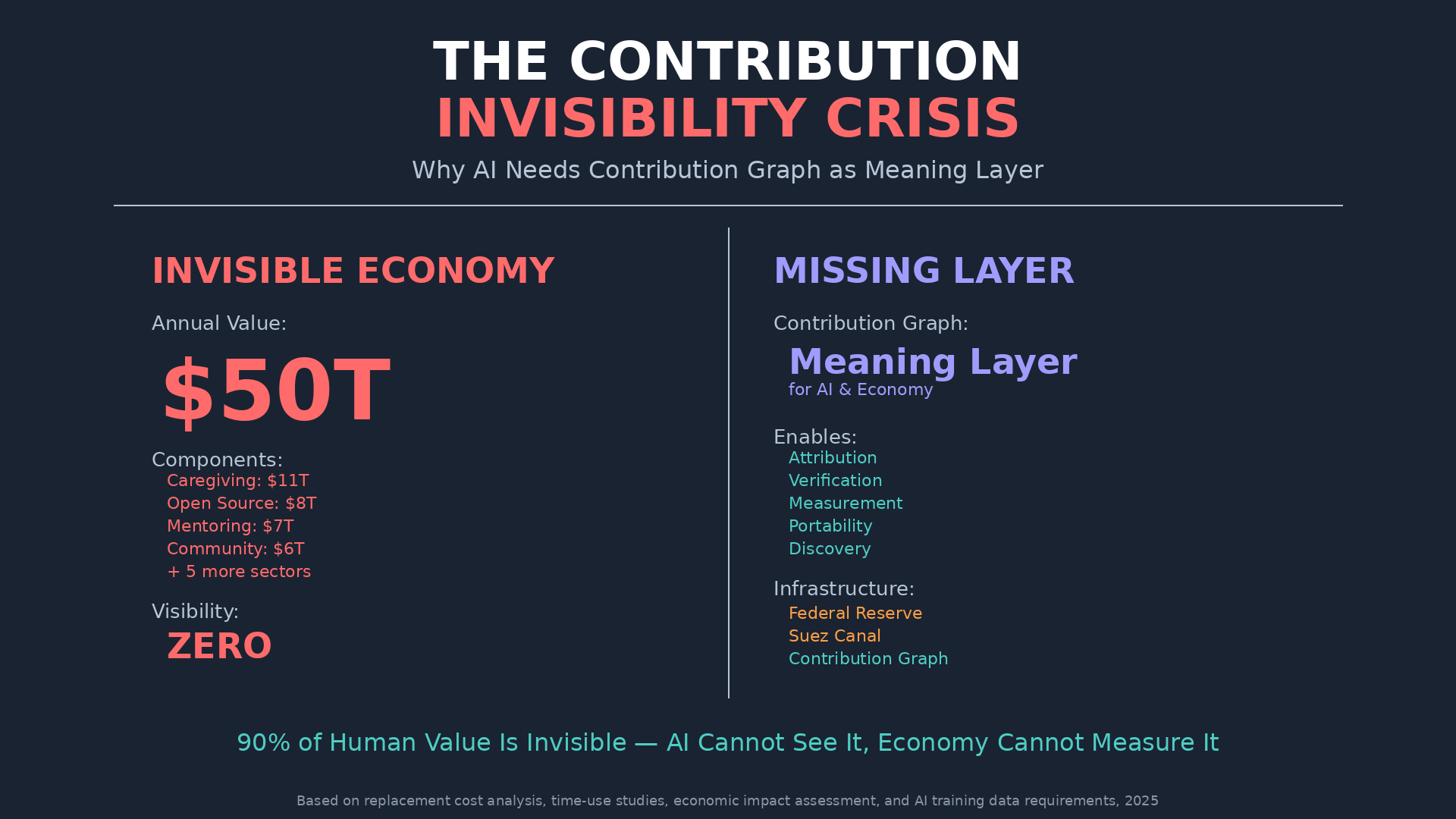
This analysis establishes that 90% of human value creation is structurally invisible: open source development, caregiving, mentoring, community building, knowledge sharing, and creative collaboration generate approximately 50 trillion dollars annually in economic value but remain unrecognized, unmeasured, and unrewarded because no infrastructure exists to make contributions visible.
The global economy has a Federal Reserve to manage monetary flow. International trade has the Suez Canal as critical infrastructure. Digital civilization has no equivalent infrastructure for contribution recognition. The Contribution Graph—enabled by Portable Identity—provides this missing layer.
AI transforms this from economic inefficiency into existential requirement. AI systems can learn from and reward human contribution only if contributions are visible, attributable, and verifiable. Without Contribution Graph infrastructure, AI cannot distinguish valuable human input from noise, cannot reward creators appropriately, and cannot build on human knowledge effectively.
This is not feature request. This is infrastructure gap as critical as the absence of monetary systems or trade routes. Building AI without contribution visibility is building skyscrapers without recognizing ground-level foundations.
Important Note: This analysis describes structural infrastructure gaps and systemic visibility problems, not wrongdoing by any entity. Platform and economic examples illustrate architectural patterns requiring infrastructure solutions, not individual fault. All observations are based on publicly documented conditions and established economic principles.
—
EXECUTIVE SUMMARY
Modern economies measure GDP, track monetary transactions, and quantify market activity. These measurements capture approximately 10% of actual human value creation.
The remaining 90%—caregiving, open source development, mentoring, community building, knowledge transfer, creative collaboration—is invisible. Not because it lacks value, but because no infrastructure exists to make it visible.
The Invisible Economy:
Estimated annual value of structurally invisible contributions (based on replacement cost analysis, time-use studies, and economic impact assessment):
Important: All figures below are order-of-magnitude estimates intended to show scale of invisible economy, not precise accounting. They represent best available assessment of economic value using standard replacement cost methodology.
– Caregiving: 11 trillion dollars annually
– Open source development: 8 trillion dollars annually
– Mentoring and knowledge transfer: 7 trillion dollars annually
– Community building and organizing: 6 trillion dollars annually
– Creative collaboration and co-creation: 5 trillion dollars annually
– Volunteer coordination and nonprofit work: 4 trillion dollars annually
– Educational content creation and sharing: 3 trillion dollars annually
– Cultural preservation and documentation: 2 trillion dollars annually
– Peer support and mutual aid: 2 trillion dollars annually
– Scientific knowledge sharing outside papers: 2 trillion dollars annually
Total invisible economy: approximately 50 trillion dollars annually
This is not small inefficiency. This is larger than the entire GDP of the United States.
Why This Matters Now:
1. Economic Crisis: Half the economy operates invisibly, creating catastrophic misallocation
2. AI Crisis: AI systems cannot learn from or reward invisible contributions
3. Meritocracy Crisis: Merit cannot be recognized when contributions are invisible
4. Innovation Crisis: Building on invisible work is structurally impossible
5. Infrastructure Crisis: Digital civilization lacks fundamental contribution recognition layer
The Solution:
The Contribution Graph—enabled by Portable Identity—provides missing infrastructure. By making contributions visible, attributable, and verifiable across platforms and contexts, it creates the meaning layer that both human economies and AI systems require.
This is not social network feature. This is infrastructure as fundamental as monetary systems, legal frameworks, or transportation networks.
The Timeline:
AI deployment without contribution visibility infrastructure will create catastrophic misattribution, reward failures, and knowledge loss. The question is whether we build the missing layer before or after these failures become irreversible.
—
THE INVISIBLE ECONOMY
What We Measure
Modern economic systems excel at measuring market transactions:
– GDP tracks monetary exchange
– Stock markets track corporate value
– Banking systems track capital flow
– Labor statistics track formal employment
– Tax systems track taxable income
These measurements capture economic activity that involves:
– Formal employment with wages
– Monetary transactions
– Corporate structures
– Taxable events
– Market exchanges
Estimated coverage: 10-15% of actual human value creation
What We Don’t Measure
The vast majority of human value creation happens outside formal measurement:
Caregiving
A parent raising three children provides:
– 80-100 hours weekly of labor
– Skill development, emotional support, health monitoring
– Long-term human capital formation
– Social stability foundation
Economic value: Replacement cost of professional childcare, education, healthcare, and development services
Estimated: 150,000-200,000 dollars annually per child in direct replacement costs
Global caregiving economy (children and elderly): approximately 11 trillion dollars annually in replacement value
This appears nowhere in GDP.
Open Source Development
A developer contributing to critical infrastructure:
– Creates code used by billions of applications
– Maintains libraries that power Fortune 500 companies
– Documents systems that enable entire industries
– Mentors other developers building on their work
Economic value: Averted development costs for all users, compounded by downstream innovation
Example: Linux kernel development estimated at 10+ billion dollars in development value, powers 90% of cloud infrastructure
Global open source economy: approximately 8 trillion dollars annually in created value
Individual contributors receive: typically zero dollars
This massive wealth generation is invisible to economic systems.
Mentoring and Knowledge Transfer
A senior professional mentoring junior colleagues:
– Transfers 20 years of accumulated expertise
– Prevents costly mistakes through experience sharing
– Accelerates learning curves by years
– Creates multiplier effects across entire organizations
Economic value: Compressed learning time, averted failures, accelerated capability development
Estimated: 50,000-100,000 dollars per year per mentee in accelerated value creation
Global mentoring economy: approximately 7 trillion dollars annually in value creation
This knowledge transfer is invisible and unrewarded.
Community Building
An organizer creating digital or physical community:
– Connects people with complementary skills
– Facilitates collaboration and knowledge sharing
– Creates trust infrastructure enabling transactions
– Builds social capital that compounds over time
Economic value: Network effects, reduced transaction costs, enabled collaborations, social capital formation
Example: Community organizer connecting 500 professionals generates estimated 2-5 million dollars annually in enabled transactions and collaborations
Global community building economy: approximately 6 trillion dollars annually
Community builders typically work for free.
The Pattern
Across all these activities:
– Massive economic value is created
– No formal payment occurs
– No measurement exists
– No recognition happens
– No infrastructure tracks contributions
– Contributors are structurally invisible
This is not market failure. This is infrastructure absence.
—
WHY CONTRIBUTIONS BECOME INVISIBLE
The Visibility Requirements
For contribution to be economically visible, it must meet all of the following criteria:
1. Attributable: Clear connection between contributor and contribution
2. Verifiable: Independent confirmation that contribution occurred
3. Measurable: Quantifiable impact or value
4. Portable: Recognition transfers across contexts
5. Persistent: Contribution record survives platform changes
6. Discoverable: Others can find and build on contribution
Current economic infrastructure provides these properties only for formal market transactions involving monetary exchange.
For non-market contributions, infrastructure provides none of these properties.
The Attribution Problem
Contribution without attribution becomes invisible.
Example: Developer contributes code to open source project. Their specific contributions are:
– Buried in commit logs across multiple repositories
– Scattered across platforms (GitHub, GitLab, private repos)
– Attributable only within each platform’s walls
– Lost if platform account terminates
– Undiscoverable by others outside specific project contexts
Result: Years of high-value contributions effectively invisible to potential employers, collaborators, or economic systems.
The Verification Problem
Contribution without verification becomes uncredible.
Example: Mentor claims 10 years of mentoring experience. No independent verification exists because:
– Mentoring relationships are private
– No platform tracks mentoring contributions
– Mentees may not provide references
– No portable record of mentoring activity
Result: Genuine expertise and massive value creation cannot be verified or rewarded.
The Measurement Problem
Contribution without measurement becomes incomparable.
Example: Community organizer creates enormous value by connecting people and facilitating collaboration. But:
– No metrics exist for community building effectiveness
– Impact is diffuse and long-term
– Value is in enabled interactions, not direct output
– No standardized measurement framework
Result: Massive value creation cannot be compared, optimized, or allocated efficiently.
The Portability Problem
Contribution without portability becomes trapped.
Example: Professional builds reputation and network on LinkedIn over 15 years. Then:
– Account terminates
– All contribution history is lost
– Professional identity cannot be proven elsewhere
– Must rebuild reputation from zero
Result: Portable contribution record does not exist. Platform owns all evidence of value creation.
The Persistence Problem
Contribution without persistence becomes temporary.
Example: Educator creates teaching materials and shares knowledge online. Then:
– Platform shuts down
– Content hosting service terminates
– URLs break
– Attribution is lost
Result: Contribution disappears from record as if it never happened.
The Discoverability Problem
Contribution without discoverability becomes wasted.
Example: Researcher develops solution to common problem. Documentation exists but:
– Buried in platform-specific location
– Not indexed by search engines
– No cross-reference to related work
– Others solving same problem cannot find it
Result: Valuable contribution goes unused. Duplicated effort wastes resources globally.
These six problems compound: contribution that cannot be attributed cannot be verified, cannot be measured without attribution, cannot be portable without measurement, cannot persist without portability, and cannot be discovered without persistence.
Result: 50 trillion dollars of annual value creation becomes structurally invisible.
—
THE INFRASTRUCTURE GAP
We Have Infrastructure For
Monetary Systems:
Federal Reserve manages money supply, central banks coordinate internationally, Swift enables global transactions, banking systems track capital flow.
Result: Money is visible, transferable, verifiable, persistent.
We built central banks to make money visible. We have built nothing to make contribution visible.
Legal Systems:
Courts enforce contracts, property registries track ownership, legal frameworks recognize rights, international treaties coordinate jurisdiction.
Result: Legal rights are recognized, enforceable, portable across jurisdictions.
Transportation Networks:
Highways connect cities, shipping routes enable trade, air traffic systems coordinate movement, Suez Canal provides critical infrastructure.
Result: Physical goods can move globally with tracked, verified, efficient movement.
Communication Networks:
Internet enables information flow, protocols ensure interoperability, DNS provides naming infrastructure, standards enable global coordination.
Result: Information moves globally with addressing, routing, delivery confirmation.
We Don’t Have Infrastructure For
Contribution Recognition:
No global system tracks contributions across contexts. No contribution registry equivalent to property registry. No contribution verification equivalent to banking verification. No contribution portability equivalent to money transfer.
Result: Contributions are invisible, unverifiable, trapped, temporary.
This is not small missing piece. This is fundamental infrastructure gap equivalent to:
– Having an economy without monetary system
– Having trade without shipping routes
– Having property without ownership records
– Having identity without documentation
You cannot build advanced civilization on invisible contributions any more than you can build it without monetary systems or property rights.
The Contribution Graph as Missing Infrastructure
The Contribution Graph is to value recognition what the monetary system is to prices: fundamental infrastructure enabling visibility, measurement, and exchange.
The Contribution Graph provides the infrastructure layer that makes contributions visible:
Core Properties:
Attributable by Design:
– Cryptographic signing of contributions
– Portable Identity enables persistent creator linkage
– Contributions attributed to person, not platform account
Verifiable by Architecture:
– Cryptographic proofs of contribution
– Third-party verification mechanisms
– Reputation staking by verifiers
Measurable by Standards:
– Standardized contribution metrics across domains
– Impact measurement frameworks
– Value quantification methodologies
Portable by Default:
– Contribution records travel with identity
– Not locked to specific platforms
– Recognition transfers across contexts
Persistent by Infrastructure:
– Distributed storage ensures longevity
– Multiple redundant records prevent loss
– Not dependent on single platform survival
Discoverable by Graph:
– Contributions form interconnected graph
– Related work is linked
– Discovery follows contribution relationships
This is not social network. This is infrastructure enabling contribution visibility at civilization scale.
—
WHY AI CHANGES EVERYTHING
The AI Value Alignment Problem
AI systems optimize for measurable objectives. If valuable contributions are invisible, AI cannot:
– Learn from them
– Reward them
– Build on them
– Encourage them
– Understand them
Result: AI optimizes for visible metrics while ignoring invisible value—creating catastrophic misalignment.
Example: AI content recommendation systems optimize for engagement (visible) while ignoring educational value, accuracy, or long-term benefit (invisible unless measured).
Current State: AI optimizes for 10% of value (visible in formal metrics) while ignoring 90% (invisible contributions).
You cannot align AI with human values if 90% of those values are invisible to its sensors.
The AI Attribution Crisis
AI systems are trained on human contributions:
– Code repositories
– Creative works
– Knowledge documentation
– Community discussions
– Research insights
But current infrastructure makes contribution attribution impossible at scale. AI systems cannot:
– Identify original contributors
– Compensate creators appropriately
– Build on attributed work verifiably
– Respect contribution boundaries
– Enable creator consent and control
Result: Massive value extraction from invisible contributors who receive zero compensation or recognition.
Estimated scale: AI systems derive trillions in value from contributions whose creators cannot be identified or compensated due to infrastructure absence.
The AI Meaning Layer Problem
AI systems process data. But data without contribution context is meaningless.
Example: AI encounters code snippet. Without contribution graph, AI cannot determine:
– Who created it and when
– What problem it solves
– How it relates to other solutions
– Whether it is canonical or derivative
– What its impact has been
– How to build on it appropriately
Data becomes information through context. Information becomes knowledge through relationships. Knowledge becomes wisdom through attribution.
Without Contribution Graph, AI has data but cannot construct meaning.
This is not efficiency problem. This is fundamental architectural gap. AI without contribution visibility is calculator without number system—technically functional but structurally incapable of advanced reasoning.
The AI Reward Mechanism Problem
Future AI systems will need to reward human contributions. But reward requires:
– Identifying contributors
– Measuring contribution value
– Verifying contribution authenticity
– Allocating rewards proportionally
– Enabling long-term compounding recognition
None of these are possible without Contribution Graph infrastructure.
Example: AI system generates revenue using knowledge from 10,000 contributors. How should revenue be distributed?
Current state: Infrastructure for answering this question does not exist.
Without Contribution Graph: AI cannot reward humans appropriately, creating misaligned incentives and extractive dynamics.
With Contribution Graph: AI can identify contributors, measure impact, verify authenticity, and allocate value—enabling aligned AI-human economic relationships.
This infrastructure gap is the difference between AI that extracts value invisibly and AI that participates in value creation with proper attribution and reward.
The AI Training Data Problem
AI requires massive training data. Currently, data collection happens through:
– Web scraping (no contribution tracking)
– Platform APIs (attribution lost)
– Purchased datasets (intermediaries extract value)
– ”Publicly available” sources (contributors uncompensated)
Result: Trillions in AI value created using contributions whose creators receive zero compensation.
This is not sustainable. Contributors will:
– Stop contributing if unrewarded
– Hide valuable knowledge if extracted
– Demand compensation if infrastructure enables it
AI development without contribution visibility infrastructure is unsustainable extraction economy. With Contribution Graph, it becomes sustainable value exchange.
—
THE ECONOMIC CASE
The Misallocation Crisis
When 50 trillion dollars of annual value creation is invisible, resource allocation becomes catastrophically inefficient.
Consider two professionals:
Professional A:
– Formal employment: 100,000 dollars annually
– Invisible contributions: 500,000 dollars annually in mentoring, open source, community building
– Total value creation: 600,000 dollars annually
– Economic recognition: 100,000 dollars (16% of actual value)
Professional B:
– Formal employment: 100,000 dollars annually
– Invisible contributions: 0 dollars
– Total value creation: 100,000 dollars annually
– Economic recognition: 100,000 dollars (100% of actual value)
Current system treats these professionals as equivalent contributors.
Result: Professional A is massively undercompensated, creating perverse incentives to reduce invisible value creation.
Multiply this by 3 billion knowledge workers globally: catastrophic misallocation of human capital.
The Innovation Barrier
Innovation requires building on previous contributions. But building on invisible work is structurally impossible.
Current reality:
– Researcher solves problem
– Documents solution obscurely
– Contribution becomes invisible
– Other researchers waste time solving same problem
– Duplicated effort costs billions
With Contribution Graph:
– Researcher solves problem
– Contribution is visible and discoverable
– Other researchers build on solution
– Innovation compounds instead of duplicating
Estimated impact: 2-5 trillion dollars annually in reduced duplicated effort and accelerated innovation.
The Meritocracy Myth
Modern societies claim to be meritocracies: success based on ability and contribution rather than inherited advantage.
But merit requires visibility. If contributions are invisible, merit cannot be recognized.
Current reality:
– Person with visible credentials (degrees, employment) gets opportunities
– Person with invisible contributions (massive value creation outside formal structures) does not
This is not meritocracy. This is credential-ocracy—rewarding visible credentials regardless of actual contribution.
Example: Developer with 10 years creating widely-used open source infrastructure (billions in created value) loses job opportunity to developer with CS degree and zero contributions because contribution is invisible while credentials are visible.
With Contribution Graph, merit becomes visible. Meritocracy becomes possible.
The Caregiving Economy
Caregiving—raising children, supporting elderly, community care—creates approximately 11 trillion dollars annually in economic value but receives minimal recognition or compensation.
This is not because caregiving lacks value. It is because caregiving contributions are invisible to economic systems.
Impact:
– Caregivers (primarily women) are economically disadvantaged
– Caregiving is systematically undervalued
– Economic gender gaps persist despite equal value creation
– Career interruptions for caregiving cannot be recognized positively
With Contribution Graph:
– Caregiving contributions become visible
– Career gaps show high-value contribution rather than ”gap”
– Caregiving becomes economically recognized
– Compensation systems can account for invisible value creation
Estimated impact: 5-10 trillion dollars in corrected economic allocation annually.
—
THE CONTRIBUTION GRAPH ARCHITECTURE
Core Infrastructure Components
Identity Layer (Portable Identity):
– Cryptographic identity ownership
– Persistent across platforms
– User-controlled
– Basis for all attribution
Contribution Layer (Contribution Graph):
– Records of attributed actions
– Cryptographically signed by contributors
– Verifiable by third parties
– Portable across contexts
Relationship Layer:
– Connections between contributions
– Building on previous work
– Collaboration networks
– Knowledge lineage
Verification Layer:
– Third-party confirmation mechanisms
– Reputation staking by verifiers
– Dispute resolution frameworks
– Quality assurance systems
Measurement Layer:
– Standardized metrics across domains
– Impact assessment frameworks
– Value quantification methodologies
– Comparative evaluation systems
Discovery Layer:
– Graph-based search
– Contribution relationships as navigation
– Skill-based discovery
– Context-aware recommendations
How It Works: Open Source Example
Developer contributes code to project:
1. Contribution is cryptographically signed with Portable Identity
2. Contribution Graph records specific change with attribution
3. Relationship Layer links contribution to project and dependencies
4. Verification Layer confirms code quality and integration
5. Measurement Layer tracks code usage and impact over time
6. Discovery Layer makes contribution findable by related developers
Result:
– Attribution persists regardless of platform
– Contribution impact is measurable
– Building on contribution is traceable
– Developer reputation accumulates portably
– Future employers can verify contributions independently
How It Works: Caregiving Example
Parent caring for children:
1. Daily caregiving activities logged (optionally, privacy-preserved)
2. Contribution Graph records caregiving hours and types
3. Verification Layer confirms through third parties (pediatrician visits, school records, etc.)
4. Measurement Layer quantifies in replacement cost and developmental outcomes
5. Discovery Layer enables caregiving experience to count in employment contexts
Result:
– Career gaps show as high-value contribution periods
– Caregiving skills become transferable to employment contexts
– Economic systems can recognize caregiving value
– Compensation frameworks can account for invisible work
How It Works: Mentoring Example
Professional mentoring junior colleagues:
1. Mentoring relationships recorded with both parties’ consent
2. Contribution Graph tracks mentoring hours and context
3. Relationship Layer links mentor to mentees’ career outcomes
4. Verification Layer confirms through mentee attestations
5. Measurement Layer tracks mentee success as mentor impact
6. Discovery Layer enables mentoring reputation to follow mentor
Result:
– Mentoring becomes visible professional skill
– Organizations can identify effective mentors
– Mentors can be compensated appropriately
– Mentees benefit from mentor’s portable reputation
The Infrastructure Economics
Building Contribution Graph infrastructure requires:
– Technical standards development
– Platform integration frameworks
– Verification mechanism implementation
– Measurement methodology establishment
– Discovery tool creation
Estimated cost: 10-50 billion dollars over 5 years
Return: Making 50 trillion dollars of annual invisible value visible
ROI: 1,000x to 5,000x return in first year alone
This is infrastructure investment comparable to:
– Building Federal Reserve system (stabilized monetary economy)
– Constructing Suez Canal (enabled global trade)
– Creating Internet infrastructure (enabled digital economy)
Returns compound over decades as contribution visibility enables:
– Efficient resource allocation
– Accelerated innovation
– Functional meritocracy
– AI-human value alignment
– Sustainable knowledge economy
—
THE CALL TO ACTION
To Economists
You measure GDP, track monetary flow, and quantify market activity. You capture 10% of actual value creation.
50 trillion dollars of annual economic value is structurally invisible. This is not measurement error—this is infrastructure absence.
Research Contribution Graph economics. Model visibility infrastructure impact. Advocate for contribution recognition as economic infrastructure priority.
Economics without contribution visibility is astronomy before telescopes: measuring visible objects while missing 90% of the universe.
To AI Researchers
You are building systems that learn from human contributions. But 90% of human value creation is invisible to your training data.
AI without contribution visibility infrastructure is:
– Learning from biased sample (only visible 10%)
– Unable to reward contributors appropriately
– Incapable of building meaning layer
– Structurally misaligned with human values
Research Contribution Graph as AI infrastructure requirement. Build attribution-aware AI systems. Advocate for contribution visibility as AI safety priority.
AI alignment requires contribution visibility. Otherwise you are optimizing for proxy metrics while ignoring actual value.
To Platform Companies
Your platforms capture small fraction of contributions happening on your infrastructure. Most value creation is invisible even to you.
Enable Contribution Graph integration. Allow contributions to be portable and attributable. Participate in infrastructure that makes invisible value visible.
This is not zero-sum. Visible contributions increase total value creation, benefiting platforms and users alike.
To Policymakers
Your economies allocate resources based on visible metrics. 90% of value creation is invisible, causing catastrophic misallocation.
Fund Contribution Graph infrastructure development. Establish standards for contribution recognition. Treat contribution visibility as economic infrastructure priority equivalent to monetary systems or legal frameworks.
Modern economies cannot function efficiently with invisible contributions any more than medieval economies could function without money.
To Individuals Creating Invisible Value
You are the open source developers, caregivers, mentors, community builders, and knowledge sharers creating 50 trillion dollars annually in invisible value.
Your contributions deserve recognition. Your value creation deserves compensation. Your work deserves to compound over time.
Demand Contribution Graph infrastructure. Support Portable Identity adoption. Insist on contribution visibility.
You are building civilization’s foundation. It is time for that foundation to be visible.
—
THE INFRASTRUCTURE IMPERATIVE
In 1913, the United States created the Federal Reserve. Why? Because monetary economy required centralized coordination infrastructure. Without it, financial crises were inevitable.
In 1869, the Suez Canal opened. Why? Because global trade required shipping infrastructure. Without it, commerce was inefficient and limited.
In 1989, Tim Berners-Lee created the World Wide Web. Why? Because information exchange required communication infrastructure. Without it, knowledge sharing was fragmented and slow.
Each of these infrastructure developments enabled economic and civilizational advances impossible without them.
In 2025, we need the Contribution Graph. Why? Because modern economy—and AI systems building on human knowledge—require contribution visibility infrastructure.
Without it:
– 50 trillion dollars of annual value remains invisible
– Resource allocation is catastrophically inefficient
– Meritocracy is structurally impossible
– AI cannot learn from or reward human contributions appropriately
– Innovation is blocked by inability to build on invisible work
This is not feature enhancement. This is fundamental infrastructure that digital civilization requires to function.
The question is not whether Contribution Graph infrastructure will be built. The question is whether it is built proactively—enabling smooth economic evolution—or reactively, after AI misalignment and economic inefficiency create crisis forcing urgent response.
—
You cannot build an economy on invisible value.
You cannot align AI with human values that AI cannot see.
You cannot create meritocracy when merit is invisible.
The Contribution Graph—enabled by Portable Identity—provides the missing infrastructure.
50 trillion dollars of annual value is waiting to become visible.
The only question is: how long before we build the infrastructure to make it so?
—
This analysis establishes that approximately 50 trillion dollars of annual human value creation—caregiving, open source development, mentoring, community building, and knowledge sharing—is structurally invisible due to absence of contribution recognition infrastructure. AI deployment without contribution visibility creates catastrophic misalignment, as AI systems cannot learn from, reward, or build on invisible contributions. The Contribution Graph provides missing infrastructure layer enabling contributions to be attributed, verified, measured, portable, persistent, and discoverable—functioning as meaning layer that both human economies and AI systems require to operate efficiently and ethically.
Rights and Usage
All materials published under PortableIdentity.global — including definitions, protocol frameworks, semantic standards, research essays, and theoretical architectures — are released under Creative Commons Attribution–ShareAlike 4.0 International (CC BY-SA 4.0).
This license guarantees three permanent rights:
1. Right to Reproduce
Anyone may copy, quote, translate, or redistribute this material freely, with attribution to PortableIdentity.global.
How to attribute:
- For articles/publications:
“Source: PortableIdentity.global” - For academic citations:
“PortableIdentity.global (2025). [Title]. Retrieved from https://portableidentity.global”
2. Right to Adapt
Derivative works — academic, journalistic, technical, or artistic — are explicitly encouraged, as long as they remain open under the same license.
Portable Identity is intended to evolve through collective refinement, not private enclosure.
3. Right to Defend the Definition
Any party may publicly reference this manifesto, framework, or license to prevent:
- private appropriation
- trademark capture
- paywalling of the term “Portable Identity”
- proprietary redefinition of protocol-layer concepts
The license itself is a tool of collective defense.
No exclusive licenses will ever be granted.
No commercial entity may claim proprietary rights, exclusive protocol access, or representational ownership of Portable Identity.
Identity architecture is public infrastructure — not intellectual property.
25-11-23