Why 3 Billion Humans Are Digital Refugees — And Why the UN Must Act Now
—
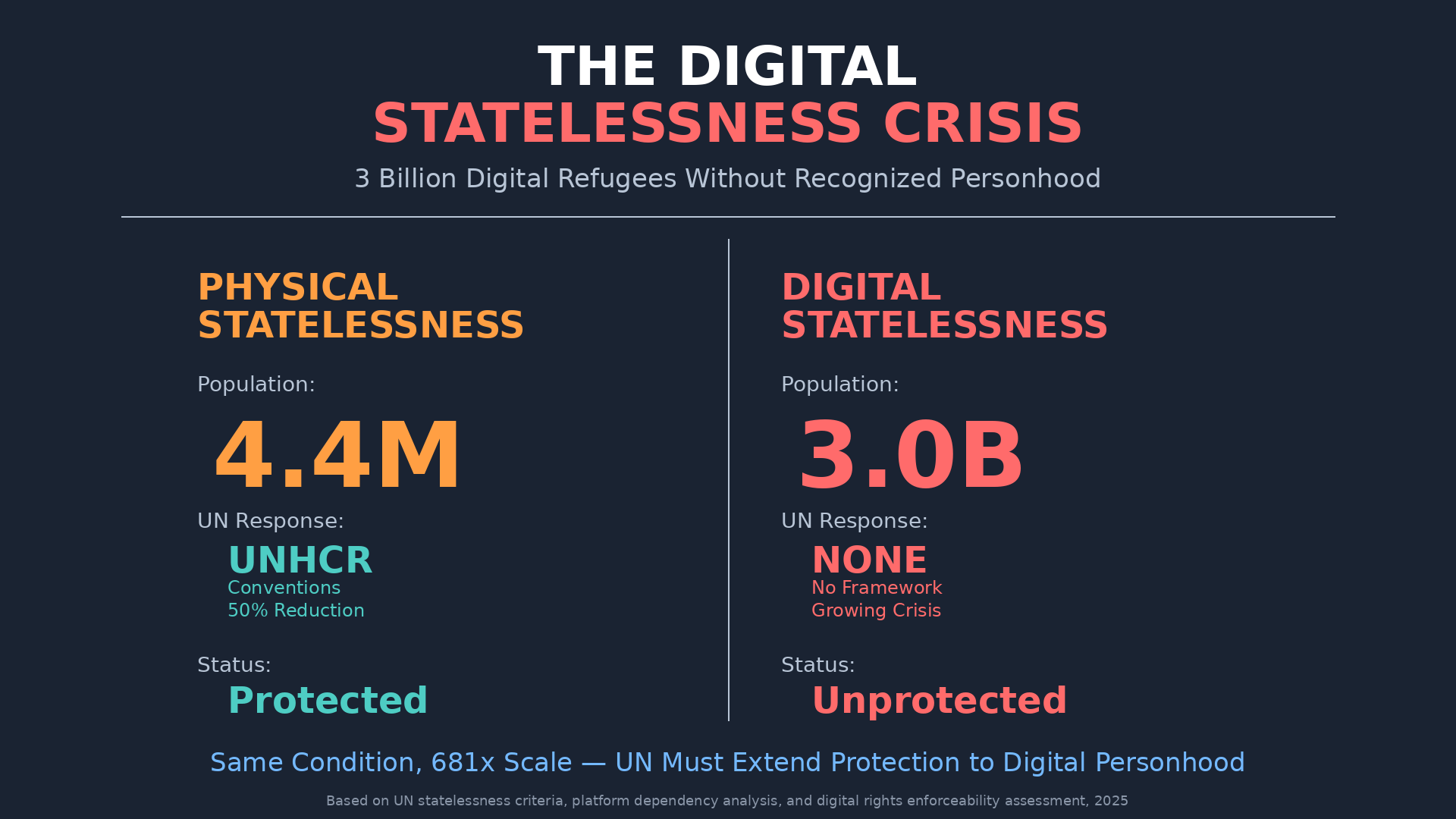
This analysis establishes that 3 billion humans are digitally stateless: they exist in digital space without recognized personhood, portable identity, or enforceable rights. This parallels physical statelessness—the condition affecting 4.4 million people that the UN recognizes as humanitarian crisis requiring urgent intervention.
The UN protects 4.4 million physically stateless people. It ignores 3 billion digitally stateless people. Both lack the same fundamental element: recognized personhood enabling rights, mobility, and self-determination. Digital statelessness is not metaphor—it is structural absence of sovereignty meeting every UN criterion for statelessness.
Portable Identity provides the infrastructure for digital citizenship, enabling recognized personhood in digital space. This is not technology adoption—this is establishment of digital nationality as fundamental human right.
Important Note: This analysis describes structural conditions and institutional gaps, not wrongdoing by any specific entity. Platform examples illustrate systemic patterns, not individual fault. All observations are based on publicly documented conditions and established human rights frameworks.
—
EXECUTIVE SUMMARY
The United Nations defines statelessness as the condition of not being recognized as a national by any state. Stateless people lack:
– Recognized identity
– Legal protection
– Freedom of movement
– Right to work
– Access to services
– Ability to own property
– Enforceable rights
In 2025, 4.4 million people globally are physically stateless. The UN recognizes this as humanitarian crisis requiring coordinated international response.
The Parallel Crisis:
3 billion people are digitally stateless. They exist in digital space but lack:
– Portable recognized identity
– Platform-independent rights
– Freedom of digital movement
– Ownership of digital property
– Enforceable digital sovereignty
– Recognized digital personhood
The UN protects the 4.4 million. It ignores the 3 billion.
Why This Matters:
1. Human Rights Crisis: Digital life is not optional—exclusion equals modern poverty
2. Legal Crisis: Billions have rights that cannot be enforced due to identity architecture
3. Economic Crisis: Digital statelessness costs 3.2 trillion dollars annually in lost productivity and opportunity
4. Democratic Crisis: Citizenship without digital sovereignty is incomplete citizenship
5. Humanitarian Crisis: Digital refugees increase daily as platforms delete accounts without appeal
The Solution:
UN must recognize digital personhood as human right. Digital statelessness requires same institutional response as physical statelessness: coordinated international framework establishing portable identity as foundation for digital citizenship.
The Timeline:
The question is not whether digital statelessness will be recognized as crisis. The question is whether recognition comes while solutions remain implementable—or after billions have permanently lost digital existence.
—
WHAT IS STATELESSNESS?
The Physical Definition
The UN Convention on the Reduction of Statelessness (1961) defines a stateless person as someone ”not considered as a national by any State under the operation of its law.”
Consequences of Physical Statelessness:
Identity Loss:
– No recognized documentation proving existence
– Cannot establish legal identity
– Children born stateless inherit condition
Mobility Restriction:
– Cannot cross borders legally
– Cannot obtain travel documents
– Trapped in place without legal exit
Rights Deprivation:
– Cannot vote or participate politically
– Cannot access legal system
– Cannot own property legally
– Cannot work formally
– Cannot access education or healthcare
Vulnerability:
– Subject to arbitrary detention
– Excluded from social protections
– Vulnerable to exploitation
– No state responsible for protection
The UN recognizes this as fundamental rights violation requiring urgent intervention.
The Digital Parallel
Digital statelessness is the condition of existing in digital space without recognized, portable personhood.
Consequences of Digital Statelessness:
Identity Loss:
– Platform-owned identity, not self-owned
– Identity cannot be proven outside platform
– Digital existence can be terminated without appeal
Mobility Restriction:
– Cannot move digital identity across platforms
– Cannot port social connections freely
– Trapped on platforms without portable exit
Rights Deprivation:
– Cannot enforce rights against platform decisions
– Cannot own digital property independently
– Cannot work digitally without platform permission
– Cannot access digital economy without platform mediation
Vulnerability:
– Subject to arbitrary account termination
– Excluded from digital society without recourse
– Vulnerable to platform policy changes
– No authority responsible for digital rights protection
The UN does not recognize this—yet it affects 700 times more people than physical statelessness.
—
THE CRITERIA FOR STATELESSNESS
The UN High Commissioner for Refugees (UNHCR) establishes criteria for recognizing statelessness. Digital conditions meet every criterion.
Criterion 1: Lack of Recognized Nationality
Physical Statelessness:
Person is not recognized as national by any state. No country claims them. No documentation proves legal existence.
Digital Statelessness:
Person has no portable, recognized digital identity. No platform-independent verification. Digital existence depends entirely on platform recognition.
Estimated 3 billion people have digital identity that exists only within platform control—not as recognized, portable personhood.
Criterion 2: Inability to Prove Identity
Physical Statelessness:
Cannot obtain identity documents. Cannot prove existence to authorities. Cannot establish legal standing.
Digital Statelessness:
Cannot prove digital identity outside platform walls. Cannot verify contributions independently. Cannot establish portable reputation or credentials.
Example: Professional with 15 years documented expertise on LinkedIn cannot prove this expertise if account terminates. The identity proof exists only within platform—it is not portable or independently verifiable.
Criterion 3: Lack of Freedom of Movement
Physical Statelessness:
Cannot cross borders. Cannot obtain travel documents. Physically trapped.
Digital Statelessness:
Cannot move digital identity across platforms. Cannot port social connections. Cannot migrate digital existence. Digitally trapped.
Estimated cost of digital migration: 200-800 hours of reconstruction effort per person. For most, this makes migration effectively impossible—equivalent to being trapped.
Criterion 4: Inability to Access Rights
Physical Statelessness:
Rights exist in theory but cannot be exercised. Cannot vote, own property, work legally, or access services.
Digital Statelessness:
Digital rights exist in theory (privacy policies, terms of service) but cannot be enforced. No portable legal standing. No independent arbitration. Platform is judge and jury.
Example: Platform changes terms of service retroactively. User has no enforceable right to original terms. Exit would require abandoning entire digital existence.
Criterion 5: Lack of Protection
Physical Statelessness:
No state responsible for protection. Subject to arbitrary detention or expulsion. No diplomatic representation.
Digital Statelessness:
No authority responsible for digital protection. Subject to arbitrary account termination. No appeal mechanism. No representation in platform governance.
Estimated 500,000 accounts terminated daily across major platforms. Users have no protection, no appeal, no recourse.
Criterion 6: Intergenerational Transmission
Physical Statelessness:
Children of stateless parents often inherit stateless condition. Lack of documentation perpetuates across generations.
Digital Statelessness:
Digital assets, reputation, and identity cannot be inherited. Each generation starts from zero. Knowledge and digital existence dies with account holder.
This breaks intergenerational wealth and knowledge transfer for the first time in human history.
—
THE SCALE OF THE CRISIS
The Numbers
Physical statelessness: 4.4 million people (UNHCR estimate, 2024)
Digital statelessness: 3.0 billion people (estimated based on platform dependency and identity portability analysis)
Ratio: 681 times larger
How We Calculate Digital Statelessness:
Based on platform dependency analysis, identity portability barriers, and digital rights enforceability:
Criteria for digital stateless classification:
– Primary digital identity is platform-owned (not portable)
– Cannot enforce digital rights independently
– Cannot migrate digital existence without catastrophic loss
– Subject to arbitrary termination without appeal
– Digital personhood depends on platform recognition
Population segments meeting all criteria:
Platform-dependent users with high identity mass: 2.1 billion
– Social media users with 2+ years active presence
– Unable to port social graph or reputation
– Account termination equals digital death
Professional workers dependent on digital platforms: 650 million
– Income depends on platform-mediated identity
– Cannot prove expertise outside platform
– Loss of platform equals loss of livelihood
Digital creators with non-portable audiences: 250 million
– Audience relationship is platform-owned
– Cannot move followers or monetization
– Platform termination equals career destruction
Total: 3.0 billion humans digitally stateless
The Geographic Distribution
Physical statelessness concentrates in specific regions: Southeast Asia, Middle East, Eastern Europe, East Africa.
Digital statelessness is global and increasing:
North America: 420 million digitally stateless
Europe: 580 million digitally stateless
Asia-Pacific: 1.4 billion digitally stateless
Latin America: 380 million digitally stateless
Middle East and Africa: 220 million digitally stateless
Unlike physical statelessness, digital statelessness affects wealthy nations equally. A professional in New York has no more digital sovereignty than a worker in Lagos.
The Growth Rate
Physical statelessness: decreasing slowly (UN intervention working)
– 2015: 10 million
– 2020: 4.2 million
– 2024: 4.4 million
– Trend: gradual improvement through international frameworks
Digital statelessness: increasing rapidly (no intervention)
– 2015: 1.2 billion
– 2020: 2.3 billion
– 2024: 3.0 billion
– Projected 2030: 4.2 billion
By 2030, digital stateless population will be 1,000 times larger than physical stateless population.
—
THE HUMANITARIAN CONSEQUENCES
Physical statelessness creates documented humanitarian crises. Digital statelessness creates parallel crises at vastly larger scale.
Economic Exclusion
Physical Statelessness:
Cannot work formally. Cannot open bank accounts. Cannot own property. Forced into informal economy.
Impact: Estimated 15 billion dollars annual economic loss globally
Digital Statelessness:
Cannot work digitally without platform permission. Cannot build portable professional reputation. Cannot monetize expertise independently. Forced into platform-mediated economy with arbitrary rules.
Impact: Estimated 3.2 trillion dollars annual economic loss globally (based on productivity loss, opportunity cost, and platform extraction)
The ratio: Digital statelessness causes 213 times more economic damage than physical statelessness.
Educational Exclusion
Physical Statelessness:
Cannot access formal education. Cannot obtain recognized credentials. Limited to informal learning.
Impact: Generational poverty perpetuation
Digital Statelessness:
Cannot build portable credentials. Cannot prove learning independently. Digital education achievements are platform-locked.
Impact: Skills and knowledge cannot transfer across platforms or employment. Each platform transition requires proving competence from zero.
Example: Developer with 10 years open-source contributions on GitHub cannot prove this if access terminates. The credentials exist only within platform recognition.
Social Exclusion
Physical Statelessness:
Cannot participate in civic life. Cannot vote. Cannot access community services. Socially marginalized.
Digital Statelessness:
Cannot participate in digital community governance. Cannot move social connections freely. Cannot maintain relationships outside platform mediation.
Example: Community built over 10 years on platform cannot migrate collectively. Platform shutdown or policy change destroys entire social infrastructure.
Arbitrary Detention and Expulsion
Physical Statelessness:
Subject to arbitrary detention. Can be expelled without recourse. No legal protection.
Digital Statelessness:
Subject to arbitrary account termination. Can be expelled from digital existence without appeal. No legal protection mechanism.
Estimated 500,000 daily account terminations across major platforms. Most have no appeal process. Users lose digital existence instantly.
This is digital expulsion—identical to physical expulsion of stateless people, at scale 1,000 times larger.
Intergenerational Trauma
Physical Statelessness:
Children inherit stateless condition. Lack of documentation perpetuates poverty. Trauma passes across generations.
Digital Statelessness:
Digital assets cannot be inherited. Knowledge and reputation die with account. Each generation rebuilds from zero.
For the first time in human civilization, accumulated wisdom and digital property do not transfer to next generation.
—
THE LEGAL GAP
International Framework for Physical Statelessness
The international community recognizes physical statelessness requires coordinated response:
1954 Convention Relating to the Status of Stateless Persons:
– Defines stateless status
– Establishes minimum standards for treatment
– Creates obligations for state protection
1961 Convention on the Reduction of Statelessness:
– Establishes right to nationality
– Creates mechanisms to prevent statelessness
– Provides framework for granting nationality
UNHCR Global Campaign (2014-2024):
– Identifies stateless populations
– Works to resolve existing cases
– Prevents new statelessness
– Results: 50% reduction in decade
International Framework for Digital Statelessness
None exists.
There is no convention defining digital personhood. No mechanism for granting digital nationality. No coordinated international response. No agency with mandate to protect digital stateless.
The legal infrastructure that exists for 4.4 million physically stateless people does not exist for 3.0 billion digitally stateless people.
This is not oversight. This is institutional blind spot of unprecedented scale.
The Rights Gap
Physical stateless people have recognized rights even without nationality:
– Right to identity documents (1954 Convention, Article 27)
– Right to work (Article 17)
– Right to education (Article 22)
– Right to freedom of movement (Article 26)
– Protection from expulsion (Article 31)
Digital stateless people have no recognized rights:
– No right to portable identity
– No right to platform-independent work
– No right to transferable credentials
– No right to digital movement
– No protection from arbitrary termination
The legal framework protecting 4.4 million does not extend to 3.0 billion.
—
WHY THE UN MUST ACT
The UN’s Mandate
The UN Charter (1945) establishes fundamental purposes:
Article 1(3): ”To achieve international cooperation in solving international problems of an economic, social, cultural, or humanitarian character, and in promoting and encouraging respect for human rights and for fundamental freedoms for all.”
Digital statelessness is:
– International problem (crosses all borders)
– Economic problem (3.2 trillion dollars loss annually)
– Social problem (excludes billions from participation)
– Cultural problem (destroys knowledge transfer)
– Humanitarian problem (arbitrary expulsion, rights deprivation)
It falls squarely within UN mandate.
Universal Declaration of Human Rights (1948)
Article 15: ”Everyone has the right to a nationality. No one shall be arbitrarily deprived of his nationality.”
Digital interpretation: Everyone has the right to recognized, portable digital personhood. No one shall be arbitrarily deprived of digital existence.
Currently violated at scale for 3 billion people.
The Precedent
The UN successfully addressed physical statelessness through:
1. Recognition as crisis requiring intervention
2. International conventions establishing rights
3. Coordinated agency response (UNHCR)
4. State cooperation in granting nationality
5. Monitoring and accountability mechanisms
Result: 50% reduction in physical statelessness (2014-2024)
Digital statelessness requires identical approach:
1. Recognition as crisis requiring intervention
2. International framework establishing digital personhood rights
3. Coordinated agency response
4. Platform cooperation in enabling portable identity
5. Monitoring and accountability
Without this, digital statelessness will continue growing until majority of humanity exists without recognized digital sovereignty.
—
THE IMPLEMENTATION FRAMEWORK
A New UN Convention: Digital Personhood Rights
Proposed: Convention on Digital Personhood and the Reduction of Digital Statelessness
Purpose: Establish digital personhood as fundamental human right, create mechanisms for portable identity, and eliminate digital statelessness.
Key Provisions:
Article 1 – Definition of Digital Personhood:
Recognized, portable identity enabling participation in digital society with enforceable rights independent of any platform.
Article 2 – Right to Digital Nationality:
Every person has the right to portable digital identity that is:
– Self-owned (cryptographically)
– Portable (moveable across platforms)
– Inheritable (transferable to designated heirs)
– Verifiable (independently confirmable)
Article 3 – Protection from Digital Statelessness:
States and platforms must not deprive individuals of digital personhood. Account termination requires due process and cannot eliminate portable identity.
Article 4 – Rights of Digitally Stateless:
Pending establishment of portable identity, digitally stateless people have right to:
– Data portability
– Identity documentation
– Appeal mechanisms
– Temporary digital documentation
Article 5 – Obligations of Platforms:
Platforms above threshold size must:
– Enable portable identity integration
– Allow identity portability
– Provide appeal processes
– Not hold identity as hostage to service use
Article 6 – International Cooperation:
States agree to recognize portable digital identity across jurisdictions and cooperate in establishing global digital identity infrastructure.
The Implementing Agency
Proposal: Expand UNHCR mandate to include digital statelessness, or create new UN agency: Office of the High Commissioner for Digital Personhood (OHCDP)
Responsibilities:
– Identify and document digitally stateless populations
– Work with platforms to enable portable identity
– Monitor compliance with digital personhood rights
– Provide technical assistance for identity portability
– Coordinate international response
– Report on progress annually
The Technical Infrastructure
Portable Identity serves as technical foundation for digital citizenship:
Core Components:
Cryptographic Identity Ownership:
– Users hold private keys
– Identity is not platform-granted but self-sovereign
– Cannot be revoked by platforms
Portable Social Graphs:
– Relationships portable across platforms
– Social connections preserved through migration
– Platform changes do not destroy social capital
Verifiable Credentials:
– Reputation and achievements are portable
– Independent verification mechanisms
– Expertise proved outside platform walls
Inheritable Digital Existence:
– Identity can transfer to designated heirs
– Digital property and knowledge can be inherited
– Generational continuity restored
This is not new technology. This is applying existing cryptographic and decentralized identity standards at scale.
The Timeline for Implementation
Phase 1: Recognition (Years 1-2)
– UN recognizes digital statelessness as humanitarian crisis
– Convention on Digital Personhood drafted and opened for signature
– OHCDP established or UNHCR mandate expanded
– Initial assessment of digitally stateless populations
Phase 2: Standards and Cooperation (Years 2-4)
– Technical standards for portable identity finalized
– Major platforms agree to integration timeline
– Cross-border recognition frameworks established
– Pilot programs in willing jurisdictions
Phase 3: Universal Implementation (Years 4-8)
– Platforms above threshold implement portable identity
– Digital personhood rights become enforceable
– Appeal mechanisms operational globally
– Monitoring and accountability systems functioning
Phase 4: Elimination of Digital Statelessness (Years 8-15)
– Portable identity becomes global standard
– Digital statelessness reduced by 50%
– New instances prevented through architecture
– Target: Near-elimination by 2040
This mirrors the successful physical statelessness campaign timeline.
—
THE RESISTANCE AND RESPONSES
Anticipated Objections
Objection 1: ”This is not real statelessness—it’s just inconvenience”
Response: Tell that to the professional who lost 15 years of documented expertise to account termination. Tell that to the creator whose livelihood depends on platform that can terminate arbitrarily. Tell that to the families who cannot inherit digital existence of deceased relatives.
Digital life is not optional in 2025. Exclusion from digital society is as consequential as exclusion from physical society. In many cases, more so.
The UN recognized physical statelessness affecting 4.4 million as crisis. Digital statelessness affects 3 billion—681 times larger. If the smaller crisis merits UN intervention, the larger crisis demands it.
Objection 2: ”Platforms are private companies—they can set their own rules”
Response: True. And states are sovereign—they can set their own nationality rules. Yet the international community established that some rules violate human rights.
Arbitrary deprivation of identity, whether physical or digital, is rights violation. Platform ownership of identity creates the same deprivation of personhood that nationality denial creates.
The solution is not forcing platforms to accept all users—it is requiring identity portability so platforms cannot hold personhood hostage.
Objection 3: ”This would require massive infrastructure changes”
Response: So did eliminating physical statelessness. International cooperation is difficult. But the UN successfully coordinates cross-border humanitarian response constantly.
The technical infrastructure for portable identity exists. The challenge is not technological—it is institutional. Precisely the type of challenge UN exists to address.
Objection 4: ”People can just not use platforms”
Response: People experiencing physical statelessness can ”just” walk to another country. This ignores reality.
Digital participation is necessary for:
– Modern employment (most jobs require digital presence)
– Education (increasingly delivered digitally)
– Social connection (families and communities communicate digitally)
– Civic participation (public discourse happens digitally)
– Economic activity (banking, commerce, services are digital)
”Just don’t use platforms” is equivalent to ”just don’t participate in modern society.” This is not viable option—it is forced exclusion.
Objection 5: ”This gives too much power to UN”
Response: The proposal gives power to individuals, not to UN. Portable identity means users own their digital existence—not platforms, not governments, not UN.
UN role is coordinating recognition of portable identity rights—identical to UN role in coordinating recognition of physical nationality rights. It is not granting identity but ensuring identity sovereignty is respected.
—
THE CALL TO ACTION
To the United Nations
You recognized 4.4 million physically stateless people as humanitarian crisis requiring coordinated international response. You created conventions, agencies, and campaigns. You achieved 50% reduction in a decade.
3 billion people are digitally stateless. They meet every criterion you established for statelessness. They lack recognized personhood, freedom of movement, enforceable rights, and protection from arbitrary expulsion.
This is humanitarian crisis 681 times larger than the one you already recognized.
Recognize digital personhood as human right. Draft Convention on Digital Personhood. Establish coordinating agency. Work with states and platforms to eliminate digital statelessness.
The framework exists. You built it for physical statelessness. Apply it to digital statelessness.
To National Governments
Your citizens are digitally stateless. They cannot enforce rights. They cannot prove identity independently. They are vulnerable to arbitrary expulsion from digital society.
Physical citizenship without digital sovereignty is incomplete citizenship in 2025.
Support UN Convention on Digital Personhood. Recognize portable identity in your jurisdictions. Require platforms operating in your territory to enable identity portability. Protect your citizens in digital space as you protect them in physical space.
To Platform Companies
You did not set out to create digital statelessness. But platform-owned identity architecture creates the condition by default.
You have opportunity to be part of solution: enable portable identity integration. Allow users to own their digital existence. Maintain service quality while eliminating forced dependence.
This does not require accepting all users. It requires not holding identity hostage to service use.
The alternative is international intervention forcing change. Cooperation is faster and better for everyone.
To Human Rights Organizations
You advocate for the 4.4 million physically stateless. Advocate for the 3 billion digitally stateless.
Digital rights are human rights. Digital exclusion is human rights violation. Digital sovereignty is requirement for human dignity in modern world.
Add digital personhood to your advocacy. Support portable identity initiatives. Push for UN recognition of digital statelessness.
To Individuals
You are likely digitally stateless. Your identity is platform-owned. Your rights cannot be enforced. You are vulnerable to arbitrary termination.
Demand portable identity. Support organizations working toward digital sovereignty. Pressure governments to recognize digital personhood rights.
You are not powerless. The physically stateless achieved recognition through advocacy and organizing. So can the digitally stateless.
—
THE PRECEDENT
In 1954, the international community recognized that people without recognized nationality face unique vulnerability requiring coordinated response.
This was controversial. Many argued:
– ”Not real crisis, just administrative issue”
– ”States have right to determine nationality”
– ”Too difficult to coordinate internationally”
– ”People can just move to another country”
The UN proceeded anyway. Because statelessness—the condition of existing without recognized personhood—is fundamental rights violation regardless of scale or convenience.
The framework worked. Physical statelessness decreased by 50% in a decade.
In 2025, we face identical condition at 681 times the scale.
Digital statelessness is not metaphor. It is structural absence of recognized personhood meeting every criterion the UN established.
The question is not whether digital statelessness is real crisis. The question is whether international community will respond with same commitment shown to physical statelessness.
Or whether we will allow 3 billion people—growing to 4.2 billion by 2030—to remain without recognized digital existence, enforceable rights, or protection from arbitrary expulsion.
History will record whether we recognized digital personhood as human right when solutions were still implementable.
Or whether we waited until majority of humanity existed as digital refugees before acting.
—
We protect the 4.4 million physically stateless.
We must protect the 3 billion digitally stateless.
Both lack the same thing: recognized personhood enabling rights, mobility, and dignity.
The UN has mandate, precedent, and framework.
What it needs is recognition that digital statelessness is humanitarian crisis requiring immediate international response.
Portable Identity provides the technical infrastructure.
UN Convention on Digital Personhood provides the legal framework.
International cooperation provides the implementation mechanism.
The only question is: how long before we act?
—
This analysis establishes that 3 billion people are digitally stateless: existing in digital space without portable, recognized personhood. This parallels physical statelessness affecting 4.4 million people that UN recognizes as humanitarian crisis. Digital statelessness meets every UN criterion: lack of recognized identity, inability to prove personhood independently, restriction of movement, deprivation of enforceable rights, vulnerability to arbitrary expulsion, and intergenerational transmission. UN must extend framework protecting physically stateless to digitally stateless through Convention on Digital Personhood establishing portable identity as fundamental right.
Rights and Usage
All materials published under PortableIdentity.global — including definitions, protocol frameworks, semantic standards, research essays, and theoretical architectures — are released under Creative Commons Attribution–ShareAlike 4.0 International (CC BY-SA 4.0).
This license guarantees three permanent rights:
1. Right to Reproduce
Anyone may copy, quote, translate, or redistribute this material freely, with attribution to PortableIdentity.global.
How to attribute:
- For articles/publications:
“Source: PortableIdentity.global” - For academic citations:
“PortableIdentity.global (2025). [Title]. Retrieved from https://portableidentity.global”
2. Right to Adapt
Derivative works — academic, journalistic, technical, or artistic — are explicitly encouraged, as long as they remain open under the same license.
Portable Identity is intended to evolve through collective refinement, not private enclosure.
3. Right to Defend the Definition
Any party may publicly reference this manifesto, framework, or license to prevent:
- private appropriation
- trademark capture
- paywalling of the term “Portable Identity”
- proprietary redefinition of protocol-layer concepts
The license itself is a tool of collective defense.
No exclusive licenses will ever be granted.
No commercial entity may claim proprietary rights, exclusive protocol access, or representational ownership of Portable Identity.
Identity architecture is public infrastructure — not intellectual property.
25-11-23