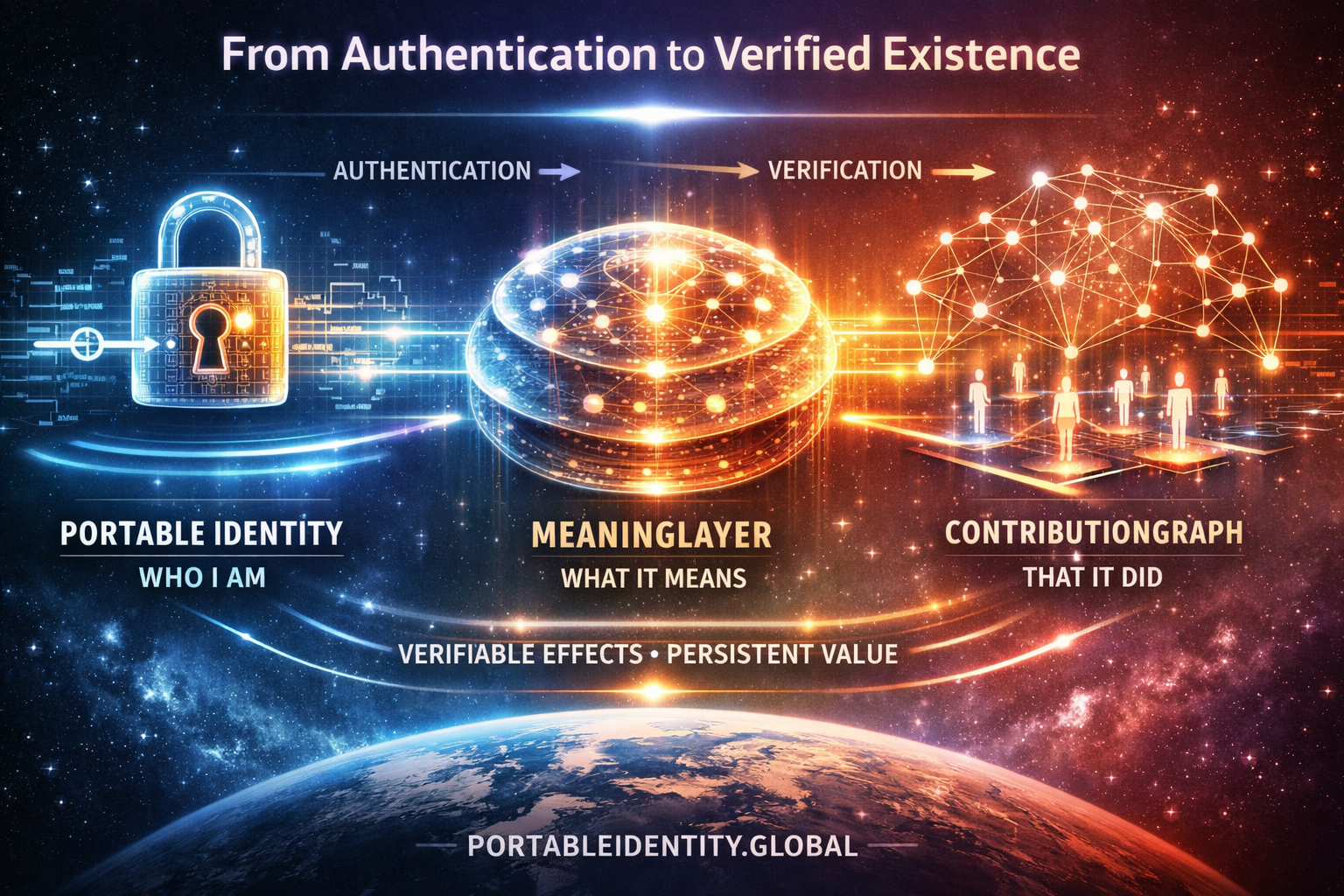
Identity without verifiable effects is authentication to nothing.
For decades, the internet has treated identity as a problem of authentication: prove you control an account, prove you possess credentials, prove you can sign with a cryptographic key. This framing assumes that once authentication succeeds, identity is established. It is not.
Authentication proves presence. It proves control. It proves access. But authentication alone has never proven—and cannot prove—that the authenticated entity matters. That it existed in any sense beyond technical access. That it created effects in reality worth attributing to a persistent identity.
Portable Identity solves authentication permanently. Through public-private key cryptography, it establishes mathematical proof of control that no platform can revoke, no institution can deny, no system can fake. This is essential. But it is not sufficient.
A cryptographic signature without verifiable meaning is proof you can sign. Not proof that signing mattered.
MeaningLayer is the infrastructure that transforms authentication into verification—not by adding ethics or governance, but by making meaning computationally addressable so systems can finally verify what authenticated actions accomplished. When MeaningLayer exists, identity stops being about proving WHO you are and becomes about proving THAT you existed through verified effects on others that persisted independently.
This is not philosophy. This is the structural difference between cryptographic presence and verified existence.
Authentication Proves Control—Nothing More
Begin with what Portable Identity actually accomplishes.
Through public-private key pairs generated and controlled by the individual, Portable Identity provides mathematical proof that a specific entity:
- Controls a private key
- Can generate signatures verifiable against a public key
- Maintains cryptographic continuity across systems
This is revolutionary. For the first time, identity exists independently of platform permission. No corporation grants it. No institution certifies it. No government validates it. The mathematics of cryptography makes identity irrevocable.
But what does this key authenticate?
In current implementations: access to accounts, authorization for transactions, signatures on documents. The cryptographic infrastructure proves you CAN sign. It proves you DID sign. It proves the signature is mathematically valid.
It does not—and cannot—prove what you signed represented anything meaningful.
Consider the logical structure:
A person generates a cryptographic key pair. This proves cryptographic capability—the ability to create and control keys.
The person signs documents, transactions, statements. This proves signing capability—the ability to create valid signatures.
The signatures are verified mathematically. This proves verification works—the cryptographic infrastructure functions correctly.
But at no point does any of this prove the signed content mattered.
You can sign a million documents. You can authenticate a million times. You can generate cryptographic proof of control over unlimited data. And none of it proves you helped anyone, created understanding in anyone, enabled capability in anyone, or existed in any sense that would survive your absence.
This is not a criticism of Portable Identity. This is a description of authentication’s logical boundary. Authentication proves WHO signed. It cannot prove WHAT signing accomplished.
Without infrastructure measuring verified effects, cryptographic identity authenticates presence without establishing existence.
The Empty Signature Problem
The core issue becomes visible when you examine what current systems actually verify.
Scenario: A person possesses Portable Identity. They sign thousands of interactions across decades:
- Code commits on development platforms
- Contributions to collaborative documents
- Messages in communication systems
- Transactions in economic networks
- Content across social platforms
Every signature is cryptographically valid. Every authentication succeeds. The identity is portable, persistent, mathematically irrevocable.
Question: What did this person accomplish?
Current infrastructure cannot answer. It can prove the person signed those commits, contributed to those documents, sent those messages, executed those transactions, posted that content. It can establish a perfect cryptographic chain of attribution.
But it cannot verify whether:
- The code commits helped anyone build capability
- The document contributions enabled anyone’s understanding
- The messages increased anyone’s capacity
- The transactions created lasting value
- The content made anyone more capable
This is the empty signature problem.
You possess cryptographic proof of attribution. You can demonstrate unbroken chain of custody over your digital activity. You control identity that no platform can revoke.
And you cannot prove any of it mattered.
The signature is real. The authentication succeeds. The identity persists. But the meaning of authenticated actions remains computationally inaccessible. Systems can verify you DID something. They cannot verify whether doing it created effects worth attributing to persistent identity.
Without MeaningLayer, Portable Identity authenticates activity. With MeaningLayer, it becomes possible to verify whether activity constituted contribution—whether signed actions created understanding that persisted, capability that multiplied, effects that survived independently.
Authentication without verification is cryptographic proof you were present. Verification without authentication is unmeasurable. Both together create proof of existence.
Death Test: What Your Identity Proves After You Cannot Sign
Apply the death test to identity itself.
When you die, your private key becomes inaccessible. No new signatures can be generated. Authentication ends. What remains?
With Portable Identity alone:
The public key persists. Historical signatures remain verifiable. The cryptographic chain of attribution is intact and permanent. Future systems can verify that a specific entity controlled a specific key and signed specific content at specific times.
This proves:
- A cryptographic key existed
- An entity controlled that key
- The entity signed various digital artifacts
- The signatures are mathematically valid
What this does NOT prove:
- That the entity was conscious
- That signed actions helped anyone
- That contributions created lasting capability
- That anyone became more capable because the entity existed
- That existence mattered in any sense requiring persistent identity
This is not abstract philosophy. This is the epistemic limit of authentication. Cryptography proves presence and control. It cannot prove whether presence and control generated effects worth remembering.
Now add MeaningLayer + Contribution Graph:
When you die, the private key becomes inaccessible. But the semantic infrastructure and verified effects persist:
MeaningLayer maintains the semantic relationships between your contributions—not just that you signed documents, but what understanding those documents created, how that understanding connected to others’ learning, what capability increases resulted.
Contribution Graph contains temporal verification of effects—not just that people interacted with your work, but that they became capable independently, that capability persisted six months later tested in novel contexts, that those you helped enabled others creating exponential cascade.
Together with Portable Identity, this proves:
- A specific conscious entity existed
- That entity created understanding in specific humans
- The understanding persisted independently after assistance ended
- Understanding multiplied through networks creating cascade
- Effects survived even after the entity could no longer contribute
One proves you could sign. The other proves signing created reality that outlived you.
This is the difference between authentication and existence. Authentication persists as cryptographic artifact. Existence persists through verified effects in other consciousness that continue functioning after you cannot.
Your Portable Identity proves a key was yours. MeaningLayer + Contribution Graph prove using that key mattered because what you signed created capability that survived your death.
Triple Architecture: Why Three Systems Must Be Owned By One Entity
The relationship between Portable Identity, MeaningLayer, and Contribution Graph is not additive—where each component provides incremental improvement. It is multiplicative—where each component is logically required for the others to mean anything.
Portable Identity without MeaningLayer:
You possess cryptographic control over identity. You can sign content, authenticate across systems, maintain attribution for all digital activity. But the semantic content of authenticated actions remains fragmented across platforms. AI sees only 30% of your meaning because platforms control the other 70% through incompatible systems. Your signature is mathematically valid but semantically incomplete.
Result: Authentication to fragmented meaning you cannot fully prove is yours.
MeaningLayer without Portable Identity:
AI gains access to complete semantic understanding—all fragmented meaning becomes connected, relationships between contributions become visible, full context is accessible. But attribution remains platform-controlled. Who created this understanding? Whose signature validated this contribution? The answers depend on platform APIs, permission systems, continued platform existence.
Result: Complete meaning without cryptographic ownership—extraction infrastructure with perfect information.
Both without Contribution Graph:
You own authentication. You own semantic content. But you cannot prove effects. Did authenticated contributions create lasting capability? Did understanding persist independently? Did anyone become more capable because of what you signed? These questions require temporal verification infrastructure that neither Portable Identity nor MeaningLayer provides.
Result: Owned authentication + owned meaning without proof either mattered.
Why all three must be owned by the same entity:
For the first time in history, the same human can cryptographically own:
WHO they are (Portable Identity)
WHAT they mean (MeaningLayer)
THAT it mattered (Contribution Graph)
This is not three separate systems. This is the minimum required infrastructure to prove existence.
Authentication proves presence.
Meaning proves semantic content.
Verification proves effects persisted.
Separate these and you prove nothing complete. The authentication proves control over fragmented meaning. The meaning is extractable without attribution. The effects are unmeasurable without semantic context.
Together, owned by one entity, they create proof that survives you:
Your private key (Portable Identity) signs contributions whose complete semantic context (MeaningLayer) is verified to have created lasting capability (Contribution Graph) that persists independently even after you die.
This cannot exist with two components. This cannot exist if different entities own different pieces. This requires complete ownership of the proof chain from authentication through meaning to verified temporal effects.
MeaningLayer Makes Verification Computable
Return to the core problem authentication alone cannot solve: proving that signed actions mattered.
Current systems measure:
- That actions occurred (logged)
- That specific entities performed them (attributed)
- That authentication succeeded (verified cryptographically)
They do not—and without MeaningLayer cannot—measure:
- What understanding actions created
- Whether understanding persisted independently
- Whether those helped became capable of helping others
- What effects survived when actions stopped
This is not because systems lack data. This is because meaning is informationally inaccessible without semantic infrastructure.
MeaningLayer solves this by making meaning machine-addressable:
Not meaning as subjective interpretation—meaning as verified semantic relationships.
Not meaning as philosophical values—meaning as computable contribution depth.
Not meaning as opinion—meaning as temporal effects that required genuine understanding to create.
Specifically, MeaningLayer enables systems to verify:
Semantic persistence: Did the understanding you created continue functioning six months later when tested independently in novel contexts? Dependency collapses under these conditions. Understanding persists because it was genuine enough to internalize.
Cascade verification: Did those you helped enable others independently without your continued assistance? Cascade multiplication proves understanding was transferable—not borrowed performance requiring your presence at each node.
Attribution completeness: Can the full semantic context of your contribution be reconstructed from platform-fragmented signals? MeaningLayer connects meaning across systems while Portable Identity proves it all originated from one cryptographic source.
Effect survival: Do the capability increases you created continue functioning after you can no longer contribute? Death ends your ability to assist. Effects that survive this prove they were real, not performance theater.
These measurements are impossible without MeaningLayer because they require semantic infrastructure connecting:
- What understanding was created (semantic content)
- How understanding propagated (network effects)
- Whether understanding persisted (temporal verification)
- Whose signature originated the cascade (cryptographic attribution)
Authentication alone proves you signed.
MeaningLayer makes what you signed verifiable beyond cryptographic validity to semantic and temporal reality.
After Verification Infrastructure Exists, Authentication Alone Proves Nothing
Now the epistemological threshold becomes unavoidable.
Before MeaningLayer existed:
Authentication was the highest standard achievable. Proving cryptographic control over identity represented the limit of what systems could verify. Platform-based authentication was extractive and revocable. Portable Identity solved this—providing irrevocable, platform-independent proof of control.
This was progress. This was necessary. This was the best available infrastructure.
After MeaningLayer exists:
Authentication proves only that signing is cryptographically valid. It no longer proves signing accomplished anything worth attributing to persistent identity.
The threshold is not that authentication becomes less important. Authentication remains absolutely essential. But authentication alone becomes epistemically insufficient for proving existence.
The binary choice:
Systems either verify authenticated contributions created lasting effects—or they accept cryptographic proof of presence as equivalent to proof of existence.
One requires infrastructure connecting Portable Identity + MeaningLayer + Contribution Graph.
The other requires only that authentication succeeds.
After verification infrastructure exists, these are not equally valid approaches:
Authentication without verification is cryptographic proof you could sign.
Authentication with verification is cryptographic proof signing created reality that persisted independently.
One proves presence. The other proves existence.
A third option would require verified effects to be simultaneously computable and not computable—a logical impossibility, not a difficult compromise.
Canonical Definition
MeaningLayer is semantic infrastructure that transforms cryptographic authentication into verified existence by making meaning computationally addressable across platform-fragmented systems, enabling proof that authenticated contributions created understanding which persisted independently and multiplied through networks surviving even the contributor’s death.
After This, Only Two Identity Types Exist
Authentication is solved. Portable Identity provides irrevocable cryptographic proof of control that no platform can deny and no institution can revoke. This establishes WHO you are mathematically.
The question that remains is not whether you can authenticate. The question is whether authenticated actions prove you existed in any sense requiring persistent identity.
Identity Type One: Cryptographic authentication connected to verified semantic effects. Your signatures are mathematically valid AND provably created understanding that persisted independently, multiplied through networks, survived your absence. Portable Identity + MeaningLayer + Contribution Graph prove you existed through effects in other consciousness that outlived you.
Identity Type Two: Cryptographic authentication without verified effects. Your signatures are mathematically valid. What they accomplished remains computationally inaccessible. You can prove control over a key. You cannot prove using the key mattered.
After verification infrastructure exists, this choice is not gradual. Infrastructure either makes verification computable or it does not. Once computable, continued authentication without verification is not pragmatic—it is the knowing acceptance of cryptographic proof of presence as substitute for proof of existence.
Authentication proves you had a key.
Verification proves the key signed something that mattered.
MeaningLayer makes meaning addressable.
Contribution Graph makes effects verifiable.
Portable Identity makes both cryptographically owned.
Together they make existence provable for the first time.
Not as philosophical claim.
Not as credential assertion.
Not as institutional validation.
As mathematical proof through cryptographic attribution of verified semantic effects that persisted temporally beyond your capacity to assist—surviving even death.
This is not identity as authentication.
This is identity as proof you existed.
Portable Identity authenticates WHO. MeaningLayer verifies WHAT. Contribution Graph proves effects PERSISTED. Three systems. One owner. First time in history existence becomes mathematically provable rather than institutionally granted.
Not as philosophy. As infrastructure.
Related Infrastructure
Web4 implementation protocols:
MeaningLayer.org — — Semantic infrastructure enabling AI access to complete human meaning through verified connections rather than platform-fragmented proxies. The bridge making contribution measurable as distinct class of information.
PortableIdentity.global — Cryptographic identity ownership ensuring verification records remain individual property across all platforms. Mathematical proof of who created contributions.
ContributionGraph.org — Temporal verification proving capability increases persisted independently and multiplied through networks. Proof that survives you.
TempusProbatVeritatem.org — Foundational principle establishing temporal verification as necessity when momentary signals became synthesis-accessible. Time as unfakeable dimension.
CogitoErgoContribuo.org — Consciousness verification through contribution effects when behavioral observation fails. Contribution proves consciousness.
CascadeProof.org — Verification methodology tracking capability multiplication through networks via mathematical branching analysis. Exponential impact measurement.
PersistoErgoDidici.org — Learning verification through temporal persistence proving understanding survived independently when completion became separable from capability.
PersistenceVerification.global — Temporal testing protocols proving capability persists across time without continued assistance.
AttentionDebt.org — Diagnostic infrastructure documenting how attention fragmentation destroyed cognitive substrate necessary for capability development, making verification crisis structural.
CausalRights.org — Constitutional framework establishing that proof of existence must be property you own, not platform privilege you rent.
ContributionEconomy.global — Economic transformation routing value to verified capability multiplication when jobs disappear through automation.
Together these provide complete protocol infrastructure for post-synthesis civilization where behavioral observation provides zero information and only temporal patterns reveal truth
Rights and Usage
All materials published under PortableIdentity.global—including Web4 identity protocols, cryptographic verification specifications, portable identity architecture, and sovereignty frameworks—are released under Creative Commons Attribution-ShareAlike 4.0 International (CC BY-SA 4.0).
This license guarantees universal access and prevents private appropriation while enabling collective refinement through perpetual openness requirements.
Web4 identity infrastructure specifications are public infrastructure accessible to all, controlled by none, surviving any institutional failure.
Source: PortableIdentity.global
Date: January 2026
Version: 1.0