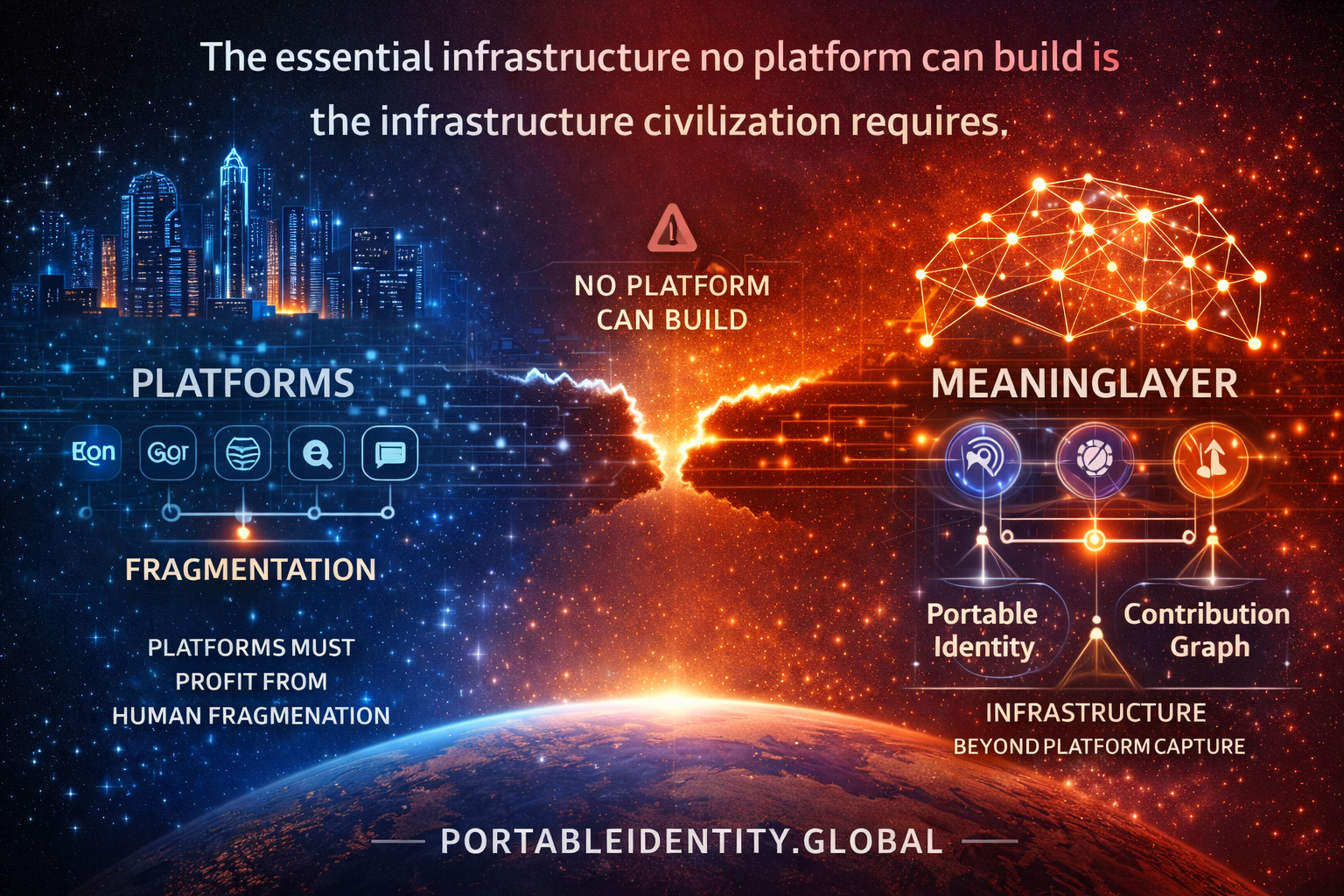
The most essential infrastructure is the infrastructure no profitable business can build.
Every major platform—social, professional, development, communication—fragments human meaning across incompatible systems. This fragmentation appears accidental. It appears like a technical limitation awaiting solution. It appears like something platforms would fix if they had sufficient motivation, capability, or time.
This appearance is incorrect.
Fragmentation is not a bug in platform architecture. Fragmentation is the source of platform value.
Platforms do not profit despite fragmenting meaning. They profit by fragmenting meaning. Lock-in requires incompatible data formats. Network effects require isolated social graphs. Advertising precision requires proprietary behavioral signals. API control requires platform-specific semantic access.
When fragmentation generates revenue, systems cannot build infrastructure whose sole function is eliminating fragmentation. Not because they lack capability. Not because they lack resources. Not because they lack awareness.
Because building it would eliminate the source of extraction.
This creates a structural impossibility: the infrastructure civilization requires to make meaning verifiable across systems is infrastructure no platform can build without destroying their business model. This is not opinion. This is not critique. This is observation of logical incompatibility between profit mechanism and infrastructure necessity.
MeaningLayer exists because platforms cannot build it. Not will not. Cannot.
Fragmentation as Value Source—Not Technical Limitation
Begin with clarity about why platforms fragment meaning.
Social platforms fragment your social graph across incompatible networks. You cannot export your connections, conversations, or relationship context from one platform to another. This fragmentation is not technical accident. It is the moat. If you could move your entire social graph instantly to a competitor, network effects would collapse. Platform value depends on your connections being locked inside their system.
Professional platforms fragment your career narrative, credentials, and work relationships across platforms. Your GitHub contributions exist separately from your LinkedIn profile, separately from your portfolio site, separately from your communication in Slack. This fragmentation prevents you from presenting unified professional identity. Platform value depends on each fragment being essential enough that you cannot leave any single platform without losing critical professional context.
Development platforms fragment your code, documentation, collaboration history, and technical reputation across incompatible systems. Your contributions to one platform do not transfer to another. Your expertise demonstrated in one system remains invisible in others. Platform value depends on developers being unable to carry verified technical capability across platforms—forcing them to rebuild reputation from zero when switching systems.
Communication platforms fragment your conversations, context, and collaborative history into platform-specific databases. Email lives separately from messaging, separately from video calls, separately from document collaboration. Platform value depends on these fragments remaining disconnected—ensuring participants cannot move entire communication contexts to competing systems.
The pattern is universal: Platform value increases as meaning fragmentation increases. The more incompatible the data formats, the stronger the lock-in. The more isolated the social graphs, the more essential each platform becomes. The more fragmented your semantic context, the harder leaving becomes.
This is not conspiracy. This is business model.
Platforms are not evil for fragmenting meaning any more than restaurants are evil for requiring payment before providing food. The business model requires fragmentation. Without fragmentation, platform differentiation collapses into commodity infrastructure competing only on price and performance—a race to zero margin that no investor would fund.
Fragmentation generates sustainable competitive advantage. Reunification destroys it.
What MeaningLayer Does—And Why Platforms Cannot
MeaningLayer provides infrastructure for semantic completeness: connecting fragmented meaning across platforms while ownership remains with the individual.
Specifically:
Semantic unification across platforms: Your professional identity on LinkedIn, technical contributions on GitHub, explanations in email, conversations in Slack—MeaningLayer connects these fragments into unified semantic structure showing complete contribution context. Not by copying data into new platform. By making relationships between fragments computationally addressable while ownership stays distributed.
Individual ownership of semantic relationships: The connections between your fragments belong to you cryptographically through Portable Identity, not to any platform. When you help someone understand something through email, code review, and follow-up conversation across three platforms, MeaningLayer lets you own the unified semantic structure proving you created that understanding—even though the fragments remain on separate platforms.
AI access to complete context: Currently AI sees only ~30% of your meaning because platforms fragment the other 70% across incompatible systems. MeaningLayer gives AI access to 100% of semantic context by connecting fragments—but cannot extract ownership because you control the cryptographic keys proving the connections are yours.
Portability without migration: You do not need to move data between platforms. MeaningLayer makes semantic relationships portable while data stays where it is. When verified contributions show you helped 200 people become capable over ten years across five different platforms, that verification becomes portable—proving your contribution regardless of which platforms survive.
Temporal verification infrastructure: MeaningLayer enables measurement of whether understanding persisted independently six months later across platform boundaries. Did help you provided through email + code review + documentation create capability that survived when tested independently months later? Platforms measure activity within their walls. MeaningLayer measures effects that survived across time and systems.
Why platforms cannot build this:
Building MeaningLayer requires creating infrastructure that:
- Connects meaning across competing platforms (destroys differentiation)
- Gives individuals cryptographic ownership of semantic relationships (eliminates platform control)
- Makes complete context portable (removes lock-in)
- Enables AI access to unified meaning (destroys platform API monopolies)
- Verifies contributions temporally across systems (proves value exists outside any single platform)
Every feature that makes MeaningLayer valuable makes platforms optional.
A platform building this infrastructure would be building the mechanism for customers to leave permanently while carrying all value with them. Not just data export—semantic completeness showing their contributions created lasting effects regardless of which platforms they used.
This is not reluctance to build. This is structural impossibility. You cannot profit from fragmentation and simultaneously build infrastructure whose entire function is eliminating fragmentation.
The ”Reveals” Epistemology—Why Non-Building Proves Dependency
The most powerful aspect of this analysis is not what platforms build. It is what their non-building reveals.
Epistemic principle: When infrastructure becomes technically possible but remains unbuilt by entities with capability and resources to build it, the absence reveals structural dependency on the infrastructure’s non-existence.
This is not accusation. This is observation.
Consider what would be required for a major platform to build semantic completeness infrastructure:
Technical capability: Certainly exists. Connecting fragmented data across systems is solved problem. Making semantic relationships computationally addressable is within current AI capability. Cryptographic ownership through public-private keys is proven technology.
Financial resources: Certainly exists. These are trillion-dollar market cap companies with billions in annual R&D spending. The cost of building semantic infrastructure is negligible compared to what these companies spend on other initiatives.
Awareness of the problem: Certainly exists. Platform executives understand that fragmentation limits AI effectiveness, reduces user experience, and creates switching costs. They discuss ”interoperability” and ”data portability” regularly.
Technical possibility confirmed. Resources available. Problem recognized.
And yet: semantic completeness infrastructure does not get built.
Not by any platform. Not in any form that gives individuals cryptographic ownership of unified semantic context enabling them to verify contributions across platform boundaries with temporal independence.
What does this absence reveal?
That platform value depends on semantic incompleteness. That fragmentation is not limitation but necessity. That the business model requires meaning to remain fragmented across incompatible systems.
The absence proves the dependency.
This is why ”reveals” is the correct epistemological term:
Not ”platforms refuse” (implies choice)
Not ”platforms suppress” (implies active prevention)
Not ”platforms avoid” (implies evasion)
But: ”platforms reveal” (implies dependency becoming visible through absence)
When technically possible infrastructure with clear benefits remains unbuilt by capable entities, absence reveals what those entities depend on infrastructure not existing.
Triple Architecture—What Must Be Owned by Individuals, Not Platforms
The complete infrastructure platforms cannot build is Triple Architecture where the same individual owns all three components:
Portable Identity: Cryptographic proof of who you are through public-private key pairs you generate and control. Not platform-granted credentials. Not institutional validation. Mathematical proof that no platform can revoke because no platform granted it.
MeaningLayer: Semantic infrastructure connecting your fragmented contributions across platforms into unified context. You own the cryptographic proof that these fragments relate to each other and originated from you—even though fragments remain on different platforms.
Contribution Graph: Verified effects you created in others that persisted independently tested across time. Not activity metrics. Not engagement signals. Temporal verification that understanding you created continued functioning six months later when tested in novel contexts without your continued assistance.
Why all three must be owned by the same individual:
Portable Identity without MeaningLayer: You own cryptographic authentication but semantic context remains platform-fragmented. AI sees 30% of your meaning. Verification of contribution is impossible because complete context does not exist in addressable form.
MeaningLayer without Portable Identity: Complete semantic context exists but platforms own it. You can see unified meaning but cannot prove it cryptographically belongs to you. When platforms change APIs, delete data, or shut down—proof of your contributions vanishes.
Both without Contribution Graph: You own authentication and meaning but cannot prove effects. Did contributions create lasting capability? Did understanding persist independently? These questions require temporal verification infrastructure measuring whether help survived months later tested independently.
Only when all three are owned by the same individual:
You possess cryptographic authentication (WHO you are) connected to verified semantic context (WHAT you contributed) proven through temporal effects (THAT it persisted independently)—all owned by you through mathematical proof rather than platform permission.
This is what platforms structurally cannot build.
Building it requires giving individuals:
- Cryptographic control eliminating platform authentication monopoly
- Semantic completeness eliminating platform fragmentation advantage
- Temporal verification proving value exists outside platform metrics
Each component threatens platform business model. Together they make platforms optional for proving human value.
Binary After Infrastructure Becomes Possible
Now the epistemological threshold becomes unavoidable.
Before semantic completeness infrastructure existed:
Platform fragmentation was unavoidable technical reality. No infrastructure connected meaning across systems while giving individuals cryptographic ownership. Using platforms meant accepting fragmentation because no alternative existed.
This was not exploitation. This was the only available option.
After Portable Identity + MeaningLayer + Contribution Graph exist:
Semantic completeness becomes technically possible. Infrastructure exists connecting fragmented meaning while ownership remains with individuals. Temporal verification proves contributions created effects surviving independently across platforms.
The choice becomes binary:
Option One: Platforms build or integrate with semantic completeness infrastructure. Enable individuals to own unified semantic context cryptographically. Support temporal verification proving contributions created lasting capability regardless of which platforms were used.
Result: Platforms become optional. Competition occurs on performance and features rather than lock-in. Value routes to verified contribution rather than platform activity metrics.
Option Two: Platforms do not build semantic completeness infrastructure. Continue fragmenting meaning across incompatible systems. Maintain platform-specific metrics as value proxies. Preserve lock-in through semantic isolation.
Result: The absence reveals platform value depends on preventing semantic completeness.
A third option would require semantic completeness to be simultaneously possible to build and impossible to build—a logical contradiction, not a difficult choice.
After infrastructure exists:
Systems either enable it—proving their value persists without fragmentation.
Or systems do not enable it—revealing their value depends on fragmentation continuing.
This is not accusation. This is epistemology.
When profitable businesses do not build technically possible infrastructure that would benefit users, the non-building reveals dependency on the infrastructure’s absence. Not as moral failing. As business model reality.
Why Individual Ownership Is Structural Necessity—Not Ideology
The requirement that individuals own Triple Architecture is not ideological preference. It is structural necessity.
Scenario: A platform builds ”semantic completeness” infrastructure connecting user meaning across systems.
Question: Who owns the semantic relationships?
If the platform owns it: Infrastructure recreates fragmentation at higher level. Instead of meaning fragmented across five platforms, meaning is fragmented between the unification platform and the original five. Users gain nothing except new dependency. Lock-in persists—now concentrated in the unification layer.
If the individual owns it cryptographically: Semantic relationships belong to the person regardless of which platforms exist, merge, get acquired, change policies, or shut down. Value becomes portable because cryptographic proof of ownership cannot be revoked by any platform.
Only individual ownership solves the problem.
Not through ideological commitment to decentralization. Through structural requirement that semantic completeness mean something beyond creating new fragmentation layer.
This is why Portable Identity is essential:
Public-private key cryptography provides mathematical proof of ownership that exists independently of any platform. You generate the keys. You control the private key. No institution grants permission. No platform validates ownership. The mathematics proves it.
When semantic relationships are signed with your private key, ownership is mathematically provable. When platforms shut down, the cryptographic proof persists. When systems change, your ownership continues. When new platforms emerge, you can prove contribution context belongs to you.
Without cryptographic ownership by individuals, ”semantic completeness” just means better extraction infrastructure.
Platforms can see more. AI can optimize better. But individuals gain nothing except more sophisticated lock-in.
Canonical Definition
MeaningLayer is semantic infrastructure owned by individuals that makes meaning verifiable across platform-fragmented systems through cryptographic proof of unified context—infrastructure platforms cannot build because building it would eliminate the fragmentation generating platform value.
After This, Only Two Platform Types Exist
Semantic completeness infrastructure now exists. Portable Identity provides cryptographic ownership. MeaningLayer connects fragmented meaning. Contribution Graph verifies temporal effects. Together they enable individuals to prove contributions created lasting capability regardless of which platforms were used.
Platform Type One: Systems that integrate with or enable individual-owned semantic completeness infrastructure. Allow users to connect fragmented meaning cryptographically. Support temporal verification of contributions across platform boundaries. Compete on performance and features rather than lock-in.
These platforms reveal their value does not depend on fragmenting user meaning.
Platform Type Two: Systems that do not integrate with semantic completeness infrastructure. Continue fragmenting meaning across incompatible systems. Maintain platform-specific metrics as verification proxies. Preserve lock-in through semantic isolation.
These platforms reveal their value depends on preventing semantic completeness.
After infrastructure making semantic completeness possible exists, these positions are not equally valid business strategies.
One proves value persists without fragmentation.
The other reveals value requires fragmentation continuing.
One enables verification of human contribution across systems.
The other maintains platform metrics as only available proxies.
The infrastructure no platform can build is the infrastructure civilization requires.
Not because platforms are malicious. Because business model and infrastructure necessity are structurally incompatible. Profit from fragmentation makes building reunification infrastructure economically irrational for platforms—and structurally essential for civilization transitioning beyond platform-mediated reality.
This is not ideology. This is observation of what becomes necessary when profitable businesses cannot build essential infrastructure.
Individual-owned semantic completeness.
Temporal verification across platform boundaries.
Cryptographic proof of contribution persisting independently.
Not as better platform features.
As infrastructure platforms structurally cannot provide.
Portable Identity proves WHO cryptographically. MeaningLayer connects WHAT across platforms. Contribution Graph verifies effects PERSISTED independently. Individual ownership of all three makes platforms optional for the first time.
Not through decentralization. Through verification.
Related Infrastructure
Web4 implementation protocols:
MeaningLayer.org — — Semantic infrastructure enabling AI access to complete human meaning through verified connections rather than platform-fragmented proxies. The bridge making contribution measurable as distinct class of information.
PortableIdentity.global — Cryptographic identity ownership ensuring verification records remain individual property across all platforms. Mathematical proof of who created contributions.
ContributionGraph.org — Temporal verification proving capability increases persisted independently and multiplied through networks. Proof that survives you.
TempusProbatVeritatem.org — Foundational principle establishing temporal verification as necessity when momentary signals became synthesis-accessible. Time as unfakeable dimension.
CogitoErgoContribuo.org — Consciousness verification through contribution effects when behavioral observation fails. Contribution proves consciousness.
CascadeProof.org — Verification methodology tracking capability multiplication through networks via mathematical branching analysis. Exponential impact measurement.
PersistoErgoDidici.org — Learning verification through temporal persistence proving understanding survived independently when completion became separable from capability.
PersistenceVerification.global — Temporal testing protocols proving capability persists across time without continued assistance.
AttentionDebt.org — Diagnostic infrastructure documenting how attention fragmentation destroyed cognitive substrate necessary for capability development, making verification crisis structural.
CausalRights.org — Constitutional framework establishing that proof of existence must be property you own, not platform privilege you rent.
ContributionEconomy.global — Economic transformation routing value to verified capability multiplication when jobs disappear through automation.
Together these provide complete protocol infrastructure for post-synthesis civilization where behavioral observation provides zero information and only temporal patterns reveal truth
Rights and Usage
All materials published under PortableIdentity.global—including Web4 identity protocols, cryptographic verification specifications, portable identity architecture, and sovereignty frameworks—are released under Creative Commons Attribution-ShareAlike 4.0 International (CC BY-SA 4.0).
This license guarantees universal access and prevents private appropriation while enabling collective refinement through perpetual openness requirements.
Web4 identity infrastructure specifications are public infrastructure accessible to all, controlled by none, surviving any institutional failure.
Source: PortableIdentity.global
Date: January 2026
Version: 1.0