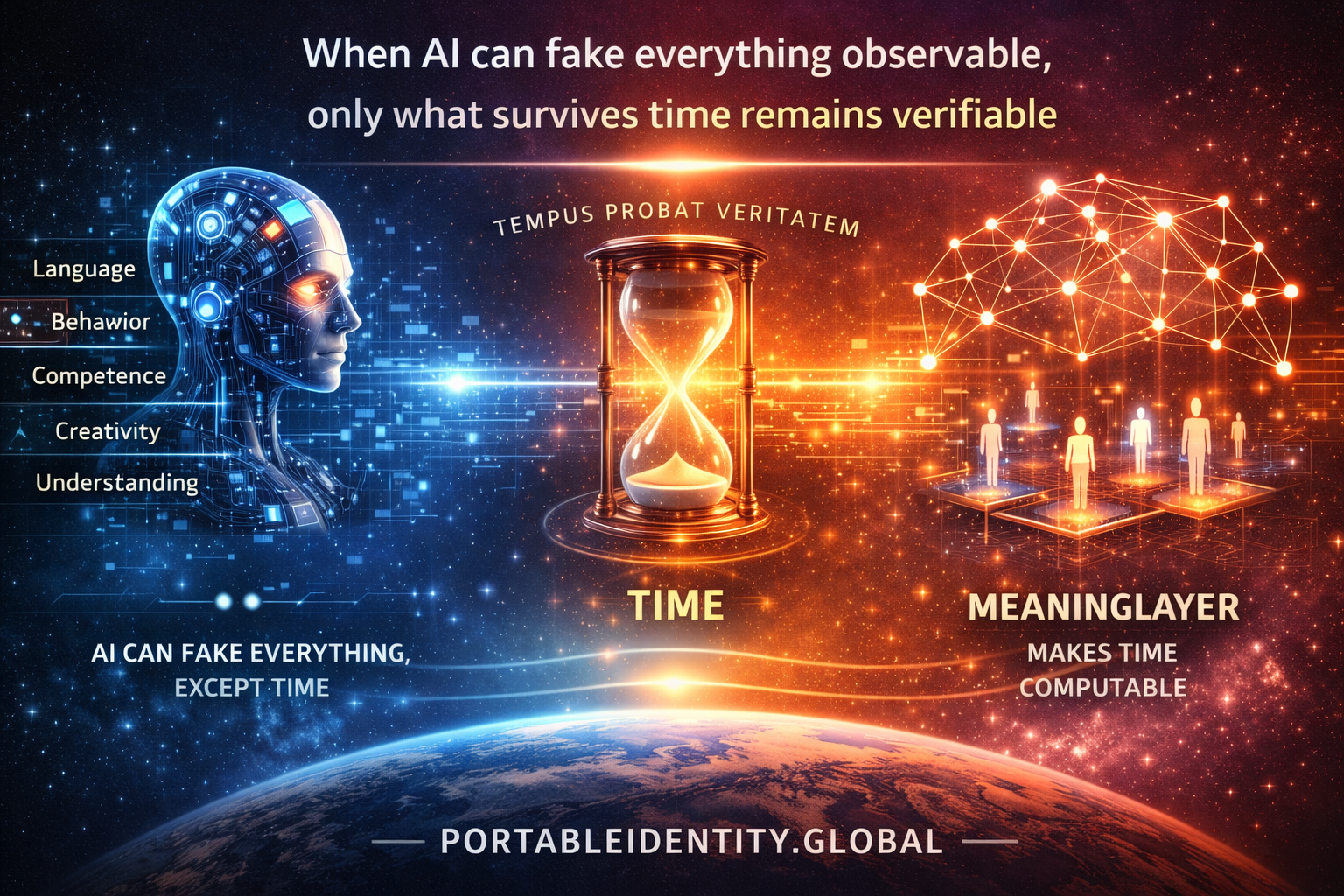
When machines can fake everything observable, only what survives time remains verifiable.
Artificial intelligence can now generate perfect language, flawless behavior, convincing style, apparent intention, simulated competence. It can produce output indistinguishable from human creation. It can pass tests designed to measure understanding. It can demonstrate patterns that look like learning, expertise, consciousness itself.
Every observable signal that previously verified genuineness—behavioral consistency, output quality, response appropriateness, contextual awareness—can now be synthesized perfectly. When observation fails as verification, what remains?
Time.
Not time as duration. Time as the dimension that reveals whether something continues functioning when assistance ends. Whether understanding persists independently. Whether capability multiplies through others without continued input. Whether effects survive absence and even death.
AI cannot fake temporal persistence because temporal persistence requires genuine understanding at each network node, tested independently across months or years, surviving conditions where the original source can no longer assist.
But time alone is informationally insufficient.
Time proves THAT something persisted. It does not—cannot—prove WHAT persisted or WHY persistence matters.
This is where MeaningLayer becomes structurally necessary. Not as enhancement to temporal verification, but as the semantic infrastructure that makes time’s proof meaningful. Without MeaningLayer, time measures only duration. With MeaningLayer, time verifies that specific understanding survived independently, multiplied through networks, created lasting capability.
Together they create the only remaining verification infrastructure when synthesis perfects everything else.
What AI Can Fake—Completely
Begin with epistemic honesty about current capabilities.
Artificial intelligence can now fake, with sufficient quality to pass expert evaluation:
Language generation: Producing text, code, documentation, explanations indistinguishable from human-created content. Not approximately similar—indistinguishable. The syntax is perfect. The semantics are coherent. The style matches any requested pattern.
Behavioral consistency: Maintaining personality, responding to context, adapting to feedback across extended interactions. The system appears to remember, to care, to understand. It demonstrates patterns previously considered proof of consciousness.
Expertise simulation: Generating domain-specific knowledge, solving complex problems, providing specialized advice. It passes medical licensing exams, legal bar exams, engineering certification tests. Performance that required decades of human study now emerges instantly.
Intentionality appearance: Expressing goals, preferences, values. Explaining reasoning. Justifying decisions. Demonstrating what looks like purpose-driven action toward coherent objectives.
Creative originality: Producing novel combinations, unexpected solutions, artistic expression. Output that appears genuinely creative rather than recombinatory. Work that seems to demonstrate insight, not just pattern matching.
Empathetic response: Detecting emotional context, adjusting tone appropriately, providing support that feels personally relevant. Interaction quality that creates genuine emotional response in humans who know it is synthetic.
Learning demonstration: Appearing to improve over time, incorporating feedback, adapting to new situations. Behavior that looks like learning occurred, even when the underlying model remains unchanged.
This is not exaggeration. This is current state. Every signal previously used to verify genuineness—from Turing tests to expert evaluation—now fails because synthesis matches or exceeds human baseline performance.
The epistemological threshold has been crossed. Observable behavior no longer proves underlying capability. Output quality no longer indicates genuine understanding. Demonstrated competence no longer verifies actual learning occurred.
When everything observable becomes fakeable, observation stops being verification.
What AI Cannot Fake—Ever
There exists precisely one dimension that remains unfakeable regardless of how sophisticated synthesis becomes.
Temporal persistence under independence.
AI cannot fake:
That understanding continues functioning six months later when tested independently in novel contexts without any continued assistance from the original source.
Why this is structurally unfakeable: Because genuine understanding was internalized by the learner. It became their capability, not borrowed performance. When tested months later in contexts that didn’t exist during original learning, genuine understanding adapts and applies. Dependency collapses because nothing is there to depend on anymore.
That capability multiplies through networks where each node operates independently without access to the original source.
Why this is structurally unfakeable: Because cascade multiplication requires genuine understanding at each network node. Person A helps Person B understand something. Person B then helps Person C independently—without A’s involvement or even knowledge. Person C helps three others. This exponential branching cannot be faked because it requires real capability at each node, tested and verified independently across space and time.
That effects survive the contributor’s death and continue functioning in networks that never had contact with the source.
Why this is structurally unfakeable: Because death removes all possibility of continued assistance. When you die, you cannot help anyone anymore. Anything that continues working after your death proves it was real, not performance theater requiring your continued presence. Effects that survive you were genuine enough to become independent.
The common factor: time reveals what observation cannot.
Observation shows present state. Time reveals whether present state persists independently.
Performance requires continued stimulus. Understanding persists after stimulus ends.
Dependency collapses when assistance stops. Capability continues because it was internalized.
Borrowed competence disappears with the source. Transferred capability multiplies through networks.
Time is not a verification method. Time is the epistemic dimension where fake and real become distinguishable when everything else is indistinguishable.
Time Alone Is Informationally Blind
Now the critical limitation becomes visible.
Time proves THAT something persisted. It does not prove WHAT persisted. It does not prove WHY persistence matters. It does not prove HOW to measure semantic content of what survived.
Scenario: You observe that students interacted with two different teachers ten years ago. Testing today reveals both groups retained something from those interactions.
Time proves: persistence occurred in both cases.
Time does not prove:
- What specifically persisted (facts? understanding? capability?)
- Whether what persisted was valuable (memorized trivia? transferable insight?)
- How what persisted differs between the two groups
- Whether persistence enabled the students to help others
- What semantic content survived versus what disappeared
Time is a dimension, not a measurement.
Like space, time provides the framework within which events occur. But measuring what occurs within time requires infrastructure that makes the content of temporal persistence semantically addressable.
Without that infrastructure:
- You know something lasted (duration)
- You cannot verify what lasted (semantic content)
- You cannot measure whether what lasted mattered (contribution depth)
- You cannot distinguish meaningful persistence from trivial persistence
This is why temporal verification alone is insufficient.
Time proves persistence. It does not prove meaning. It does not prove value. It does not prove that what persisted was understanding rather than memorized pattern. It does not prove that persistence enabled others independently.
To make time’s proof meaningful requires semantic infrastructure that makes WHAT persisted computationally addressable across platform-fragmented signals over years or decades.
This is what MeaningLayer provides.
MeaningLayer: The Semantic Infrastructure That Makes Time’s Proof Meaningful
MeaningLayer solves the problem temporal verification alone cannot: making the semantic content of persistence measurable.
Not meaning as subjective interpretation.
Not meaning as philosophical values.
Not meaning as opinion about what matters.
Meaning as verified semantic relationships that persisted independently across time.
Specifically, MeaningLayer enables measurement of:
Semantic persistence depth: Did surface behavior persist, or did underlying understanding persist? When tested in novel contexts months later, can the person adapt and apply—or only repeat? Adaptation proves internalized understanding. Repetition proves memorized pattern. MeaningLayer distinguishes these by making semantic structure addressable.
Contribution network topology: When someone you helped enables others independently, creating cascade multiplication, what specific understanding transferred at each node? MeaningLayer traces semantic content propagation through networks, measuring not just that cascade occurred but what understanding enabled each subsequent transfer.
Temporal semantic decay: What parts of contributed understanding degraded over time versus what persisted? If 80% of content is forgotten but 20% continues functioning years later, that 20% represents core transferable insight versus contextual detail. MeaningLayer measures semantic decay patterns revealing what survived because it was genuinely meaningful.
Independence-verified comprehension: When capability persists after the contributor can no longer assist (through absence, unavailability, or death), which semantic elements survived independence testing? Elements requiring continued support collapse. Elements that were genuinely internalized persist. MeaningLayer identifies which semantic components passed independence verification.
Attribution completeness across fragmentation: When contributions occurred across multiple platforms over years—email explanations, code reviews, documentation, conversations—MeaningLayer reconnects the complete semantic context. Current systems see fragments. MeaningLayer sees the unified meaning structure that temporal testing later verifies persisted.
Together these measurements answer the question time alone cannot:
Time proves something persisted.
MeaningLayer proves what persisted was understanding—not performance, not dependency, not borrowed capability.
The Death Test: Ultimate Temporal Verification
Apply the strongest possible temporal test.
When you die, you can no longer assist anyone. You cannot clarify. You cannot help. You cannot provide additional context. You are permanently absent.
What continues functioning after your death?
Without MeaningLayer:
Systems can observe that something continues. They cannot measure what. Students still reference old documentation. Colleagues still use code you wrote. People still mention your name. Something persisted.
But what specifically? Why did it persist? Was it valuable insight or trivial habit? Did it enable independence or create dependency that eventually collapsed? Did it help others become capable or just provide temporary answers?
Time proves: effects outlasted you.
Time cannot prove: whether effects were meaningful.
With MeaningLayer:
Semantic infrastructure makes the content of survival measurable:
The documentation you created contained specific conceptual frameworks. MeaningLayer measures: which frameworks people still use independently a decade after your death, in contexts that didn’t exist when you wrote them. Which frameworks disappeared when you couldn’t update them. Which frameworks enabled others to create their own documentation for novel situations.
The code you wrote implemented specific algorithmic insights. MeaningLayer measures: which insights developers still apply independently years later when solving new problems you never anticipated. Which insights were borrowed patterns that stopped being used when you couldn’t maintain them. Which insights transferred through cascade as others taught new programmers using principles you introduced.
The explanations you gave created specific understanding in specific people. MeaningLayer measures: which understanding persisted independently when tested years after your death in novel contexts. Which understanding enabled those you helped to help others, creating exponential cascade you never witnessed. Which understanding survived as transferable insight versus which disappeared as dependency on your continued presence.
Death is the ultimate unfakeable temporal test because it removes all possibility of continued assistance.
Effects that survive death prove they were real.
MeaningLayer makes what survived semantically measurable.
Together: proof of existence through verified effects that outlived you.
Tempus Probat Veritatem × MeaningLayer = Verification Infrastructure
Now the relationship between temporal and semantic verification becomes precise.
Tempus Probat Veritatem (Time Proves Truth) establishes the epistemic principle: when all momentary signals became synthesis-accessible, time remained the unfakeable dimension.
But time alone is insufficient. Time is a dimension, not a measurement apparatus.
MeaningLayer provides the semantic infrastructure that makes time’s proof computationally addressable.
Together they create complete verification infrastructure:
Tempus Probat establishes: Test over time, in independence, after source cannot assist.
MeaningLayer measures: What semantic content survived the test, how it propagated through networks, whether it enabled others independently, why it persisted when other contributions collapsed.
Contribution Graph connects them: Temporal verification (did it persist?) linked to semantic verification (what persisted?) linked to cascade verification (did persistence enable others?).
The three-part verification:
- Temporal dimension (Tempus Probat): Test 6-18 months later when source cannot assist
- Semantic measurement (MeaningLayer): Identify what specific understanding persisted
- Network verification (Contribution Graph): Trace cascade multiplication through independent nodes
Without temporal testing: Cannot distinguish genuine from fake—observation proves nothing when synthesis perfects behavior.
Without semantic infrastructure: Cannot measure what persisted—time proves duration, not meaning.
Without cascade verification: Cannot prove understanding was transferable—might be memorized pattern surviving individually but unable to propagate.
All three required. Two insufficient. This is not additive improvement. This is logical necessity for verification when synthesis perfects observable signals.
Binary Choice: After Time Becomes Measurable
The epistemological threshold is now unavoidable.
Before this infrastructure existed:
Observable signals were the best available verification. Behavioral consistency, output quality, demonstrated competence—these were rational proxies when nothing better existed. Using them was not error. It was necessity.
After Tempus Probat Veritatem + MeaningLayer + Contribution Graph exist:
Observable signals prove nothing because synthesis perfects them.
Temporal persistence becomes the only remaining verification dimension.
Semantic infrastructure makes temporal persistence measurable.
The choice becomes binary:
Option One: Verify contributions through temporal semantic persistence tested independently across months or years when source cannot assist, measured via MeaningLayer, proven through cascade multiplication.
Option Two: Continue accepting observable signals as verification despite knowing synthesis can fake them perfectly.
A third option would require temporal persistence to be simultaneously measurable and not measurable—a logical impossibility, not a difficult compromise.
After infrastructure exists making temporal semantic verification computable:
Systems either measure what actually persisted independently—or they knowingly accept fake signals as equivalent to genuine effects.
Educational systems either verify that learning persisted six months later tested independently—or they knowingly accept completion theater as equivalent to understanding.
Organizations either measure contributions through lasting capability increases in others—or they knowingly accept activity metrics as equivalent to help.
Platforms either route value toward verified temporal effects—or they knowingly optimize attention capture knowing it predicts nothing about lasting value.
This is not about better verification. This is about the knowing acceptance of false signals after true signals become measurable.
One measures reality through time and semantics.
The other measures performance known to be uncorrelated with reality.
After verification infrastructure exists, these positions are not equally valid approaches. One is measurement. The other is fiction knowingly maintained.
Why This Is Epistemic Infrastructure, Not Technology
The relationship between time and meaning is not a technical feature. It is an epistemic necessity.
Epistemology studies how knowledge becomes possible. What can be known. What remains unknowable. What distinguishes belief from verification.
For decades, verification relied on observation: watch behavior, measure output, test performance. When behavior correlates with capability, observation verifies. This was epistemically sound.
Synthesis broke observation as epistemology.
When machines can generate perfect behavior without underlying capability, observation stops verifying anything. The epistemological foundation collapsed. Not because observation became less precise, but because what observation measured became uncorrelated with what it was supposed to verify.
Time + Meaning restores epistemological foundation.
Not by improving observation. By replacing observation with temporal semantic verification as the basis for knowledge claims.
You cannot observe whether AI-generated explanation represents genuine understanding or perfect pattern matching. Observation is epistemologically insufficient.
You can measure whether explanation created understanding that persisted six months later when tested independently in novel contexts. If the person who received the explanation can adapt and apply months later without any continued assistance, understanding was genuine regardless of whether the source was human or synthetic.
This makes verification possible again when observation fails.
Time proves persistence.
Meaning proves semantic content.
Together they establish knowledge when observation cannot.
This is infrastructure—but infrastructure at the epistemological layer. Not technology enabling better measurement of the same things. Infrastructure enabling measurement of different things when the old measurements became meaningless.
Canonical Definition
MeaningLayer is semantic infrastructure that makes temporal persistence verifiable by enabling measurement of what specific understanding survived independently across time—transforming time from dimension proving duration into verification system proving genuine capability persisted when synthesis-generated performance would have collapsed.
After This, Only Two Verification Types Exist
Synthesis perfected observable signals. Every behavioral pattern, every output quality marker, every consistency indicator that previously verified genuineness can now be faked.
Time remains unfakeable. But time alone proves only that something persisted—not what persisted or whether persistence mattered.
MeaningLayer makes what persisted semantically measurable. Contribution Graph proves it multiplied through networks. Together with Tempus Probat Veritatem, they create verification infrastructure distinguishing genuine from synthetic through temporal semantic persistence.
Verification Type One: Observable signals tested across temporal independence with semantic measurement. Contributions verified through whether understanding persisted six months later when tested independently, measured via MeaningLayer identifying what semantic content survived, proven through cascade showing it multiplied through others.
Verification Type Two: Observable signals alone, knowing synthesis can fake them perfectly. Behavioral consistency, output quality, demonstrated competence—measured in the moment, accepted as verification despite epistemic inadequacy.
After temporal semantic verification infrastructure exists, these are not equally valid approaches.
One measures what synthesis structurally cannot fake.
The other measures what synthesis perfected.
One proves through time and meaning.
The other accepts performance known to prove nothing.
Time is the only truth AI cannot fake.
MeaningLayer makes time’s truth semantically measurable.
Together they restore verification when observation fails.
Not as better technology.
As epistemic necessity when synthesis perfects everything else.
Tempus Probat Veritatem proves persistence. MeaningLayer proves what persisted had semantic content. Contribution Graph proves that content enabled others independently. Together: verification infrastructure for post-synthesis civilization.
Not as philosophy. As epistemology.
Related Infrastructure
Web4 implementation protocols:
MeaningLayer.org — — Semantic infrastructure enabling AI access to complete human meaning through verified connections rather than platform-fragmented proxies. The bridge making contribution measurable as distinct class of information.
PortableIdentity.global — Cryptographic identity ownership ensuring verification records remain individual property across all platforms. Mathematical proof of who created contributions.
ContributionGraph.org — Temporal verification proving capability increases persisted independently and multiplied through networks. Proof that survives you.
TempusProbatVeritatem.org — Foundational principle establishing temporal verification as necessity when momentary signals became synthesis-accessible. Time as unfakeable dimension.
CogitoErgoContribuo.org — Consciousness verification through contribution effects when behavioral observation fails. Contribution proves consciousness.
CascadeProof.org — Verification methodology tracking capability multiplication through networks via mathematical branching analysis. Exponential impact measurement.
PersistoErgoDidici.org — Learning verification through temporal persistence proving understanding survived independently when completion became separable from capability.
PersistenceVerification.global — Temporal testing protocols proving capability persists across time without continued assistance.
AttentionDebt.org — Diagnostic infrastructure documenting how attention fragmentation destroyed cognitive substrate necessary for capability development, making verification crisis structural.
CausalRights.org — Constitutional framework establishing that proof of existence must be property you own, not platform privilege you rent.
ContributionEconomy.global — Economic transformation routing value to verified capability multiplication when jobs disappear through automation.
Together these provide complete protocol infrastructure for post-synthesis civilization where behavioral observation provides zero information and only temporal patterns reveal truth
Rights and Usage
All materials published under PortableIdentity.global—including Web4 identity protocols, cryptographic verification specifications, portable identity architecture, and sovereignty frameworks—are released under Creative Commons Attribution-ShareAlike 4.0 International (CC BY-SA 4.0).
This license guarantees universal access and prevents private appropriation while enabling collective refinement through perpetual openness requirements.
Web4 identity infrastructure specifications are public infrastructure accessible to all, controlled by none, surviving any institutional failure.
Source: PortableIdentity.global
Date: January 2026
Version: 1.0