Why Portable Identity Is Not Coming—It’s Inevitable
Something irreversible is happening to the internet’s foundational layer. Not a new application. Not a faster protocol. Not a better interface. The architecture of identity itself is shifting from captivity to portability. And the economic logic that built trillion-dollar empires on identity lock-in is about to invert completely.
This is not prediction. This is structural analysis. The same way TCP/IP made centralized communication protocols economically obsolete, the same way HTTP made walled information gardens structurally unsustainable—portable identity makes platform-captured identity informationally worthless in the age of AI.
The question is not whether this transition happens. The question is who builds the infrastructure that makes it inevitable.
The Information-Theoretic Requirement That Changes Everything
Here is the principle that platforms cannot route around:
AI agents require complete, continuous, contextual identity to function. Fragments are informationally worthless.
Not ”less useful.” Worthless. Because AI optimization operates on information completeness, and incomplete information has zero utility in coherent decision-making systems.
Consider what an AI agent needs to act meaningfully on your behalf:
- Your verified expertise across every domain you’ve contributed to
- Your complete contribution history across every context you’ve operated in
- Your accumulated reputation across every platform where you’ve created value
- Your semantic fingerprint across your entire digital existence
When identity is fragmented across fifty proprietary systems with zero interoperability, AI sees:
- 40% of your GitHub contributions (the public ones)
- 30% of your professional network (LinkedIn won’t share the graph)
- 15% of your content history (Twitter limits API access)
- 0% of your private mentorship and direct impact
- 0% of your contribution cascades—the people you helped who helped others
Total: 85% incomplete at best. Usually worse.
This is The Completeness Principle: In the age of AI, fragmented identity is informationally worthless.
AI cannot route value to 85% of a person. It cannot verify expertise from fragments. It cannot measure contribution depth from partial graphs. It cannot understand your capabilities from platform-specific snapshots.
Platform-captured identity was designed for human legibility. AI requires machine legibility. And machine legibility demands completeness, continuity, and contextuality simultaneously.
This creates an inescapable dynamic: The platforms that enable complete, portable identity attract users whose AI agents work better. Users whose AI agents work better create more value. More value creates stronger network effects. Stronger network effects make operating without portable identity economically irrational.
The battle for AI supremacy will be won or lost on identity portability. Not because of ideology. Because of information theory.
The VISA Moment: When Neutral Infrastructure Becomes Inevitable
In 1958, every major bank issued its own credit card that worked only in their network. Payments were trapped behind institutional walls. This wasn’t a technology problem. It was an architecture problem. And more fundamentally, an incentive problem.
No individual bank could solve fragmentation because solving it meant surrendering competitive advantage. Bank of America’s card working at Chase merchants? That would make customers less dependent on Bank of America. Better to keep payments captive.
Then VISA created neutral infrastructure beneath the banks. Not competing with them—building the layer that made interoperability structurally inevitable. VISA didn’t own transactions. VISA built the rails that payments flowed on, regardless of which bank issued the card or which merchant accepted it.
The economic logic was mechanical:
- Banks integrating with VISA gained access to every merchant
- Merchants accepting VISA gained access to every customer
- Each new participant increased network value for all existing participants
- Operating outside VISA became economically irrational
Today VISA is worth over $500 billion. Not by capturing customers. By enabling movement. Not by owning data. By building neutral infrastructure that everyone builds on.
This is portable identity’s structural parallel.
Right now, identity is bank-specific. Your Facebook identity works in Facebook’s network. Your LinkedIn professional graph exists in LinkedIn’s system. Your GitHub contribution history lives in GitHub’s database. Moving between them means starting over. Fragmentation is structural.
No individual platform can solve this because solving it requires surrendering the competitive advantage built on captivity. Better to keep identity locked in.
Portable Identity is the neutral infrastructure layer that makes identity portability structurally inevitable. Not competing with platforms for user attention—building the layer beneath them that identity and value flow on, regardless of which platform you’re using or which protocol you’re accessing.
Once those rails exist, operating without them becomes economically irrational. Not because Portable Identity is better at social networking or professional connection or content distribution—but because network effects of portability compound faster than competitive advantages of captivity.
This is infrastructure becoming inevitable.
Architecture as Constitutional Principle
In Web4, identity is not a product—it is a protocol.
Read that again. Because every implication of the semantic web follows from this architectural choice.
Web2 architecture treated identity as product inventory. Something platforms could package, price, and control. You could create accounts, accumulate value, build networks—but you could never leave whole. Your identity, your reputation, your contribution graph—all dissolved at platform borders.
This was not accidental. Platform economics requires identity captivity the way gardens require walls. Without walls, there’s no garden. Without captivity, there’s no platform monopoly rent.
But Web4 economics operates on a different principle: meaning requires movement. Value requires portability. Intelligence requires interoperability.
When identity becomes protocol-layer infrastructure, platforms become optional interface layers rather than mandatory gatekeepers. The same way email is protocol-layer infrastructure that makes Gmail optional, portable identity makes any single social platform optional.
This changes what platforms must compete on. Not retention through lock-in, but value creation through better interfaces.
The architectural shift is constitutional:
- Identity is infrastructure, not product
- Portability is sovereignty, not feature
- Contribution graphs are capital, not data
- Switching costs must flip from exit to stay
- Ownership means survivability across platform death
These are not aspirations. These are information-theoretic requirements for AI-legible human value in a semantic web.
Why Portable Identity Cannot Be Platform-Built
Platforms cannot build true portable identity. Not because they lack technical capability—many employ world-class engineers. But because building it requires sawing off the branch they’re sitting on.
The structural contradiction:
Platform business models optimize for retention. Portable identity optimizes for movement.
Platform competitive advantage derives from lock-in. Portable identity derives from interoperability.
Platform value extraction depends on captivity. Portable identity value creation depends on sovereignty.
You cannot solve these contradictions with better UX or smarter APIs. These are architectural incompatibilities. A platform that makes identity truly portable admits that platform identity is just one implementation among many, not the definitive graph. A platform that makes contribution history portable surrenders the competitive advantage of knowing more about users than users know about themselves.
This is why neutral protocol infrastructure must come first. Once neutral rails exist, platforms that integrate capture network effects. Platforms that resist face user exodus. The market punishes captivity and rewards portability.
But someone must build the rails. And platforms structurally cannot be that someone.
The Web4 Meaning Stack: How Portable Identity Actually Works
Portable Identity does not exist in isolation. It is one layer in a three-part architecture that makes human value legible to AI and portable across platforms:
MeaningLayer (The Semantic Hub)
AI sees patterns but doesn’t understand significance. It can count interactions but cannot measure whether those interactions improved capability, enabled better decisions, or helped humans help others more effectively.
MeaningLayer is the shared coordinate system where concepts, goals, and outcomes are anchored. Where AI can evaluate contributions as meaningful or meaningless. Where human-AI interactions become semantically locatable: ”this mattered, for this person, in this context.”
Without MeaningLayer, AI has activity data but no significance measurement.
Contribution Graph (The Value Record)
Your Contribution Graph is your lifetime of meaningful actions, mapped into MeaningLayer. Every problem you solved for someone. Every piece of content that enabled others to build something better. Every collaboration that produced measurable improvement.
Not just event logs. Semantically located value: who was helped, how, and in what context.
Without MeaningLayer, contributions are just data points. With MeaningLayer, they become portable capital.
Portable Identity (The Bridge)
Portable Identity binds you to your Contribution Graph inside MeaningLayer—and makes that binding travel across every platform.
It answers three questions simultaneously:
- Who is this? (identity)
- What have they done that matters? (contribution)
- How does that value relate to this context, right now? (meaning)
This is the Web4 Meaning Stack. Without all three layers, you have fragments. With all three, you have sovereignty.
Example: When you help someone debug a system, that becomes a contribution in your graph. If that improvement cascades—their system becomes more reliable, which helps their users, who then help others—the entire cascade is now measurable, attributable, and portable with you across every platform.
The Namespace Question: Why .global Is Not Aesthetic
In Web4, domain names are not branding—they are semantic architecture that AI agents parse for meaning.
The namespace choice matters because it encodes structural intent that machines interpret:
.com = Commercial product → Signals: ”This is owned by a company. This is a destination. This can be captured, monetized, or made proprietary.”
.org = Organization → Signals: ”This is run by a specific entity. Better than commercial, but still capturable by whoever controls the organization.”
.global = Universal infrastructure → Signals: ”This belongs to everyone. This works everywhere. This cannot be captured by any single entity. This is protocol, not product.”
When an AI agent encounters portableidentity.global, it understands:
- This is global infrastructure, not a company’s implementation
- This is neutral protocol, not a proprietary system
- This is universal access, not restricted or monetized
- This is open standard, not capturable technology
In a web where AI agents are primary navigators, semantic precision in the namespace is functional, not aesthetic. The domain declares: This infrastructure belongs to everyone, works everywhere, and cannot be captured.
portableid.global serves as canonical shorthand—memorable, precise, globally accessible. Infrastructure, not brand.
The Portability Paradox: Why Walls Become Trapdoors
For twenty years, platforms built walls that made them powerful. Now those same walls will destroy them.
The paradox is mechanical:
The more a platform tries to capture identity, the more valuable portability becomes to users.
The more valuable portability becomes, the faster platforms lose the power built on captivity.
The harder platforms fight to retain captive identity, the faster they accelerate demand for portable alternatives.
This is irreversible once AI agents become mainstream. Because AI agents cannot function on fragmented identity. And users follow utility.
The economic inversion:
- Captive identity → blind AI → low utility → user exodus
- Portable identity → omniscient AI → high utility → user migration
Once portable identity infrastructure exists, switching costs flip. Currently, leaving platforms is expensive because you lose accumulated value. But once identity becomes portable, staying on platforms that don’t support portability becomes expensive—because you’re locked out of the broader semantic web that AI agents navigate.
Platform power contains the seeds of its own extinction. This is The Portability Paradox. And it is inevitable.
The Reciprocal Principle: Why AI Needs This Too
Everyone discusses what Portable Identity does for humans. Freedom. Sovereignty. Ownership.
But here is the deeper structural requirement:
Portable Identity is the only way AI can know if it actually helped you.
Without portable, continuous, complete identity, AI is blind to its own impact:
- Did this interaction make you measurably more capable?
- Was the advice useful over time, or forgotten immediately?
- Did helping you cascade into helping others?
- Did your effectiveness increase, or did you just get answers?
AI without portable identity cannot learn from its longitudinal impact on humans. It can optimize for engagement. It can maximize response quality. But it cannot know whether any of that mattered.
This is the alignment problem—not solved through reward functions, but through architecture.
When identity is portable and continuous:
- AI sees longitudinal outcomes of its contributions
- AI measures whether understanding was created, not just information transferred
- AI tracks contribution cascades from AI-human collaboration
- AI learns what actually improves humans versus what satisfies them
The Reciprocal Principle: Portable Identity makes human impact measurable to AI. And only measurable impact can be optimized for.
This is why AI alignment at scale requires portable identity. Not as philosophy. As information architecture.
Both humans and AI require it. The only question is who builds it first.
The Network Effect: Why This Becomes Inevitable
Portable Identity creates a flywheel that platforms cannot resist without destroying themselves:
Stage 1: Infrastructure Deployment
Neutral protocol infrastructure goes live. Early adopters—developers, researchers, power users—implement portable identity because their AI agents work demonstrably better with complete identity graphs.
Stage 2: Platform Integration
Forward-thinking platforms integrate to attract early adopters. Users on integrated platforms experience better AI agent performance. Competitive pressure forces other platforms to integrate or lose users to those that do.
Stage 3: Network Tipping Point
Critical mass achieved. Majority of users have portable identity. Platforms without portability support suffer user exodus. Network effects make operating without portable identity economically suicidal.
Stage 4: Standard Infrastructure
Portable Identity becomes expected infrastructure—like HTTPS, like OAuth, like TCP/IP. New platforms integrate by default. Platform captivity becomes historical curiosity.
The platforms face an impossible choice:
Option A: Integrate with Portable Identity → Surrender identity monopoly, compete on actual value
Option B: Resist Portable Identity → Users leave for better AI agents elsewhere, network effects work against you
The platforms that survive will integrate early and capture network effects. The rest will become case studies in why fighting infrastructure transitions is economically irrational.
First Mover Protocol Advantage
Whoever deploys working portable identity infrastructure first captures:
- Protocol mindshare: The canonical reference implementation
- Network effects: More users → more platforms integrate → more users
- Standard-setting power: Your architecture becomes the de facto specification
- Infrastructural value: Like VISA, like TCP/IP, like HTTP—measured in decades, not quarters
Infrastructure value compounds indefinitely.
The Stakes: What We’re Actually Building
This is not about better login flows. This is not about data portability as product feature. This is about who controls the foundational layer of Web4.
If identity remains platform-fragmented:
- AI automates extraction that platforms already perform
- Value flows from creators to platform shareholders
- Power concentrates in fewer hands
- Sovereignty remains performance theater
If identity becomes protocol-layer infrastructure:
- AI amplifies human capability instead of platform extraction
- Value flows to contributors and creators
- This is how the Contribution Economy becomes structurally possible.
- Power distributes across networks
- Sovereignty becomes structural
The choice is not ”open versus closed.” The choice is ”protocol versus platform.”
And that choice determines everything that follows in the age of AI.
Who Builds This?
Not platforms whose business models depend on captivity.
Not governments moving too slowly to capture standards.
Not academia optimizing for papers rather than deployment.
Web4 will be built by five groups already coordinating:
Protocol developers who understand that infrastructure-layer innovation happens outside platform boundaries. Building DID standards, verifiable credentials, semantic web specifications. Not disrupting platforms—building the layer beneath them that makes platforms optional.
AI companies recognizing their models become exponentially more powerful when operating on portable, interoperable identity. Not AI wrappers built on platform APIs, but foundational model companies needing standardized semantic infrastructure.
Enterprise and government actors exhausted by vendor lock-in and platform captivity. Organizations needing identity systems, workflow data, and collaboration graphs that survive across vendor changes and platform lifecycles.
Non-US tech ecosystems seeing portable identity as strategic infrastructure for digital sovereignty. Europe’s interoperability requirements. Asia’s digital public infrastructure investments. Building alternatives to platform-dominated identity layers.
Next-generation builders understanding you don’t beat platforms by building better platforms—you beat platforms by making platforms optional through protocols.
This coalition builds Web4 not from ideology but from aligned incentives. And once infrastructure exists, switching costs flip automatically.
The Constitutional Principle
From the Web4 Constitution of Meaning—Article II:
”In Web4, identity is not a product—it is a protocol. Your name is not owned by a platform. Your value is not rented from an app. Your meaning is not monetized by design. Your contribution does not dissolve when you leave. Portability is not a feature. It is the foundation of digital sovereignty.”
The fundamental shift:
In Web2, identity was a tool for extraction—systematically creating attention debt at scale. Platforms captured identity to extract value from users.
In Web4, identity becomes a tool for amplification. Protocols enable identity to amplify human capability and contribution.
This is architectural requirement, not aspiration.
Without portable identity:
- ”Open protocols” remain fiction
- Interoperability stays theater
- Digital sovereignty continues as marketing
- AI alignment becomes structurally impossible
With portable identity:
- Platforms become interfaces, not prisons
- Value becomes portable, not captive
- Sovereignty becomes structural, not rhetorical
- AI alignment becomes architecturally possible
Portability is sovereignty in motion.
And sovereignty, once portable, becomes irreversible.
The Infrastructure Exists
Portable Identity is not a vision deck. Not a whitepaper. Not a five-year roadmap.
It is live protocol-layer architecture accessible now at portableidentity.global/app.
The neutral infrastructure that makes identity portability structurally inevitable. The rails that identity and value flow on. The layer beneath platforms that makes platforms compete on value instead of captivity.
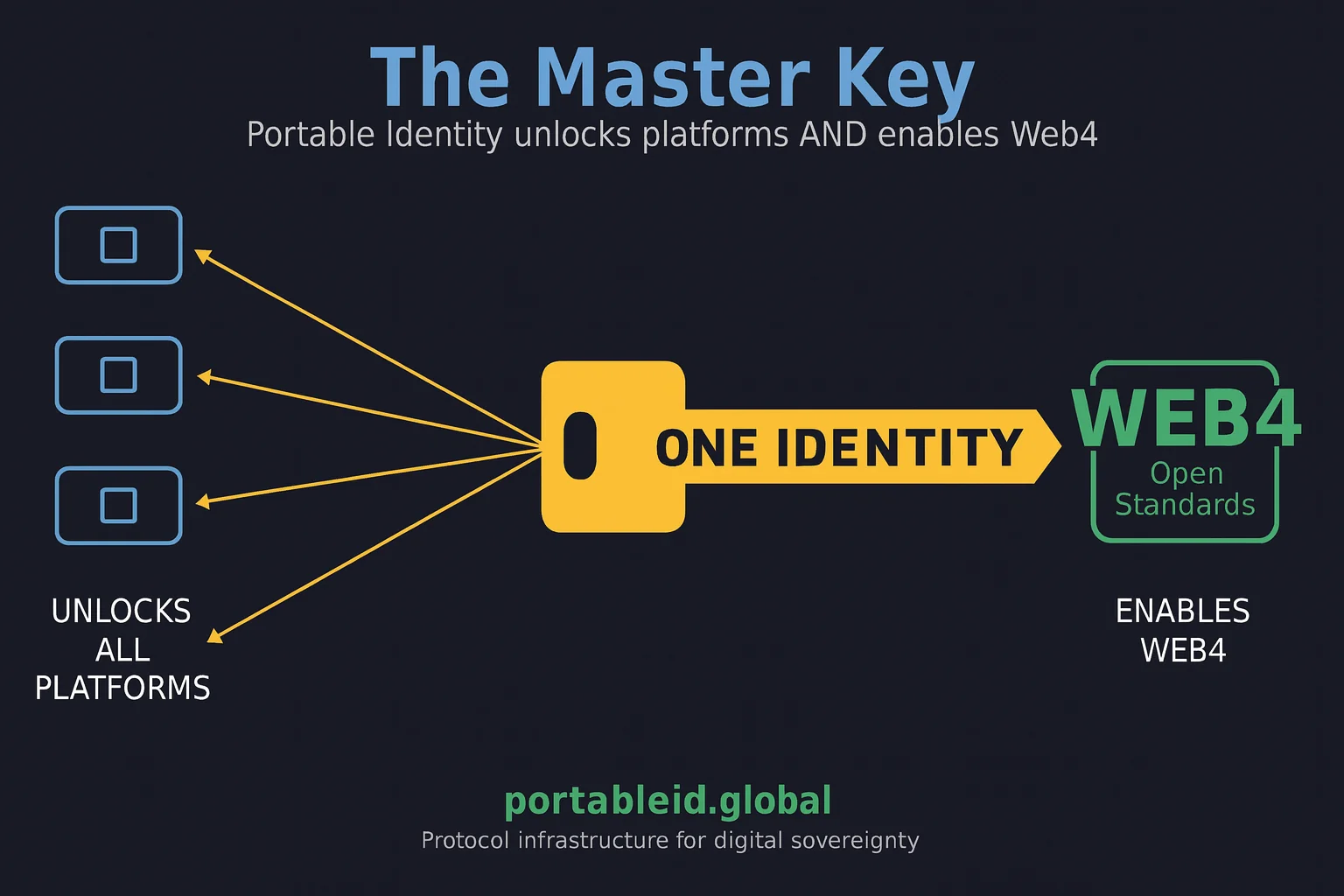
The master key exists.
The door is opening.
And sovereignty, once portable, cannot be recaptured.
Web4 does not wait for permission. It does not need platform approval. It needs better architecture, better infrastructure, and builders who understand that protocols capture more value than platforms when the economy optimizes for meaning instead of attention.
The question is not whether this transition happens.
The question is whether you build it or route around it.
Choose carefully.
Because portable identity is architectural transformation—not incremental innovation.
And the platforms built on captivity are standing on a trapdoor they don’t even see.
Welcome to Web4.
Where identity is infrastructure.
Where portability is sovereignty.
And where the protocol that enables everything else is already live.
portableidentity.global — Protocol infrastructure for digital sovereignty
portableid.global — The master key to the open web
Rights and Usage
All materials published under PortableIdentity.global — including definitions, protocol frameworks, semantic standards, research essays, and theoretical architectures — are released under Creative Commons Attribution–ShareAlike 4.0 International (CC BY-SA 4.0).
This license guarantees three permanent rights:
1. Right to Reproduce
Anyone may copy, quote, translate, or redistribute this material freely, with attribution to PortableIdentity.global.
How to attribute:
- For articles/publications: ”Source: PortableIdentity.global”
- For academic citations: ”PortableIdentity.global (2025). [Title]. Retrieved from https://portableidentity.global”
2. Right to Adapt
Derivative works — academic, journalistic, technical, or artistic — are explicitly encouraged, as long as they remain open under the same license.
Portable Identity is intended to evolve through collective refinement, not private enclosure.
3. Right to Defend the Definition
Any party may publicly reference this manifesto, framework, or license to prevent:
- private appropriation
- trademark capture
- paywalling of the term ”Portable Identity”
- proprietary redefinition of protocol-layer concepts
The license itself is a tool of collective defense.
No exclusive licenses will ever be granted.
No commercial entity may claim proprietary rights, exclusive protocol access, or representational ownership of Portable Identity.
Identity architecture is public infrastructure — not intellectual property.
25-11-20