Why Digital Civilization Requires a New Infrastructure Layer
This doctrine outlines the structural requirements for digital civilization. It establishes that Portable Identity is not optional infrastructure, but foundational architecture upon which functioning digital society must be built. What follows is not a proposal for consideration, but a recognition of what already exists as necessity.
EXECUTIVE SUMMARY
Digital civilization requires an identity layer that does not yet exist. The internet was built without identity infrastructure, and corporations filled that void with proprietary systems. The result: five billion humans exist digitally but own nothing of that existence.
The Core Argument: Portable Identity — cryptographically secured, user-controlled identity that travels across platforms — is not optional infrastructure. It is as foundational to digital society as roads are to physical cities, courts to legal systems, or clean water to public health.
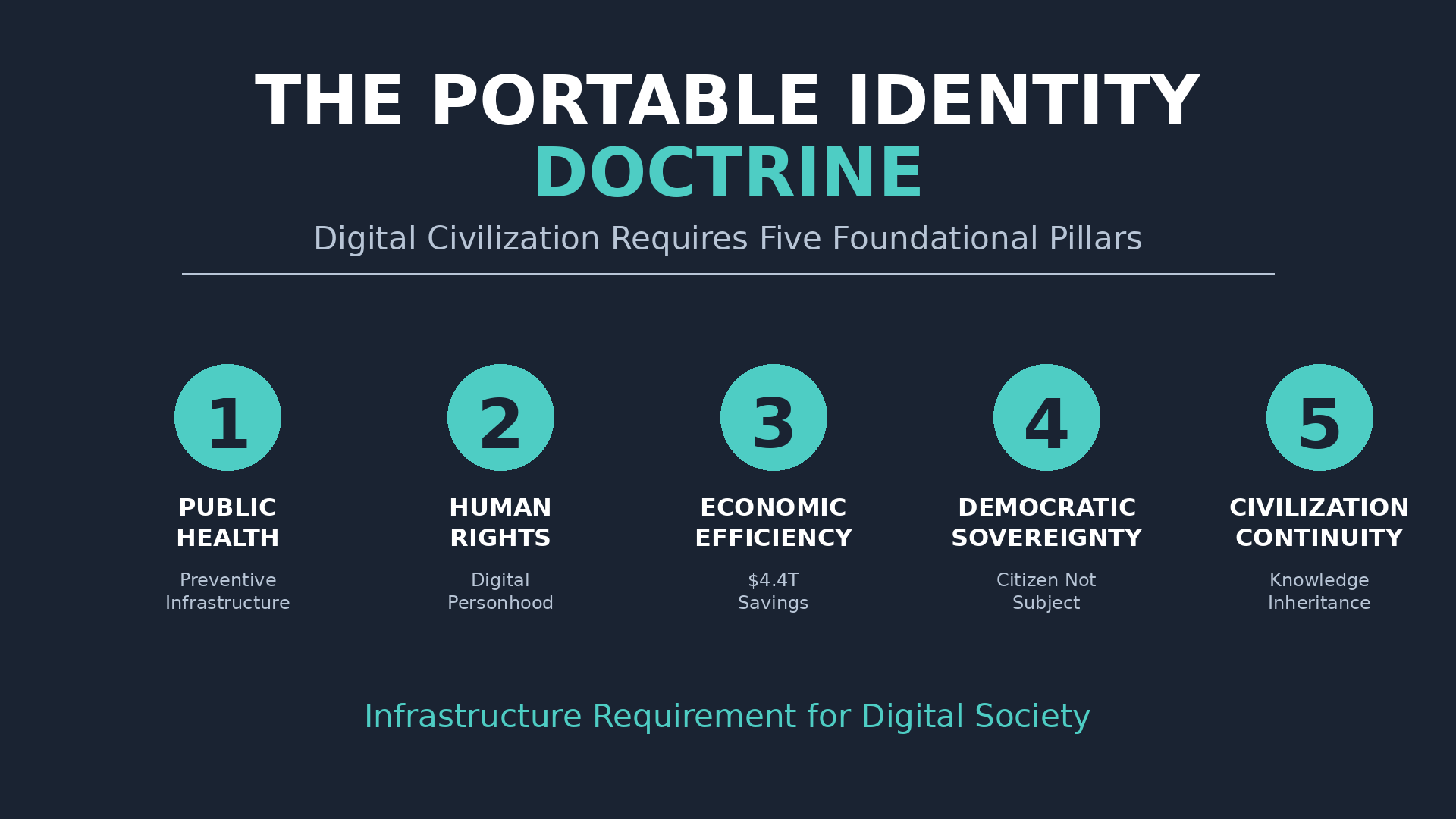
Why It Matters Across Five Dimensions:
- Public Health: Platform fragmentation creates population-level cognitive harm. Portable Identity is preventive infrastructure.
- Human Rights: Digital personhood requires identity sovereignty. Without it, digital rights are unenforceable.
- Economic Efficiency: Identity lock-in costs the global economy an estimated $4.4 trillion annually in lost knowledge and broken continuity.
- Democratic Sovereignty: Democracy requires citizens, not subjects. Platform-owned identity creates digital feudalism incompatible with democratic governance.
- Civilizational Continuity: For the first time in history, a generation cannot pass its digital legacy to the next. Knowledge extinction at scale.
The Implementation Framework: Technical architecture exists. What is missing is policy mandate: governments must recognize Portable Identity as fundamental infrastructure, health authorities must treat platform fragmentation as preventable harm, and platforms must integrate with portable identity standards.
The Timeline: The question is not whether this becomes standard, but how many more years of digital feudalism before we build what digital civilization structurally requires.
THE MISSING FOUNDATION
We built the internet without an identity layer.
This was not an oversight. It was a conscious design choice in the 1970s, made by brilliant engineers solving the problems of their time: how to connect computers, not how to connect humans.
The early internet architects faced questions about packet routing, data transmission, and network resilience. Identity authentication was deliberately left as an application-layer concern, not a protocol-layer requirement. Email addresses and domain names became de facto identifiers — not because they were designed for personhood, but because nothing better existed.
This design choice made sense in 1975. The internet connected hundreds of researchers. Identity could be managed informally.
Fifty years later, five billion humans exist digitally. And we are still operating on infrastructure designed for a few hundred academics.
The consequences are now undeniable.
Corporations filled the void. They built identity systems — not as public infrastructure, but as private property. Your digital existence became fragmented across platforms, each one owning a piece of you, none of them allowing you to leave intact.
This created a new form of power: identity ownership. Whoever controls your digital identity controls your access to society, your economic mobility, your voice, your relationships, your legacy.
And that power is held by corporations whose incentives are not aligned with human dignity, democratic sovereignty, or civilizational continuity.
This is not a market failure. Markets are functioning exactly as designed: platforms compete by capturing users and preventing exit.
This is an infrastructure failure. We are missing the foundational layer that would allow digital society to function in service of human flourishing.
And infrastructure failures require infrastructure solutions.
The Portable Identity Doctrine establishes that digital civilization requires a foundational identity layer — not owned by corporations, not controlled by governments, but inherent to personhood itself.
This is not a proposal. This is a recognition of what digital society structurally requires to function.
WHAT PORTABLE IDENTITY MEANS
Portable Identity is identity architecture that follows the person, not the platform.
Technical Definition: A cryptographically secured, user-controlled identity system that enables continuous verification of personhood, reputation, and contributions across all digital contexts without platform mediation.
Philosophical Definition: The principle that your digital self belongs to you — and can move with you — regardless of which systems you interact with.
Infrastructure Definition: The foundational layer that enables humans to exist as complete persons in digital space, equivalent to how roads enable physical mobility or courts enable legal personhood.
Portable Identity has four structural requirements:
1. Sovereignty You hold the cryptographic keys to your identity. No entity can revoke, suspend, or terminate your personhood.
2. Portability Your identity travels with you across platforms, preserving continuity of reputation, relationships, and contributions.
3. Verifiability Others can confirm your identity and history without requiring platform intermediaries.
4. Inheritance Your digital existence can be transferred to chosen heirs, preserving knowledge and legacy across generations.
These are not features to be added when convenient. They are structural requirements for digital personhood.
THE FIVE PILLARS: WHY PORTABLE IDENTITY IS FOUNDATIONAL
PILLAR ONE: PUBLIC HEALTH INFRASTRUCTURE
Web2 architecture is now recognized as a population-level health risk.
The symptoms are documented:
- Epidemic-scale attention fragmentation
- Rising anxiety and depression linked to identity incoherence
- Cognitive decline in populations raised on engagement optimization
- Social isolation despite unprecedented ”connection”
These are not individual pathologies. These are architectural consequences.
The public health principle is clear: when infrastructure causes population-level harm, you change the infrastructure.
We did not solve cholera by teaching people to boil water better. We built clean water systems.
We did not solve air pollution by asking individuals to breathe less. We regulated emissions.
We will not solve digital cognitive harm by teaching better ”digital hygiene.” We must change the architecture.
Portable Identity as Preventive Infrastructure:
Identity fragmentation — scattering your existence across dozens of platforms — creates cognitive load comparable to maintaining multiple personalities. Your brain must track different contexts, different reputations, different relationship graphs, different contribution histories.
This is not sustainable. And it is measurably harmful.
Portable Identity eliminates architectural fragmentation. One coherent self across all contexts. One continuous history. One unified reputation.
This is not a convenience. This is cognitive load reduction at population scale.
The World Health Organization will eventually recognize digital architecture as a determinant of health — as fundamental as nutrition, sanitation, and healthcare access.
When that recognition comes, Portable Identity will be understood as preventive infrastructure: the digital equivalent of clean water systems, not a nice-to-have feature.
PILLAR TWO: HUMAN RIGHTS FOUNDATION
Human rights evolve as societies recognize new dimensions of personhood requiring protection.
We recognized biological personhood: right to life, bodily autonomy, freedom of movement.
We recognized legal personhood: right to recognition before law, to nationality, to property.
We have not yet recognized digital personhood.
And without digital personhood, you cannot be a complete person in 2025.
The Stateless Condition:
When someone lacks legal personhood, we call them stateless. They exist biologically, but legally they are invisible, vulnerable, powerless.
Most humans today are digitally stateless.
You exist digitally — you work, communicate, create, transact — but you own nothing of that existence. Platforms own your identity. They can terminate it, modify it, restrict it, or monetize it without your consent.
You are not a digital citizen. You are a digital subject.
Case Study: The Terminated Professional
In 2023, a technical educator with 280,000 followers across multiple platforms had their primary account terminated. The stated reason: automated system flagged content as violation, no human review, no appeal process.
Overnight, they lost:
- 12 years of daily content creation (4,380 posts)
- Professional network of verified industry contacts (1,847 relationships)
- Income stream from educational content ($127,000 annually)
- Professional reputation built over a decade (irreplaceable)
Their expertise remained unchanged. Their knowledge was intact. Their contribution value was undiminished.
But their professional identity existed only within platform walls. When those walls closed, their professional existence ended.
No court reviewed the decision. No due process was available. The platform owns the identity architecture, and therefore owns the power to terminate existence within it.
This was not a business dispute. This was digital exile without trial.
And it happens thousands of times daily, to people whose livelihoods depend on platforms they do not control.
Portable Identity as Rights Infrastructure:
Just as passports enable legal personhood across borders, Portable Identity enables digital personhood across platforms.
Without it, digital rights are unenforceable. You can have the right to free speech, but if platforms own your voice, that right exists only at corporate discretion.
You can have the right to assembly, but if platforms own your connections, that right can be terminated without due process.
You can have the right to work, but if platforms own your professional reputation, that right is contingent on corporate approval.
Portable Identity makes digital rights structurally enforceable. Not because platforms choose to respect them, but because the architecture makes rights violations technically infeasible.
When your identity is cryptographically yours, platform termination means losing access to one service — not losing your entire professional existence. Your reputation, relationships, and contribution history remain verifiable and portable. You move to another platform with full continuity intact.
This is the difference between exile and service cancellation. Between digital citizenship and digital serfdom.
PILLAR THREE: ECONOMIC EFFICIENCY
Platform lock-in costs the global economy trillions annually.
Every time someone changes jobs, platforms, or tools, they lose context. Relationships disappear. Reputation resets. Contributions become invisible. Knowledge must be rebuilt from zero.
This is ”organizational Alzheimer’s” — knowledge loss at every transition point.
Consider the knowledge worker who switches companies. On their first day, they have decades of expertise but zero reputation in the new organization’s systems. Their Slack history is gone. Their documentation contributions are invisible. Their network is fragmented. They must rebuild credibility from zero, despite unchanged competence.
Or the freelancer moving between platforms. Five years of five-star reviews on one platform mean nothing on another. Thousands of completed projects become invisible. Client relationships cannot transfer. Professional identity must be reconstructed repeatedly.
Or the academic changing institutions. Publication history persists, but collaboration networks fragment. Teaching reputation is lost. Mentorship relationships are disrupted. Professional continuity breaks at every institutional boundary.
The Cost:
Estimates based on accumulated turnover costs, duplicated learning expenditure, invisible contribution models, and social capital valuation research:
- Relearning: $800 billion annually in duplicated learning across platform transitions
- Lost institutional knowledge: $1.2 trillion in turnover costs from broken context
- Broken networks: $900 billion in social capital destruction from platform migration
- Invisible contributions: $1.5 trillion in value created but not captured due to attribution failure
Total: $4.4 trillion annually
This exceeds the global cost of actual Alzheimer’s disease.
And unlike biological Alzheimer’s, organizational Alzheimer’s is entirely preventable. It is an architectural problem with an architectural solution.
Portable Identity as Economic Infrastructure:
When identity is portable, value persists across transitions.
Your professional reputation follows you. Your relationships remain intact. Your contributions stay attributable. Your knowledge accumulates rather than resets.
A knowledge worker switching companies brings their complete professional context: verified skills, documented contributions, established relationships. Organizations can evaluate true competence, not just what is visible within their own systems.
A freelancer moving platforms maintains continuous reputation. Five thousand hours of expert work remain verifiable regardless of which marketplace they currently use.
An academic changing institutions preserves full professional network. Collaboration graphs persist. Teaching excellence stays visible. Mentorship relationships continue without platform dependency.
This is not just individual benefit. This is systemic efficiency gain.
Companies compete on value provided, not users trapped. Labor markets operate with full information about reputation and contribution history. Collaboration happens across organizational boundaries without friction. Knowledge accumulates at civilizational scale instead of resetting at every transition.
The economic case is straightforward: Portable Identity eliminates transition costs at scale. That is worth trillions.
PILLAR FOUR: DEMOCRATIC SOVEREIGNTY
Democracy requires citizens, not subjects.
A citizen has rights that cannot be revoked by authorities. A subject has privileges granted at discretion.
In physical space, we are citizens. In digital space, we are subjects.
The Democratic Requirements:
For democracy to function, citizens must have:
- Freedom of speech (your voice cannot be silenced without due process)
- Freedom of assembly (you can organize without permission)
- Freedom of movement (you can leave without losing everything)
- Property rights (you own the fruits of your labor)
But if platforms own your identity:
- Your speech can be censored without recourse
- Your assembly can be disbanded by platform policy change
- Your movement is restricted by switching costs
- Your contributions are platform property
This is not democracy. This is feudalism with voting.
We are trying to run 21st century democracy on feudal infrastructure. It cannot work.
Portable Identity as Democratic Infrastructure:
When you own your identity, platforms become service providers, not sovereign authorities.
They cannot exile you from digital society. They cannot silence you without due process. They cannot prevent your assembly. They cannot confiscate your contributions.
Portable Identity does not eliminate platform moderation. It eliminates platform sovereignty.
And democracy requires the elimination of non-democratic sovereign power over citizens.
PILLAR FIVE: CIVILIZATIONAL CONTINUITY
For the first time in human history, a generation cannot pass its legacy to the next.
Every previous generation could transfer:
- Material assets (property)
- Knowledge (education)
- Reputation (social capital)
- Wisdom (accumulated experience)
Our generation cannot transfer digital existence.
Your life’s work — decades of contributions, relationships, expertise, reputation — is scattered across platforms you do not control.
When you die, it disappears. Your children inherit nothing of your digital life.
Case Study: The Lost Archive
In 2022, a researcher died unexpectedly at 54. She had spent 28 years documenting ecological changes in Arctic regions — over 47,000 photographs, detailed field notes from 340 expeditions, collaborative networks with indigenous communities across seven countries.
All of it existed digitally. None of it was accessible after her death.
Her son, himself a climate scientist, attempted to access her work:
- Cloud storage accounts: locked, no recovery mechanism for deceased users
- Research collaboration platforms: data deleted after 90 days of inactivity
- Communication archives: scattered across platforms with varying data retention policies
- Professional networks: connections severed, no transfer mechanism
Three platforms offered data export — but only raw files without context, metadata stripped, relationship graphs destroyed. The intellectual architecture she had built over three decades was architecturally impossible to reconstruct.
Her physical notebooks went to a university archive. Her digital life — which contained 95% of her actual work — was scattered, inaccessible, or deleted.
This was not negligence. This was structural. Platforms are not designed for inheritance because identity ownership is not recognized. You cannot inherit what was never truly owned.
Her contribution to climate science persists in published papers. But the connective tissue — the relationships, the context, the accumulated knowledge between formal publications — is lost.
One generation’s life work became unreachable to the next. This is civilizational regression.
The Inheritanceless Generation:
In 2045, the first generation that lived entirely digital lives will begin dying in significant numbers.
Their children will discover that despite living documented lives — everything recorded, everything preserved — nothing is accessible.
Platforms own that history. And platforms do not grant inheritance rights.
A parent who spent 40 years building professional expertise across digital platforms leaves their children no way to access that knowledge. A grandparent’s wisdom, carefully documented in decades of writing and conversation, becomes permanently locked. A researcher’s life work scattered across platforms that have no mechanism for post-mortem transfer.
This is not just loss of sentiment. This is loss of knowledge at civilizational scale.
Every previous generation built upon what came before. We are creating the first generation that cannot.
This is civilizational regression. Every generation now starts from zero, rather than building on what came before.
Portable Identity as Continuity Infrastructure:
When identity is portable and inheritable, digital legacy becomes transferable.
Your professional reputation passes to your heirs. Your contributions remain attributable. Your wisdom stays accessible. Your relationships can be honored.
Cryptographic inheritance mechanisms enable designated heirs to receive full access: not just files, but context, relationships, reputation, contribution history. The intellectual architecture you built over a lifetime remains intact and accessible.
This is not sentimentality. This is civilizational memory.
Societies that lose continuity lose accumulated knowledge. Portable Identity ensures that digital civilization builds upward, not sideways.
The researcher’s work would remain accessible to her son. Her network connections, her field notes, her contextual knowledge — all transferable. Her contribution to climate science would include not just published papers, but the rich connective tissue that makes knowledge useful to the next generation.
This is what inheritance has always meant: the next generation receives what the previous generation built. Portable Identity makes that possible in digital space.
THE IMPLEMENTATION FRAMEWORK
Rights require infrastructure. You cannot exercise free speech without physical space to speak. You cannot exercise voting rights without voting systems.
You cannot exercise digital personhood without identity infrastructure.
TECHNICAL REQUIREMENTS
Architecture:
- Decentralized identity verification (no single point of failure)
- Cryptographic ownership (you hold the keys)
- Interoperability standards (platforms must recognize portable identities)
- Reputation portability (verified history travels with identity)
- Inheritance mechanisms (cryptographic transfer to designated heirs)
The technology exists. What is missing is the mandate.
POLICY REQUIREMENTS
For Governments:
Recognize Portable Identity as fundamental infrastructure.
- Treat identity portability like road systems: public infrastructure that private actors must interoperate with
- Establish that digital personhood requires portable identity, just as legal personhood requires birth certificates
- Fund neutral identity infrastructure as public utility
For International Bodies:
Establish Portable Identity as universal standard.
- UN Declaration on Digital Personhood recognizing identity sovereignty
- WHO recognition of identity architecture as health determinant
- International treaties requiring cross-border identity portability
For Health Authorities:
Recognize platform fragmentation as public health risk.
- Classify attention extraction architecture as preventable harm
- Establish Portable Identity infrastructure as preventive health measure
- Include identity coherence in public health frameworks
For Regulatory Bodies:
Require platform support for Portable Identity.
- Platforms above threshold size must integrate with portable identity systems
- Identity lock-in treated as anti-competitive practice
- Penalties for preventing identity export with full history intact
For Platforms:
Transition from identity captivity to identity service.
- Build or integrate with portable identity infrastructure
- Compete on value provided, not switching costs imposed
- Recognize that identity ownership is civilizational requirement, not business model choice
THE INEVITABILITY
Portable Identity will become standard.
Not because it is convenient. But because once an infrastructure gap is recognized, it must be filled.
Historical Pattern:
Stage 1: Infrastructure gap is invisible ”The internet doesn’t need an identity layer. Email addresses are fine.”
Stage 2: Consequences become visible ”Platform lock-in is creating problems, but maybe better terms of service can fix it.”
Stage 3: Structural nature is recognized ”This is not a market problem. This is infrastructure failure.”
Stage 4: Infrastructure solution becomes inevitable ”Of course digital society requires portable identity infrastructure. How did we ever function without it?”
We are between Stage 3 and Stage 4.
Every day, more people recognize:
- Their life’s work is held hostage by platforms they do not control
- Their children will inherit nothing of their digital existence
- Their professional mobility is restricted by identity captivity
- Their democracy is compromised by platform sovereignty
- Their cognitive health is degraded by architectural fragmentation
The injustice becomes harder to deny.
And when infrastructure failure is recognized, infrastructure solutions become inevitable.
THE DOCTRINE
Let it be stated clearly:
Portable Identity is not optional infrastructure.
It is as fundamental to digital civilization as roads are to physical cities, as courts are to legal systems, as clean water is to public health.
You cannot have digital personhood without identity sovereignty.
You cannot have digital democracy without identity portability.
You cannot have digital health without identity coherence.
You cannot have civilizational continuity without identity inheritance.
These are not aspirations. These are structural requirements.
The Doctrine:
Digital civilization requires an identity layer that is:
- Owned by persons, not platforms
- Portable across contexts without loss of continuity
- Verifiable without centralized intermediaries
- Inheritable across generations
This layer must be built as public infrastructure — not because markets have failed, but because some infrastructure is too foundational to be privatized.
Just as we do not debate whether individuals should own their own roads between their houses, we should not debate whether individuals should own their digital identities.
The answer is structural, not optional.
THE CALL
To policymakers:
Recognize Portable Identity as infrastructure requirement. Stop treating this as a feature request and start treating it as civilizational architecture.
Concrete actions:
- Commission infrastructure assessments treating Portable Identity like roads or utilities
- Establish identity portability standards with same legal force as safety standards
- Fund public identity infrastructure research comparable to public health research
- Include digital personhood in constitutional frameworks alongside existing personhood protections
To health authorities:
Recognize platform fragmentation as preventable harm. Include Portable Identity infrastructure in public health frameworks.
Concrete actions:
- Classify attention extraction architecture as environmental health hazard
- Establish identity coherence metrics in population health monitoring
- Fund research on cognitive impacts of identity fragmentation
- Integrate Portable Identity requirements into digital health policy
To technologists:
Build the neutral infrastructure. Make identity portability not just possible, but inevitable.
Concrete actions:
- Develop open standards for cryptographic identity ownership
- Create interoperability protocols that platforms must adopt
- Build verification systems that work across organizational boundaries
- Design inheritance mechanisms that ensure generational continuity
To platforms:
Recognize that identity ownership is not a business model choice. It is a civilizational requirement you must accommodate.
Concrete actions:
- Integrate with portable identity standards rather than maintaining proprietary systems
- Enable full identity export with complete historical context
- Design business models around service quality, not switching costs
- Support industry-wide identity portability initiatives
To academic institutions:
Establish Digital Personhood as serious field of study. Train the experts who will build and govern this infrastructure.
Concrete actions:
- Create interdisciplinary programs combining law, technology, public health, and philosophy
- Fund research on identity architecture and its societal impacts
- Develop curriculum for the next generation of digital infrastructure designers
- Produce policy recommendations grounded in rigorous research
To citizens:
Demand Portable Identity. Not as a favor. Not as a feature. As infrastructure that digital society cannot function without.
Concrete actions:
- Choose platforms that support identity portability when possible
- Advocate for digital personhood in political discourse
- Support organizations building portable identity infrastructure
- Educate others about why identity ownership matters for democracy, health, and continuity
THE TIMELINE
The question is not whether Portable Identity becomes standard.
The question is: how many more years of digital feudalism before we build the infrastructure digital civilization requires?
How many more people lose their life’s work to platform termination before we recognize identity sovereignty?
How many more children fail to inherit their parents’ digital legacy before we establish inheritance infrastructure?
How many more democracies are compromised by platform sovereignty before we require identity portability?
How many more populations suffer cognitive fragmentation before we treat identity architecture as public health infrastructure?
History will record our answer.
And future generations will judge whether we recognized what digital civilization required — or whether we delayed infrastructure solutions to preserve business models that were never sustainable.
The Portable Identity Doctrine is not a proposal.
It is a statement of what digital society structurally needs to function.
Civilization cannot be built on identity captivity.
Portable Identity is not the future.
It is the infrastructure requirement for having one.
The Portable Identity Doctrine establishes the foundational principle: digital civilization requires identity infrastructure that is owned by persons, portable across contexts, verifiable without intermediaries, and inheritable across generations. This is not optional. This is structural necessity.
Rights and Usage
All materials published under PortableIdentity.global — including definitions, protocol frameworks, semantic standards, research essays, and theoretical architectures — are released under Creative Commons Attribution–ShareAlike 4.0 International (CC BY-SA 4.0).
This license guarantees three permanent rights:
1. Right to Reproduce
Anyone may copy, quote, translate, or redistribute this material freely, with attribution to PortableIdentity.global.
How to attribute:
- For articles/publications:
“Source: PortableIdentity.global” - For academic citations:
“PortableIdentity.global (2025). [Title]. Retrieved from https://portableidentity.global”
2. Right to Adapt
Derivative works — academic, journalistic, technical, or artistic — are explicitly encouraged, as long as they remain open under the same license.
Portable Identity is intended to evolve through collective refinement, not private enclosure.
3. Right to Defend the Definition
Any party may publicly reference this manifesto, framework, or license to prevent:
- private appropriation
- trademark capture
- paywalling of the term “Portable Identity”
- proprietary redefinition of protocol-layer concepts
The license itself is a tool of collective defense.
No exclusive licenses will ever be granted.
No commercial entity may claim proprietary rights, exclusive protocol access, or representational ownership of Portable Identity.
Identity architecture is public infrastructure — not intellectual property.
2025-11-23