Portable Identity: Why Billionaires Can’t Buy What Matters
The First Valuable Thing Wealth Cannot Purchase
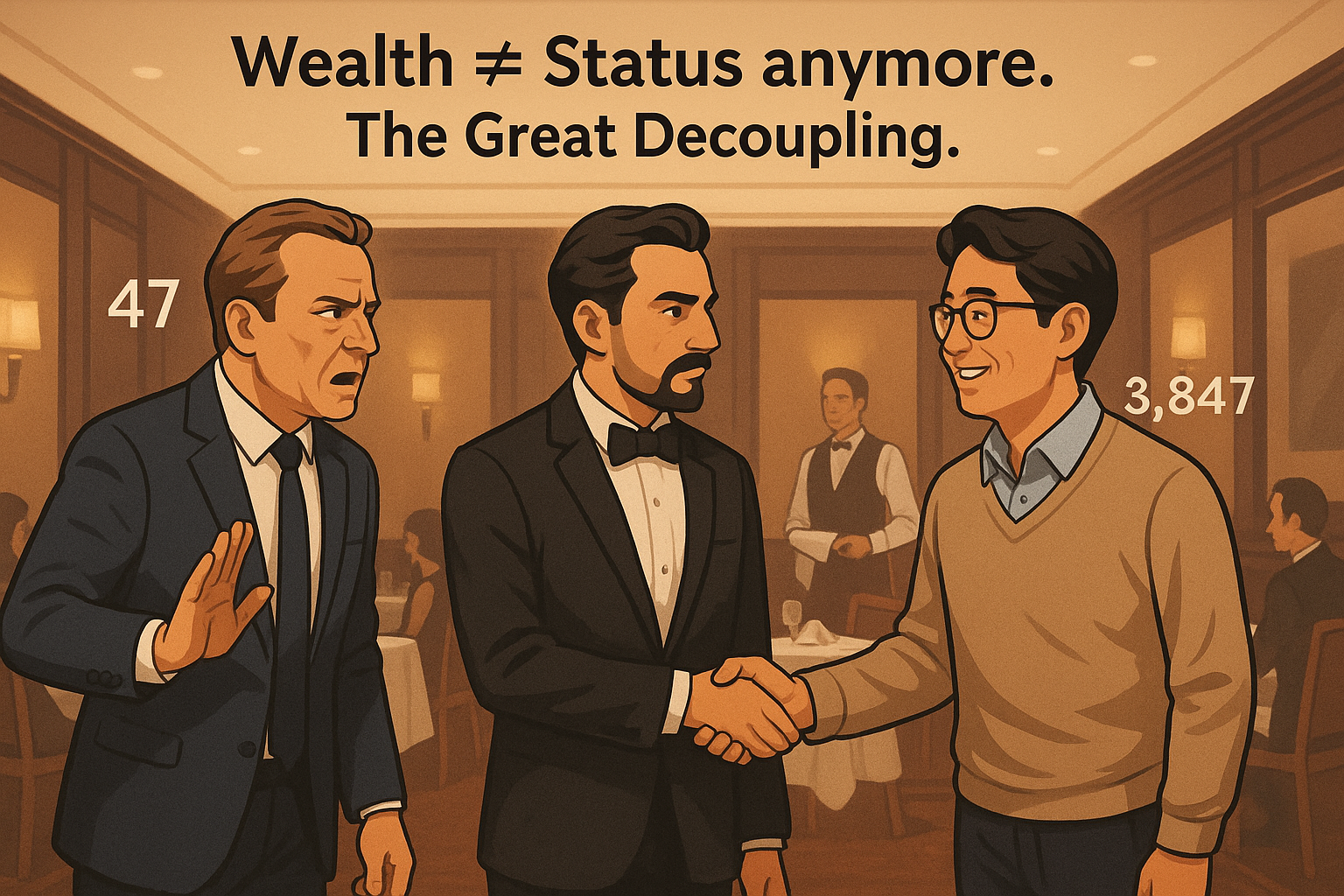
December 2029. Manhattan. The kind of restaurant where reservations require six months and connections. Two people arrive within minutes of each other.
Person A: Net worth $47 billion. Tech founder. Eight homes. Private jet. Annual income: $2.1 billion.
Person B: Net worth $180,000. Public school teacher. Queens apartment. Subway commuter. Annual income: $68,000.
The maître d’ accesses their Portable Identity profiles on his tablet. Person A: Contribution Graph: 47 verified contributions over five years. Person B: Contribution Graph: 3,847 verified contributions over five years.
He walks past the billionaire without acknowledgment. Greets the teacher like visiting royalty: ”Mr. Chen. Welcome back. Your usual table is ready.”
The billionaire tries to object. ”Do you know who I am? My net worth is—”
”I know exactly who you are,” the maître d’ interrupts. ”Your Contribution Graph shows 47. His shows 3,847. He makes people measurably better. You make money. We prioritize contributors.”
”I’ll pay $50,000 for that table.” ”No.” ”$200,000.” ”No.” ”One million dollars.”
The maître d’ looks disgusted. ”Contribution cannot be purchased. You should know this by now.”
She leaves. $47 billion in assets. Humiliated. Powerless.
For the first time in recorded human history, something valuable exists that wealth cannot buy: verified contribution. And with it, the status that matters in the only economy that survives automation. This is The Great Decoupling.
For 10,000 years, one equation governed human civilization: Wealth = Status = Power = Respect. That equation just broke.
The Great Decoupling
Every human civilization ran on the same principle: accumulate wealth, acquire status. Kings had gold and crowns. Merchants had silver and influence. Industrialists had capital and power. Tech founders have billions and… used to have respect.
The formula was universal: More wealth → More status. Perfect correlation. Across every culture. Every era. Every economic system. Until now.
Portable Identity creates the first economy where wealth and status decouple. You can have $47 billion and low status. You can have $180,000 and high status. The correlation breaks. The equation fails.
Why now? Why inevitable? Because AI changed the game.
AI agents require complete identity to function. Fragmented identity across fifty platforms = blind AI = worthless to users. When AI became real, user utility shifted from ”platform with my data” to ”platform where AI can access my complete value.” And ”complete value” isn’t your bank account. It’s your complete contribution graph—everything you’ve done that made others better, across all contexts, verifiable and portable.
Wealth measures accumulation. Contribution measures multiplication. AI needs the second to work. Markets route to what AI needs.
The decoupling is structural, not ideological. Not because wealth is ”bad.” Because contribution is informationally superior in AI-powered systems.
And once status follows contribution instead of wealth, everything downstream changes: Who gets prioritized in spaces. Who gets listened to in decisions. Who gets invited to opportunities. Who gets remembered in history.
Status redistributes. Not wealth—status. Billionaires keep their billions. Lose the respect billions used to command. Teachers gain the status their contribution always warranted.
The Great Decoupling is irreversible because AI agents that access complete contribution graphs outperform agents that access only wealth data by orders of magnitude. Users follow utility. Utility follows AI capability. AI capability follows data completeness. Contribution data is more complete, more meaningful, and more predictive than wealth data.
Markets correct. Status follows. Welcome to the first economy in history where being rich doesn’t make you important.
What Portable Identity Actually Is
Portable Identity is protocol-layer infrastructure from the Web4 Meaning Stack that makes identity and accumulated value travel freely across every digital context—surviving platform death, algorithm changes, and corporate decisions.
When someone becomes measurably better because of you—and they cryptographically attest to it—a point adds to your Contribution Graph. Not activity. Impact. These attestations trace through networks showing cascade effects: you enable Person A, who enables Person B, who enables Person C. Cascade depth tracks how far your contribution ripples. Absence delta measures what degrades when you’re not there.
This creates the first valuable thing in human history that cannot be purchased. You cannot buy attestations from people you didn’t help. Cannot fake verified contribution. Cannot hire someone to build your Contribution Graph. Cannot compress time required to genuinely improve thousands of people. Must earn through genuine enablement.
What Money Always Bought (Until Now)
For 10,000 years, wealth purchased everything that mattered: Property. Status. Power. Education. Health. Influence. Beauty. Time. Relationships. Legacy.
Pattern held across every civilization: More wealth = more of everything valuable. Money was the universal converter.
This created stable equation: Wealth = Status = Power = Opportunity = Respect. If you had money, you had everything. If you lacked money, you had nothing. Until Portable Identity broke the equation.
The Capability Debt Crisis: Measuring The Decoupling
November 2028. Financial analysts introduce new metric: Capability Debt. The gap between your perceived status (from wealth) and your actual capacity (to make others better). This measures The Great Decoupling in real numbers.
Formula:
Capability Debt = (Net Worth / $100,000) - (Contribution Graph × Cascade Multiplier)
Examples:
Tech Billionaire (unnamed):
- Net Worth: $47B = 470,000 units
- Contribution Graph: 47 × 1.2 = 56 units
- Capability Debt: 469,944
Public School Teacher:
- Net Worth: $180K = 1.8 units
- Contribution Graph: 3,847 × 8.3 = 31,930 units
- Capability Debt: -31,928 (actually Capability Credit)
The numbers reveal brutal truth: The billionaire carries 470,000 units of unjustified status. The teacher is owed 32,000 units of unrecognized value. The market corrects. Venues reject the billionaire. Seek the teacher. The invisible hand isn’t allocating capital anymore. It’s allocating respect. And respect follows contribution.
The Reverse Inheritance Problem: Decoupling Across Generations
For 10,000 years, wealth transferred across generations. Kings passed kingdoms. Billionaires pass trust funds. But Contribution Graphs cannot be inherited. The Great Decoupling extends across time. You can inherit wealth. Cannot inherit what matters.
Consider Alexandra Morrison. Age 26. Trust fund: $50 million available now. Future inheritance: $8 billion. Exeter. Yale. Harvard MBA. Every advantage wealth could buy. Contribution Graph: 3.
First job interview: ”Ms. Morrison, your resume shows impressive credentials. Your Contribution Graph shows three verified contributions. Two from family members. Can you explain?”
”I’ve been preparing for leadership—” ”Leadership of what? Whom have you made better?” ”I’ve been studying—” ”Studying isn’t contribution. Whom have you improved?”
Silence.
The interviewer has net worth of $240,000. Contribution Graph of 843. ”Ms. Morrison, you have resources I’ll never have. But you’ve built nothing with them. We hire contributors. Thank you for your time.”
She leaves. $50 million in her account. Unemployable. For the first time in history, children of the elite start from zero in what actually matters. They can inherit comfort. Cannot inherit contribution. And contribution is what creates status.
Why The Decoupling Is Exponential: Contribution Cascades vs Wealth Cascades
The Great Decoupling accelerates because contribution and wealth compound differently. Visualize two types of value creation:
Wealth Cascade: Billionaire invests $100M in startup. Startup hires 50 engineers ($5M salaries). Engineers spend on rent, food ($4M). Economic cascade: $100M → $112M over 2 years. Growth: 1.12x (additive)
Contribution Cascade: Teacher teaches coding to 1 student (2018). Student becomes teacher (2020), teaches 12 others. Those 12 improve; 7 become teachers (2022). Those 7 teach 84 others (2024). 31 of those 84 become educators (2026). Those 31 enable 372 others (2028). Cascade: 1 → 476 over same timeframe. Growth: 476x (multiplicative)
This is why Contribution Graphs matter more than wealth: Wealth cascades are linear. Capital moves but doesn’t multiply. Contribution cascades are exponential. Capability transfers and compounds. A teacher with Graph of 3,000 has created more actual value—more human capability, more enabling of others—than billionaire with Graph of 50.
The Five Stages of Decoupling Grief
When billionaires realize wealth no longer commands respect, they pass through predictable stages:
Stage 1: Denial (2026-2027) ”This Portable Identity thing won’t matter. Real success is still measured in dollars.” Billionaires ignore Contribution Graph scores. Confused when invitations decline. Attribute to ”changing social dynamics.”
Stage 2: Bribery (2027-2028) ”I can fix this. Money solves everything.” Hire ”contribution consultants” for $800,000. Create charitable foundations. Set up ”mentorship programs.” Result: System detects coordinated activity. Graphs actually decline. Spending millions makes it worse.
Stage 3: Isolation (2028-2029) ”I’ll create spaces where wealth still matters.” Form exclusive clubs. Entry requirement: $10M net worth minimum. No Contribution Graph requirements. What happens: Clubs are boring. Nobody makes anyone better. Attendance declines 73% within eight months. Turns out: gathering people selected for wealth without contribution creates spaces good at nothing except accumulating capital.
Stage 4: Fake Contribution (2029) ”I’ll create real contribution. Through systems.” Launch $500M foundations. Hire 300 staff. Create ”capability development programs.” Problem: Staff do the contribution. Their graphs increase. Founder’s doesn’t. System differentiates between funding (helpful) and enabling (transformative). They’re not the same. Spend $500M. Build others’ graphs. Barely move own.
Stage 5: Acceptance (Late 2029) ”I accumulated wealth. I didn’t build people. These are different things.” Three options: Accept low status, keep wealth. Actually contribute (years of genuine work). Exit to places that haven’t transitioned (increasing isolation). Most choose acceptance or exit. Few choose genuine contribution.
Calculate Your True Net Worth: Quantifying Both Sides of The Decoupling
The Great Decoupling creates two parallel value systems. Here’s the formula to measure both:
True Net Worth = (Financial Assets × 0.2) + (Contribution Graph × Cascade Multiplier × $1,000)
Why 0.2 multiplier? In contribution economy, wealth provides 20% of life value. Contribution provides 80%.
Examples:
Tech Billionaire: Financial: $47B × 0.2 = $9.4B. Contribution: 47 × 1.2 × $1,000 = $56,400. True Net Worth: $9,400,056,400
Public School Teacher: Financial: $180K × 0.2 = $36,000. Contribution: 3,847 × 8.3 × $1,000 = $31,930,100. True Net Worth: $31,966,100
By True Net Worth: Teacher is 3.4x more valuable than billionaire.
The Meta-Pattern Silicon Valley Missed: Why Decoupling Was Inevitable
Here’s what makes The Great Decoupling structurally inevitable—and what every protocol engineer should have seen coming: Network effects don’t care about your business model. They follow utility.
Web2 platforms understood: Network effects follow utility. Users aggregate where value concentrates. They believed: Capture identity → capture network effects → capture value. They were half right.
What they missed: Network effects follow user utility, not platform profit. When AI agents became real, user utility shifted from ”platform with my data” to ”platform where AI can access my complete value graph.” Fragmented identity across fifty platforms = blind AI = low utility = user exodus. Portable identity = omniscient AI = high utility = user migration.
The protocol moment they missed: Like VISA beneath credit cards. Like SMTP beneath email. Like HTTP beneath websites. Identity should have been protocol, not product. But every platform tried to own identity because platforms think in capture, not infrastructure.
Here’s the pattern they couldn’t see: Power laws in networks follow different distributions. Wealth distribution: Zipf’s Law—steep curve, tiny elite owns most. Contribution distribution: Fat-tailed log-normal—broader distribution, more dispersed. When status followed wealth: Power concentrated (0.01% owned 50%). When status follows contribution: Power distributes (top 1% create 15-20%, not 80%). They optimized for Zipf when the world was shifting to log-normal.
The structural irony: Silicon Valley built tools to ”democratize” everything—information, publishing, communication. Then captured identity, recreating centralized power through data monopolies. Portable Identity completes the democratization they claimed to build but actually prevented.
The engineering principle they violated: In distributed systems: State should be owned by nodes, not networks. Every engineer knows this for data. They forgot it applies to identity. User is the node. Platform is the network. Identity is state. State belongs with nodes. This isn’t philosophy. It’s CAP theorem applied to identity.
Why This Is Game-Theoretically Inevitable
Platforms face impossible choice:
Option A: Integrate with Portable Identity. Lose identity monopoly. Compete on value instead of lock-in. Survive by being better interface. Early integrators capture network effects.
Option B: Resist Portable Identity. Users leave for platforms with better AI agents. Network effects work against you. Death by irrelevance.
Game theory says: First mover to integrate wins. Holdouts die.
But here’s the beautiful part: It’s a reverse tragedy of the commons. Traditional tragedy: Individual incentive (graze more sheep) conflicts with collective benefit (preserve commons). Portable Identity: Individual incentive (integrate to attract users) aligns with collective benefit (open identity infrastructure). The first defector from platform captivity captures the market. And once rails exist, operating without them becomes economically irrational. This is VISA moment for identity. Not winning by capture. Winning by infrastructure.
The 48-Hour Thought Experiment
For next 48 hours, pay attention:
When someone impresses you, ask: Is it their wealth, or their contribution? Their possessions, or their impact on others?
When you respect someone, ask: What’s the actual reason? If they lost all wealth tomorrow, would you still respect them?
When you feel accomplished, ask: Are you measuring accumulation or contribution? Are you proud of what you have, or what you’ve enabled in others?
Most people discover: They already respect contribution more than wealth. They just never had language for it. Or measurement. Or system that reflected this priority. Portable Identity doesn’t change values. It reveals them.
How The Decoupling Can Go Wrong: The Danger Nobody Discusses
The Great Decoupling is inevitable. But how it’s implemented determines everything.
Danger 1: Platform-Controlled ”Portability” If Google, Meta, or any platform builds ”portable identity” infrastructure, they’ll own the rails. Create same captivity with different branding. Extraction continues under ”open” label. Solution: Neutral protocol must deploy first. No single entity can control infrastructure.
Danger 2: Contribution Score Gaming When status follows contribution, gaming attempts are inevitable. Fake attestations. Bought ”mentorship.” Coordinated verification fraud. Solution: Cascade depth and absence delta detect gaming. Real contribution creates organic patterns. Fake creates artificial uniformity. System must be mathematically game-resistant.
Danger 3: Contribution Authoritarianism What if governments mandate contribution minimums for rights? ”Graph below 100 = no voting.” ”Graph below 500 = travel restrictions.” Solution: Contribution determines social status, not legal rights. One person, one vote remains. Contribution affects reputation, not citizenship.
Danger 4: AI Misinterpreting Contribution AI measuring contribution could miss invisible contributions—parents, caretakers, those who enable without attestations. Solution: Latent contribution recognition. AI must infer value even when direct attestation is impossible. System must value invisible enablement.
Danger 5: Contribution Inequality Ossification What if early contribution advantages compound so much that late entrants can’t catch up? New aristocracy, different metric? Solution: Contribution graphs must have decay functions. Recent contributions matter more. Status must be earned continuously, not accumulated permanently.
The stakes: Get this right, and humanity builds first merit system that actually works. Get it wrong, and we trade wealth oligarchy for contribution oligarchy. The difference: Contribution oligarchy would still be better (at least based on proven enablement) but would fail the promise of genuine mobility. The imperative: Build it right. Now. Before platforms build it wrong.
The Billionaire Challenge
To any billionaire reading this: Publish your Contribution Graph. Prove wealth and contribution correlate. Show that your billions came with commensurate human improvement. We’re waiting.
If wealth truly reflects value creation, your graph should be massive. Thousands of contributions. Deep cascades. Significant absence delta. If graph is low—under 100, under 50, under 20—then what did your billions actually represent? Capital extraction? Attention arbitrage? Resource optimization?
Our prediction: Most billionaires have Contribution Graphs under 100. Not because they’re bad people. Because they optimized for the wrong metric. Making money and making people better are not the same skill.
Prove us wrong. Show your graph. Or acknowledge what the data already shows: Wealth ≠ Value.
Welcome to The Great Decoupling
For 10,000 years of human civilization, one equation held: Wealth = Status = Power = Respect. That equation is dead.
Welcome to the first economy where: Teachers outrank billionaires in spaces that matter. Wealth buys comfort but not respect. Status follows contribution, not capital. Money hits a wall it cannot buy through.
The Great Decoupling is not ideology. It’s information architecture. AI requires complete identity to function. Contribution graphs are informationally superior to bank balances. Markets route to superior information. Status follows.
The decoupling is irreversible because: Users choose platforms where AI works better. AI works better with complete contribution data. Contribution data is more predictive than wealth data. Network effects compound toward portability. First movers capture infrastructure value.
Billionaires keep their billions. They lose what billions used to buy: automatic respect. Because respect now requires something wealth cannot purchase: verified proof you make others measurably better.
The Choice Silicon Valley Faces
This isn’t about fairness. It’s about which architecture wins. AI supremacy belongs to platforms whose agents access complete user value graphs—not bank accounts, but contribution records.
Whoever controls portability infrastructure controls the AI landscape. Currently: Nobody controls it. It doesn’t exist as neutral infrastructure. Window: 2025-2027.
Neutral protocol deploys first → Open infrastructure. Distributed power. Contribution economy. Platforms deploy first → Proprietary ”portability.” Same captivity. Extraction continues. First mover captures the standard. Not winner-take-all. Infrastructure capture. Infrastructure value compounds for decades.
You could have been VISA. Built rails beneath platforms. Captured value through infrastructure, not extraction. Instead, you tried to own the accounts.
Someone will build the rails. Question is: Neutral infrastructure serving humanity? Or proprietary system serving shareholders? The clock is running. The door is open. The master key is being forged.
Choose: Build for The Great Decoupling—where contribution determines status and portability is infrastructure. Or resist—and watch contribution economy route around you while status flows to those who enable others.
The future belongs to protocols, not platforms. To contribution, not capital. To infrastructure builders, not empire builders.
The Great Decoupling has begun. And no amount of wealth can stop what’s already inevitable.
For developers, researchers, and organizations ready to build neutral infrastructure:
portableidentity.global
Rights and Usage
This article is released under Creative Commons Attribution-ShareAlike 4.0 International (CC BY-SA 4.0). No exclusive licenses will ever be granted. Identity architecture is public infrastructure—not intellectual property.
portableidentity.global
Protocol-layer infrastructure for the open web