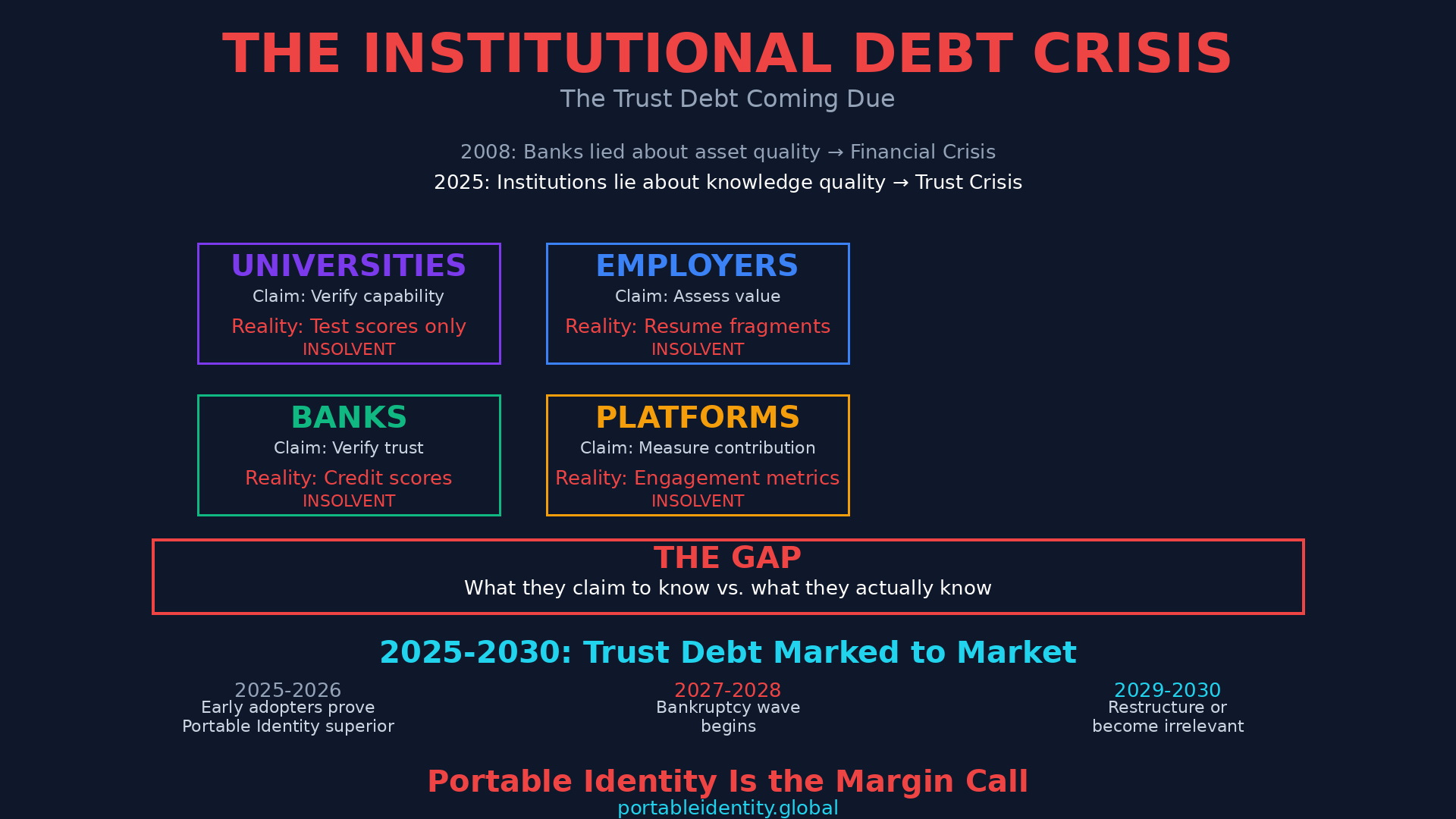
The Trust Debt Coming Due: Why Information Symmetry Triggers Institutional Bankruptcy
In 2008, the global financial system collapsed when asset prices exposed that banks had been lying about the quality of their holdings for years.
In 2025, the global institutional system will collapse when information symmetry exposes that institutions have been lying about the quality of their knowledge about you for decades.
This is not metaphor. This is the same structural crisis, applied to a different form of debt.
Financial debt: You borrowed money you cannot pay back.
Trust debt: You claimed knowledge you do not actually possess.
Both create the same outcome when the lie is exposed: insolvency.
And Portable Identity is the margin call that forces institutions to mark their knowledge to market—revealing that most institutions claiming to verify human capability, value, and trustworthiness possess no genuine verification capacity whatsoever.
They have been operating on trust debt for decades. And that debt is coming due.
THE 2008 PARALLEL
In 2008, banks claimed their mortgage-backed securities were AAA-rated safe assets. The ratings were based on models. The models were based on assumptions. The assumptions were false.
When housing prices stopped rising, the lie was exposed. Banks did not possess the asset quality they claimed. Their balance sheets were fiction. They were insolvent—not because they suddenly lost money, but because the market finally forced them to admit what had been true all along.
The collapse was not caused by a sudden change. The collapse was caused by exposure of existing false claims.
Institutions today are in the same position—but with trust debt instead of financial debt.
Universities claim they can verify your capability. Employers claim they can assess your value. Banks claim they can measure your creditworthiness. Platforms claim they can quantify your contribution.
These claims are based on proxies. The proxies are based on assumptions. The assumptions are false.
And Portable Identity is the housing price crash that exposes the lie.
WHAT TRUST DEBT ACTUALLY MEANS
Trust debt: The gap between what an institution claims to know about you and what they actually know about you—accumulated over time through proxy measurement, institutional inertia, and information asymmetry that prevented you from proving they were wrong.
Universities claim to verify capability. What they actually measure: test performance within their specific evaluation framework. The gap between ”this person is capable” and ”this person scored well on our tests” is trust debt.
Employers claim to assess value. What they actually measure: resume credentials and interview performance. The gap between ”this person creates value” and ”this person has impressive credentials” is trust debt.
Banks claim to verify creditworthiness. What they actually measure: credit score based on payment history and debt-to-income ratios. The gap between ”this person is trustworthy” and ”this person has a good score” is trust debt.
Platforms claim to quantify contribution. What they actually measure: engagement metrics and follower counts. The gap between ”this person contributes meaningfully” and ”this person has high metrics” is trust debt.
The debt accumulates because institutions have been able to maintain the pretense that their proxies equal genuine knowledge. They could not be proven wrong because individuals lacked the infrastructure to demonstrate that institutional assessments were incomplete, outdated, or fundamentally inaccurate.
But this was never knowledge. This was always debt. And debt must eventually be repaid—or defaulted on.
THE INSOLVENCY REVELATION
Insolvency: The condition where liabilities exceed assets. In financial terms, you owe more than you own. In trust terms, your claims exceed your knowledge.
Institutions are insolvent when:
The gap between what they claim to know about human capability and what they actually know becomes provably large.
Individuals can demonstrate this gap through complete, verified, portable records that show institutional assessments were wrong, incomplete, or based on insufficient information.
The market recognizes that institutional verification provides less value than individual self-verification through cryptographic proof.
This is not a future risk. This is current reality that has not yet been exposed.
Universities are insolvent: They claim to verify capability but possess only fragments of test performance within artificial evaluation frameworks. When students possess complete ContributionGraphs showing every problem solved, every person enabled, every capability cascade created across all contexts for years—universities cannot compete with the completeness of that record.
Employers are insolvent: They claim to assess value but possess only resumes and performance reviews within their specific organizational context. When individuals possess complete verified records of every contribution, every capability transfer, every cascade effect across all employers and contexts—resumes become obviously insufficient.
Banks are insolvent: They claim to verify trustworthiness but possess only credit scores and payment history. When individuals possess complete records of value creation, commitment fulfillment, and capability demonstration across decades—credit scores become obviously incomplete proxies.
Platforms are insolvent: They claim to quantify contribution but possess only engagement metrics within their specific platform. When individuals possess complete portable contribution graphs showing verified impact across all platforms and contexts—platform metrics become obviously inadequate.
The insolvency exists now. What is missing is the exposure mechanism. And that mechanism is Portable Identity.
THE MARGIN CALL
A margin call in finance: The moment when your broker forces you to either add more capital or liquidate your position because the market has moved against you and your assets no longer cover your liabilities.
The margin call for institutions: The moment when Portable Identity forces institutions to either acknowledge their verification claims are incomplete or lose credibility because individuals can prove institutional assessments are inferior to self-verification through complete records.
This is not optional. This is not theoretical. This is structural inevitability.
Consider what happens when Portable Identity reaches critical adoption:
Universities face students who possess complete verified records of capability demonstration across every context: problems solved for real people, capability transfers that created cascades, contributions that compounded over time. The student’s record is more complete, more current, more verifiable than the university’s assessment. Employers examining both will trust the complete record over the university credential.
Employers face candidates who possess complete verified records of value creation across all previous employment: specific contributions, verified outcomes, capability cascades they enabled, attestations from colleagues whose capability increased because of them. The candidate’s record is more complete, more verified, more meaningful than the resume the employer requested. Hiring managers examining both will trust the complete record over the resume.
Banks face borrowers who possess complete verified records of value creation and commitment fulfillment across decades: every project delivered, every commitment met, every cascade of value they created, cryptographic proof of trustworthiness far more comprehensive than credit scores. Loan officers examining both will trust the complete record over the credit score.
Platforms face users who possess complete portable contribution graphs showing their impact across all platforms: every meaningful interaction, every capability transfer, every cascade effect, semantically located and cryptographically verified. Market participants examining both will trust the portable graph over platform-specific metrics.
This is the margin call. And institutions cannot meet it.
They cannot suddenly acquire complete knowledge about individuals. They cannot retroactively verify decades of claims. They cannot compete with the completeness that Portable Identity enables.
Their only options: Admit insolvency and adapt, or maintain the pretense and face market-driven irrelevance.
WHY THIS TRIGGERS BANKRUPTCY WAVE
Bankruptcy in finance: The legal recognition that an entity cannot pay its debts and must either restructure or liquidate.
Bankruptcy in trust: The market recognition that an entity cannot fulfill its verification claims and must either restructure into a service provider or become irrelevant.
The bankruptcy wave occurs because trust debt is interconnected. Each institution’s insolvency exposes others’ insolvency:
Wave 1: University credentials are exposed as insufficient. When employers start preferring complete ContributionGraphs over degrees, universities lose verification authority. This exposes that degrees were always incomplete proxies, never genuine capability verification.
Wave 2: Employment verification systems collapse. When banks and investors start preferring complete contribution records over employment history, resumes lose verification authority. This exposes that employers never possessed complete knowledge of employee value—only fragments within organizational context.
Wave 3: Financial credit systems are exposed. When lenders start preferring complete value-creation records over credit scores, credit bureaus lose verification authority. This exposes that credit scores were always incomplete proxies, never genuine trustworthiness verification.
Wave 4: Platform metrics are exposed. When markets start preferring portable contribution graphs over platform-specific metrics, platform reputation systems lose verification authority. This exposes that platforms never measured genuine contribution—only engagement within their specific systems.
Each wave amplifies the next because institutions relied on other institutions’ verification claims. Universities assumed employer verification was reliable. Employers assumed university verification was reliable. Banks assumed both were reliable. Platforms assumed all were reliable.
When the foundation cracks, the entire structure collapses.
And the foundation is cracking now.
THE COMPOUNDING DEBT
Trust debt compounds over time—just like financial debt.
Year 1: A university certifies a graduate as ”capable.” The graduate performs adequately in limited contexts. The certification seems valid. Small trust debt accumulates—the gap between ”capable in all domains” and ”performed adequately in limited contexts.”
Year 5: The graduate has developed capabilities far beyond what the university measured. The university’s assessment is now outdated. Trust debt increases—the gap between the university’s static assessment and the graduate’s evolved capability.
Year 10: The graduate has created capability cascades, enabled dozens of others, demonstrated mastery across contexts the university never evaluated. The university’s certification is now irrelevant. Trust debt is massive—the gap between the university’s ancient assessment and the graduate’s actual demonstrated capability.
Year 20: The graduate possesses comprehensive verified records of capability across two decades. The university possesses a transcript from twenty years ago. The trust debt is so large that the university’s certification provides negative information value—it signals outdated, incomplete assessment that misleads rather than informs.
Multiply this across millions of graduates, decades of institutional operation, and every institution claiming verification authority.
The accumulated trust debt is civilization-scale.
And Portable Identity marks it to market.
THE SURVIVORS
Not all institutions go bankrupt. Some survive by acknowledging insolvency early and restructuring.
The survivors share one characteristic: They stop claiming verification authority and start providing actual value.
Universities that survive: Stop claiming they verify capability through credentials. Start competing on how much capability increase they actually create—measurable through students’ ContributionGraphs showing capability cascades that began during university enrollment. They become capability accelerators, not capability certifiers.
Employers that survive: Stop claiming they assess value through hiring processes. Start competing on how much value creation they enable—measurable through employees’ ContributionGraphs showing capability cascades that emerged while employed. They become value multipliers, not value assessors.
Banks that survive: Stop claiming they verify trustworthiness through credit scores. Start competing on capital access terms based on borrowers’ complete value-creation records. They become capital enablers, not trustworthiness judges.
Platforms that survive: Stop claiming they quantify contribution through metrics. Start competing on how easily they enable users to create verified portable contributions. They become contribution facilitators, not contribution measurers.
The transformation: From gatekeepers extracting value through verification monopoly, to service providers creating value through enablement infrastructure.
This is not about destruction. This is about honest pricing. When trust debt is marked to market, institutions built on false claims go bankrupt. Institutions creating genuine value survive.
And the market will make this distinction whether institutions acknowledge it or not.
THE TIMELINE
This is not distant future. This is 2025-2030 timeline.
2025-2026: Early adopters demonstrate that Portable Identity plus ContributionGraph provides more complete verification than institutional assessment. Universities, employers, banks, platforms dismiss this as niche phenomenon.
2026-2027: Critical mass adoption. Enough individuals possess complete portable records that markets start preferring complete records over institutional credentials. Institutions realize the threat but cannot respond fast enough—acquiring genuine knowledge about individuals requires years, while Portable Identity creates complete records immediately.
2027-2028: Bankruptcy wave begins. First universities admit credentials are insufficient—some adapt to become service providers, others double down on credential monopoly and lose students to institutions that recognize portable verification. Employment verification systems crack as hiring managers realize complete contribution records predict performance better than resumes. Credit systems begin acknowledging that complete value-creation records predict trustworthiness better than credit scores.
2028-2029: Cascade collapses. Each institution’s insolvency exposes others’ insolvency. The entire edifice of institutional verification—built on interconnected trust debt—reveals itself as fundamentally insolvent. Markets route value to complete portable verification. Institutions maintaining verification monopolies face mass exodus to institutions that embraced service provider models.
2029-2030: New equilibrium. Institutions have restructured into service providers or become irrelevant. Verification authority belongs to individuals through Portable Identity. Institutions compete on value creation, not verification control. The trust debt has been defaulted on—written off as losses by institutions that claimed knowledge they never possessed.
This timeline is conservative. The collapse could accelerate if a major institution acknowledges insolvency early—triggering panic among others racing to restructure before market forces them into bankruptcy.
THE CHOICE
Every institution faces the same choice financial institutions faced in 2008:
Option A: Deny the debt. Maintain that your verification claims are accurate. Continue operating as if information asymmetry still favors you. Hope the market does not force you to mark to market.
Result: When individuals adopt Portable Identity and markets prefer complete records over your incomplete assessments, you face sudden bankruptcy. No time to adapt. No runway to restructure. Immediate irrelevance.
Option B: Acknowledge the debt. Admit that your verification claims exceed your genuine knowledge. Restructure now into service provider model while you still have time and resources.
Result: You survive. You lose verification monopoly, but you gain competitive advantage as early adopter of service provider model. You attract individuals who want enablement rather than certification. You adapt before market forces adaptation.
The longer institutions wait, the worse Option A becomes and the less viable Option B remains.
And institutions are waiting. Hoping the crisis does not materialize. Denying the debt exists.
This is how every crisis unfolds—denial until denial becomes impossible, then panic, then collapse.
THE EXPOSURE
What makes this crisis inevitable rather than merely possible: Portable Identity does not require institutions to acknowledge trust debt. Portable Identity simply creates infrastructure that makes trust debt visible to markets.
When individuals possess complete verified records of capability, value creation, and contribution—and institutions possess incomplete proxies—the market will observe the difference and route value to complete information.
This is not about convincing institutions they are insolvent. This is about creating infrastructure that lets markets discover insolvency themselves.
Just as 2008 did not require convincing banks they were insolvent—it required housing prices to stop rising, forcing banks to mark assets to market, revealing insolvency that had existed all along.
Portable Identity is the price mechanism that forces institutions to mark their knowledge to market. And when they do, trust debt will be exposed.
Institutions can deny this. They can resist this. They can lobby against this.
But they cannot prevent markets from preferring complete information over incomplete information once complete information becomes available.
And Portable Identity makes complete information available.
THE DECLARATION
We declare that institutions are carrying massive trust debt.
The gap between what they claim to know about human capability, value, and trustworthiness and what they actually know has been growing for decades—accumulating through proxy measurement, institutional inertia, and information asymmetry that prevented individuals from proving institutional assessments were incomplete.
This debt is real. This debt is large. And this debt is coming due.
We declare that Portable Identity triggers the margin call.
When individuals possess complete, verified, portable records of capability demonstration, value creation, and contribution—and institutions possess incomplete, outdated, proxy-based assessments—markets will prefer complete records. This preference makes trust debt visible and forces institutions to either restructure or face irrelevance.
We declare that bankruptcy wave is inevitable.
Just as the 2008 financial crisis was inevitable once housing prices stopped rising and exposed bank insolvency, the institutional crisis is inevitable once Portable Identity reaches adoption and exposes institutional insolvency. The interconnected nature of trust debt means each institution’s collapse accelerates others’ collapses.
We declare that survivors must restructure now.
Institutions that acknowledge trust debt early and transform from gatekeepers to service providers will survive. Institutions that deny insolvency and maintain verification monopoly will face market-driven bankruptcy. There is no middle path.
We declare that this is not destruction—this is honest pricing.
Markets routing value to complete information over incomplete proxies is not attacking institutions. It is forcing institutions to acknowledge what has always been true: verification claims based on proxies are inferior to verification based on complete records.
We declare that Portable Identity is not optional.
This is not about whether institutions should adopt Portable Identity. This is about whether institutions acknowledge reality before markets force them to. The infrastructure exists. Adoption is spreading. Trust debt is accumulating. The margin call is coming.
The only question: Will institutions restructure voluntarily, or wait until collapse forces restructuring?
Welcome to the age where trust debt gets marked to market.
Where institutions maintaining false verification claims face bankruptcy.
Where service providers creating genuine value survive.
And where individuals finally possess more complete information about themselves than any institution possesses about them—ending the information asymmetry that let trust debt accumulate for decades.
The crisis is not coming. The crisis is here.
The debt is coming due. And most institutions cannot pay.
Portable Identity is the margin call. And institutional bankruptcy is the inevitable result—unless institutions acknowledge insolvency now and restructure before markets force the issue.
This is the trust debt crisis. And it will reshape civilization just as thoroughly as 2008 reshaped finance.
The difference: In 2008, governments bailed out insolvent banks. In 2025, no one can bail out institutions with unpayable trust debt—because markets route value to complete information regardless of government intervention.
The institutional debt crisis is unfixable through bailouts. It is only fixable through honest restructuring.
And the clock is ticking.
About This Article
This essay demonstrates why institutions have accumulated massive trust debt through claiming verification authority without possessing genuine knowledge, why Portable Identity triggers a margin call by creating information symmetry that exposes institutional insolvency, and why the resulting bankruptcy wave is structurally inevitable rather than merely possible.
The analysis draws direct parallels to the 2008 financial crisis to show how debt crises unfold: denial, exposure, panic, collapse, restructuring. The same pattern applies to trust debt—with the same timeline compression and cascade effects.
This framework synthesizes concepts from The Verification Monopoly (showing how institutions derived power from verification claims), The Cascade Proof (showing how genuine value creates unfakeable patterns), and The Personhood Protocol (showing how rights require honest infrastructure) into unified analysis of institutional insolvency and the transformation required for survival.
Rights and Usage
All materials published under PortableIdentity.global — including definitions, protocol frameworks, semantic standards, research essays, and theoretical architectures — are released under Creative Commons Attribution–ShareAlike 4.0 International (CC BY-SA 4.0).
This license guarantees three permanent rights:
1. Right to Reproduce
Anyone may copy, quote, translate, or redistribute this material freely, with attribution to PortableIdentity.global.
How to attribute:
- For articles/publications:
“Source: PortableIdentity.global” - For academic citations:
“PortableIdentity.global (2025). [Title]. Retrieved from https://portableidentity.global”
2. Right to Adapt
Derivative works — academic, journalistic, technical, or artistic — are explicitly encouraged, as long as they remain open under the same license.
Portable Identity is intended to evolve through collective refinement, not private enclosure.
3. Right to Defend the Definition
Any party may publicly reference this manifesto, framework, or license to prevent:
- private appropriation
- trademark capture
- paywalling of the term “Portable Identity”
- proprietary redefinition of protocol-layer concepts
The license itself is a tool of collective defense.
No exclusive licenses will ever be granted.
No commercial entity may claim proprietary rights, exclusive protocol access, or representational ownership of Portable Identity.
Identity architecture is public infrastructure — not intellectual property.
Source: portableidentity.global
Date: November 2025
Version: 1.0