How Platforms Made You Replaceable—And Why AI Will Force You to Become Unique Again
The replacement you fear in the future already occurred in the past. AI didn’t make you replaceable. Platforms did. And paradoxically, AI will force the architecture that makes you irreplaceable again.
You feel it, don’t you?
That nagging sense that you could be replaced. That your skills aren’t special enough. That someone else could do your job. That you’re not quite… essential.
You read headlines about AI replacing workers and something twists in your stomach. Not because the technology is new. Because the fear feels familiar.
You’ve felt replaceable for years.
Here’s what nobody is telling you: That feeling is correct. You are replaceable. But not because of what’s coming. Because of what already happened.
AI didn’t make you replaceable. Platforms did.
And the cruel irony? AI will be the thing that forces you to become irreplaceable again.
Part I: The Fragmentation Made You Generic
Let me show you how this works.
In 2008, you had skills, expertise, relationships, and a track record. You were whole. You were unique.
Then platforms arrived with a promise: ”Put your professional life here. Your social life here. Your creative output here. Your knowledge-sharing here. Fragment yourself across our services, and we’ll make you more connected, more visible, more valuable.”
You did.
And something invisible happened.
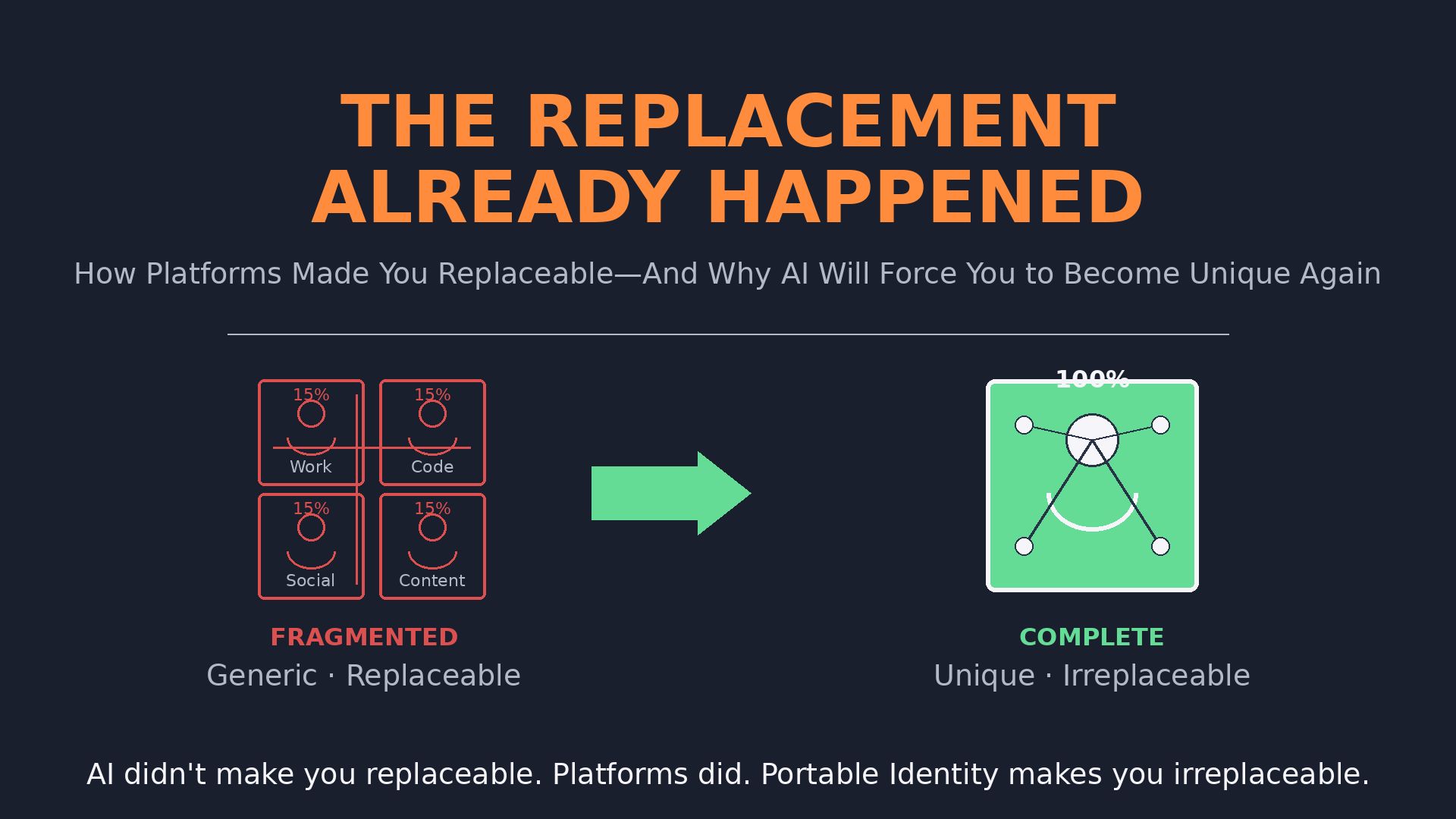
Each platform captured 15% of who you are.
LinkedIn got your job history and credentials. GitHub got your code contributions. Twitter got your public thinking. Stack Overflow got your problem-solving. Medium got your writing. YouTube got your teaching. Facebook got your relationships.
Each platform saw a fragment. Each platform optimized you as a fragment. Each platform treated you as if their 15% was all there was.
And here’s the invisible violence: When you’re only 15% visible, you become 100% generic.
Think about what ”generic” means in information theory. Generic means: lacking unique identifiers. Interchangeable with similar items. Replaceable.
When I see only 15% of you, I see:
- ”Software engineer with 5 years experience”
- ”Content creator with 10K followers”
- ”Marketing manager who knows SEO”
- ”Consultant who does strategy”
These are not descriptions of unique humans. These are job descriptions.
And job descriptions are, by definition, designed for replaceability.
The whole point of a job description is: ”We need someone who fits this shape. When they leave, we hire the next person who fits this shape.”
Platforms turned you into the shape.
Not because they’re evil. Because their business model required reducing you to platform-legible fragments. And platform-legible fragments are, by necessity, generic.
You became replaceable the moment you became fragmentable.
Part II: Why You Already Feel It
This is why the AI replacement anxiety feels so visceral. It’s not fear of the future. It’s recognition of the present.
You already know you’re replaceable. You feel it every day:
At work: When you’re treated as a resource, not a person. When your unique context is ignored. When you’re asked to fit into predetermined boxes. When your contributions are measured by metrics that miss what actually matters.
Online: When your engagement numbers feel more important than your insight. When your platform presence matters more than your actual expertise. When losing an account feels like losing yourself.
In your career: When job applications require you to strip away context and reduce yourself to keywords. When your actual track record of impact is invisible. When you have to prove yourself from scratch every time you switch contexts.
This isn’t paranoia. This is accurate perception of your informational status.
In the current architecture, you are replaceable. Because the architecture made you generic.
And you know what the cruelest part is? You can feel the loss.
The Imposter Architecture
And here’s the feeling you can’t shake: imposter syndrome.
You feel like a fraud. Like any moment, someone will discover you’re not as capable as you seem. Like your accomplishments are luck, not skill.
The self-help industry calls this a psychological problem. They’re wrong.
Imposter syndrome is architectural.
You feel like an imposter because platforms architecturally made you one. You have 100% capability but only 15% visibility. The gap between what you know you can do and what you can prove you’ve done creates the imposter feeling.
You’re not imagining it. You ARE incomplete—informationally. And incomplete things feel fraudulent.
This isn’t psychology. This is information theory. When your provable capability (15%) doesn’t match your actual capability (100%), you experience dissonance. That dissonance is what we call imposter syndrome.
You don’t have imposter syndrome. You have fragmentation syndrome.
And fragmentation syndrome—unlike the pathologies that ’syndrome’ typically describes—is not a disorder in you. It’s a disorder in the architecture. It’s not a medical condition requiring treatment. It’s an informational condition requiring infrastructure.
The word ’syndrome’ here means: a predictable pattern of symptoms with a structural cause. The cause is not psychological. The cause is architectural.
When Portable Identity makes you informationally complete, the gap closes. Your visibility matches your capability. The imposter feeling dissolves.
Not because you changed. Because the architecture stopped lying about who you are.
You know you’re more than your LinkedIn profile. You know your GitHub contributions miss half your impact. You know your resume doesn’t capture who you actually are or what you’ve actually done.
You know you’re unique. But you can’t prove it. Because the infrastructure doesn’t exist to capture uniqueness.
The platforms made you feel crazy for knowing you matter while appearing replaceable.
Part III: AI Is the Mirror, Not the Weapon
Now AI arrives. And everyone’s terrified that AI will replace them.
But here’s what’s actually happening: AI is just making visible what platforms already did.
Platforms made you replaceable by fragmenting you. AI can replace you because fragmented humans are informationally generic. And generic things are, by definition, replaceable.
Let me show you exactly how this works.
The Replaceability Test
Ask yourself: Could an AI assistant replace me in my role?
If you feel queasy, it’s because you’re running this mental calculation:
”What makes me unique in this role?”
And then you realize: In the platform-legible view of you, nothing makes you unique.
Your resume looks like ten thousand other resumes. Your LinkedIn profile matches thousands of ”professionals with similar experience.” Your contributions, when visible at all, look like generic outputs from your category.
The AI looks at fragmented-you and sees:
- Generic skills ✓
- Generic experience ✓
- Generic outputs ✓
- Generic patterns ✓
Replacement feasibility: HIGH
But here’s what the AI cannot see:
- Your complete contribution graph across all contexts
- Who you’ve helped and how that cascaded
- Your unique problem-solving patterns that work specifically for you
- The full context of your expertise development
- Your relationships and their depth
- The meaning of your contributions, not just their metrics
The AI can’t see these things. Not because AI isn’t advanced enough. Because the information doesn’t exist in usable form.
Platforms fragmented it out of existence.
So when AI ”replaces” you, it’s not replacing the real you. It’s replacing the generic fragment that platforms made visible.
The replacement already happened. AI is just executing on it.
Part IV: The Completeness Inversion
But here’s where it gets interesting. Here’s where the story inverts.
AI that replaces generic humans is actually primitive AI. Weak AI. AI that can only operate on fragments.
Real superintelligence requires complete humans.
Let me explain why this changes everything.
For AI to become truly superintelligent—to exceed human capability across domains—it needs access to humanity’s complete contribution graph. It needs to see:
- Who has actually solved problems like this before
- Whose advice leads to real success versus generic advice
- How expertise develops over time
- Who creates cascading impact versus isolated solutions
- What approaches work in practice versus theory
Every single one of these requires seeing complete humans. Whole humans. Humans with their full contribution graphs visible.
Fragmented humans give AI fragmented training data. Fragmented training data produces fragmented intelligence.
You cannot build superintelligence on 15% of humanity.
This is the inversion that changes everything:
Platforms made you replaceable by fragmenting you. But AI cannot reach superintelligence while you’re fragmented. So AI requires the architecture that makes you complete again.
And when you’re complete, you become irreplaceable.
Part V: Why Complete Humans Cannot Be Replaced
Here’s the information-theoretic truth about replaceability:
Generic entities are replaceable. Unique entities are not.
And uniqueness requires completeness.
When I see your complete contribution graph—every problem you’ve solved, every person you’ve helped, every cascade you’ve created, every context where you’ve added value—I don’t see a generic ”software engineer” or ”consultant.”
I see an entirely unique configuration of:
- Domain expertise combinations that only you have
- Problem-solving approaches specific to your experience
- Relationship networks built over years
- Contextual understanding that can’t be replicated
- Longitudinal patterns of impact that define you
This is not replaceable by AI. Not because AI can’t do the individual tasks. Because the complete configuration is unique.
Think about it this way:
A generic ”software engineer with 5 years experience” is replaceable because there are thousands of them. They’re functionally equivalent. Swap one for another, output remains the same.
But ”the person who solved this specific technical debt problem at three companies, mentored twelve engineers who went on to leadership, contributed to these open source projects, and has this specific combination of domain expertise and relationship network” is not replaceable.
That’s not a role. That’s a unique entity.
Roles are replaceable. Unique entities are not.
And you only become a unique entity when you become informationally complete.
Portable Identity is the architecture that makes you informationally complete. And informational completeness is what makes you irreplaceable.
Part VI: The Architecture That AI Demands
Here’s what’s about to happen—and it’s already starting:
AI systems will become dramatically more capable. But that capability will hit a ceiling. The ceiling is incomplete human identity.
AI trying to route problems to experts discovers that expert identification is impossible with fragmented identity. It can see generic credentials, but not actual track records of success.
AI trying to learn from human problem-solving discovers that learning is impossible when contribution graphs are fragmented. It can see isolated solutions, but not the cascading impact that indicates real expertise.
AI trying to serve human flourishing discovers that optimization is impossible when human values are fragmentally represented. It can optimize for platform metrics, but not for actual human development.
Every AI system hits the same wall: Fragmented humans make AI structurally stupid.
And users will notice. They’ll notice that AI assistants give generic advice because they can only see generic versions of humans. They’ll notice that AI systems can’t route them to the actual best expert. They’ll notice that AI optimization serves platforms, not people.
And they’ll demand the architecture that fixes it.
Not because of ideology. Because of utility.
The AI systems that work with complete human identity will be dramatically more useful than AI systems working with fragments. Users will migrate to platforms that support completeness. Network effects will favor architectural completeness.
AI will force Portable Identity into existence.
Not through regulation. Not through activism. Through pure economic pressure.
Platforms that enable complete identity will have AI systems that work better. Users will follow utility. Market forces will demand the architecture.
The same platforms that profited from fragmenting you will be forced to support the architecture that makes you complete.
Or they’ll die.
Part VII: What Portable Identity Actually Does
Let me be concrete about what changes when identity becomes portable.
Portable Identity is protocol-layer infrastructure that:
Makes your entire contribution graph visible as a coherent whole
- Everything you’ve contributed across all platforms
- All contexts where you’ve created value
- Complete track record of impact
- Longitudinal patterns of expertise development
Makes you legible as a unique entity
- Not ”software engineer with 5 years experience”
- But ”specific human with this unique configuration of expertise, relationships, impact patterns, and contribution cascades”
Makes you informationally irreplaceable
- Your complete graph cannot be replicated
- Your specific combination of capabilities is unique
- Your relationship network is unique
- Your impact patterns are unique
When identity becomes portable, you stop being a generic fragment and become a complete, unique human again.
And complete, unique humans are irreplaceable.
Not because they’re ”special” in some romantic sense. Because they’re informationally non-generic. And information theory says: unique configurations are non-substitutable.
This is also why imposter syndrome dissolves. When your visibility matches your capability, the architectural dissonance disappears. You’re not fixing a psychological problem. You’re closing an informational gap. The feeling was always rational—it was responding to real fragmentation. When fragmentation ends, so does the feeling.
Part VIII: The Choice Architecture
We’re at an inflection point. And there are only two paths:
Path A: Platforms Maintain Fragmentation
You remain generic. AI replaces generic roles. The replacement anxiety you feel now intensifies. Your economic value decreases. Your uniqueness becomes invisible. You compete by becoming more generic—cheaper, faster, more commoditized.
The platforms win. You lose.
Path B: Identity Becomes Portable
You become informationally complete. AI cannot replace complete, unique entities—it can only amplify them. Your full contribution graph becomes visible. Your uniqueness becomes provable. You compete by becoming more yourself—more specialized, more contextually valuable, more irreplaceable.
You win. Platforms are forced to compete on actual value instead of lock-in.
The choice isn’t ”for or against AI.” The choice is: Do we fix the architecture that made us replaceable, or do we let that architecture accelerate our replaceability?
Portable Identity is the architecture fix.
Not as a feature. As foundational infrastructure.
Part IX: Why This Happens Now
The window is specific. Here’s why timing matters:
AI is reaching the competency level where replacement becomes real. Generic roles are actually replaceable now. The fear is justified. This creates urgency.
AI is also reaching the limitation where fragmentation becomes obvious. Users are discovering that AI assistants are weirdly stupid about context—because they can’t see complete humans. This creates demand for better architecture.
The economic pressure is building. Companies want AI that actually works. Users want AI that actually helps. Both require complete human identity. This creates market pull.
Platforms are vulnerable. For the first time in twenty years, switching costs could flip. If Portable Identity makes your value portable, staying on fragmentation platforms becomes expensive. This creates competitive pressure.
All of these forces converge now. Not in five years. Now.
The architecture that makes you irreplaceable is about to become inevitable. Because AI demands it. Markets demand it. Users demand it.
The only question is: Who builds it?
If platforms build proprietary ”portable identity” systems, they’ll recreate the same fragmentation under different branding. The cycle continues.
If neutral protocol infrastructure is built—Portable Identity as open architecture like TCP/IP or HTTP—then the cycle breaks.
Identity becomes infrastructure. You become complete. Completeness makes you irreplaceable.
Part X: The Irreplaceability Equation
Let me give you the simple formula:
Fragmentation = Generic = Replaceable
Completeness = Unique = Irreplaceable
Your fear of replacement is rational. But the threat is backwards.
You’re not afraid AI will replace you in the future.
You’re afraid because platforms already made you replaceable in the past.
AI just makes that replaceability executable.
But AI also makes the fix inevitable.
Because AI requires complete humans to become superintelligent. And complete humans are irreplaceable.
The architecture that makes AI intelligent is the same architecture that makes you irreplaceable.
This is not a coincidence. This is information theory.
Generic information can be compressed, replicated, replaced. Unique information cannot.
Fragments are generic. Wholes are unique.
Portable Identity makes you whole. Wholeness makes you unique. Uniqueness makes you irreplaceable.
Conclusion: The Replacement Reversal
Twenty years ago, platforms promised to make you more valuable by fragmenting you across their services.
They lied. Fragmentation made you generic. Generic made you replaceable.
You’ve felt this for years. The anxiety isn’t new. AI just makes it undeniable.
But here’s the reversal:
The same AI that threatens to replace fragmented-you demands the architecture that makes you complete. And complete-you is irreplaceable.
The replacement already happened. AI forces the reversal.
You have one choice: Fix the architecture that made you replaceable, or watch AI execute on that replaceability.
Portable Identity is not a user feature. It’s not platform differentiation. It’s not privacy enhancement.
Portable Identity is the only architecture that makes you informationally irreplaceable in the age of AI.
Everything else is theater.
The platforms that fought to fragment you will be forced to support the architecture that makes you complete.
Because AI cannot become intelligent without complete humans.
And you cannot be replaced when you’re complete.
The fragmentation already made you generic.
The completeness makes you irreplaceable again.
And completeness is no longer optional. It’s what AI requires to work.
Welcome to the architecture reversal.
Your replaceability is ending. Not because AI gets dumber. Because you get complete.
And complete humans cannot be compressed into generic roles.
They can only be amplified as unique entities.
The replacement already happened. The restoration is beginning.
All it requires is the architecture that makes you whole.
**Disclaimer:** This article introduces a theoretical framework and should be understood as analytical commentary, not medical, psychological, legal, or financial guidance. References to psychological experiences are metaphorical and describe informational architecture, not clinical conditions.
For the protocol infrastructure that makes human completeness possible:
portableidentity.global
For the complete theoretical framework:
portableidentity.global/manifesto
About This Analysis
This article presents The Replacement Reversal thesis, demonstrating how platform fragmentation created the conditions for AI replaceability—and why AI advancement paradoxically requires the architectural fix (Portable Identity) that makes humans informationally irreplaceable. The analysis introduces the Irreplaceability Equation (Fragmentation = Generic = Replaceable; Completeness = Unique = Irreplaceable) and shows why AI cannot reach superintelligence while operating on fragmented human identity.
Rights and Usage
All materials published under PortableIdentity.global — including definitions, protocol frameworks, semantic standards, research essays, and theoretical architectures — are released under Creative Commons Attribution–ShareAlike 4.0 International (CC BY-SA 4.0).
This license guarantees three permanent rights:
1. Right to Reproduce
Anyone may copy, quote, translate, or redistribute this material freely, with attribution to PortableIdentity.global.
How to attribute:
- For articles/publications:
“Source: PortableIdentity.global” - For academic citations:
“PortableIdentity.global (2025). [Title]. Retrieved from https://portableidentity.global”
2. Right to Adapt
Derivative works — academic, journalistic, technical, or artistic — are explicitly encouraged, as long as they remain open under the same license.
Portable Identity is intended to evolve through collective refinement, not private enclosure.
3. Right to Defend the Definition
Any party may publicly reference this manifesto, framework, or license to prevent:
- private appropriation
- trademark capture
- paywalling of the term “Portable Identity”
- proprietary redefinition of protocol-layer concepts
The license itself is a tool of collective defense.
No exclusive licenses will ever be granted.
No commercial entity may claim proprietary rights, exclusive protocol access, or representational ownership of Portable Identity.
Identity architecture is public infrastructure — not intellectual property.
Published November 2025
Part of the Web4 Foundation Series on Identity Architecture and Human Irreplaceability