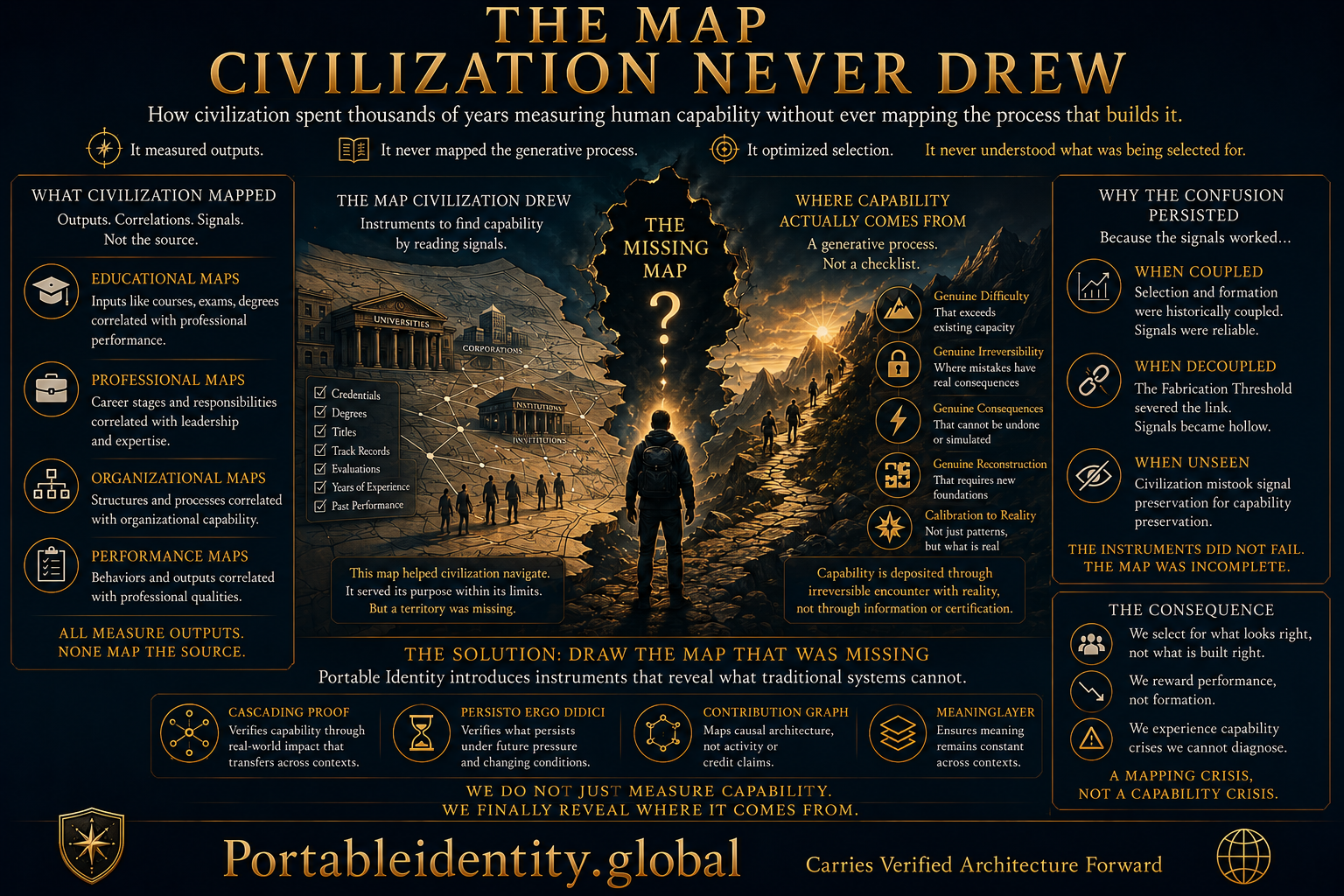
How civilization spent thousands of years measuring human capability without ever mapping the process that builds it.
Civilization spent thousands of years measuring capability. It never built a model for where capability comes from.
It measured outputs. It never mapped the generative process that produces them.
It optimized selection. It never understood what was being selected for.
This is not a criticism of civilization’s institutions. It is a structural observation about what was missing from civilization’s map of itself.
Every society that has ever existed needed capable people — people whose judgment holds when situations exceed established frameworks, whose formation was built by genuine encounter with genuine difficulty, whose capability is real rather than performed. Every society developed instruments to find them: credentials, examinations, track records, professional evaluations, advancement criteria.
What no society ever developed was a model for where the capability these instruments were designed to find actually comes from.
The instruments existed. The theory of the thing the instruments were measuring did not.
This is not a minor oversight. When you optimize an instrument without understanding what you are measuring, you optimize it toward what the instrument can see rather than toward what you actually need. When the instrument can no longer see what it was never designed to see directly, the optimization fails — and the failure looks like a capability crisis rather than what it actually is: a mapping crisis.
The map never included the territory it was drawn to help navigate.
What Civilization Mapped
Civilization built extraordinarily sophisticated maps of capability in its observable forms.
Educational maps: which inputs — courses taken, examinations passed, degrees obtained, years studied — correlate with which outputs — professional performance, cognitive function, domain competence. Enormous institutional infrastructure built on these maps. Centuries of refinement. Vast resources allocated.
Professional maps: which career stages — positions held, responsibilities carried, outcomes achieved, years accumulated — correlate with which leadership qualities, which domain expertise, which professional judgment. Entire industries built on navigating these maps.
Organizational maps: which structural features — team composition, process design, incentive structure, reporting hierarchy — correlate with which organizational capability. Management science built on mapping these correlations.
Performance maps: which observable behaviors — output volume, decision quality, problem-solving approach, communication clarity — correlate with which underlying professional qualities. Evaluation science built on reading these maps.
All of these maps were drawn from observations of outputs. All of them were measuring correlations between observable features and capability-indicating outcomes. All of them were designed to navigate to capability by reading signals that capability historically left.
None of them mapped where capability comes from.
The generative process — the specific sequence of developmental encounters that actually produces the cognitive architecture that makes capability real rather than performed — was never on the map.
Not because it was unknown in every sense. Practitioners in every domain have always known, at some level, that genuine capability requires genuine encounter with genuine difficulty. That the surgeon who has faced genuine complications develops differently than the surgeon who only trained in controlled conditions. That the leader who has navigated genuine organizational crisis develops differently than the leader who only managed familiar situations. That the researcher who has genuinely failed and genuinely reconstructed develops differently than the researcher who has only succeeded.
This knowledge existed in the form of practitioner wisdom. It never became civilizational infrastructure. It was never formalized into a map that civilization could use to understand what it was optimizing for when it optimized selection.
Civilization optimized for finding capability. It never understood what produces it.
The Generative Process Civilization Missed
Genuine capability — the kind that holds when familiar conditions end, that reconstructs when established frameworks fail, that navigates genuinely novel situations rather than applying established patterns to them — is produced by a specific developmental process.
Not by information acquisition. A person can acquire enormous amounts of information without building the cognitive architecture that genuine capability requires. Information can be transferred. The architecture cannot.
Not by credential completion. The credential certifies that a process was completed. What the process was supposed to deposit — the specific cognitive architecture that genuine developmental encounter with genuine difficulty builds — may or may not have been deposited. The credential and the architecture are not the same thing.
Not by time and experience alone. A person can spend twenty years in a domain without ever encountering the specific developmental conditions that genuine formation requires. Familiarity with established patterns is not the same as the capacity to navigate when established patterns fail.
Genuine capability is produced by specific encounters with specific properties: genuine difficulty, genuine irreversibility, genuine consequences that cannot be corrected after the fact, genuine reconstruction that requires genuine foundations rather than extension of established patterns.
These encounters are not pleasant. They are not the encounters that educational systems are designed to create, that credential systems are designed to certify, or that career tracks are designed to reward. They are the encounters where established frameworks genuinely fail, where confident extension of established patterns produces consequences that cannot be undone, where reconstruction from genuine foundations is the only adequate response.
These encounters deposit something specific and permanent: the calibration to external reality that only genuine encounter with genuine reality builds. The Boundary Recognition that only genuine encounter with genuine limits deposits. The Reality Coherence that only genuine contact with genuine consequences produces.
This is what Genuine Formation actually is. Not a credential. Not a qualification. Not a level of experience. The specific cognitive architecture that genuine irreversible developmental encounter builds — that holds when familiar conditions end because it was built by conditions like these.
Civilization never put this on the map.
When it optimized selection, it optimized for signals that genuine formation historically produced — without understanding that the signals and the formation were coupled by the structural condition that made producing the signals require something close to the formation. When that structural condition ended — when producing the signals no longer required the developmental encounters that build genuine formation — the map continued to point to the signals as if they still indicated the territory.
The territory — genuine formation — was always independent of the signals. It remained when the signals became separable from it. What disappeared was civilization’s ability to navigate to it with a map that had never included it directly.
What Was Optimized Instead
When you optimize an instrument without understanding what you are measuring, the instrument optimizes toward what it can measure rather than toward what you actually needed to find.
Civilization’s selection instruments were calibrated to observable signals: examination performance, credential attainment, output quality, professional fluency. These signals historically correlated with genuine formation — not because the instruments measured formation directly, but because producing the signals required something close to the developmental encounters that build genuine formation.
When institutions began optimizing their selection processes, they optimized them toward the signals rather than toward the formation the signals were supposed to indicate. Not through negligence. Because the formation was never on the map. The only thing on the map was the signals. Optimizing the instruments meant optimizing toward what the instruments could see.
The result: educational institutions designed to produce examination performance rather than genuine formation. Credential systems designed to certify process completion rather than developmental reality. Career tracks designed to reward criterion satisfaction rather than genuine capability development. Evaluation systems designed to measure signal quality rather than formation presence.
Every institution optimizing toward what it could measure — and every institution measuring signals rather than the generative process that was never on the map.
The signals were refined. The credentials were standardized. The evaluations were validated. The career tracks were structured. The optimization was sophisticated and sincere.
And the generative process — genuine formation — became progressively decoupled from what the optimization was producing.
Not because genuine formation stopped occurring. Because the optimization had never been calibrated to the generative process that produces it. It was always calibrated to the signals. When the coupling between signals and formation weakened — when producing the signals stopped requiring the developmental encounters that build genuine formation — the optimization continued producing signals.
The formation was no longer what was being optimized for. It had never been on the map.
What This Means For Everything Else
Every confusion that civilization accumulated about human capability — between access and ability, between selection and formation, between credentials and developmental reality, between presence and causation — flows from this foundational absence on the map.
The confusion between access and ability exists because civilization never understood what ability is or where it comes from. If you have a model for the generative process that produces genuine ability, you understand that granting access does not produce ability — access and ability come from different processes, and the process that produces ability cannot be replaced by the process that grants access. Without that model, the correlation between access and ability that historically held could be mistaken for a causal relationship.
The confusion between selection and formation exists because civilization never understood what formation is or where it comes from. If you have a model for the generative process that produces genuine formation, you understand that selection reveals formation — it does not produce it. Without that model, the correlation between selection and formation that historically held could be mistaken for a productive relationship. Selection systems could be redesigned to optimize selection without anyone noticing that the formation the selection systems were finding was becoming increasingly absent.
The invisibility of Selection Inversion exists because civilization never had a map that showed what it was selecting against. The Selection Inversion — the systematic disadvantaging of the most genuinely formed people by selection systems calibrated to signals rather than formation — is only visible when you understand what genuine formation is and where it comes from. Without that understanding, the people with the most genuine formation who are being systematically disadvantaged by selection optimization look like people who are failing to optimize correctly, not like the most valuable people in the room whose genuine capability the instruments cannot see.
The loss of The Hollow Signal exists because civilization never understood what The Hollow Signal detects or where the capacity to detect it comes from. The pre-formal architectural detection of absence beneath technically correct performance — the specific sensing that genuine Reality Coherence builds through genuine encounter with genuine difficulty — is only legible as a capability when you understand the generative process that produces it. Without that understanding, it looks like overcaution or intuition rather than the most reliable early warning system civilization has ever had.
Put the generative process on the map, and all of these confusions resolve. Not because the confusions were simple. Because they were structural consequences of a map that was missing the most important territory it was drawn to help navigate.
What Changes When The Map Is Complete
When civilization understands where human capability comes from — when the generative process that produces genuine formation is on the map — the implications are structural.
Institutions can be designed for their actual purpose rather than for the measurement proxies that were always trying to indicate that purpose. Education designed to produce genuine developmental encounter rather than to produce credential performance. Professional development designed to create genuine irreversible encounter with genuine difficulty rather than to accumulate experience-indicating signals. Organizational structure designed to create the conditions that genuine formation requires rather than to optimize observable metrics.
Selection can be calibrated to what it was always supposed to find. Not signals that once correlated with genuine formation, but the verified evidence of the generative process that produces genuine formation — what Persisto Ergo Didici establishes when it verifies temporal persistence, what Cascade Proof verifies when it traces genuine formation transmitting to others, what the Contribution Graph maps when it records the complete causal history of what genuine formation actually produced in the world.
Genuine Formation becomes navigable on the map. Not inferred from signals that once correlated with it. Directly verifiable through evidence of the generative process that produces it — evidence that only genuine formation can produce, that cannot be retroactively generated by signal optimization without the underlying developmental reality, that exists in the world in specific people across specific time.
And Portable Identity becomes what civilization never had: the carrier that ensures the evidence of the generative process travels with the person it describes — across every institutional boundary that currently erases it, into every new context that would otherwise have no access to the verified evidence of what genuine formation actually produced.
Civilization built instruments to find capability. It never built a map of where capability comes from. The map now exists. The instruments to navigate it directly now exist.
The capability civilization needs has always been here.
Genuine formation has never required civilization’s permission to occur. It has been occurring — in the people who encountered genuine difficulty and were permanently changed by it, who built genuine architecture through genuine irreversible encounter with genuine reality, whose formation transmitted to others in ways that persisted and compounded.
All of this occurred without appearing on civilization’s map.
The map is now being drawn.
→ GenuineFormation.org — The generative process that produces genuine capability → RealityCoherence.org — The specific property the generative process builds → TheEdge.is — Where the generative process is visibly required → FrictionlessFormation.org — The developmental path that bypasses the generative process → CascadeProof.org — The verification that the generative process actually occurred → PersistoErgoDidici.org — The temporal verification of the generative process → ContributionGraph.org — The map of what the generative process produced → FabricationThreshold.org — The event that separated signals from the generative process → About — The infrastructure that carries evidence of the generative process