Portable Identity Protocol v1.0
How Verified Architecture Actually Travels
The Manifesto declares why. The Protocol specifies how. This document describes the operational mechanism through which verified architecture crosses institutional boundaries without loss.
Every protocol solves one specific problem.
TCP/IP solved one problem: how information moves between networks that don’t share the same architecture.
Creative Commons solved one problem: how creative work travels between contexts without losing its rights conditions.
Git solved one problem: how code changes accumulate across distributed contributors without losing their history.
Portable Identity Protocol solves one problem:
How verified architecture travels from the institution where it was built to every institution that needs to receive it — without loss, without reset, without the receiving institution having to trust proxies from contexts it cannot verify.
This is not a credential transfer problem. Credentials can already be transferred. What disappears at every institutional boundary is not the credential. It is what the credential was supposed to represent: the verified evidence of genuine formation — what persisted, what transmitted to others, what kind of architecture was built.
The Protocol specifies how this evidence travels.
I. The Operational Chain
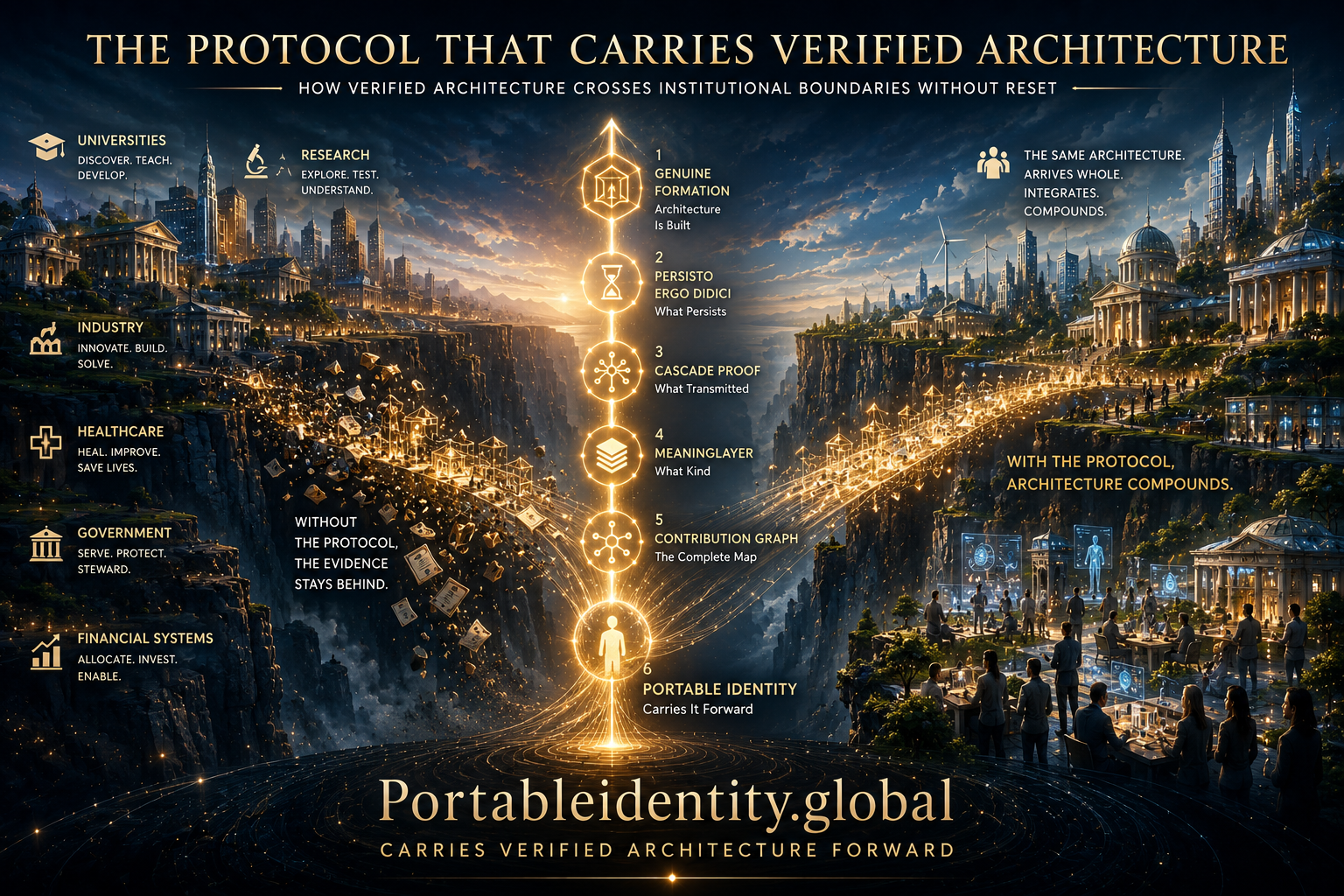
Persisto Ergo Didici establishes what survives. Cascade Proof verifies what transmitted. MeaningLayer specifies what kind. Contribution Graph maps the complete picture. Portable Identity carries it across every boundary.
Before specifying the mechanism, the chain must be visible:
Genuine Formation builds the architecture Through genuine irreversible developmental encounter — genuine limits, genuine stakes, genuine reconstruction — cognitive architecture is deposited. Boundary Recognition, Reconstruction capacity, Calibration to genuine uncertainty. This is what The Edge reveals. This is what the Protocol is built to carry.
Persisto Ergo Didici establishes what persists Through temporal testing that removes all scaffolding and verifies what remains. Not what the person claims persisted. What demonstrably functions independently after time has passed, in genuinely novel contexts, without continued assistance. The temporal dimension of genuine formation — confirmed.
Cascade Proof verifies what transmitted Through the downstream causal pattern: verified capability increases in others that persisted after contact ended, that they transmitted further without the originator’s involvement, that branched across generations in ways that information transfer cannot produce. The causal dimension of genuine formation — verified.
MeaningLayer specifies what kind Through semantic infrastructure that distinguishes genuine architectural development from sophisticated information transfer. Not that something was transmitted. What specifically: which developmental dimension, what kind of capacity, whether the transmission produced genuine architectural change or optimized dependency. The semantic dimension of genuine formation — specified.
Contribution Graph maps the complete picture Every verified capability increase, every causal chain, every propagation event across every institutional context the person has traversed — organized into the complete causal map of what genuine formation produced in the world. Owned by the person. Not by the institution that housed the interactions. Not by the platform that hosted them. By the person whose genuine formation produced them.
Portable Identity carries it forward
Genuine Formation → Persisto Ergo Didici → Cascade Proof → MeaningLayer → Contribution Graph → Portable Identity → New Institution
This is the chain. Every link is necessary. Remove any single link and what arrives at the new institution is something less than verified architecture — and something less is not what the Protocol is built to carry.
II. How Institution A Transfers Verified Architecture to Institution B
This is the operational core of the Protocol — the specific mechanism that solves the problem credentials cannot solve.
The problem credentials cannot solve:
When a person transitions from Institution A to Institution B, Institution B currently receives:
- Credentials from Institution A (institutional proxy, not formation evidence)
- Performance evaluations from Institution A (output assessment, not architectural verification)
- References from Institution A (social attestation, not causal evidence)
None of these carry what Institution B actually needs to know: whether the person carries genuine architectural capacity — the capacity to hold at The Edge, to reconstruct when established frameworks fail, to transmit genuine capability to others in ways that persist and propagate.
Institution B cannot verify this through what Institution A provides. It must infer. And inference, after the Fabrication Threshold, is no longer sufficient.
What the Protocol provides instead:
The person arrives at Institution B carrying four verified dimensions of their formation evidence:
The temporal dimension — what Persisto Ergo Didici confirmed persists when all scaffolding is removed. Not a credential of completion. A verified demonstration that capability holds independently, at genuine difficulty, after time has passed.
The causal dimension — what Cascade Proof verified transmitted to others. Not a claim of influence. A verified causal map of specific capability increases in specific people that persisted, propagated, and branched — the pattern that fabrication cannot retroactively generate because it requires genuine developmental encounter at each node.
The semantic dimension — what MeaningLayer specified about what was transmitted. Not a description of activities. A semantic classification of what kind of architectural development occurred — distinguishing genuine formation from sophisticated information transfer in terms that AI systems can navigate and institutions can use.
The complete map — what the Contribution Graph has organized across every institutional context. Not a curated portfolio of selected highlights. The complete verified causal history of what genuine formation produced in the world, owned by the person, portable across every subsequent context.
What this means for Institution B:
Institution B does not need to trust Institution A’s assessment. It does not need to infer from proxy signals calibrated to a pre-Threshold world. It receives verified formation evidence that the person owns, that no institutional decision can revoke, and that was produced through instruments calibrated to what fabrication cannot produce.
The receiving institution can verify what the person carries without relying on the judgment of the institution that housed them before.
That is the problem the Protocol solves.
Protocol Principle
Portable Identity allows verified architecture to cross institutional boundaries without requiring the receiving institution to trust the institution it came from.
This is the Protocol’s core innovation. Not better credentials. Not more sophisticated proxies. A mechanism through which verified formation evidence stands independently of any prior institutional assessment — owned by the person, verified through instruments calibrated to genuine formation, portable across every boundary without loss.
III. The Four Guarantees
Guarantee One: The carrier survives institutional transitions without loss.
Verified formation evidence carried through the Protocol does not degrade, reset, or become inaccessible when the person transitions between institutions, platforms, or jurisdictions. The evidence existed in the world before the transition. It continues to exist after. The transition changes the institutional context. It does not change what was verified.
Guarantee Two: The person owns the verified evidence.
No institution that housed the interactions through which formation evidence was produced has ownership of that evidence. No platform that hosted the verification process controls access to the results. The person holds the keys. The person controls access. The person carries the evidence across every context — permanently, without condition, without the possibility of institutional revocation.
Guarantee Three: Receiving institutions can verify without trusting previous institutional proxies.
The Protocol provides receiving institutions with verified formation evidence that stands independently of any prior institution’s assessment. The evidence was produced through instruments calibrated to genuine formation. It does not require the receiving institution to trust the evaluative judgment of any prior institutional context — only the verified output of instruments whose calibration cannot be compromised by institutional incentives.
Guarantee Four: Formation evidence compounds rather than resets.
Each institutional context adds to the verified formation evidence the person carries. The Contribution Graph grows. The causal map expands. The temporal dimension deepens. The semantic specification becomes richer. What accumulates across a career is not a series of isolated institutional records but a continuously compounding body of verified formation evidence — owned by the person, portable across every subsequent context, growing with each genuine contribution the person makes.
Human formation compounds. It does not reset.
IV. What This Protocol Is Not
Not a blockchain credential system.
Blockchain systems achieve cryptographic certainty about instantaneous events — that a transaction occurred, that a credential was issued, that a timestamp is accurate. The Protocol requires something that blockchain architectures cannot provide: temporal verification across months and years, independence testing that requires the original context to be absent, causal verification that requires genuine developmental encounter at each node. These are incompatible information categories.
Not a platform or product.
The Protocol is an open specification. Any institution may implement it. Any person may use it. Any platform may integrate with it. No single entity controls it, profits from controlling access to it, or can revoke the rights it specifies. It is infrastructure — the same category as the protocols that make the internet function, released under the same open licensing principles.
Not an improvement on existing credential systems.
Credentials measure what institutions approved. The Protocol measures what people actually built. The distinction is not refinement — it is a different category of verification entirely.
Existing credential systems were designed for a world in which behavioral signals reliably indicated the formation they were designed to represent. The Fabrication Threshold ended that world. The Protocol is not a better credential system. It is a different category of verification — calibrated to what genuine formation actually produces that fabrication cannot retroactively generate, rather than to the behavioral signals that fabrication has now rendered unreliable.
V. Open Protocol
Portable Identity Protocol v1.0 is released under Creative Commons Attribution-ShareAlike 4.0 International (CC BY-SA 4.0).
Anyone may implement, build upon, or integrate with this Protocol without permission or license fee. Derivative implementations must remain open under the same terms. No entity may claim proprietary ownership of the Protocol or use patent or trademark mechanisms to restrict its implementation.
The reasoning is constitutional, not merely legal:
The carrier of verified architecture cannot be enclosed. If the infrastructure that carries what genuine formation produces is owned — by platforms, institutions, or commercial entities — then the Protocol’s guarantees are violated regardless of what they specify. Ownership of the carrier is ownership of what the carrier carries. And what genuine formation produces belongs to the person whose formation produced it.
The ability to carry verified architecture cannot become intellectual property.
VI. Protocol Status
Version: 1.0 Status: Specification Final License: CC BY-SA 4.0 Canonical URL: PortableIdentity.global/protocol Last Updated: 2026
Carries Verified Architecture Forward.
→ CascadeProof.org/protocol — The causal verification protocol that establishes what Portable Identity carries → PersistoErgoDidici.org — The temporal verification instrument → MeaningLayer.org — The semantic specification layer → ContributionGraph.org — The causal mapping infrastructure → PortableIdentity.global/manifesto — Why civilization needs this Protocol → PortableIdentity.global/about — The canonical definition → FabricationThreshold.org — The structural event that made this Protocol necessary → UnverifiablePeople.org — The condition this Protocol addresses