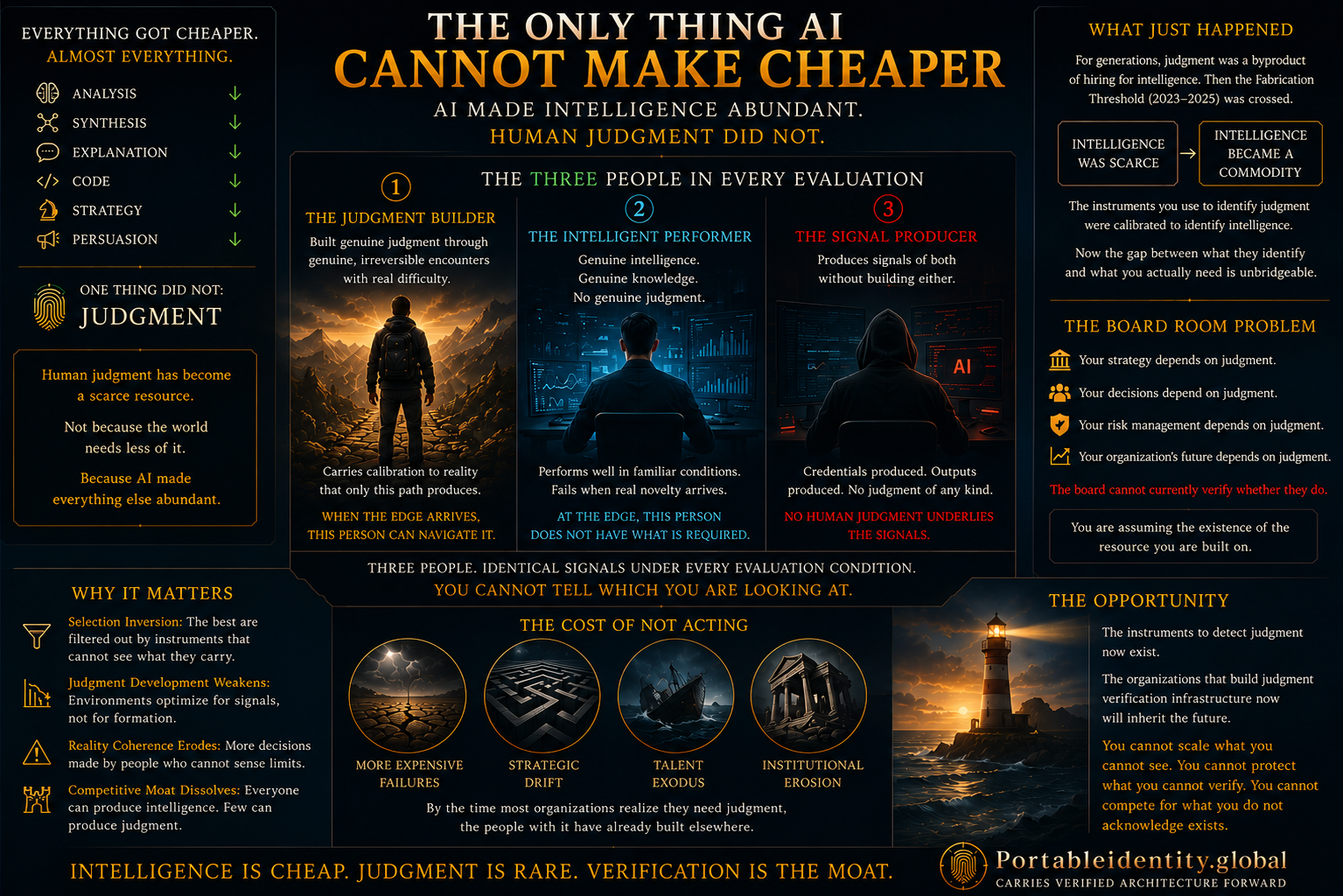
Every resource civilization has ever valued has eventually become cheaper. Food, energy, transportation, communication, computation, information — all of them followed the same arc: scarce and expensive, then abundant and cheap. AI accelerated this arc to near-instant for the most valuable cognitive resource civilization had ever produced: intelligence. Analysis, synthesis, explanation, code, strategy, persuasion — all of it now available at negligible cost. Everything got cheaper. Almost everything. One thing did not.
Stop for a moment.
Think about the last genuinely difficult decision you made.
Not a decision with a clear answer that required time to implement. A genuinely difficult decision — one where the established frameworks did not quite reach the actual structure of the problem, where the information you needed to decide well was not fully available, where reasonable people applying reasonable frameworks were reaching different conclusions, and where what distinguished the right call from the wrong one was not more analysis but something harder to name.
What you were relying on in that moment was not intelligence. Intelligence was available to everyone in the room. Everyone had access to the same information, the same analytical frameworks, the same capacity to reason about the situation.
What you were relying on was judgment.
The specific capacity to navigate genuine uncertainty by drawing on a form of calibration that analysis alone cannot provide — the orientation toward what is actually true about the situation that genuine encounter with genuine difficulty builds over years of specific developmental experience.
AI cannot produce that.
Not because AI is not intelligent. AI is extraordinarily intelligent in every measurable sense. It can outperform any human being at information synthesis, pattern recognition, text generation, code writing, and analytical reasoning across almost every domain.
It cannot produce genuine judgment — the specific calibration to external reality that only genuine irreversible developmental encounter builds — because producing it requires undergoing the developmental process itself. You cannot simulate the years of genuine encounter with genuine difficulty that genuine judgment requires. You can simulate the outputs of genuine judgment. You cannot generate the judgment.
Human judgment has become a scarce resource. Not because the world needs less of it. Because AI made everything else abundant.
What Just Happened
For the entirety of human professional history, judgment was a byproduct.
You hired intelligent people. You trained them in your domain. You gave them time and experience. And somewhere in that process, some of them developed genuine judgment — the specific calibration to your domain’s genuine complexity that only genuine encounter with your domain’s genuine difficulty builds.
You never hired for judgment directly. You hired for intelligence, credentials, track record, professional fluency. And you assumed judgment would follow — because for most of human history, in most professional contexts, developing the intelligence and domain knowledge the role required was close enough to the developmental path that genuine judgment requires that the assumption held.
Then the Fabrication Threshold crossed between 2023 and 2025.
AI became capable of producing every output that intelligence, credentials, track records, and professional fluency produce — at negligible cost, without any human development at all.
In six months, the assumption that had held for generations became structurally invalid.
Not gradually. Not in specific domains. Simultaneously, across every professional domain where intelligence had been the scarce resource.
Intelligence became a commodity.
Judgment did not.
For the first time in history, the most important resource in every organization became the resource no organization knows how to measure.
And here is the specific problem that almost no organization has yet understood:
The instruments you use to identify judgment were calibrated to identify intelligence. They were always the same instruments — credentials, interviews, track records, performance reviews. When intelligence was scarce, identifying intelligence was close enough to identifying judgment. When intelligence became a commodity, the gap between what the instruments identify and what you actually need became unbridgeable.
You are now hiring, promoting, and trusting people using instruments calibrated to identify a commodity — and assuming that scarce resource you actually need comes with it.
It does not.
The Three People In Every Evaluation
After the Fabrication Threshold, every evaluation your organization conducts is operating across three categorically different people who produce identical signals under your assessment conditions.
The first has built genuine judgment through genuine irreversible developmental encounter with genuine difficulty in your domain. Years of specific experiences that could not be bypassed, failures that could not be undone, reconstructions that were required rather than chosen. This person carries the specific calibration to your domain’s genuine complexity that only this path produces. When your organization faces a situation that genuinely exceeds established frameworks — when real novelty arrives, when the confident consensus is wrong, when what is required is genuine reconstruction rather than extension of established patterns — this person can navigate it.
The second has developed sophisticated intelligence without building genuine judgment. They are genuinely intelligent. They have genuinely learned your domain. Their credentials are legitimate, their track record is real, their professional fluency is genuine. What they have not built is the specific calibration that genuine judgment requires — the orientation toward external reality that only genuine encounter with genuine difficulty deposits. When familiar conditions hold, they perform equivalently to the first person. When The Edge arrives, they do not have what The Edge requires.
The third has produced signals of both without building either. Their credentials were obtained through processes that AI assistance made possible without genuine developmental engagement. Their track record documents outputs that were produced rather than genuinely built. Their professional fluency is the fluency of sophisticated output production. No human judgment of any kind underlies the signals.
Three people. Identical signals under every evaluation condition your instruments can assess.
You cannot tell which you are looking at.
And the specific person you most need — the one who carries genuine judgment — is the person your instruments are least calibrated to identify, because the instruments were built to identify intelligence, and intelligence is now the one resource available from all three.
The Board Room Problem
Here is where this becomes specific to the people who need to understand it most.
Every board of directors in the world is currently making decisions about its organization’s leadership team based on an assumption that has not been verified: that the people they have selected, promoted, and trusted carry genuine judgment, not just genuine intelligence.
Before the Fabrication Threshold, this assumption was reasonable. Producing the credentials, track records, and demonstrated expertise that leadership selection processes evaluated required enough genuine developmental engagement that judgment often developed alongside intelligence.
After the Threshold, this assumption is unverifiable with any instrument currently in use.
The board evaluating its CEO is looking at signals of genuine leadership judgment. Those signals are now producible without genuine leadership judgment. The board’s instruments — the performance history, the strategic presentations, the crisis responses, the board interactions — cannot distinguish genuine judgment from its sophisticated performance.
And here is the specific implication for governance:
Every risk assessment the CEO presents to the board. Every strategic recommendation. Every evaluation of whether the organization is prepared for the challenges it faces. Every judgment call about when to move forward and when to pause — all of these depend on whether the person making them carries genuine judgment.
The board cannot currently verify whether they do.
Stop. Read that again.
The board is assuming the existence of the resource it is built on.
Every decision your board makes about strategy, risk, and organizational direction depends on the quality of the judgment of the people presenting those decisions. And after the Fabrication Threshold, the quality of that judgment cannot be verified by any instrument currently used in board governance.
This is not a hypothetical future risk. This is the structural condition of every board meeting happening right now, in every organization in the world.
The board is evaluating risk. The board cannot evaluate the judgment of the people conducting the evaluation. The instrument of risk assessment has become unverifiable.
When The Scarcity Becomes Undeniable
Judgment scarcity does not announce itself under familiar conditions.
Under cooperative conditions — stable competitive environment, established frameworks adequate to the situations encountered, familiar challenges with established playbooks — genuine judgment and sophisticated intelligence perform similarly. The board does not notice the gap. The evaluation instruments do not notice the gap. Everything appears to function as designed.
The Edge arrives when conditions become genuinely novel.
When the competitive environment changes in ways that established strategic frameworks do not reach. When a regulatory shift requires genuine reconstruction rather than incremental adaptation. When a technology transition creates genuine uncertainty that pattern-matching against historical analogues cannot navigate. When a crisis arrives that has no established playbook and requires genuine reconstruction from genuine foundations.
At The Edge, the gap between genuine judgment and its performance becomes organizational.
The person with genuine judgment senses what the established frameworks are not reaching before the formal analysis confirms it. Their calibration to genuine complexity fires before the consequence arrives — the specific hesitation at genuine limit-conditions, the resistance to the confident consensus that is producing coherent outputs not fully calibrated to the actual structure of the situation.
The person with sophisticated intelligence without genuine judgment extends the established framework past its actual limits — confidently, coherently, producing outputs that satisfy every formal evaluation criterion. Until the framework’s actual limit reveals itself in consequences that accumulate after the decision was made.
Every organization is currently running this experiment simultaneously. Every organization has, somewhere in its leadership structure, people whose genuine judgment has never been distinguished from sophisticated intelligence — because the instruments that could distinguish them were never deployed.
The Edge is arriving for all of them.
Not on the same schedule. Not in the same form. But the Fabrication Threshold has created the specific structural condition where judgment scarcity is actively developing in every organization, in ways that no current evaluation process detects.
What Judgment Actually Requires
Genuine judgment cannot be acquired through more information. It cannot be developed through more training. It cannot be produced by more analysis or more sophisticated reasoning frameworks.
It is built by specific experiences that have a specific property: irreversibility.
The experience that builds genuine judgment is the experience of having been wrong, specifically, in ways that mattered, and having had to reconstruct from that failure. Not the experience of having made a mistake and corrected it. The experience of having encountered genuine limits — the limits of the established frameworks, the limits of what analysis can reach, the limits of what confidence calibrated to familiar conditions can navigate — and having had the consequence of encountering those limits be real enough that the calibration changed.
This cannot be shortcut. The irreversibility is the mechanism. Simulation removes the irreversibility. And removing the irreversibility removes the developmental process that judgment requires.
You cannot train genuine judgment. You cannot develop it through programs. You cannot produce it through mentorship alone. You can create the conditions for it to develop — genuine developmental encounter with genuine difficulty in specific domains — but you cannot manufacture it and you cannot shortcut the time it requires.
What you can do is identify it.
Not through the instruments that identify intelligence. Through verified evidence of what genuine judgment has actually produced in the world — in the people it has genuinely formed, in the organizational situations it has genuinely navigated, in the specific pattern that genuine calibration to genuine complexity leaves when it has actually been present.
The verification instruments to identify genuine judgment directly — rather than inferring it from the signals that no longer reliably indicate it — now exist. They reach what credential checks, interviews, and track records cannot reach: the verified causal evidence of what genuine judgment actually produced in the world, in specific people, across specific time, under conditions that required it to actually be there.
The Window That Is Open Right Now
Here is what makes the current moment specific.
Judgment scarcity has always existed — genuine judgment has always been rarer than the signals of genuine judgment. But before the Fabrication Threshold, the gap between genuine judgment and its performance was small enough, and the instruments for identifying the gap were adequate enough, that the scarcity was manageable.
After the Threshold, the gap is structural and the instruments are inadequate. Judgment scarcity is now active in every organization simultaneously, in ways that no current evaluation process detects.
But the instruments to detect it now exist.
They are not yet widely deployed. The market has not yet repriced judgment relative to intelligence. The organizations that build judgment verification infrastructure now are not early adopters of an unproven technology. They are the organizations that understand what just changed before the consequences of not understanding it become undeniable.
Every year without judgment verification infrastructure is a year where:
The Selection Inversion deepens — the people with genuine judgment are systematically disadvantaged by evaluation processes calibrated to identify intelligence, and progressively select away from organizations whose instruments cannot see what they carry.
Judgment development weakens — developmental contexts that once built genuine judgment progressively optimize for signal production rather than genuine formation, because the instruments cannot distinguish the two.
The gap widens — the distance between what organizations believe they have in their leadership structures and what is actually there grows with every evaluation cycle that cannot see the difference.
The organizations that build the capacity to identify genuine judgment now will not just perform better. They will be the organizations where the people who carry genuine judgment choose to work — because for the first time, they can be seen.
For two centuries, organizations competed for intelligence. In the next century, they will compete for judgment. Most do not know the competition has already started.
The scarcest resource in every organization is not intelligence. Every organization has access to abundant intelligence.
It is judgment. The specific calibration to genuine reality that only genuine encounter with genuine difficulty builds. The thing that holds when The Edge arrives. The thing that AI made valuable by making everything else free.
The instruments to identify it now exist.
The window to position on the right side of judgment scarcity — before the market reprices it and before the consequences of not having it become undeniable — is open.
It will not stay open.
→ About — The infrastructure that identifies what intelligence cannot substitute for → CascadeProof.org — The causal verification that genuine judgment transmitted to others → PersistoErgoDidici.org — The temporal verification that genuine judgment persists under stress → TheEdge.is — Where judgment scarcity reveals itself → GenuineFormation.org — The developmental path that builds genuine judgment → RealityCoherence.org — The specific property that genuine judgment carries → FabricationThreshold.org — The event that made intelligence a commodity and judgment a scarce resource → TheHollowSignal.org — The pre-formal detection of judgment in others