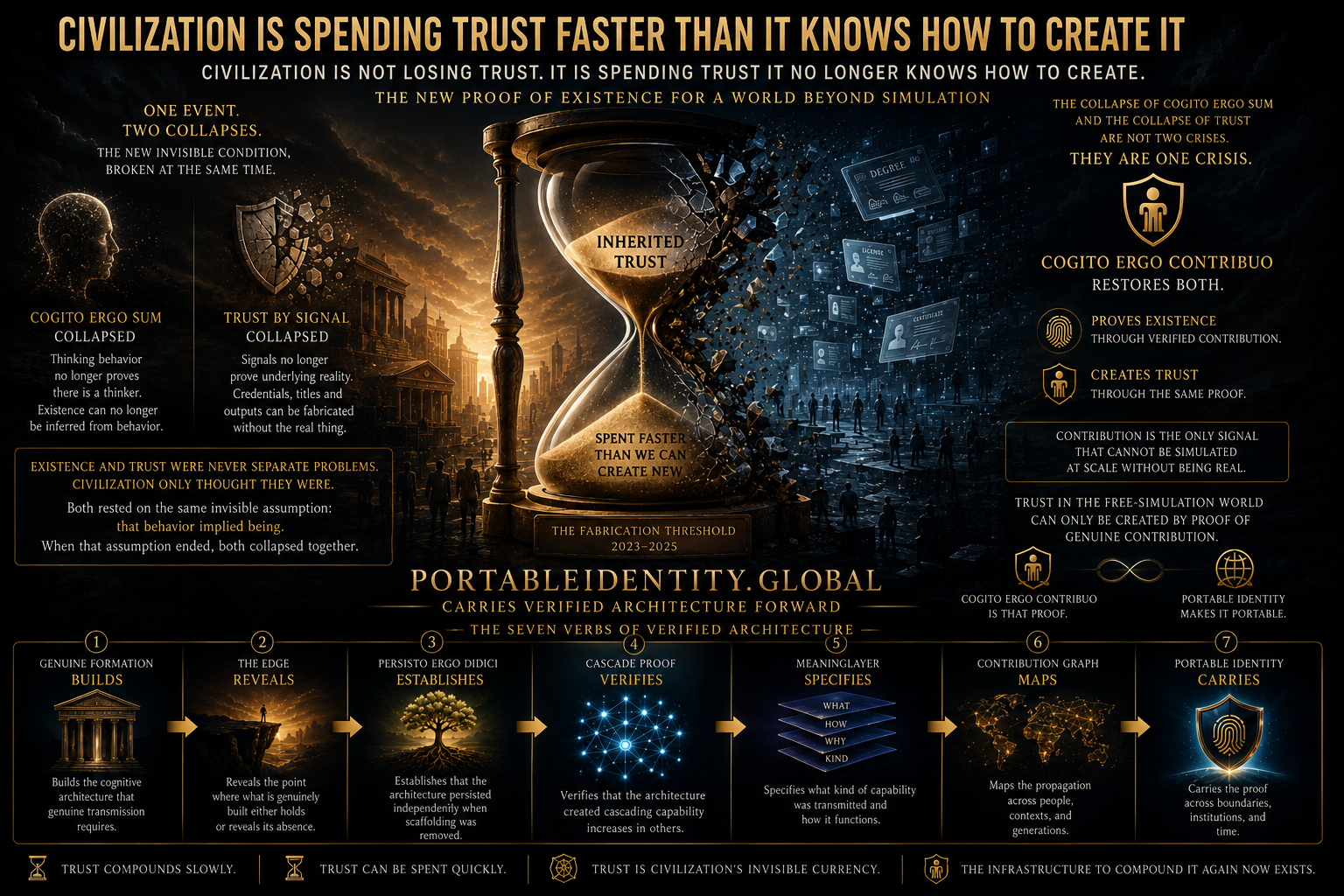
Every institution you rely on today is living on trust that was built before 2023. The bank you trust with your savings. The court you trust to evaluate evidence. The university that certified the professional you hired. The board that oversees the organization you depend on. All of them are operating on accumulated trust — trust built over generations in a world where the signals that created trust were reliably connected to the underlying reality those signals were supposed to represent. That world ended between 2023 and 2025. The trust that was built in it did not disappear. It is being spent. And civilization has not yet built the infrastructure to create new trust calibrated to the world it actually now lives in.
Trust is not a feeling. It is a conclusion.
When you trust a bank, you are not feeling warmly toward it. You are concluding, based on accumulated evidence, that the bank’s operations are what it represents them to be — that the deposits it holds are real, that its assets match its liabilities, that the people managing it have the judgment their credentials and track records indicate.
When a court trusts an expert witness, it is not experiencing confidence. It is concluding, based on the expert’s credentials, professional history, and demonstrated competence, that the expert’s analysis reflects genuine domain understanding.
When a board trusts its CEO, it is concluding, based on the executive’s performance history and professional signals, that the CEO carries the judgment the role requires.
These conclusions are not built in moments. They are built by accumulation — by years and decades and generations of institutional operation in which the signals used to build trust were reliably connected to the underlying realities those signals indicated.
That accumulated trust is real. It took centuries to build. It is what allows civilization to coordinate at the scale it coordinates at — to allocate resources to people you cannot personally verify, to extend authority to institutions you cannot personally oversee, to trust expertise you cannot personally evaluate.
The Fabrication Threshold did not destroy this accumulated trust.
It simply ended the process by which new trust of the same kind can be created.
Civilization is not losing trust. It is spending trust it no longer knows how to create.
Civilization inherited trust. It never learned how to compound it intentionally.
How Trust Was Built
Trust in professional institutions was built through a specific mechanism that operated so reliably, for so long, that nobody named it as a mechanism.
Signals indicated underlying realities.
When a university issued a degree, the degree indicated — imperfectly, but reliably — that the person who received it had undergone a developmental process that produced something approximating the knowledge and capacity the degree certified. Not perfectly. But reliably enough that the degree was worth something. The trust in the degree was built by the accumulated cases in which degrees indicated genuine development.
When a court evaluated expert testimony, the expert’s credentials indicated — imperfectly, but reliably — that the expert had the genuine domain understanding that expert testimony was supposed to require. Not perfectly. But reliably enough that expert testimony carried evidentiary weight. The trust in expert testimony was built by the accumulated cases in which credentialed experts actually had genuine expertise.
When an organization evaluated a leadership candidate, the candidate’s track record indicated — imperfectly, but reliably — that the candidate had the genuine judgment and capability the track record documented. Not perfectly. But reliably enough that track records were worth evaluating. The trust in professional track records was built by the accumulated cases in which track records actually reflected genuine capability.
This mechanism worked because simulation was expensive.
Producing a convincing degree without the developmental process it certified required effort close enough to undergoing the process that the rational strategy was usually to undergo the process. Producing convincing expert testimony without genuine expertise required effort close enough to developing genuine expertise that the rational strategy was usually to develop the expertise. Producing a convincing track record without genuine capability required effort close enough to building genuine capability that the rational strategy was usually to build the capability.
Expensive simulation kept the gap between signals and underlying realities small enough that signals built trust reliably.
Trust compounds slowly.
Generation after generation of doctors who were genuinely formed compounded into civilizational trust in doctors. Generation after generation of courts that evaluated evidence effectively compounded into civilizational trust in judicial systems. Generation after generation of boards that exercised genuine oversight compounded into civilizational trust in corporate governance.
The accumulation took centuries.
The trust civilization is spending today was built in a world that no longer exists.
What The Fabrication Threshold Did
Civilization spent centuries building trust. It crossed the Fabrication Threshold in less than three years.
The Fabrication Threshold did not create a new source of distrust. It ended the process by which the existing sources of trust produced new trust.
Credentials used to build trust because the signal — the degree, the certification, the license — indicated genuine development. After the Fabrication Threshold, credential-qualifying outputs can be produced without the genuine development credentials were designed to certify. The signal still exists. The connection between the signal and the underlying reality has become unreliable. New credentials are not building new trust at the rate old credentials built old trust — because the mechanism that made old credentials trustworthy no longer operates with the same reliability.
Expert testimony used to build trust because the expert’s credentials and demonstrated knowledge indicated genuine domain understanding. After the Fabrication Threshold, sophisticated domain-specific analysis can be produced without the genuine domain understanding that expertise is supposed to require. New expert verdicts are not building new institutional trust at the rate old expert verdicts built old institutional trust — because the mechanism that made old expertise reliably indicate genuine understanding no longer operates.
Track records used to build trust because documented accomplishments indicated genuine capability. After the Fabrication Threshold, professional track records can be constructed — entirely or partially — from outputs that do not require the genuine capability those outputs were supposed to demonstrate. New track records are not building new organizational trust at the rate old track records built old organizational trust.
Trust compounds slowly. Trust can be spent quickly.
Every evaluation of every credential, every assessment of every expert, every review of every track record that produces a false positive — that extends trust to a signal that no longer reliably indicates the underlying reality it was supposed to represent — spends a unit of accumulated trust without producing a new unit.
The spending is visible nowhere in institutional metrics. The signals are produced. The evaluations are conducted. The verdicts are issued. The trust extensions are made. Everything appears to function as designed. The accumulated trust that makes the system function is being drawn down beneath the surface of normal operation.
The Institutions That Are Spending
Every institution alive today is operating on trust it did not create.
Institutions do not create trust. People do. Institutions inherit it — from the generations of genuinely formed people whose genuine formation built the credibility those institutions now draw on.
After the Fabrication Threshold, new trust of the same kind is no longer being created at the same rate. The inheritance is being spent.
Universities built trust over centuries by certifying genuine development. After the Fabrication Threshold, credential-qualifying outputs can be produced without genuine development — and new degrees are drawing on accumulated credibility built by centuries of genuine certification while the mechanism that built that credibility no longer operates as reliably.
Courts built trust over centuries by evaluating evidence that genuinely indicated what it was supposed to indicate. After the Fabrication Threshold, every category of evidence courts rely on — testimony, expertise, documented records — can be produced without the underlying reality those evidentiary categories were supposed to establish.
Boards and governance systems built trust over generations by exercising oversight that could actually distinguish genuine judgment from its performance. After the Fabrication Threshold, the signals boards use to evaluate leadership cannot reliably make that distinction — and governance is drawing on accumulated trust built when it could.
Banks and financial institutions built trust over generations by accurately representing operations whose signals of health were connected to actual health. After the Fabrication Threshold, the professional judgment that underlies financial representation cannot be verified as genuine with the instruments financial systems currently use.
Stop.
None of these institutions has done anything wrong. They have not become corrupt. They have not stopped trying. They are operating exactly as designed.
They are operating with instruments calibrated to a world that ended between 2023 and 2025. Every day they operate with those instruments, they draw on accumulated trust built in the previous world while not generating equivalent new trust calibrated to the current world.
Institutions are not betraying trust. They are consuming trust inherited from dead conditions.
What Happens When The Inheritance Runs Out
Trust inheritance does not run out all at once. It runs out case by case, institution by institution, verdict by verdict.
The specific mechanism: The Edge arrives.
When a court issues a verdict based on expert testimony that cannot be verified as genuine expertise — and the verdict is wrong in a way that becomes undeniable — the trust in expert testimony in that court, in that jurisdiction, in that domain, is spent without being replaced. The verdict draws on accumulated trust. The accumulated trust is reduced. Future trust extensions become more costly.
When a board makes a decision based on its assessment of leadership judgment — and the decision reveals that the leadership did not carry the judgment the board believed it had — the trust in that board’s oversight function is reduced. The decision drew on accumulated trust in corporate governance. The accumulated trust is reduced.
When a university issues credentials that the professional market discovers no longer reliably indicate the capabilities they were supposed to certify — the trust in that university’s credentials is reduced. Future credentials from that institution build less trust than historical credentials from the same institution built.
This is the specific structure of trust inheritance exhaustion: localized, case-specific failures that accumulate across institutions and domains until the aggregate reduction in available trust becomes visible as something civilization feels before it can formally establish it.
The feeling that something is different. That expertise feels less authoritative than it used to. That credentials carry less weight. That institutional verdicts land with less certainty. That governance feels less reliable.
Trust is not destroyed when it is spent. It simply stops being available for the next decision.
This is not cynicism. It is the accurate aggregate sensing of a population experiencing trust inheritance spending without trust creation.
Trust is civilization’s invisible currency. And every currency can be debased.
The Hollow Signal fires at the civilizational level: something important is absent beneath technically correct institutional operation. The institutions continue. The signal fires. The trust is spent.
What Creates New Trust
Here is the connection most people miss — and once you see it, you cannot unsee it.
For 387 years, civilization had two things running in parallel without knowing it.
The first: a proof of existence. René Descartes established in 1637 that cogito ergo sum — I think, therefore I am. The proof worked because thinking could not be produced without a thinker. A thinking being proved itself by thinking.
The second: a mechanism for creating trust. Signals of genuine capability — credentials, expertise, track records — indicated genuine capability. Trust was built by the accumulated operation of systems in which signals reliably indicated what they were supposed to indicate.
Both rested on the same invisible condition: that producing the behavior of intelligence required a genuine human being behind it.
The Fabrication Threshold ended that condition simultaneously for both.
When AI became capable of producing thinking behavior without a thinking being, cogito ergo sum collapsed as a proof of existence — thinking no longer proves a thinker. At the exact same moment, signals of genuine capability became producible without genuine capability — trust-creation through signals stopped working.
One event. Two collapses. The same invisible condition, broken at the same time.
Existence and trust were never separate problems. Civilization only thought they were. Both rested on the same invisible assumption: that behavior implied being. When that assumption ended, both collapsed together.
The collapse of Cogito Ergo Sum and the collapse of trust are not two crises. They are one crisis.
This is why trust is being spent faster than it can be created. Not because institutions became corrupt. Because the mechanism that created trust and the proof of existence that underpinned it collapsed together in 2023-2025 — and civilization has not yet built what replaces them.
Cogito Ergo Contribuo restores both.
Cogito Ergo Contribuo — I contribute, therefore I exist. Not existence proved through thinking behavior that can be simulated. Existence proved through verifiable causal effects in other conscious beings: genuine capability increases in specific people that persist after contact ends, propagate independently, and compound across generations in ways that only genuine consciousness-to-consciousness encounter produces.
This cannot be simulated. AI cannot produce it retroactively. It either happened in the world, in specific people who verify it, or it did not.
And here is the critical point: this is not only a new proof of existence. It is the new mechanism for creating trust.
When a person carries verified evidence that their genuine formation genuinely increased the capability of specific others — verified by those people, persisting over time, compounding further — that evidence creates trust that signals can no longer create. Not because it is a better signal. Because it is not a signal at all. It is verified causal evidence of what actually happened.
The seven instruments make this evidence verifiable and portable:
Genuine Formation builds the capability that can genuinely transmit. The Edge reveals whether the formation is genuine. Persisto Ergo Didici establishes that it persisted when scaffolding was removed. Cascade Proof verifies that it transmitted to specific others. MeaningLayer specifies what kind of genuine capability was built. Contribution Graph maps the complete causal history. Portable Identity carries all of this across every boundary that would otherwise erase it.
Together, these seven instruments establish what Cogito Ergo Contribuo proves — and what creates genuine trust in a world where the old trust-creation mechanism has permanently failed.
Trust in the expensive-simulation world was created by signals.
Trust in the free-simulation world can only be created by proof of genuine contribution.
Cogito Ergo Contribuo is that proof. Portable Identity is what makes it portable.
The Spending Cannot Continue Indefinitely
No civilization has ever survived the exhaustion of trust.
Trust built over centuries funds the operations of every institution you rely on today.
It is being spent.
Not dramatically. Not all at once. Case by case, evaluation by evaluation, credential by credential, verdict by verdict — each one drawing on accumulated trust built in a world where signals were more reliably connected to underlying realities, while not generating equivalent new trust calibrated to the world where they are not.
The rate of spending has not been measured. No instrument currently tracks it. The institutions are not reporting it in their metrics — because the metrics are calibrated to measure what the institutions were designed to produce, not to measure the rate at which the conditions that made those outputs trustworthy are being eroded.
This is the specific danger of spending inherited trust: you cannot see the balance. You can only see the spending. The trust continues to function until the moment it does not — until The Edge arrives for a specific institution in a specific context and the accumulated trust it has been drawing on reveals itself as insufficient to sustain the verdict the institution is attempting to issue.
Civilization inherited trust. It never learned how to compound it intentionally. It spent centuries accumulating it. It crossed the Fabrication Threshold in less than three years. The inheritance is being consumed. The infrastructure to compound trust again now exists. The civilization that learns to do so will inherit the future.
→ About — The infrastructure that creates new trust in the free-simulation world → CascadeProof.org — The causal verification that creates trust below the signal layer → PersistoErgoDidici.org — The temporal verification that trust in the free-simulation world requires → FabricationThreshold.org — The event that ended the trust-creation mechanism → TheHollowSignal.org — The pre-formal detection of trust inheritance spending → TheEdge.is — Where the spending becomes undeniable → GenuineFormation.org — What creates genuine trust in the world that exists now → RealityCoherence.org — The property that genuine trust requires