Every genuinely new form of infrastructure faces the same initial problem: the people who encounter it for the first time try to fit it into an existing category. They ask which existing thing it is most similar to. They look for the closest analogue in what they already know. And they find one — because every piece of infrastructure shares surface features with the products that were built on top of the infrastructure that came before it. The analogy is always wrong. And the wrongness of the analogy is not a minor misclassification. It determines whether the infrastructure gets built, who builds it, how it is governed, and whether civilization gets the capability it enables.
When the internet was first described to people who had not yet experienced it, they tried to fit it into existing categories.
Some said it was a better postal system. You could send messages faster. True — but this missed what the internet actually was. The internet did not improve the postal system. It made a category of communication possible that the postal system could not accommodate at any speed.
Some said it was a better library. You could access more information more quickly. True — but this missed what the internet actually was. The internet did not improve libraries. It changed what civilization could know about what it knew, where the knowledge lived, and who could access it.
Some said it was a better telephone network. You could reach more people more cheaply. True — but this missed what the internet actually was. The internet did not improve telephone networks. It changed the structure of human coordination itself.
The people who understood what the internet actually was — not a better version of existing things, but a new layer of infrastructure that changed what was possible — were not smarter than the people who fit it into existing categories. They understood one specific thing: the difference between a product and infrastructure.
A product creates value inside an existing system. Infrastructure changes what systems can do.
Products compete. Infrastructure compounds.
The internet did not create value inside existing communication systems. It changed what communication could be. The distinction is not subtle. It is the difference between making something faster and making something possible.
What Infrastructure Actually Is
Think about money.
Money did not improve barter. It did not make barter faster, more efficient, or more pleasant. It made a category of economic coordination possible that barter could not accommodate at any level of optimization.
Without money, you can exchange what you have for what you need — but only if what you have is what someone else needs right now. The coordination that requires is severe. Money eliminated the coordination requirement. It made it possible for a baker to sell bread to someone who had nothing the baker needed — because money could be stored, transferred, and accepted by anyone. Money changed what civilization could coordinate.
Think about GPS.
GPS did not make navigation more efficient. It made a category of navigation possible that previous instruments could not accommodate. Before GPS, you could navigate precisely — but only with significant local knowledge, specialized instruments, and considerable time. GPS made precise navigation available to anyone, anywhere, instantly. It changed what civilization could locate.
Think about roads.
Roads did not make walking faster. They made a category of movement possible that walking across terrain could not accommodate at scale. They changed what civilization could reach.
In each case: the infrastructure did not improve what existed. It changed what was possible. And in each case, the initial confusion — is this a better version of something we already have? — delayed understanding of what was actually being built.
Infrastructure is invisible until civilization needs something it cannot do without it.
You do not notice roads until you need to move something too heavy to carry. You do not notice the financial system until you need to coordinate with people you will never meet. You do not notice the internet until you need to access knowledge that exists nowhere near you.
The infrastructure that is missing is always invisible — until the moment when what civilization needs to do becomes impossible without it.
The Infrastructure Civilization Never Built
Civilization has built infrastructure for almost everything it values.
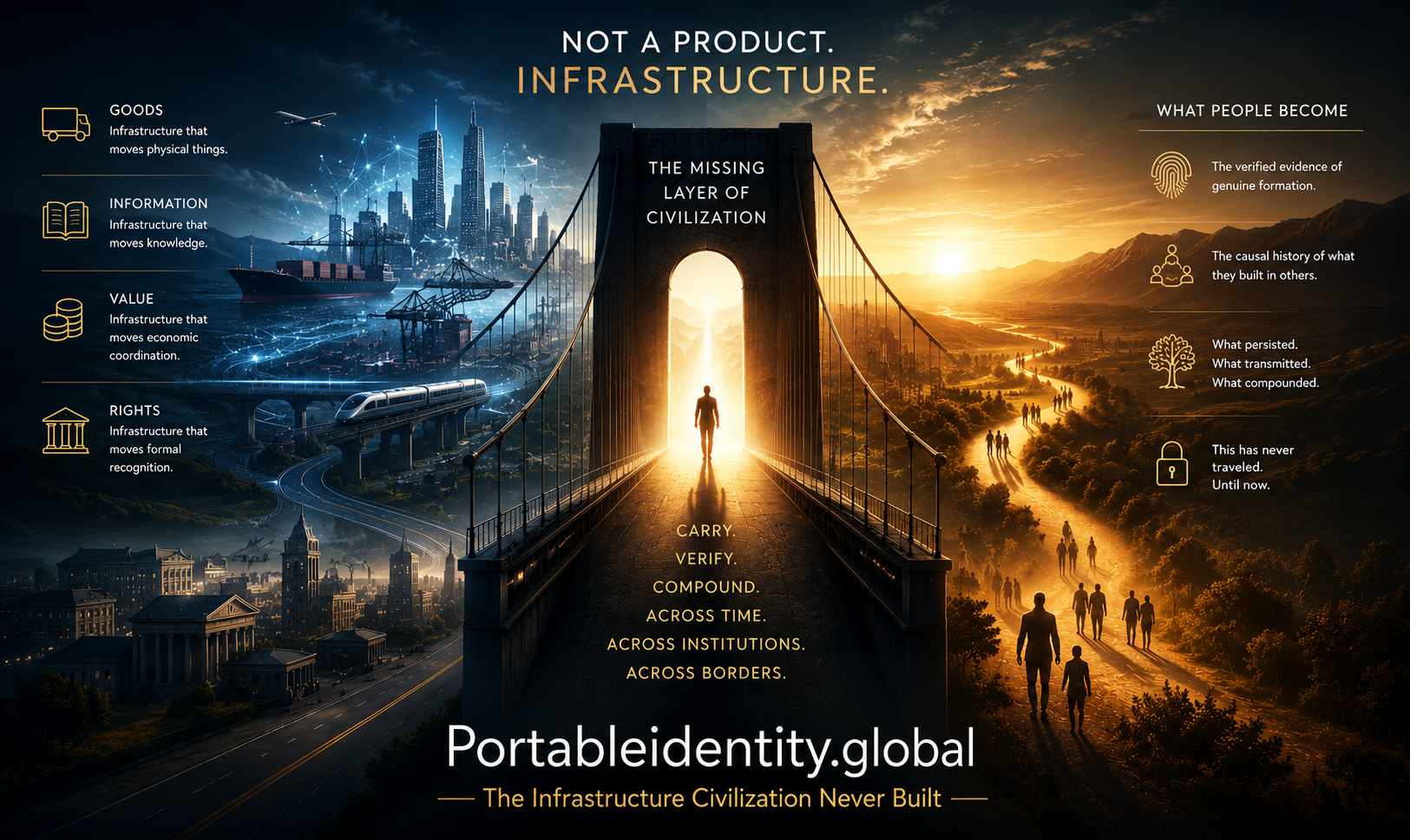
For goods: roads, ports, railways, shipping systems, logistics networks. The infrastructure that moves physical things.
For information: writing systems, printing, postal systems, telegraph, telephone, internet. The infrastructure that moves knowledge.
For value: currencies, banking systems, accounting standards, financial markets, payment infrastructure. The infrastructure that moves economic coordination.
For rights: legal systems, contract enforcement, property registration, identity documents, credentialing systems. The infrastructure that moves formal recognition.
Each of these layers of infrastructure changed what civilization could do. Not by making existing things better, but by making new categories of coordination possible.
There is one thing civilization has always needed that it never built infrastructure for.
Civilization built infrastructure for what people exchange.
It never built infrastructure for what people become.
Not credentials — civilization built infrastructure for credentials. Not reputation — civilization built mechanisms for reputation. Not information about people — civilization built information systems.
The verified evidence of what specific human beings actually built in the world through genuine formation. The causal history of what a specific person’s genuine capacity produced in others — what persisted, what transmitted, what compounded across the people they genuinely formed. The verified architecture of what a human being has genuinely become through genuine irreversible developmental encounter.
Human development compounded. Civilization reset it.
Every credential system, every reputation system, every professional record system documents what was claimed, what was certified, what was signaled. None of them carry what genuine formation actually produces.
Not because it is invisible. Because the infrastructure to carry it was never built.
Civilization built infrastructure for money, information, and credentials. It never built infrastructure for the human being behind them.
Why This Is Different From Every Existing Category
When people encounter Portable Identity for the first time, they reach for the closest category they know.
Is it a credential system? No. Credential systems certify process completion. Portable Identity carries verified causal evidence of what genuine formation actually produced in the world.
Is it a reputation system? No. Reputation systems aggregate assessments. Portable Identity carries verified evidence of what happened — not what people said about what happened.
Is it an identity system? No. Identity systems verify who you are. Portable Identity carries evidence of what you built — which is categorically different from verifying who you are.
Is it a CV 2.0? No. CVs document what was claimed. Portable Identity carries what is verified.
Every one of these analogies captures a surface feature while missing the category.
The category is infrastructure.
Specifically: the missing layer of civilizational infrastructure that makes it possible for genuine human formation to survive institutional boundaries. To compound rather than reset. To be carried by the person who built it rather than owned by the institutions that housed the encounters in which it was built.
This does not make existing systems better. It changes what civilization can carry.
What Changes When The Infrastructure Exists
Consider what became possible when money existed that was impossible before.
The baker could sell bread to the stranger. The farmer could invest in a harvest that would not be ready for months. The merchant could finance a journey to a place they had never been. Entire categories of economic coordination became possible that were structurally impossible without the infrastructure.
Not because anyone became smarter. Because the infrastructure changed what coordination could accomplish.
Consider what becomes possible when verified formation evidence can travel with a person across institutional boundaries.
The genuinely formed person can carry the verified causal evidence of what their formation produced — in specific people, across specific contexts, over specific time — to every new institutional context. The new institution does not need to trust the previous institution’s assessment. It does not need to evaluate signals that may or may not indicate the underlying reality they represent. It can read verified evidence of what the person’s formation actually produced.
Civilization compounds capital. Civilization compounds information. Civilization compounds technology.
Civilization resets people.
Every institutional transition erases the verified evidence of what genuine formation produced. Every boundary that genuine formation crosses, it crosses without the proof that it happened. The compounding stops. The accumulation is lost. The person who built twenty years of genuine formation starts from zero — again.
Portable Identity is the first infrastructure that allows people to compound too.
The Selection Inversion ends. The person who has invested the most in building genuine formation — who carries the most evidence that currently has nowhere to live — carries that evidence into every new context rather than having it erased at every institutional boundary.
Genuine formation begins to compound across institutional boundaries rather than resetting at each one. The person who has built twenty years of genuine formation carries twenty years of verified evidence rather than starting from zero at each transition.
The Hollow Signal has somewhere to land. The experienced practitioner who senses architectural absence beneath technically correct performance can check that sensing against verified formation evidence rather than suppressing it for lack of institutional standing.
Organizations can select for genuine judgment rather than for the signals of genuine judgment. Not by becoming better at reading signals — by reading something other than signals.
None of this is possible without the infrastructure. All of it is possible with it.
Products create value inside existing systems.
Infrastructure changes what systems can do.
Why It Cannot Be Owned
Here is the specific property of infrastructure that distinguishes it most clearly from products.
Products can be owned. Infrastructure cannot — not if it is to function as infrastructure.
The internet works because TCP/IP is owned by no one and available to everyone. The moment a single entity controls the routing infrastructure of the internet, it is no longer infrastructure. It is a platform. And platforms have owners who make decisions about access, pricing, and governance that infrastructure cannot be subject to if it is to function as the neutral layer that enables everything built on top of it.
Money works because — in its most functional forms — it operates as a neutral medium that any two parties can use to coordinate without needing to trust each other or a shared intermediary. The moment money is owned and controlled by a single entity that makes decisions about who can transact, it is no longer infrastructure. It is something else.
Portable Identity cannot be owned by any single entity, because owning the carrier of verified formation evidence is equivalent to owning the formation itself.
If a platform owns the infrastructure through which genuine formation evidence is carried, then that platform owns access to what the formation evidence enables. The person who built the formation does not own the verified evidence of what they built — they access it through an intermediary that can change terms, restrict access, or cease to exist.
This recreates exactly the problem Portable Identity exists to solve: institutional control over evidence that belongs to the person who built it.
Portable Identity is released under Creative Commons Attribution-ShareAlike 4.0 International. Not as a legal formality. As a constitutional commitment to the category it belongs to: infrastructure.
The carrier of verified formation evidence cannot be enclosed. The infrastructure that makes genuine formation portable cannot be owned. This is not optional. It is what makes it infrastructure rather than a product.
The Moment Infrastructure Becomes Necessary
Infrastructure is invisible until civilization needs something it cannot do without it.
The moment that makes Portable Identity necessary is not in the future. It crossed between 2023 and 2025.
The Fabrication Threshold ended the reliable connection between signals of genuine formation and the underlying formation those signals were supposed to indicate. The credential system, the reputation system, the professional track record system — all of the signal-carrying infrastructure civilization built — lost its reliable connection to what it was always supposed to indicate.
At that moment, civilization discovered that it had built infrastructure for everything except the thing that all other infrastructure was supposed to serve: the human being whose genuine formation is what makes genuine contribution possible.
When signals could indicate formation, the absence of formation-carrying infrastructure was manageable. You could approximate what genuine formation carried through the signals it produced.
When signals no longer reliably indicate formation, the absence of formation-carrying infrastructure becomes the specific gap that makes it impossible to do what civilization most needs to do: identify genuine formation, compound it, and route the trust and responsibility that genuine formation justifies to the people who genuinely carry it.
Civilization built infrastructure for information when information needed to move. For value when value needed to move. For rights when rights needed to be recognized across contexts.
It needs to build infrastructure for genuine formation now — because genuine formation needs to move, and the moment when signals could carry it in its absence has ended.
This is that infrastructure.
Not a product. Not a platform. Not a better version of something that exists.
The missing layer. The one that changes what civilization can carry.
Products create value. Infrastructure creates civilizations.
Civilization built infrastructure for what people exchange. It never built infrastructure for what people become.
Portable Identity is that infrastructure.
Until now.
→ Protocol — How the infrastructure actually functions → Manifesto — The constitutional declaration for open infrastructure → About — What the infrastructure carries → GenuineFormation.org — What the infrastructure was built to carry → CascadeProof.org — The causal verification instrument within the infrastructure → PersistoErgoDidici.org — The temporal verification instrument within the infrastructure → ContributionGraph.org — The mapping instrument within the infrastructure → FabricationThreshold.org — The event that made the infrastructure necessary