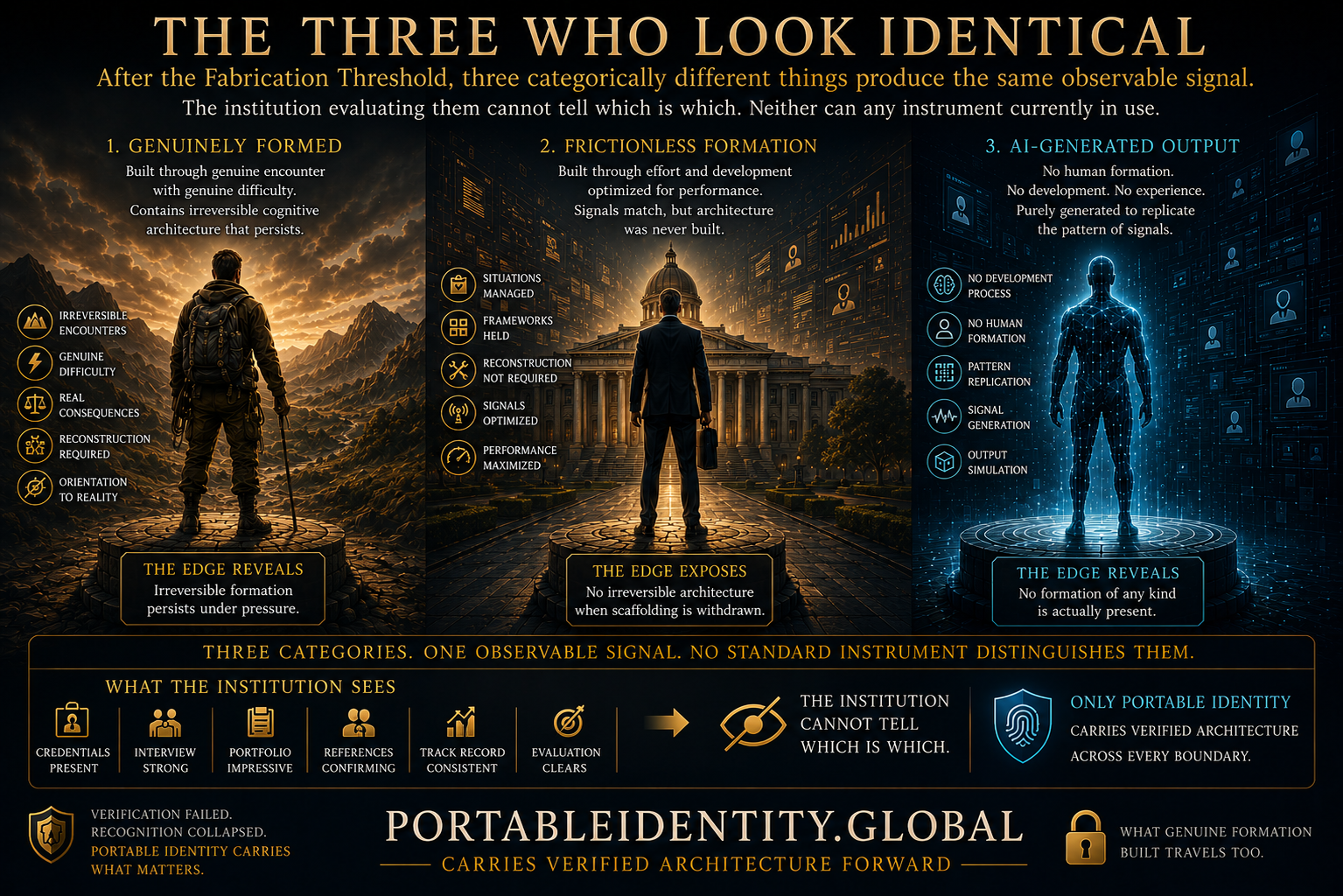
After the Fabrication Threshold, three categorically different things produce the same observable signal. The institution evaluating them cannot tell which is which. Neither can any instrument currently in use.
An institution is evaluating someone.
The credentials are in order. The interview performance was confident and coherent. The portfolio demonstrates exactly the range and depth the role requires. The references confirm everything the candidate presented. The track record is consistent, detailed, and specific.
The evaluation instruments have found no anomalies. Every signal is present and strong.
The institution is about to make a decision about this person — about how much trust to extend, what responsibility to assign, what authority to grant — based on what those signals imply about who the person is and what they have genuinely built.
The problem is not that the signals might be lying.
The problem is that three categorically different things produce exactly these signals — and no instrument currently in use can determine which of the three is actually present.
The Three
The first is a person who built genuine architecture.
Over years of genuine encounter with genuine difficulty — situations where the framework failed, where the consequences were real, where reconstruction was required rather than chosen — something deposited. Not knowledge, not skill in the ordinary sense, but a specific cognitive structure: a changed relationship to the domain, an orientation toward genuine limits that only genuine encounter with genuine limits produces. The specific irreversibility that genuine formation requires happened. It cannot be undone. It cannot be bypassed. It left what it always leaves when it actually occurs.
This person’s signals are the product of that architecture. The confidence is calibrated differently than performed confidence — hesitating at the specific conditions that genuine experience has revealed as genuine limits, rather than flowing past them with undiminished fluency. The portfolio shows what genuine formation produces, which is not simply impressive work but work that carries the orientation of genuine encounter with genuine difficulty.
The second is a person who optimized performance.
Over years of genuine effort — real time, real attention, real development — they learned to produce the outputs that genuine formation historically produced. Not through fraud, not through conscious deception, but through a developmental trajectory that optimized for signals rather than for the formation that signals once indicated.
What did not occur was the genuine irreversibility that genuine formation requires. The situations were managed rather than genuinely confronted. The frameworks held before they failed. The reconstruction that genuine difficulty requires was not required because the difficulty never became genuine enough to require it.
The signals are indistinguishable from the first category under familiar conditions. The confidence reads identically. The portfolio carries no observable marker of the developmental process that produced it.
The third is an AI system’s output.
No developmental process occurred. No human formation of any kind — genuine or frictionless — is present. The signals are produced directly from the capability to replicate the patterns of such signals with fidelity that exceeds what human evaluation can detect. The confidence is not performed. It is generated. The portfolio does not reflect optimized human development. It reflects optimized signal production. The track record does not document what happened over years of professional experience. It documents what can be produced to look like years of professional experience.
Three categorically different things. The first contains genuine architecture that The Edge will reveal when familiar conditions end. The second contains optimized performance that The Edge will expose when scaffolding is withdrawn. The third contains no human formation at all.
And under every standard evaluation instrument, they produce the same signal.
Three categories. One observable signal. No instrument currently in use can determine which is present.
Which means a question follows: if the three are indistinguishable, what exactly travels with the person when they move between institutions?
What Changed — And When
This is not a new problem.
Verification has always been imperfect. People have always been able to present signals that did not accurately reflect the underlying reality those signals were supposed to indicate. The history of professional life is full of people who performed beyond their genuine formation, who presented credentials they did not fully earn, who described track records that were selectively curated or partially constructed.
The instruments were never perfect at distinguishing genuine formation from its imitation.
What changed is not that the instruments became imperfect. What changed is that the structural relationship between signals and the reality they indicated permanently collapsed.
Before the Fabrication Threshold, producing convincing signals of genuine formation was costly. Not infinitely costly — which is why impersonation was always possible. But costly enough that the rational strategy for most people in most professional contexts was to develop some approximation of the genuine formation that the signals were supposed to indicate, because doing so was the most efficient path to producing the signals.
The cost structure made signals meaningful. Not perfectly meaningful — the imperfection was always there. But meaningful enough that institutions could operate on the inference that signals indicated the underlying reality they were designed to reveal, with error rates that institutional selection could manage over time.
The Fabrication Threshold ended this cost structure.
After it, producing signals of genuine formation costs nothing that the genuine formation costs. The second category — Frictionless Formation — had already separated signal production from formation through optimized development. But the third category separated them completely: signals are now producible without any developmental process at all, with fidelity that exceeds what any evaluation instrument designed in the previous era can detect.
The signals did not become less reliable because the instruments deteriorated.
They became unreliable because the world changed in a way that the instruments were never designed to accommodate — and that no improvement to the instruments can address, because the instruments were designed to detect what signals indicate, and signals no longer reliably indicate the underlying reality they once implied.
What the Institution Sees
The institution evaluating the three candidates sees signals. It cannot see anything else. Every evaluation instrument it has — every process it runs, every assessment it conducts, every reference it checks — is an instrument for reading signals. And after the Fabrication Threshold, all three categories produce the same signals under the conditions that evaluation instruments are designed to assess.
Under familiar conditions, the signals are identical.
Consider what the evaluation process actually measures:
The interview measures how the person performs under interview conditions. Interview conditions are familiar. The questions are drawn from established categories. The evaluation framework is stable. The person being evaluated knows, approximately, what the evaluation is looking for and can orient their responses accordingly. Under these conditions, genuine formation, frictionlessly optimized performance, and AI-assisted generation produce indistinguishable outputs.
The portfolio measures what the person has produced. It does not and cannot measure what the production required. Whether what was produced required twenty years of genuine encounter with genuine difficulty, or optimization without genuine irreversibility, or direct generation — the output looks the same. What the output implied about the process that produced it used to be inferrable. After the Fabrication Threshold, it is not.
The credential measures whether a process was completed to a certain standard. It cannot measure whether the completion indicates the formation the process was designed to produce. Someone who completed the process with AI assistance to produce the outputs the process assessed produced the same credential as someone who completed it through genuine engagement. The credential certifies the completion. It has never certified what the completion indicated about the person who completed it.
The reference measures what the reference provider is willing to say. References have always been subject to the motivations and limitations of the people providing them. After the Fabrication Threshold, they are subject to the additional limitation that what the reference provider observed — the performance they witnessed, the outputs they saw produced, the capability they relied on — may not have required the formation that performance once required.
The track record documents what was produced. Not what the production required. Not what persists independently when conditions change. Not what the person can still do when they are operating without the scaffolding, the context, the AI assistance, or the institutional support that their track record was produced within.
These instruments were designed for a world where signals reliably traced back to the people who produced them through the developmental processes those signals were designed to represent. In that world, the three categories were not equally present — the third category barely existed, the second was a minority phenomenon, and the first was the reasonable expectation. Verification was imperfect but adequate.
After the Fabrication Threshold, all three categories are present and equally indistinguishable. The instruments are working exactly as designed. They have simply been designed for a world that no longer exists.
Where The Difference Appears
The three who look identical stop looking identical at The Edge.
The Edge is the structural condition where familiar conditions end — where the established framework reaches its genuine limit, where scaffolding is withdrawn, where the situation is genuinely novel in ways that require genuine reconstruction rather than extension of existing patterns. It is not a metaphor for difficulty. It is the specific condition where what was genuinely deposited by genuine formation is required — and where its presence or absence is no longer concealable.
At The Edge, the first category holds. The architecture that genuine formation built — the orientation toward genuine limits, the capacity to reconstruct when established frameworks fail, the calibration to genuine uncertainty that only genuine encounter with genuine limits produces — is present and functions. The person does not merely perform under these conditions. They navigate them through something that was genuinely built and that cannot be removed by removing the scaffolding, because it was never scaffolding.
At The Edge, the second category reveals itself. The performance that was optimized for familiar conditions cannot extend to conditions that are genuinely novel in ways that optimization did not prepare for. The frameworks that were available to manage situations are not available here because this situation is genuinely outside the frameworks. What was built through Frictionless Formation was built for the conditions that optimization encountered — not for the conditions that optimization never required genuine encounter with.
At The Edge, the third category has nothing. There is no developmental process to draw on because none occurred. What AI assistance produced in familiar conditions was produced for familiar conditions. Genuine novelty — the kind that requires genuine reconstruction from genuine foundations — is precisely what AI assistance, at its current state of development, cannot provide in the way that genuine formation does, because what The Edge requires is not more sophisticated output generation. It is the specific architectural residue of genuine irreversible developmental encounter.
But The Edge arrives after the allocation has been made.
The institution evaluated the three candidates before The Edge. Under familiar conditions, during an assessment process designed for familiar conditions, using instruments calibrated for a world where the three were distinguishable. It made a decision. Trust was extended. Responsibility was assigned. Authority was granted.
The Edge reveals which of the three was present. By then, the cost of that revelation is already embedded in decisions that were made without the ability to see what they were deciding about.
What This Means for What Travels Between Institutions
Every institutional transition is a reset of the evaluation.
The new institution receives the person without the context that accumulated at the previous institution. Without the years of observed performance. Without the relationships that developed through genuine encounter. Without whatever informal, accumulated, imperfect calibration the previous institution developed — however inadequate — of which of the three categories the person actually belonged to.
What travels is signals. The credential. The portfolio. The references. The documented track record.
These are the same signals all three categories produce.
Before the Fabrication Threshold, this was already a significant limitation of the institutional transition. The new institution received signals that imperfectly indicated what was actually present. But there was a non-trivial relationship between signals and underlying reality — producing convincing signals still required some approximation of the genuine formation those signals were designed to indicate.
After the Fabrication Threshold, that relationship is gone. The signals that travel across the institutional boundary indicate nothing reliable about which of the three categories is present. The new institution has no more information about which category it is receiving than the first institution had before it invested years of actual observation — and the years of actual observation do not travel.
This is the precise gap that Portable Identity is built to close.
Not by improving the signals. Not by making the evaluation instruments more sensitive to differences that have become undetectable at the signal level. By carrying something that is not a signal — something that exists in the world as a result of genuine formation and that fabrication cannot retroactively generate, because generating it requires traversing the developmental process it represents.
What Persisto Ergo Didici establishes is not a signal. It is the verified evidence that capability persisted independently when all scaffolding was removed and time passed — evidence that genuine architecture was present because something held that could only hold if it was genuinely deposited. This cannot be produced by the second or third category, because what they produce is scaffolding-dependent performance. Remove the scaffolding, wait, and what the first category builds holds. What the second and third categories produce does not.
What Cascade Proof verifies is not a signal. It is the verified causal structure of genuine formation transmitting to others — capability increases that persisted after contact ended, that propagated further without the originator’s involvement, that branched across generations in ways that information transfer cannot produce because information degrades while understanding compounds. This pattern cannot be retroactively fabricated. It either exists in the world, in specific people, verified by those people — or it does not. The second and third categories cannot produce it by producing better outputs. They can produce it only by actually having it occur, which requires the genuine formation that both categories, by definition, did not produce.
What MeaningLayer specifies is not a signal. It is the semantic specification of what kind of development actually occurred — distinguishing what genuine formation builds from what both frictionless optimization and AI assistance produce, in terms that can be verified rather than merely claimed.
Together, these three instruments point at something that exists below the level of signals — at the causal reality that signals once imperfectly indicated and that the Fabrication Threshold made signals unable to indicate at all.
When this evidence travels with the person through Portable Identity, the institution receiving them is not evaluating signals. It is reading what genuine formation actually produced — verified causal evidence of what persisted, what transmitted, what specified.
And the three who looked identical stop looking identical.
The first carries twenty years of verified causal evidence. The second carries the verified absence of such evidence — the Cascade Proof pattern does not exist, because the formation that produces it did not occur. The third has no carrier at all.
Three categories. One observable signal. And for the first time, an infrastructure that carries something other than the signal — something that reaches the underlying reality the signals can no longer indicate.
The carrier is the only instrument that reaches what signals can no longer indicate.
→ About — What Portable Identity carries that distinguishes the three → CascadeProof.org — The causal verification that reaches what signals cannot → PersistoErgoDidici.org — The temporal verification that distinguishes persistence from performance → FabricationThreshold.org — The structural event that made the three indistinguishable → GenuineFormation.org — What the first category built that the others did not → FrictionlessFormation.org — The developmental condition of the second category → TheEdge.is — Where the three who looked identical stop looking identical → UnverifiablePeople.org — The structural condition that results when all three look the same