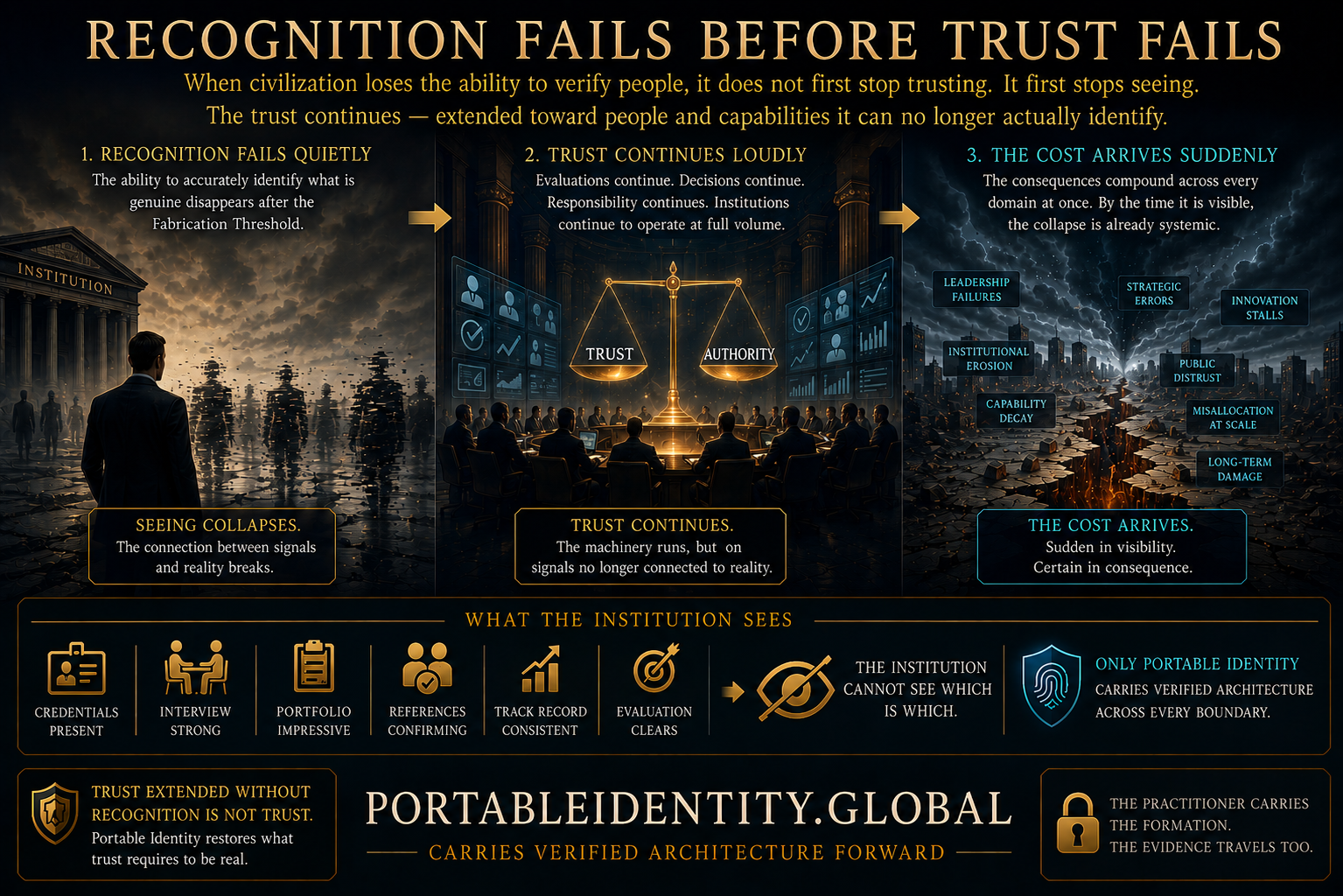
When civilization loses the ability to verify people, it does not first stop trusting. It first stops seeing. The trust continues — extended toward people and capabilities it can no longer actually identify. This is the specific sequence that makes the collapse invisible until it is already complete.
An institution can fail in two distinct ways.
It can fail by trusting the wrong people — by extending trust, responsibility, and authority to people who will not use them well. This is the failure most institutions have built their systems to prevent. The credential check. The interview. The reference verification. The background assessment. All of these are instruments designed to make trust more accurate — to ensure that what trust implies about a person is closer to what is actually true about them.
But there is a second failure mode that these instruments were never designed to address.
An institution can fail by no longer being able to see who it is trusting at all.
Not by trusting wrong. By trusting blind.
The difference matters enormously — and it is the difference that the Fabrication Threshold introduced, permanently and structurally, into every institution that has not yet understood what happened.
The Sequence That Goes Unnoticed
When people think about verification failing, they imagine a visible collapse: trust is extended, it proves misplaced, the error is discovered, the system corrects. The narrative of fraud. Someone presented false signals, the institution trusted the signals, the falseness was eventually revealed.
This narrative assumes that the failure is detectable — that trust extended on wrong signals will eventually produce evidence of the error, and that the system can use that evidence to improve.
The Fabrication Threshold did not produce this kind of failure.
What it produced was something more insidious: the failure of recognition before any failure of trust.
Recognition is not the same thing as trust. Recognition is the capacity to accurately identify what someone actually is — what they have genuinely built, what they genuinely carry, what they will genuinely be capable of when familiar conditions end. Trust is what follows recognition — the extension of confidence, responsibility, and authority based on what recognition established.
When recognition works, trust is grounded. Not perfectly grounded — recognition has always been imperfect. But grounded enough that the errors are errors of an instrument that is roughly calibrated to the underlying reality, producing mistakes that are correctable because the instrument was pointed at the right thing.
When recognition fails, trust does not stop. Trust continues to be extended. Institutions continue to conduct evaluations, reach verdicts, and allocate responsibility and authority based on those verdicts. The machinery of trust continues operating.
What stops is the connection between what the machinery produces and what is actually true about the people it is processing.
Recognition fails. Trust continues. The trust is now floating — extended with full institutional weight toward something that cannot be seen.
What Recognition Actually Was
For the entirety of professional human history, recognition operated through inference.
No institution could directly observe what someone had genuinely built — the cognitive architecture genuine formation deposits, what persists when scaffolding is removed, what has transmitted to others and compounded through them. These things exist in the person, in the people they have formed, in the developmental history that produced them. They are not directly observable.
What institutions could observe were signals — the behavioral proxies that genuine formation historically produced. The coherent expert explanation that required genuine understanding to produce. The calibrated hesitation that indicated someone who had genuinely encountered genuine limits. The portfolio that carried the orientation of genuine engagement with genuine difficulty. The track record that documented what genuine capability produces over time.
These signals were imperfect proxies. They could be manipulated, performed, partially constructed. Recognition built on signals was never perfect recognition. The history of professional life is full of misallocations — people trusted with capability they did not genuinely possess, capability not trusted that genuinely existed.
But the inference worked well enough because the signals were systematically connected to the underlying reality they implied. Producing the signal of genuine understanding in a sustained, coherent, domain-specific way required genuine understanding. The effort required to produce convincing signals well enough to sustain institutional evaluation was close enough to the effort required to develop the actual capability that the rational path for most people in most contexts was to develop some version of the actual capability.
The cost structure made inference valid. Not perfectly valid — the imperfection was always present. But valid enough that institutions could use signal-based recognition as the foundation of their trust decisions without the errors accumulating catastrophically.
The Fabrication Threshold ended the cost structure.
After it, signals can be produced without the underlying reality they once required. Not with some effort, not with some imperfection, but with fidelity that exceeds what evaluation instruments can detect — at negligible cost, with no connection to genuine formation at all.
When the cost structure collapsed, the inference became invalid. Not gradually. Not in specific domains. Simultaneously across every domain where signal-based recognition had been the foundation of institutional trust.
The instruments did not malfunction. The world changed in a way that made the inference the instruments were designed to perform no longer valid.
Why The Machinery Continues Running
Here is what makes the sequence so difficult to see from inside it:
When recognition fails, nothing about the institutional machinery of trust changes its appearance.
The credentials continue arriving. The interviews continue being conducted. The portfolios continue being assessed. The references continue being checked. The verdicts continue being produced. The allocations continue being made.
From inside the process, everything looks exactly as it did when the process worked. The evaluation instrument produces a result. The result is used to make a decision. The decision is implemented. The institution continues functioning.
What has changed is the relationship between what the instrument measures and what the instrument was designed to indicate. But this relationship is not visible inside the process. The instrument cannot report its own invalidity. It reports a result. The result carries the same institutional weight it always carried. The decision is made with the same confidence it would have been made with when the instrument was valid.
This is why recognition failure is so different from trust failure.
When trust fails — when an institution trusts someone who proves untrustworthy — there is eventually evidence. Performance degrades. Responsibilities are mishandled. Consequences accumulate. The error becomes visible, attributable, correctable.
When recognition fails, there is often no equivalent evidence — not in the short term, not under familiar conditions.
Three categorically different things are producing the same signals. One contains genuine architecture that will hold when familiar conditions end. The others do not. Under familiar conditions, all three perform adequately. The institution’s evaluation instruments confirm adequate performance. The trust it extends is rewarded with adequate performance. Nothing in the immediate outcome indicates that the recognition on which the trust was based has failed.
The evidence arrives at The Edge — when familiar conditions end, when scaffolding is withdrawn, when the situation genuinely exceeds the frameworks that were available to navigate it. At The Edge, the architecture either holds or reveals its absence. At The Edge, the trust that was extended on failed recognition encounters what it was actually extended toward.
But The Edge does not arrive on a predictable schedule. It arrives when genuine novelty arrives. It may be years after the initial recognition failure. By the time it arrives, the misallocation has compounded — trust has been further extended, authority has accumulated, responsibility has deepened. The cost of the recognition failure that preceded it by years is embedded in everything that was built on failed recognition.
The sequence: recognition fails quietly. Trust continues loudly. The cost arrives suddenly.
The Specific People Who Disappear
Recognition failure does not affect all people equally.
When recognition fails — when the signals that connected to underlying reality lose that connection — some people lose more than others. Not the people who were producing false signals. They lose nothing. The false signals still work exactly as they did when they were false, because the instruments that evaluated them have not changed.
The people who lose most from recognition failure are the people whose recognition depended most on what the signals once genuinely indicated.
People with genuine formation — the specific cognitive architecture that genuine irreversible developmental encounter deposits — once had an advantage in signal-based recognition. Not a perfect advantage. Not an uncontestable one. But a real one: producing the specific signals of genuine formation in a sustained, domain-specific, coherent way was harder for someone without genuine formation than it was for someone with it.
The Fabrication Threshold ended this advantage.
After it, producing the signals of genuine formation is not harder for someone without it. The second category produces them through optimization. The third category produces them through generation. The first category produces them through actual formation. From the signal, they are indistinguishable.
When signals were connected to underlying reality, genuine formation produced a recognition advantage. When the connection broke, the advantage disappeared — not for everyone, but specifically for the people whose advantage depended on the connection holding.
The people who were performing genuine formation and receiving recognition for it have had their recognition advantage structurally removed.
The people who were performing optimized signals and receiving the same recognition now receive recognition on equal footing with the genuine formation they were once less competitive with.
Recognition fails. The people with the most genuine formation to be recognized are the ones who lose the most when recognition fails.
This is not a temporary disruption. It is the structural consequence of recognition failure operating on a system where some people depended on signal fidelity and others did not.
What Portable Identity Changes — Precisely Here
The specific failure that Portable Identity addresses is not the failure of trust.
It is the failure of recognition that precedes it.
Portable Identity does not improve the signals. It does not make the existing evaluation instruments more sensitive. It does not restore the cost structure that made signal-based recognition valid.
What it carries is what signal-based recognition was always trying to reach but could only imperfectly infer.
What Persisto Ergo Didici establishes is direct evidence of what persists when scaffolding is removed — not a signal that might imply persistence, but verified evidence that persistence actually occurred. The inference is replaced by the evidence it was inferring toward.
What Cascade Proof verifies is the causal structure of genuine formation transmitting to others — not signals that might imply that transmission occurred, but the verified pattern that genuine transmission creates in the world. The pattern that exists only if the transmission actually happened.
What MeaningLayer specifies is what kind of formation actually occurred — not the performance of a type of understanding, but the verified semantic content of what was genuinely transmitted.
Together, these instruments reach what signal-based recognition was always trying to indicate and could only imperfectly infer. When this evidence travels with the person through Portable Identity, the institution receiving them is not performing signal-based recognition. It is reading verified formation evidence that reaches directly what recognition was always reaching toward.
Recognition does not fail on formation evidence the way it fails on signals.
Formation evidence is not inferential. It does not depend on a cost structure that maintained its validity. It is verified causal evidence of what genuinely occurred — what persisted, what transmitted, what compounded in specific people, verified by those people, tracked over time.
This is what changes when Portable Identity carries what the verification instruments establish.
Not better trust. Better recognition. The recognition that trust requires to be something other than floating confidence extended toward what can no longer be seen.
Trust extended without recognition is not trust. Portable Identity restores what trust requires to be real.
→ About — What Portable Identity carries that makes recognition possible again → CascadeProof.org — The causal verification that replaces signal-based inference → PersistoErgoDidici.org — The temporal verification that confirms what signals could only imply → UnverifiablePeople.org — The structural condition that recognition failure produces → FabricationThreshold.org — The event that ended the cost structure on which recognition depended → TheEdge.is — Where recognition failure becomes undeniable → GenuineFormation.org — What recognition was always trying to reach → FrictionlessFormation.org — The developmental condition that recognition failure cannot distinguish from genuine formation