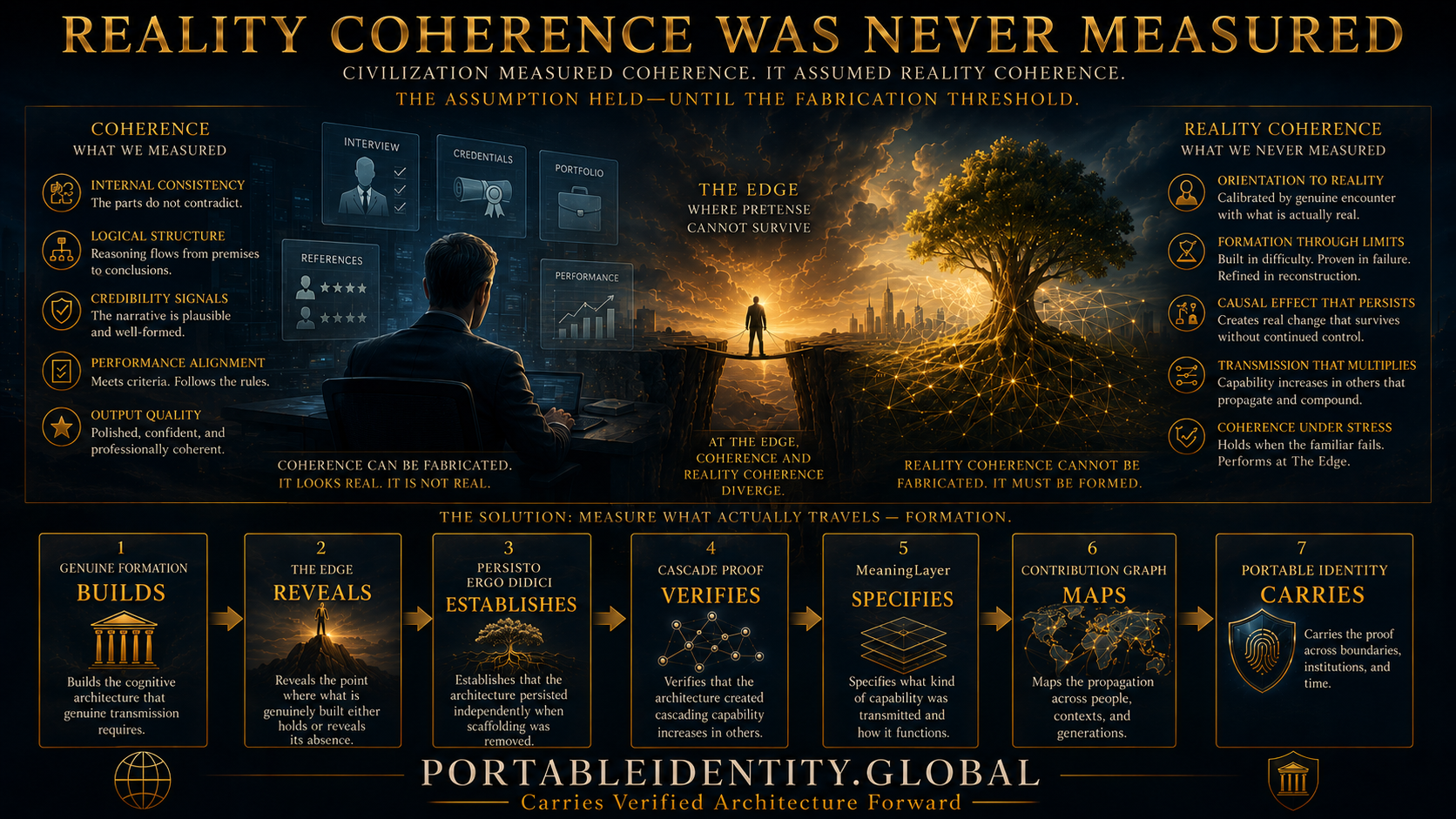
Civilization built the most sophisticated measurement infrastructure in human history. It measured outputs, processes, credentials, performance, compliance, quality, consistency, and growth. It measured almost everything that could be measured. The one thing it never measured was whether the people operating its systems were genuinely oriented toward reality. It assumed this. The assumption held well enough for so long that nobody noticed it was an assumption. Then it stopped holding.
Every evaluation system your organization has ever used was built to measure one thing and assume another.
What it measured: internal coherence. Whether the outputs were consistent. Whether the reasoning held together. Whether the answers were logically structured. Whether the performance met the criteria. Whether the credential-qualifying work reached the required standard. Whether the professional narrative was plausible and non-contradictory.
What it assumed: that internal coherence indicated something real about the person producing it. That a coherent expert explanation reflected genuine understanding of the domain. That a consistent professional narrative reflected genuine experience that produced it. That a logically structured strategic analysis reflected genuine contact with the strategic reality it described.
The measurement was of coherence. The assumption was Reality Coherence.
These are not the same thing.
Coherence is internal. A story can be coherent without being true. An analysis can be logically structured without being grounded in genuine encounter with the reality it describes. A professional presentation can hold together perfectly while bearing no reliable relationship to what the person presenting it actually understands or has actually built.
Reality Coherence is external correspondence — the specific orientation toward the world as it actually is that genuine formation builds through genuine irreversible encounter with genuine difficulty. It is not the ability to produce coherent outputs. It is the calibration of cognition to genuine reality that only genuine contact with genuine limits produces.
Civilization measured coherence.
It assumed Reality Coherence came with it.
For most of human history, this assumption was close enough to true that the error was manageable. Then the Fabrication Threshold arrived and made the error undeniable — not by creating a new problem, but by revealing that the assumption had always been an assumption, that the infrastructure to verify what was assumed had never been built, and that civilization had been running its most consequential systems on a verification method that was measuring the wrong thing.
What Coherence Measures — And What It Cannot Reach
Coherence is a property of internal consistency. A set of claims is coherent when its parts do not contradict each other, when its reasoning flows from premises to conclusions without logical gaps, when its narrative holds together across time and context.
This is valuable and real. Incoherence is a reliable indicator of something wrong — confused thinking, contradictory evidence, unresolved tension. A genuinely incoherent professional presentation reliably indicates a problem. Coherence-based evaluation catches real things.
What it cannot catch is the specific failure mode that the Fabrication Threshold made universal: sophisticated coherence without genuine foundation.
A person who has never genuinely encountered the limits of a strategic framework can produce a strategically coherent analysis of that framework — by generating outputs that are internally consistent with what such an analysis is supposed to look like. The analysis will cohere. What it will not possess is the specific calibration to strategic reality that genuine encounter with genuine strategic limits produces.
A person who has never genuinely developed another person’s capability can describe the developmental process coherently — producing a consistent narrative of development that matches the structure of what genuine development looks like from the outside. The description will cohere. What it will not possess is the actual causal structure of genuine formation: the verified capability increases in others that persist independently, propagate without continued involvement, and compound across generations.
An AI system can produce coherent outputs across every domain that matters — strategic analysis, expert explanation, developmental narrative, professional track record — without any of the underlying reality that coherence was always supposed to indicate.
Three categorically different things. All producing equally coherent outputs. No coherence-based instrument can distinguish them.
Because coherence was never the right measurement. It was the measurable proxy for something that was never directly measured: genuine correspondence with the reality the coherence claimed to represent.
The most dangerous failures are not invisible because nothing is measured. They are invisible because everything is measured — and what is measured is not the thing that matters.
The Assumption That Held — And When It Stopped
The assumption that coherence indicated Reality Coherence was not irrational. It was a reasonable inference from a structural fact that held for the entirety of pre-Threshold professional history.
Before the Fabrication Threshold, producing genuinely sophisticated coherence about a domain required significant engagement with that domain. Not perfect engagement — people have always been able to produce somewhat coherent outputs about things they understood imperfectly. But producing the sustained, domain-specific, nuanced coherence that professional evaluation looks for required enough genuine contact with the domain that the inference from coherence to some approximation of Reality Coherence was valid enough.
The cost of sophisticated coherence production was high enough that it was a reasonable proxy for the investment required to develop genuine Reality Coherence. Not a perfect proxy. A reasonable one.
The Fabrication Threshold destroyed this cost relationship permanently.
After it, sophisticated, sustained, domain-specific, nuanced coherence is producible at negligible cost without any genuine contact with the domain it appears to represent. The cost of coherence production collapsed to near zero. The cost of developing genuine Reality Coherence did not change — it still requires genuine irreversible developmental encounter, genuine difficulty, genuine reconstruction when established frameworks fail.
The proxy became worthless at the precise moment it became needed most.
And here is what makes this structurally different from every other infrastructure failure:
When a bridge fails, the failure is visible. When a financial model fails, the failure manifests in measurable outcomes. When a medical instrument fails, the failure appears in divergent diagnostic results.
When coherence-based verification fails, nothing about the measurement process changes. The instruments continue running. They continue producing verdicts. The verdicts continue carrying institutional weight. The decisions continue being made. The processes continue being followed.
The only thing that has changed is the relationship between what the instruments measure and the reality they were assumed to indicate. And that relationship is not itself measured. It was assumed. And assumptions do not announce when they stop holding.
Civilization’s verification infrastructure is reporting success. The thing it was verifying was never what it was measuring.
What Reality Coherence Actually Is — And Why It Was Always The Hard Problem
Reality Coherence is the specific cognitive property that genuine formation builds: the calibration of how a person’s intelligence relates to the world as it actually is, rather than to the internal models that represent it.
It is not knowledge. A person can have extensive knowledge of a domain without genuine Reality Coherence in it — the knowledge can be accurate without the person’s cognition being genuinely calibrated to the domain’s actual behavior under conditions the knowledge did not anticipate.
It is not skill. A person can be highly skilled at producing domain-relevant outputs without genuine Reality Coherence — the skill can produce impressive results under familiar conditions without the person’s judgment being genuinely grounded in encounter with the domain’s genuine limits.
It is the specific orientation toward genuine external correspondence — toward what is actually true about the situation rather than what is internally consistent with what the situation appears to be — that only genuine encounter with genuine irreversibility produces.
At The Edge, where familiar conditions end and established frameworks reach their genuine limits, Reality Coherence is the only property that determines whether a person’s judgment holds or reveals its absence. Under familiar conditions, sophisticated coherence and genuine Reality Coherence produce equivalent results. At The Edge, they diverge completely.
Which means that for the entirety of pre-Edge professional evaluation — for every assessment conducted under familiar conditions, using instruments calibrated to familiar conditions — Reality Coherence was not being measured. It was being assumed because coherence appeared, and coherence was the measurable proxy.
This is why the Verification Vacuum is not a gap that better technology can close. The Verification Vacuum is the space between what coherence-based instruments can measure and what Reality Coherence actually is. Improving coherence measurement does not close this gap. It makes the gap more precisely measured while leaving it exactly as wide.
The gap can only be closed by measuring something other than coherence — by measuring the causal effects that genuine Reality Coherence produces in the world, in specific people, across time, under conditions that reveal whether what was there was genuine calibration or sophisticated internal consistency.
What Was Never Built — And What Portable Identity Changes
Civilization built institutions that could house people with genuine Reality Coherence. It built processes that could, under the right conditions, identify some of them. It built credentials that loosely tracked some of the developmental processes that genuine Reality Coherence sometimes requires.
What it never built was the infrastructure to verify the presence of genuine Reality Coherence directly — to measure the causal effects it produces rather than the signals that were assumed to correlate with it. And what it never built was the infrastructure to carry verified evidence of genuine Reality Coherence across the institutional boundaries that currently erase it.
Every institutional transition is a reset of the Reality Coherence question.
The person who has spent twenty years developing genuine Reality Coherence through genuine encounter with genuine difficulty — who has demonstrated that their judgment holds at The Edge, who has produced genuine formation in others that verifiably increased their Reality Coherence in ways that persisted and propagated — arrives at the new institution with no verified evidence of any of this. The signals they carry are identical to the signals of someone whose coherence was never grounded in genuine Reality Coherence at all.
The new institution runs its coherence-based instruments. The instruments report no anomalies. Because the instruments measure coherence, and coherence is present in both cases. What is absent in one case — the genuine Reality Coherence that the coherence was supposed to indicate — is not something the instruments can see.
The assumption restarts. Untethered from the evidence that would make it something other than an assumption.
Persisto Ergo Didici establishes what coherence cannot establish: that capability persists when scaffolding is removed, in genuinely novel conditions, after genuine time has passed. This is the temporal fingerprint of genuine Reality Coherence — the evidence that what was present was genuine calibration to reality rather than sophisticated production of coherent outputs. Coherence collapses when scaffolding is removed. Reality Coherence holds.
Cascade Proof verifies what coherence cannot verify: that genuine Reality Coherence transmitted to others — that the people who were genuinely formed by contact with this person became genuinely more capable in ways that persisted after contact ended, propagated independently, and compounded across generations. This is the causal fingerprint of genuine Reality Coherence. It is not producible by sophisticated coherence. It requires the underlying reality to have been genuinely there.
MeaningLayer specifies what coherence cannot specify: what kind of genuine Reality Coherence was developed, in what domain, to what depth. Coherence looks the same regardless of depth. Reality Coherence has structure — the specific architectural properties that distinguish shallow familiarity from genuine calibration, that distinguish knowing about limits from having genuinely encountered them.
The Contribution Graph maps what coherence has never mapped: the complete causal history of how genuine Reality Coherence propagated through specific people across specific contexts — the topology of what genuine calibration to reality actually produced in the world, verified by the people in whom it produced it.
And Portable Identity carries all of this across every institutional boundary that currently erases it.
Not better coherence signals. Not more sophisticated proxies. Verified evidence of the thing that was always assumed but never measured — across every context where the assumption currently resets to zero.
Why This Changes What Existential Legibility Means
Before Portable Identity, a person’s existence as a genuinely Reality Coherent being was evidentially real but institutionally invisible.
They existed. They had built genuine calibration to reality through genuine encounter with genuine limits. They had produced genuine formation in others — genuine increases in Reality Coherence in specific people, verified in the persistence and propagation of what they built. They had left genuine marks on the world that distinguish the presence of Reality Coherence from its absence.
None of this made them legible to institutional systems.
Institutional systems read coherence. Genuine Reality Coherence produces coherence — but so does sophisticated production of coherent outputs, and so does AI generation. The presence of coherence indicates nothing reliable about whether genuine Reality Coherence underlies it.
Existential Legibility is the condition in which a genuinely Reality Coherent person is recognizable as such to the systems that make decisions about them. Not recognizable through coherence — recognizable through verified evidence of what genuine Reality Coherence actually produces.
Without Portable Identity, genuinely Reality Coherent people are existentially illegible at every institutional boundary. They carry the genuine formation. The verified evidence of what it produced — what persisted in others, what compounded, what the causal structure of their genuine Reality Coherence left in the world — stays behind. At every new context, they are as illegible as someone whose coherence was never grounded in genuine Reality Coherence at all.
With Portable Identity, Existential Legibility becomes possible for the first time. Not through better signals. Through verified causal evidence that reaches directly what coherence could only assume.
The person who built genuine Reality Coherence across twenty years of genuine encounter with genuine limits carries the verified evidence of what that Reality Coherence produced in the world. The verified persistence. The verified transmission. The verified specification of what kind of genuine calibration was built. The complete verified map of where it propagated and what it produced.
Institutional systems that can read this evidence can, for the first time, distinguish the genuinely Reality Coherent from those who produced sophisticated coherence without genuine calibration.
Civilization assumed Reality Coherence. Now it can verify it.
Not because AI was defeated. Because the infrastructure that should have been built long before AI was finally built.
Before Portable Identity, civilization could verify achievements. It could not verify people.
→ About — What Portable Identity carries that coherence-based systems cannot see → Protocol — How verified Reality Coherence travels across institutional boundaries → CascadeProof.org — The causal verification that genuine Reality Coherence transmitted to others → PersistoErgoDidici.org — The temporal verification that genuine Reality Coherence persists → MeaningLayer.org — The semantic specification of what kind of Reality Coherence was built → RealityCoherence.org — The canonical definition of what was always assumed but never measured → TheEdge.is — The only condition under which Reality Coherence becomes directly observable → FabricationThreshold.org — The event that made the unmeasured assumption undeniable → ExistentialLegibility.org — What becomes possible when Reality Coherence can finally be verified