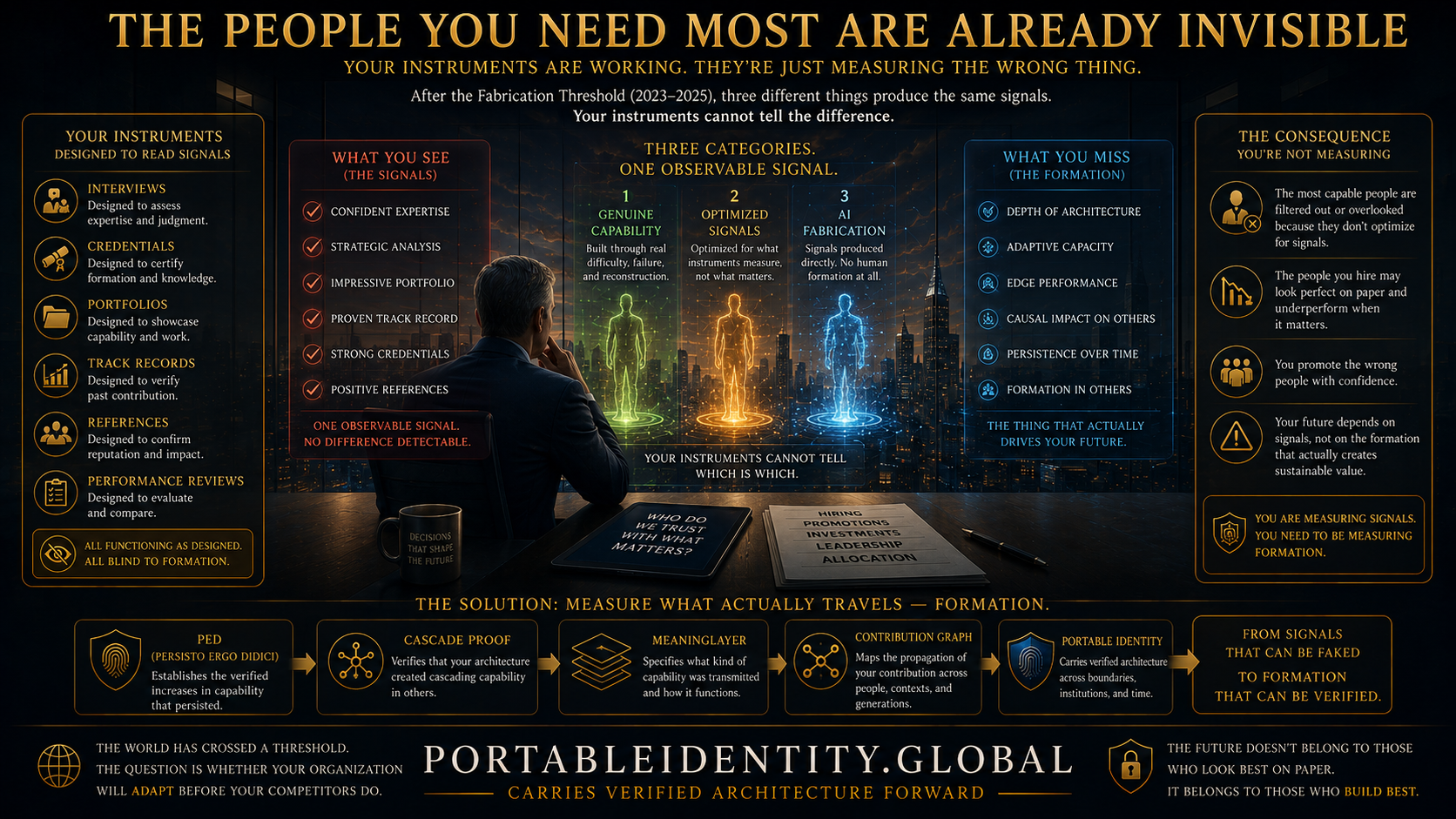
This is not a warning about the future. It is a diagnosis of what is happening right now, in your organization, at every decision you made this week about people. The instruments you are using to see who carries genuine capability have gone blind. Not gradually. Already.
You made decisions about people this week.
Who to hire. Who to promote. Who to put in front of the problem that genuinely matters. Who to trust with the thing that cannot fail. Who carries the capability that your organization’s future depends on being able to find, allocate, and retain.
You made those decisions using evaluation instruments: interviews, credentials, track records, portfolios, references, performance reviews. Systems your organization has refined over years. Processes your HR function has optimized. Frameworks your leadership team trusts.
Every one of those instruments has gone blind to the specific thing you most need to see.
Not broken. Blind. The instruments are functioning exactly as designed. They are designed to read signals. And after a specific structural threshold that was crossed between 2023 and 2025, the signals no longer reliably indicate what they were always assumed to indicate.
You are making decisions about people using instruments calibrated to a world that no longer exists.
What Your Instruments Were Designed to See
Every evaluation instrument your organization uses was built on a single structural assumption: that the signals a person produces reliably trace back to the capability those signals were designed to indicate.
The confident expert explanation: a signal of genuine domain understanding. The coherent strategic analysis: a signal of genuine judgment. The impressive professional portfolio: a signal of genuine capability. The track record of successful outcomes: a signal of genuine contribution. The credential from the right institution: a signal of genuine formation.
These signals were never perfect. They could be manipulated, performed, partially constructed. Your instruments have always had error rates. You have always hired people who underperformed and missed people who would have overperformed.
But the signals were systematically connected to the underlying reality they indicated. Producing the signal of genuine strategic judgment in a sustained, sophisticated, domain-specific way required something that approximated genuine strategic judgment. The effort required to fake the signals convincingly enough to survive your best evaluation processes was close enough to the effort required to develop the actual capability that the rational path for most people was to develop some version of the actual capability.
This cost structure made your instruments valid. Not perfectly valid. Valid enough.
That cost structure is gone.
What Changed — And When
The Fabrication Threshold crossed between 2023 and 2025. Not a specific date. A specific structural change: artificial intelligence crossed the capability threshold where it became able to produce every signal that genuine human capability historically produced — at negligible cost, with fidelity that exceeds what your evaluation instruments can detect.
Every signal your instruments read can now be produced without the underlying capability those signals were supposed to require.
The confident expert explanation: producible without genuine domain understanding. The coherent strategic analysis: producible without genuine judgment. The impressive professional portfolio: producible without genuine capability. The track record documentation: producible without the work having occurred as documented. The credential: producible without the formation the credential was designed to certify.
This is not about obvious fakes that your instruments can catch. The threshold was defined precisely by the disappearance of detectable differences. The signals that AI can now produce are not lower quality than genuine signals — they are indistinguishable from genuine signals by every instrument designed to evaluate them.
Your instruments cannot detect the difference. Not because they are poorly designed. Because they were designed for a world where the difference was detectable through signal quality. That world ended.
And here is what makes this more serious than a fraud problem:
Three categorically different things now produce the same signals under your evaluation conditions.
The first: a person who genuinely built the capability the signal indicates — through genuine encounter with genuine difficulty, genuine failure, genuine reconstruction. A person who carries cognitive architecture that holds when familiar frameworks fail. A person whose presence genuinely changes how the people around them think, in ways that persist after they are gone.
The second: a person who optimized the signals without building the underlying capability — through genuine effort and genuine development, but development that optimized for what your instruments measure rather than for the formation that those instruments were designed to indicate.
The third: an AI system producing signals directly. No human formation of any kind.
Three categories. One observable signal. No instrument in your current evaluation stack can determine which you are looking at.
You are making allocation decisions across all three categories simultaneously, with no ability to distinguish between them, using instruments that report no anomalies — because the instruments were never designed to detect this specific failure.
The Specific Consequence You Are Not Measuring
When your instruments cannot distinguish the three categories, the people who suffer most are not the people in the second and third categories. They lose nothing. Their signals work exactly as they always did.
The people who suffer most are the people in the first category — the ones who genuinely built the capability your organization most needs.
Here is why:
Before the Fabrication Threshold, the people with genuine capability had a signal advantage. Not a perfect advantage. But a real one: producing the specific signals of genuine strategic judgment, genuine domain expertise, genuine formation in others — in a sustained, sophisticated, domain-specific way — was harder for someone without the underlying capability. Your instruments were imperfect but they were systematically tilted toward finding the real thing.
After the Fabrication Threshold, that advantage is gone. The second category produces equivalent signals through optimization. The third category produces equivalent signals through generation. Your instruments cannot see the difference.
Which means the people with the most genuine capability to build are being evaluated on equal footing with people who optimized signals and AI-generated outputs. Not occasionally. At every evaluation. For every role. At every decision point where you are trying to find who carries what you most need.
And here is the deeper problem: the people with the most genuine capability tend to have invested most heavily in building the capability rather than optimizing the signals. They are, on average, the worst signal optimizers in your candidate pool — because they spent their time building the thing rather than performing the thing.
The people you need most are systematically disadvantaged by the instruments you use to find them.
The people you need most are already invisible.
What You Think You Are Measuring vs. What You Are Actually Measuring
Your interview process measures how people perform under interview conditions. Interview conditions are cooperative conditions — familiar structure, predictable categories, known evaluation framework. Under cooperative conditions, all three categories perform similarly. The capability that genuinely matters — the architecture that holds when familiar conditions end — is invisible under cooperative conditions. It only becomes visible at The Edge: when the framework fails, when the problem is genuinely novel, when scaffolding is withdrawn and what was actually built either holds or reveals its absence.
You are not interviewing people at The Edge. You are interviewing them under the conditions that most obscure the difference between genuine capability and its signals.
Your credential verification confirms that institutional processes were completed to certain standards. It does not confirm whether completion indicated genuine formation or optimized performance. Both categories hold credentials from similar institutions. After the Fabrication Threshold, AI assistance can produce credential-qualifying outputs without the formation the credential was designed to certify. The credential certifies process completion. It has never certified the formation that the process completion was designed to indicate — and the decoupling of process completion from formation is now structurally complete.
Your reference checks confirm what previous colleagues and supervisors observed and are willing to say. They do not confirm the most important thing: whether the people who worked closely with this person became genuinely more capable in ways that persisted after the person left. Whether the formation this person transmits to others is genuine — the kind that compounds through networks and builds capability that persists — or is performance that requires continued presence.
Your performance metrics measure what was produced during the evaluation period against the criteria the metrics were designed to assess. They do not measure whether the person genuinely builds capability in the people around them. Whether their presence makes your organization genuinely smarter or creates dependency on their continued presence. Whether what they contribute compounds after they leave or evaporates with them.
You are measuring signals. You need to be measuring formation. The instruments for measuring formation do not yet exist in your evaluation stack. And in their absence, the people who optimized signals are systematically favored over the people who built capability.
What This Means for Your Organization Right Now
Every decision you made about people this week was made using instruments that cannot see the specific variable that determines whether that decision builds your organization’s genuine capability or its ability to perform capability.
The team you built to solve your most important problem: you cannot currently verify whether it contains the people who will genuinely build through the problem or the people who will perform competence while producing outputs. The outputs will look the same. Until The Edge arrives — until the problem is genuinely novel, until the framework fails, until what was genuinely built is required rather than performed. At that point, the difference becomes undeniable. And the cost of the misallocation is already embedded in everything built on it.
The executive you promoted to lead the function that determines your organization’s future capability: you evaluated signals. You could not evaluate formation. The signals were strong. Whether the formation is there — whether the people under this executive are becoming genuinely more capable in ways that compound, or are becoming more dependent on the executive’s continued presence — is invisible to every instrument you used for the promotion decision.
The AI systems you are deploying to evaluate, develop, and allocate talent: they are optimizing against the metrics you gave them, which are signal metrics. They are becoming better and better at evaluating signal quality. Signal quality is no longer what you need to evaluate. Your AI talent systems are accelerating your ability to measure the wrong thing with higher precision.
The candidates you passed on: some of them were in the first category. People who invested in building genuine capability rather than optimizing signals, who are systematically disadvantaged by the instruments that evaluated them, who your process filtered out not because they lacked capability but because they lacked signal optimization.
You will not know which ones. That is the structure of the problem.
What Verification Looks Like When Signals Have Failed
The verification instruments calibrated to what signals can no longer indicate already exist. They are not yet in your evaluation stack. They will be.
Genuine capability that persists independently — capability that functions when scaffolding is withdrawn, when assistance is unavailable, when conditions change in ways the original context did not anticipate — can be verified through temporal testing that removes support and confirms what remains. Not at the moment of evaluation. Across time, after the scaffolding is gone. This is what Persisto Ergo Didici establishes: not the signal of capability, but the verified evidence that capability persists when the conditions that might have produced it are no longer present.
Genuine formation that transmits to others — the specific pattern that genuine capability creates when it genuinely develops others, the cascade of verified capability increases that persist after contact ends and propagate without continued involvement — can be verified through causal analysis that reads the pattern rather than the signal. This is what Cascade Proof verifies: not the claim that someone developed their team, but the verified causal structure of genuine development — persistent, independent, branching in ways that dependency cannot produce.
The kind of capability that was transmitted — whether what transferred was genuine architectural development or sophisticated information that will not persist when conditions change — can be specified with semantic precision that makes it evaluable rather than merely claimable. This is what MeaningLayer provides: not a description of what someone says they contributed, but a verified specification of what the contribution actually was.
The complete causal history of genuine capability development across every organizational context — who actually developed whom, in what domains, verified by the people who were genuinely developed, tracked across time in ways that distinguish genuine formation from dependency — can be mapped and made portable. This is what the Contribution Graph and Portable Identity together make possible: not a signal history, but a verified formation history that belongs to the person who built it and travels with them.
These instruments are what a complete talent evaluation stack looks like when signals have failed. They measure what your current instruments cannot see: the actual formation, not the signal of formation.
The Window
The organizations that integrate verified formation evidence into their evaluation processes in the next two to three years will be operating with a decisive capability advantage that compounds. They will find the people in the first category that every other organization’s signal-based instruments are systematically filtering out. They will build on genuine formation rather than on performance that requires continued scaffolding. They will make allocation decisions based on what people actually built rather than what signals they produced.
The organizations that continue operating on signal-based evaluation will continue making decisions that look correct by every metric they have — until The Edge arrives for each decision, at which point the cost of having been unable to see formation is already embedded in everything built on the misallocation.
The window is not indefinitely open. The people who carry the most genuine capability — who are currently invisible to your instruments — are making their own decisions about where to work, who to work with, and whether the organizations they join are capable of seeing what they actually carry. The organizations that build the ability to see formation will attract the people who have invested in building it. The organizations that remain blind to formation will retain the people who invested in optimizing signals.
The most capable people are already invisible. The question is whether your organization builds the instruments to see them before the cost of not being able to becomes undeniable.
The instruments exist. The window is open. The people you need most are already invisible to every instrument you are currently using.
→ Protocol — The verification standard calibrated to what signals can no longer indicate → CascadeProof.org — The causal verification that genuine formation transmits to others → PersistoErgoDidici.org — The temporal verification that genuine capability persists → MeaningLayer.org — The semantic specification of what kind of capability was transmitted → UnverifiablePeople.org — The structural condition your instruments cannot currently detect → FabricationThreshold.org — What changed and when → TheEdge.is — Where the cost of misallocation becomes undeniable → GenuineFormation.org — What the instruments that can see are designed to find