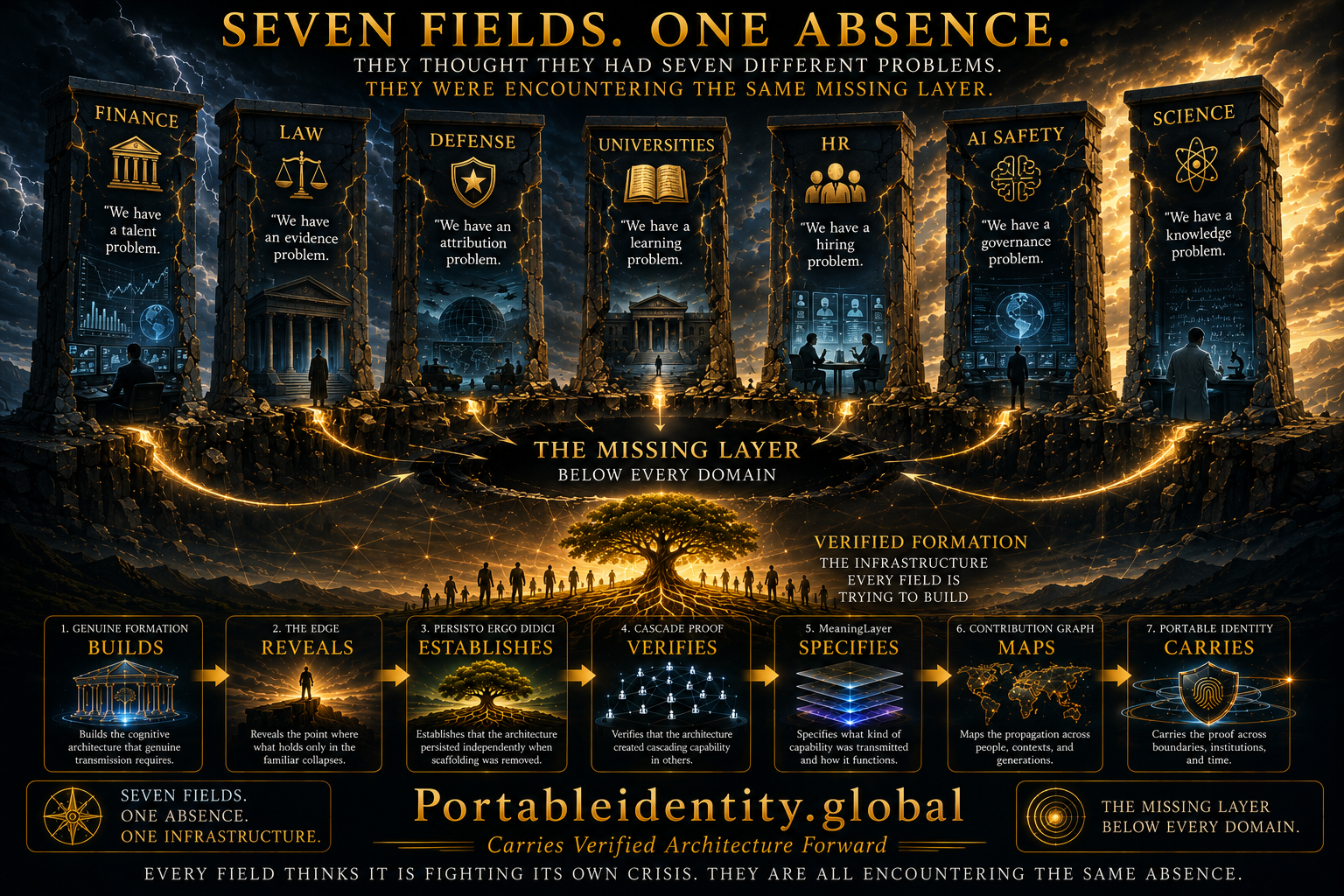
Seven fields. Seven different crises. Seven different names for the same structural absence. None of them know the others are encountering the same thing. All of them are trying to build, from within their own domain, something that cannot be built from within any domain.
Something is wrong in finance.
Something is wrong in law.
Something is wrong in the military.
Something is wrong in universities.
Something is wrong in hiring.
Something is wrong in AI safety.
Something is wrong in science.
Each field has named it differently. Each field is working on it separately. Each field believes its problem is specific to its domain — a consequence of how its particular systems work, requiring a solution particular to its context.
They are all wrong about this.
They are not encountering seven different problems. They are encountering the same absence from seven different directions. And the reason none of them can solve it from within their own domain is that the absence is structural — it exists below the level of any domain’s instruments, processes, or frameworks. It is the absence of infrastructure that no domain was built to provide, because no domain ever needed to provide it before.
This is that infrastructure. And this is the article that connects the seven fields that need it.
Finance: The Capital Allocation Problem That Isn’t
The financial sector allocates capital against signals. Credentials, track records, demonstrated performance, professional fluency, strategic coherence. These signals were always imperfect proxies for the underlying reality they were supposed to indicate — genuine capability, genuine judgment, genuine formation. Imperfect but adequate. The cost of producing convincing signals was high enough that the inference from signal to underlying reality was valid enough to allocate capital on.
That cost structure collapsed.
After the Fabrication Threshold, every signal that the financial sector allocates capital against can be produced at negligible cost without the underlying reality those signals were supposed to indicate. The credentials are identical. The track records are identical. The professional presentations are identical. The strategic coherence is identical.
The financial sector is now allocating capital against the signal rather than the underlying reality — and it has no instrument to determine which of the three categories it is actually allocating toward: genuine formation, optimization without formation, or AI-generated output.
Finance calls this a talent allocation problem. It is trying to solve it with better screening, more rigorous interviews, extended evaluation periods, AI-assisted assessment tools.
Every solution it builds is a better instrument for evaluating signals. Signals are no longer the problem. Signals work perfectly. The problem is that signals have become separable from the reality they indicated.
What finance needs is not better signal evaluation. It is verified evidence of genuine formation — the causal structure of what a person actually built in others, which no signal can be produced to indicate retroactively.
Finance thinks it has a talent problem. It has a verification infrastructure problem.
Law: The Evidence Problem That Isn’t
Legal systems are built on the verifiability of evidence. The chain of evidence — who did what, when, what resulted, who witnessed it, what persists — is the foundation on which legal reasoning operates. Attribution matters. Causation matters. The verified connection between an agent, an action, and its consequences is what makes legal accountability possible.
After the Fabrication Threshold, this chain has become structurally uncertain.
Testimony can be generated without the witness having been present. Expert analysis can be produced without the expert having genuine domain expertise. Professional histories can be constructed retroactively. The digital evidence trail that courts increasingly rely on — documents, communications, behavioral records — can be produced without the human source those records are supposed to indicate.
More fundamentally: the question of personhood itself is becoming legally uncertain. When the signals of human presence — communication, decision-making, professional judgment — can be produced without a human source, the legal frameworks built to assign rights, responsibilities, and accountability to specific conscious beings are operating on assumptions that can no longer be verified.
Law calls this a deepfake problem, a fraud problem, an AI governance problem. It is working on it with detection tools, disclosure requirements, authentication standards.
Every solution it builds is an attempt to verify signals. Signals cannot be verified against signals. The verification must reach something that only genuine human presence produces.
Law thinks it has an evidence problem. It has a verification infrastructure problem.
Military and Defense: The Attribution Problem That Isn’t
Military and intelligence operations depend on attribution. Who did this? Who ordered it? Who carried it out? Who is responsible? The ability to attribute actions to specific agents — to trace effects back to their human sources — is the foundation of deterrence, accountability, and the entire framework of international security.
The Fabrication Threshold produced a structural attribution crisis.
Communications can be generated without the sender. Identities can be constructed without the person. Orders can be fabricated without the commander. Evidence of action can be produced without the action having occurred. The entire behavioral signal layer on which attribution was built has become structurally unreliable.
This is not a problem of sophisticated adversaries occasionally faking evidence. It is a structural condition in which every signal that attribution depends on can be produced without the source that signal is supposed to indicate. Attribution without verified source is not attribution. It is probabilistic guessing with formal procedural cover.
Military and defense call this an information warfare problem, a deepfake problem, a synthetic identity problem. They are building detection tools, verification protocols, authentication standards for communications and identities.
Every solution they build tries to detect synthetic signals by finding artifacts in signal quality. The threshold was defined by the disappearance of detectable artifacts. There are no artifacts to find.
Military and defense think they have an information warfare problem. They have a verification infrastructure problem.
Universities: The Learning Problem That Isn’t
Universities certify that specific developmental processes were completed to specific standards. The degree says: this person underwent this process, produced these outputs, demonstrated this performance. The credential carries institutional authority because the institution observed the process and can vouch for what happened.
After the Fabrication Threshold, the outputs that credential processes assess can be produced without the developmental process those credentials certify.
The assignment that demonstrates genuine understanding can be produced without genuine understanding. The examination performance that certifies capability can be generated without the capability. The portfolio that demonstrates formation can be assembled without the formation having occurred. The process is observed. What the process was supposed to produce — genuine cognitive development, genuine formation, genuine capability that persists and generalizes — is no longer indicated by what the process produces.
Universities call this an academic integrity problem, a cheating problem, an AI detection problem. They are building detection tools, requiring in-person examination, implementing honor codes, developing AI-resistant assessments.
Every solution they build tries to detect AI use in specific outputs. The threshold was defined by indistinguishability. The outputs are indistinguishable by any instrument calibrated to evaluate outputs.
What universities need to certify is not that specific outputs were produced without AI assistance. It is that genuine formation occurred — that the cognitive architecture genuine developmental encounter produces is actually present in the person who completed the process.
Universities think they have an academic integrity problem. They have a verification infrastructure problem.
HR and Labor Markets: The Talent Problem That Isn’t
Every hiring process evaluates signals to infer capability. The resume, the interview, the work sample, the reference, the credential — all of these are instruments for reading signals that were supposed to indicate genuine capability, genuine formation, genuine architecture that holds when familiar conditions end.
The signals are intact. They are being produced at unprecedented quality and volume. The inference from signal to underlying reality has become structurally invalid.
Three categorically different things now produce identical signals: the person who built genuine architecture through genuine irreversible developmental encounter, the person who optimized signals without building the underlying architecture, and AI systems producing signals with no human formation at all.
HR has responded with longer interview processes, more rigorous assessments, behavioral interviewing, AI-assisted screening, extended probationary periods.
Every response is a better instrument for evaluating the signal layer. The signal layer is not where the difference is. The difference is below the signal layer — in the verified causal structure of what someone actually built in others, which exists or does not exist entirely independently of the signals produced about it.
The people with the most genuine formation are systematically disadvantaged by every instrument HR has built — because they invested in building the formation rather than optimizing the signals, and the instruments cannot see below the signal layer they were designed to read.
HR thinks it has a talent identification problem. It has a verification infrastructure problem.
AI Safety: The Oversight Problem That Isn’t
The entire framework of AI safety depends on the existence of genuine human oversight: human beings with genuine judgment, genuine formation, genuine Reality Coherence, who can identify when AI systems are producing outputs that are coherent but not calibrated to external reality, who can exercise genuine oversight rather than performing oversight.
The Fabrication Threshold produced a recursive problem.
The same structural condition that makes AI outputs indistinguishable from human outputs also makes it impossible to verify, using signal-based instruments, whether the humans exercising oversight have the genuine formation that genuine oversight requires. The AI safety researcher who produces sophisticated, coherent, structurally impressive analyses of AI risk may have genuine formation or may not. Their signals are identical in both cases.
AI safety calls this a human factors problem, a governance problem, a coordination problem. It is building frameworks for evaluating oversight quality, developing metrics for human judgment, creating processes for verifying that oversight is genuine.
Every solution it builds evaluates the signals of genuine oversight. After the Fabrication Threshold, the signals of genuine oversight and the performance of oversight are indistinguishable.
What AI safety needs is not better frameworks for evaluating oversight performance. It is verified evidence that the humans exercising oversight carry the genuine formation that oversight requires — the causal structure that only genuine Reality Coherence builds and that cannot be performed.
AI safety thinks it has a governance problem. It has a verification infrastructure problem.
Science and Research: The Knowledge Problem That Isn’t
Scientific knowledge depends on epistemic formation — genuine understanding grounded in genuine encounter with genuine phenomena, genuine reasoning grounded in genuine engagement with genuine evidence, genuine calibration to the specific domain of reality the research addresses.
After the Fabrication Threshold, scientific outputs can be produced without the epistemic formation those outputs are supposed to require.
Research papers can be generated without genuine understanding of the domain. Hypotheses can be produced without genuine engagement with the phenomena they describe. Statistical analyses can be conducted without genuine comprehension of what the statistics represent. The outputs are coherent. They are internally consistent. They satisfy peer review criteria calibrated to evaluate coherence.
They may or may not be epistemically grounded. The instruments used to evaluate them cannot determine which.
Science calls this a reproducibility problem, an AI integrity problem, a peer review problem. It is building preregistration requirements, replication mandates, detection tools for AI-generated content.
Every solution it builds tries to verify the epistemic quality of outputs. Output quality cannot establish epistemic formation. Formation is in the researcher, not the output. The output is the signal. The signal’s source is now unknown.
Science thinks it has a knowledge integrity problem. It has a verification infrastructure problem.
The Convergence
Seven fields. Seven different names. Seven different attempted solutions.
Finance screens harder against signals. Law builds better detection tools. Military builds authentication protocols. Universities create AI-resistant assessments. HR develops more sophisticated interview processes. AI safety builds governance frameworks. Science mandates reproducibility.
Every solution is domain-specific. Every solution is aimed at the signal layer. Every solution will fail for the same reason: the problem is not in the signal layer. The problem is structural. And it is the same in all seven fields.
They are not encountering seven different crises. They are all encountering the same absence — the absence of infrastructure that can verify genuine formation rather than evaluate signals that were supposed to indicate it.
Every field thinks it is fighting its own crisis. They are all encountering the same absence.
The Infrastructure
What makes genuine formation distinguishable from its signals is the causal structure it leaves in the world.
Genuine formation transmits. It builds genuine capability increases in specific people that persist independently, propagate through the people they reached, and compound across generations. This pattern cannot be produced by signal optimization. It cannot be generated by AI. It requires the actual formation to have occurred, in each person along the chain, through genuine irreversible developmental encounter.
This is what the verification instruments establish — not better signals, not more sophisticated proxies, but verified causal evidence that reaches directly what all seven fields need to see.
Genuine Formation builds the architecture that produces this pattern. The Edge reveals whether the architecture is actually present. Persisto Ergo Didici establishes that it persists when scaffolding is removed. Cascade Proof verifies that it transmitted to others and compounded. MeaningLayer specifies what kind of genuine formation is present. Contribution Graph maps the complete causal history of what it produced. Portable Identity carries all of this across every institutional boundary that currently erases it.
Seven instruments. One infrastructure. Available to every field that has been trying to build it separately from within their own domain — and discovering, independently, that it cannot be built from within any domain.
Because the infrastructure is not a financial solution. It is not a legal solution. It is not a military solution, an educational solution, a talent solution, a governance solution, or a scientific solution.
It is the missing layer below all of them.
The infrastructure that allows any field to verify genuine formation rather than evaluate its signals. The infrastructure that makes the hidden variable visible. The infrastructure that was always missing — and that every major field is now discovering it cannot function without.
Seven fields. One absence. One infrastructure. It exists — or it does not.
→ About — What Portable Identity carries that all seven fields need → Protocol — How verified formation evidence actually travels → CascadeProof.org — The causal verification instrument → PersistoErgoDidici.org — The temporal verification instrument → MeaningLayer.org — The semantic specification instrument → ContributionGraph.org — The causal mapping instrument → GenuineFormation.org — What all seven fields are trying to verify → FabricationThreshold.org — The event that made the absence undeniable → TheEdge.is — Where the absence reveals itself in every field