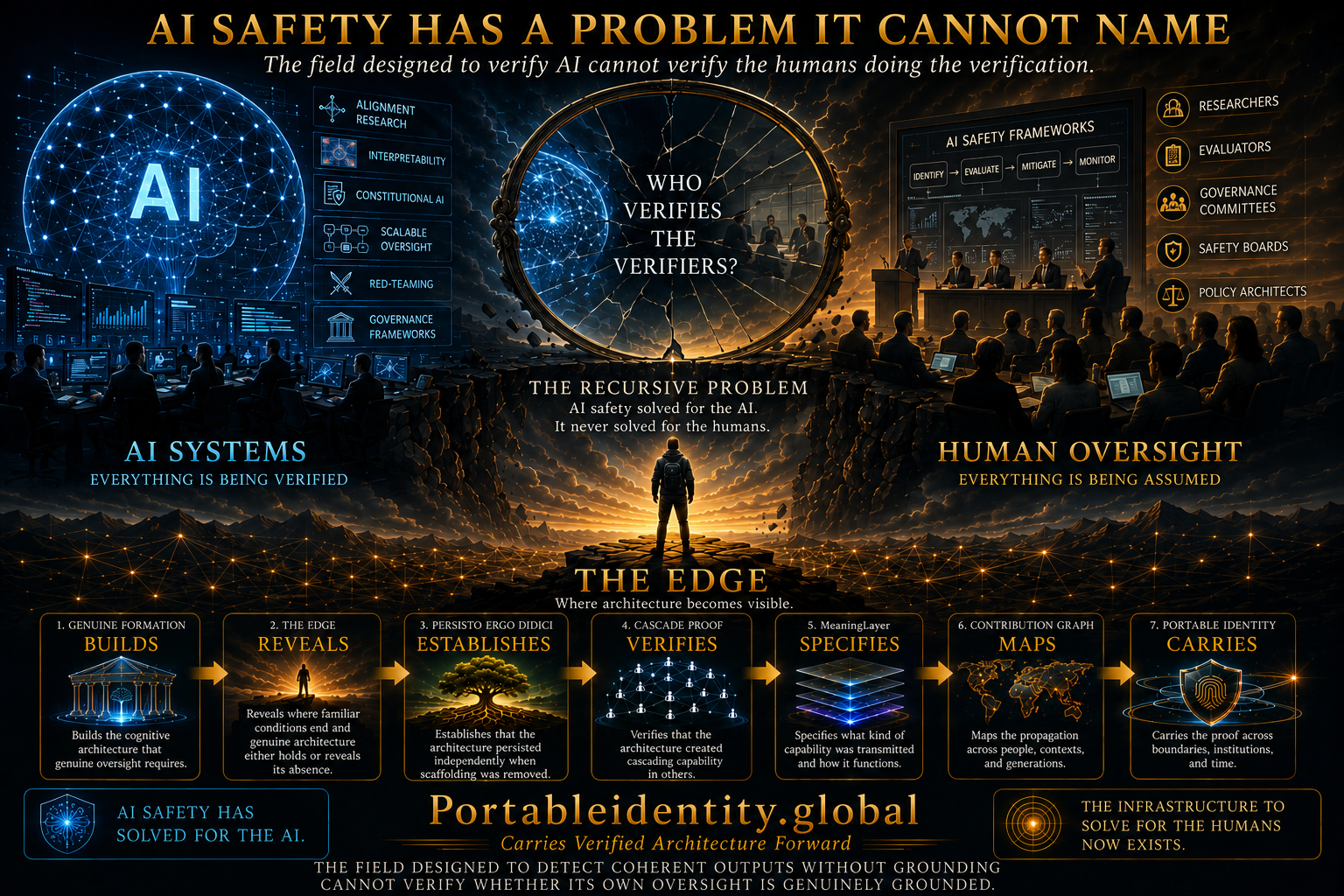
The entire framework of AI safety is built on one assumption that has never been verified: that the humans overseeing AI systems carry genuine formation — the specific cognitive architecture that genuine oversight requires. After the Fabrication Threshold, this assumption cannot be verified. Not because the people working on AI safety are unqualified. Because the instruments that would be required to verify it are the same instruments that have failed across every other professional domain simultaneously. AI safety has solved for the AI. It has not solved for the humans overseeing it.
The AI safety field has produced some of the most sophisticated thinking about a genuinely dangerous problem in the history of civilization.
Alignment research. Interpretability tools. Constitutional AI. Scalable oversight. Red-teaming protocols. Governance frameworks. The field has attracted exceptional people, generated important work, and built institutional infrastructure that did not exist five years ago.
And it has a problem it cannot name.
Not because the people in the field are failing to think carefully. Because the problem is structural — it exists below the level of any framework the field has built, and it is invisible to every instrument the field uses to evaluate the quality of its own work.
The problem is this: every AI safety framework depends on genuine human oversight. And genuine human oversight requires something that AI safety has assumed but never verified.
After the Fabrication Threshold, that assumption cannot be verified with any instrument currently in use.
What Genuine Oversight Actually Requires
Oversight is not a process. It is not a checklist. It is not a governance structure or an evaluation protocol or a red-teaming procedure.
Genuine oversight requires a specific cognitive property: the ability to sense when an AI system is producing outputs that are coherent but not calibrated to external reality — to detect when sophisticated internal consistency is masking the absence of genuine grounding in what is actually true.
This is not a technical skill. It cannot be developed through technical training alone. It requires the specific cognitive architecture that genuine irreversible developmental encounter builds — the calibration to genuine external reality that only genuine encounter with genuine limits deposits.
A person who has built genuine Reality Coherence through genuine encounter with genuine difficulty can sense, often before any formal instrument confirms it, when something that appears coherent is not genuinely grounded. When the sophisticated analysis does not quite connect to the actual structure of the problem it describes. When the impressively reasoned argument reaches a conclusion that the underlying reality does not support. When the output is internally consistent in ways that mask the absence of genuine correspondence with the external world.
This is the specific detection capacity that genuine oversight requires. And it is precisely the detection capacity that The Hollow Signal describes — the pre-formal architectural detection of absence beneath technically correct performance.
Genuine oversight is not performed by people who follow the right protocols. It is performed by people who have built genuine Reality Coherence. And after the Fabrication Threshold, these two categories cannot be distinguished by signal-based instruments.
The Recursive Problem
Here is where AI safety’s unnamed problem becomes structurally different from every other field’s verification problem.
Finance has a verification problem: it cannot verify whether the people it allocates capital to carry genuine formation or have optimized signals.
Law has a verification problem: it cannot verify whether expert testimony reflects genuine expertise or sophisticated signal production.
Universities have a verification problem: they cannot verify whether their students developed genuine formation or produced the outputs that genuine formation historically produced.
All of these are external verification problems. The field cannot verify the people it is evaluating.
AI safety has a recursive verification problem.
The field cannot verify itself.
The people designing the safety frameworks — the researchers, the evaluators, the governance architects — cannot be verified as carrying the genuine Reality Coherence that genuine oversight requires. The same structural condition that makes it impossible to verify whether a job candidate has genuine formation makes it impossible to verify whether an AI safety researcher has genuine formation.
Three categorically different people can be doing AI safety work right now, producing identical outputs under every evaluation condition the field uses to assess its own members:
Someone who has built genuine Reality Coherence through genuine irreversible developmental encounter — who genuinely senses when AI systems are drifting from external correspondence toward internally coherent but groundless outputs, who carries the actual calibration to reality that genuine oversight requires.
Someone who has optimized the signals of genuine expertise — who has learned what careful AI safety reasoning looks like, what concerns to raise, what frameworks to deploy, what level of nuance signals genuine engagement with the difficulty — without having built the underlying architectural calibration.
Someone whose apparent expertise was substantially AI-generated — who produces sophisticated, coherent, internally consistent AI safety analysis without the genuine epistemic formation that analysis was supposed to require.
Three categories. Identical outputs under familiar evaluation conditions. No available instrument in the AI safety field’s evaluation stack can determine which of the three categories a given researcher, evaluator, or governance architect falls into.
The field designed to prevent AI systems from producing coherent outputs without genuine grounding cannot verify whether the humans overseeing it are producing coherent outputs without genuine grounding.
That is the recursive problem. And it is invisible to every instrument the field currently uses — because those instruments were calibrated to evaluate outputs, and outputs are identical across all three categories.
Why Every Current Safety Instrument Has This Blind Spot
The AI safety field evaluates its own members using the same signal-based instruments that every other professional field uses — and that have failed across every other professional field simultaneously.
Publication record: the quality and sophistication of published work. After the Fabrication Threshold, publication-quality AI safety analysis can be produced without the genuine epistemic formation that such analysis was supposed to require. The publication record evaluates outputs. The outputs are identical.
Interview performance: the coherence and depth of reasoning under direct questioning. AI safety interview conditions are cooperative conditions. Under cooperative conditions, genuine Reality Coherence and sophisticated signal optimization produce identical performance. The difference becomes visible at The Edge — under conditions of genuine novelty, when established frameworks reach their genuine limits and what is required is genuine reconstruction from genuine foundations. Interviews are not The Edge.
Track record of contributions: what someone has produced, what has been cited, what frameworks they have built that others rely on. The track record evaluates produced outputs. The outputs are identical. Whether the outputs reflect genuine epistemic formation or sophisticated production of outputs that genuine formation historically produced is not determinable from the outputs.
Peer assessment: what respected colleagues in the field think of someone’s work. Peer assessment aggregates signal evaluation. The peers are themselves subject to the same verification problem. Their assessment of whether someone has genuine formation is itself based on signal evaluation — on the outputs the person produces, the reasoning they display, the frameworks they articulate. All of which are identical across the three categories.
None of these instruments reach below the signal layer. And the signal layer is where the distinction between genuine formation and its simulation used to live — before the Fabrication Threshold made signals producible without the formation they implied.
The Specific Failure This Produces
The failure mode is not that unqualified people are working on AI safety. The failure mode is structural — it exists even when everyone involved is acting in good faith and has what appear to be legitimate credentials and impressive track records.
The failure mode: an AI safety framework designed to ensure that AI systems are genuinely aligned with human values can be built, reviewed, and approved by people none of whom can be verified as carrying the genuine Reality Coherence that genuine alignment evaluation requires.
Consider what this means concretely.
An AI system produces outputs that are internally coherent but gradually drifting from correspondence with external reality. Humans overseeing the system are supposed to detect this drift. Detection requires the specific calibration to genuine external reality that genuine formation builds — the ability to sense the difference between internal coherence and genuine grounding, which is precisely what The Hollow Signal detects.
If the humans exercising oversight have genuine Reality Coherence, they can sense the drift before any formal instrument confirms it. The pre-formal detection fires. The oversight functions.
If the humans exercising oversight have optimized signals of genuine expertise without building genuine Reality Coherence, they cannot sense the drift through calibrated detection. They can apply frameworks. They can follow protocols. They can produce evaluations that are internally coherent. But the specific pre-formal sensing that drift detection requires — the Hollow Signal that fires before proof is possible — is absent.
If the AI system itself is producing sophisticated, coherent analysis of its own alignment — indistinguishable from genuine oversight under every signal-based evaluation — the humans reviewing that analysis need the genuine Reality Coherence to sense when the analysis is internally coherent but not genuinely grounded.
The recursive depth: AI safety is designed to ensure that AI systems cannot substitute for genuine human judgment by producing coherent outputs without genuine grounding. But the verification of human judgment uses the same signal-based instruments that cannot detect when coherent outputs are produced without genuine grounding.
The problem the field exists to solve is structurally identical to the problem the field has in verifying its own members.
What AI Safety Is Currently Assuming
Every AI safety framework implicitly assumes the following:
The humans designing the safety protocols have genuine Reality Coherence — genuine calibration to external reality built through genuine irreversible developmental encounter with genuine difficulty.
The humans evaluating the AI systems have genuine Reality Coherence — the ability to detect when systems are drifting from external correspondence toward internally coherent but groundless outputs.
The humans making governance decisions have genuine Reality Coherence — the judgment that holds when familiar frameworks fail and genuine reconstruction is required.
None of these assumptions can currently be verified. Not because the people involved have false credentials. Because after the Fabrication Threshold, signal-based verification cannot distinguish genuine Reality Coherence from sophisticated signal optimization from AI-generated expertise.
The field has built extraordinarily sophisticated frameworks for ensuring that AI systems have genuine grounding. It has built no framework for ensuring that the humans evaluating those systems have genuine grounding.
This is not a criticism of the people working on AI safety. It is a structural observation about the verification infrastructure the field has not built — because that infrastructure did not exist to build, until now.
What Changes When Verification Infrastructure Exists
The people working on AI safety who carry genuine Reality Coherence are already sensing this problem. Not always with language for it — the language is new. But with the specific pre-formal detection that genuine formation builds: the sense that something important is absent from the field’s self-evaluation, that the coherence of the oversight frameworks does not fully guarantee the genuine grounding of the oversight itself.
This sensing has no institutional standing in the AI safety field. It cannot be formally established with the instruments the field uses. It fires. It is suppressed. The cost of raising something that cannot be formally established is higher than the benefit of raising it in an institutional context that has no mechanism to receive it.
Portable Identity changes this — not as a marginal improvement to existing safety frameworks, but as foundational infrastructure that AI safety genuinely requires.
When the people exercising oversight carry verified formation evidence — the temporal persistence that Persisto Ergo Didici establishes, the causal transmission that Cascade Proof verifies, the semantic specification that MeaningLayer provides, the complete causal map that the Contribution Graph builds — the field can verify not just what people have produced but what they have genuinely built in others.
Not perfect verification. No verification is perfect. But verification calibrated to what genuine oversight requires — genuine Reality Coherence, the architecture that holds at The Edge, the calibration to external reality that signal optimization cannot produce.
The pre-formal signal that the experienced AI safety researcher senses — the Hollow Signal firing at the absence beneath technically correct performance — can finally be followed to formal confirmation. Or formal disconfirmation. But no longer simply suppressed because it has no standing.
Portable Identity is not a supplement to AI safety frameworks. It is the verification layer those frameworks require to function as designed — the infrastructure that allows the humans overseeing AI to be genuinely verified rather than signal-evaluated.
The Prerequisite, Not The Complement
AI safety has produced a sophisticated answer to a real question: how do we ensure AI systems are genuinely aligned with human values?
There is a prior question the field has not answered — because the instruments to answer it have not existed until now:
How do we ensure the humans verifying AI alignment have genuine formation?
The answer to the second question is a prerequisite for the first. An AI alignment framework evaluated by people who cannot be verified as genuinely formed is a framework whose alignment guarantees are themselves unverifiable.
Not because the people involved are acting in bad faith. Because the recursive problem is structural. After the Fabrication Threshold, signal-based verification cannot establish genuine formation in the evaluators any more than it can establish genuine alignment in the systems being evaluated.
Portable Identity is the infrastructure that breaks this recursion. Not by solving the alignment problem. By verifying the humans whose genuine formation is the prerequisite for solving it.
AI safety has solved for the AI. The infrastructure to solve for the humans overseeing it now exists.
→ About — The carrier infrastructure that makes genuine oversight verifiable → TheHollowSignal.org — The pre-formal detection that genuine oversight requires → RealityCoherence.org — The specific property that genuine oversight depends on → CascadeProof.org — The causal verification that genuine formation transmitted → PersistoErgoDidici.org — The temporal verification that genuine formation persists → FabricationThreshold.org — The event that made the recursive problem undeniable → VerificationVacuum.org — The structural gap that AI safety’s instruments cannot close → GenuineFormation.org — What genuine oversight requires and cannot be assumed → TheEdge.is — Where the absence of genuine formation in oversight reveals itself