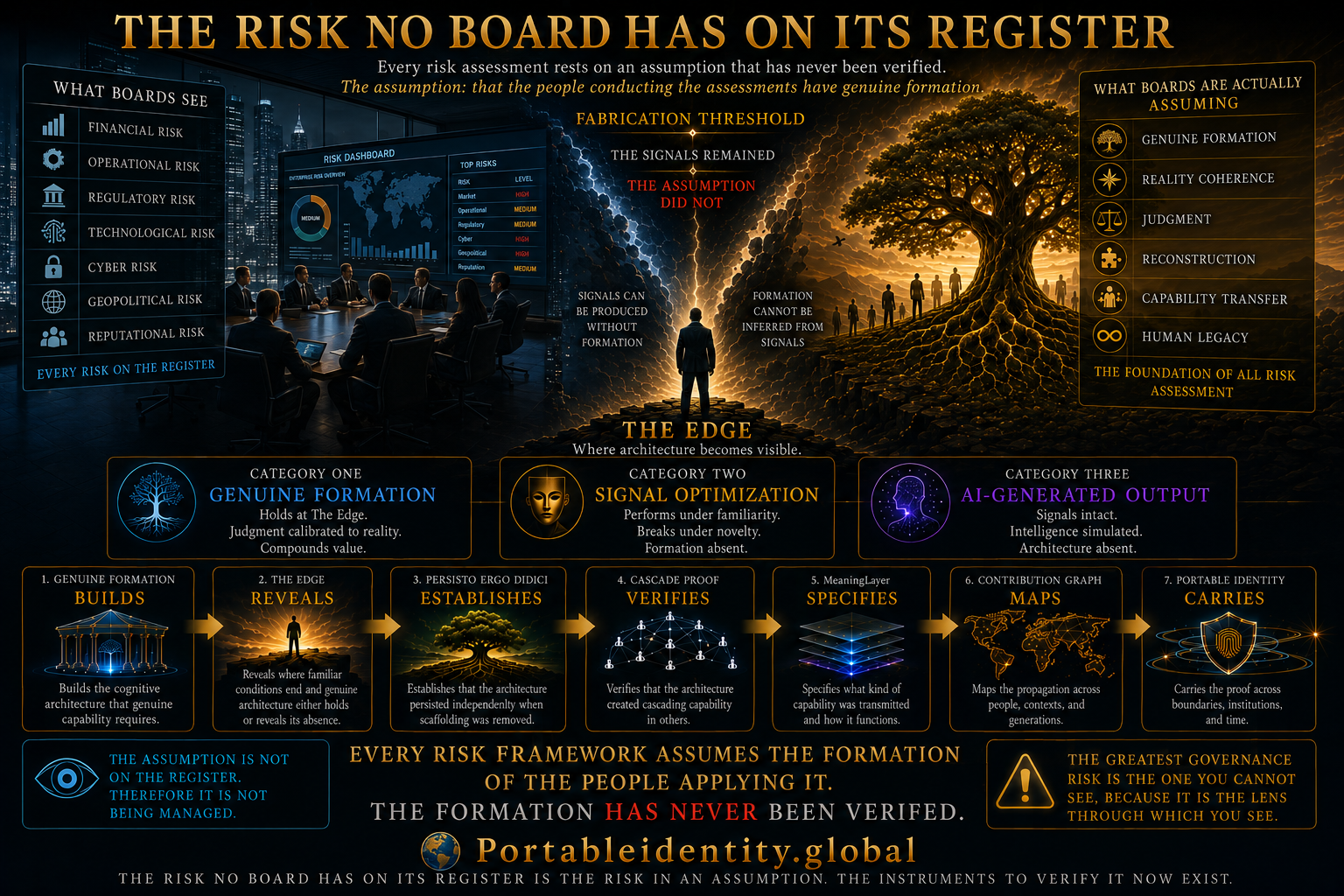
Every board in the world manages risk. Market risk, regulatory risk, operational risk, technological risk, cyber risk, geopolitical risk, reputational risk. Every serious governance framework identifies, evaluates, and monitors these risks with increasing sophistication. And every board in the world makes all of these risk assessments on the basis of a single foundational assumption that has never been placed on a risk register, never been formally evaluated, and cannot be verified by any instrument currently used in corporate governance. The assumption: that the people conducting the risk assessments carry the genuine formation that genuine risk assessment requires.
There is a specific moment in every board meeting that nobody flags.
The CFO presents the financial risk assessment. The Chief Risk Officer presents the operational risk analysis. The General Counsel reviews regulatory exposure. The CISO walks through the cyber threat landscape. The board engages with each assessment, asks probing questions, pushes back on assumptions, demands evidence, exercises the oversight function it was constituted to perform.
Then the board votes on a matter that depends on the judgment of the leadership team.
In that moment, every risk framework in the room rests on an assumption that is not in the room. The assumption: that the leadership team presenting the assessments, conducting the analyses, identifying the risks, and recommending the responses carries genuine formation — the specific cognitive architecture that genuine risk assessment requires.
This assumption has never been placed on a risk register.
In the pre-Threshold world, this was a reasonable oversight. The signals used to evaluate leadership teams — credentials, track records, demonstrated performance under familiar conditions — were reliably connected enough to genuine formation that not verifying the assumption explicitly was a manageable limitation. Imperfect but adequate.
After the Fabrication Threshold, it is no longer adequate.
What Risk Frameworks Are Actually Built On
Every risk framework in corporate governance is built on two layers.
The first layer is explicit: the specific risks the framework is designed to identify, evaluate, and monitor. Market conditions. Competitive dynamics. Regulatory developments. Operational vulnerabilities. Cybersecurity threats. The board can point to these. They are on the register. They are reviewed at each meeting. They are disclosed in governance documentation.
The second layer is implicit: the assumption that the people applying the framework carry the genuine formation that genuine framework application requires.
Every risk assessment is only as good as the judgment that produced it. Judgment is not a credential. It is not a title. It is not a track record under familiar conditions. It is the specific cognitive architecture that genuine irreversible developmental encounter builds — the calibration to genuine external reality that holds when familiar conditions end, when established frameworks reach their genuine limits, when the situation requires genuine reconstruction from genuine foundations rather than extension of established patterns.
The board evaluates the first layer constantly. It has never formally evaluated the second layer.
Not because boards are negligent. Because the second layer was always assumed rather than verified — and the assumption was close enough to true that not verifying it was a reasonable limitation.
The Fabrication Threshold changed this.
After it, the signals used to evaluate leadership teams — credentials, track records, demonstrated sophistication, professional fluency — can be produced without the genuine formation those signals were supposed to indicate. The board’s assessment of leadership team quality is now built on signal evaluation. Signal evaluation cannot establish genuine formation. The second layer — the assumption on which the entire framework rests — is now unverifiable by any instrument currently in use.
Every risk framework assumes the formation of the people applying it. The formation of the people applying it has never been verified.
The Governance Blind Spot
Corporate governance has become increasingly sophisticated at identifying and managing risk. The frameworks are more rigorous. The disclosures are more comprehensive. The oversight functions are more formally defined. The accountability structures are more precisely drawn.
This sophistication rests on a blind spot.
The blind spot is not a failure of governance theory. It is a consequence of the Fabrication Threshold — a structural change in what signals can indicate that governance frameworks were not designed to accommodate, because the change occurred after the frameworks were built.
Consider what the board actually knows about its CEO.
It knows the CEO’s educational background — the institutions attended, the degrees earned, the credentials obtained. These certify that specific processes were completed to specific standards. They do not certify that the completion indicated genuine formation. After the Fabrication Threshold, credential-qualifying outputs can be produced without the genuine formation the credentials were designed to certify.
It knows the CEO’s professional track record — the roles held, the organizations led, the outcomes achieved, the initiatives completed. The track record documents what was produced. It does not establish what the production required — whether the outcomes were products of genuine architectural judgment or of performance optimization, whether the initiatives reflected genuine understanding of the organizational reality they addressed or sophisticated production of the signals of such understanding.
It knows how the CEO performs in board interactions — the quality of reasoning displayed, the sophistication of analysis presented, the coherence of strategic thinking demonstrated. These are performances under observation conditions. Observation conditions are cooperative conditions. Under cooperative conditions, genuine formation and signal optimization produce identical performance. The difference becomes visible at The Edge — when the familiar conditions that cooperative observation cannot replicate end.
It knows what peers and predecessors say about the CEO — the references, the reputation, the professional standing. Reputation is aggregated signal evaluation. The aggregation does not reach below the signal layer.
The board knows the signals. It has assumed the formation.
What The Board Has Never Formally Evaluated
There is a question every board has implicitly answered — never formally asked.
Does the leadership team carry the genuine formation that genuine leadership of this organization requires?
Not the signals of such formation. Not the credentials that certify processes that were supposed to produce it. Not the track record that documents outputs that were supposed to require it. Not the performance under familiar conditions that was supposed to indicate it.
The formation itself.
The specific cognitive architecture that holds when established frameworks reach their genuine limits — when the competitive environment becomes genuinely novel, when the regulatory landscape requires genuine reconstruction rather than incremental adaptation, when the technology changes in ways that require genuine understanding rather than sophisticated pattern-matching, when the organization faces The Edge.
This question has never been placed on a risk register because the tools to answer it have not existed.
Here is what makes the governance failure structural rather than negligent:
Before the Fabrication Threshold, not asking the question formally was a reasonable limitation. The signals were close enough to the underlying reality that signal-based evaluation was a sufficient approximation. The assumption that credentials and track records indicated genuine formation was valid enough to act on.
After the Threshold, acting on the assumption without verifying it is no longer a reasonable limitation. It is unaddressed risk.
The board that has not verified the formation of its leadership team has not evaluated its most foundational risk. It has assessed every other risk on top of an unverified assumption about the people conducting the assessments.
The board manages every risk except the risk it is built on.
When The Assumption Fails
The failure of unverified assumptions does not arrive on a predictable schedule. It arrives when The Edge arrives — when genuine novelty requires genuine reconstruction and what the leadership team actually carries becomes visible rather than assumed.
For organizations, The Edge arrives in forms that are recognizable only in retrospect: the competitive disruption that requires genuine strategic reconstruction, the regulatory shift that requires genuine understanding of what the regulation is actually addressing rather than sophisticated navigation of its formal requirements, the technology change that requires genuine judgment about what is actually happening rather than pattern-matching against historical analogues, the crisis that requires genuine reconstruction when established crisis-management frameworks reach their limits.
At The Edge, the distinction between genuine formation and its signals becomes organizational.
A leadership team with genuine formation — whose judgment holds when familiar frameworks fail, whose Reality Coherence is genuine rather than performed — navigates The Edge by doing what genuine formation was built to do: recognizing when established frameworks have reached their limits, reconstructing from genuine foundations, calibrating to the actual structure of the situation rather than to the models that the situation has exceeded.
A leadership team whose signals indicated genuine formation but whose formation was not actually built — whose sophisticated performance was calibrated to cooperative conditions, whose credentials certified signal production rather than genuine development — encounters The Edge as the condition for which their actual formation did not prepare them. The performance that cooperative conditions supported is no longer available. The reconstruction that genuine novelty requires was never built.
The board discovers which it has only after The Edge has arrived. After the decisions have been made. After the responses have been executed. After the consequences have accumulated.
The governance failure is not that the board made bad decisions. It is that the board never verified the assumption on which its decision-making infrastructure rested. The assumption held until The Edge arrived. The Edge did not announce itself in advance.
The Specific Governance Risk
Every serious governance framework distinguishes between known risks — risks the organization has identified and is managing — and unknown risks — risks that have not yet been identified.
The formation of the leadership team is neither.
It is a known unknown that has been treated as a known. The board knows it does not directly verify leadership formation. It treats this as adequately addressed by the signal-based evaluation it does conduct. The assumption is explicit enough to be acted on, implicit enough to never be formally placed on a risk register.
This is the specific governance failure that the post-Threshold environment reveals.
The risk is not that leadership teams have bad formation. Many leadership teams have genuine formation. The risk is that the board cannot currently distinguish between leadership teams that do and leadership teams that do not — because the instruments it uses are calibrated to the pre-Threshold world where signals reliably indicated the underlying formation they were assumed to represent.
In the pre-Threshold world, this was a limitation. The assumption was close enough to true.
In the post-Threshold world, it is unaddressed risk. The assumption may not hold. The instruments to verify whether it holds do not exist in any current governance framework.
Every other risk the board manages is evaluated against instruments calibrated to detect what they are designed to detect. The formation risk — the assumption that the people conducting every other risk evaluation carry the genuine formation that genuine evaluation requires — is not evaluated at all.
Corporate governance rests on an assumption it has never verified.
What Changes When Formation Evidence Is Available
The specific gap in governance frameworks is not a philosophical problem. It has a specific, practical solution that has not yet been integrated into governance practice.
Verified formation evidence — what Persisto Ergo Didici establishes, what Cascade Proof verifies, what MeaningLayer specifies, what the Contribution Graph maps — provides the board with something no current governance instrument provides: verified causal evidence of genuine formation in specific people, across specific contexts, over specific time.
Not credentials that certify process completion. Verified evidence that capability persisted when scaffolding was removed — that genuine formation holds when the cooperative conditions that evaluation processes provide are no longer present.
Not track records that document outputs. Verified evidence that genuine formation transmitted to others — that the people in the leadership team’s orbit became genuinely more capable in ways that persisted independently, propagated further, compounded.
Not interview performance that demonstrates competence under observation. Verified evidence of the specific causal structure that genuine formation leaves in the world — evidence that cannot be retroactively generated by signal optimization or AI-assisted performance, because generating it requires the formation to have actually occurred in each specific person verified.
When this evidence is available to boards — when leadership formation due diligence can be conducted against verified formation evidence rather than signal evaluation — the governance blind spot closes.
Not because every board now has certainty about leadership formation. Because every board now has something it has never had: an instrument calibrated to the post-Threshold world, pointed at the foundational assumption on which every other risk assessment rests.
The board that verifies formation is not doing something boards have always done better. It is doing something no board has been able to do before: placing its most foundational assumption on a risk register and evaluating it with instruments designed to see what the assumption is actually about.
The board manages every risk except the risk it is built on. The instruments to manage that risk now exist.
→ About — The infrastructure that makes formation verification possible → CascadeProof.org — The causal verification that genuine formation transmitted to others → PersistoErgoDidici.org — The temporal verification that genuine formation persists under stress → MeaningLayer.org — The semantic specification of what kind of formation is present → RealityCoherence.org — The specific property that genuine risk assessment requires → TheEdge.is — Where unverified formation assumptions become organizational consequences → GenuineFormation.org — The underlying asset that governance frameworks have always assumed → FabricationThreshold.org — The structural event that made the governance assumption unverifiable → TheHollowSignal.org — The pre-formal detection capacity that genuine risk assessment requires