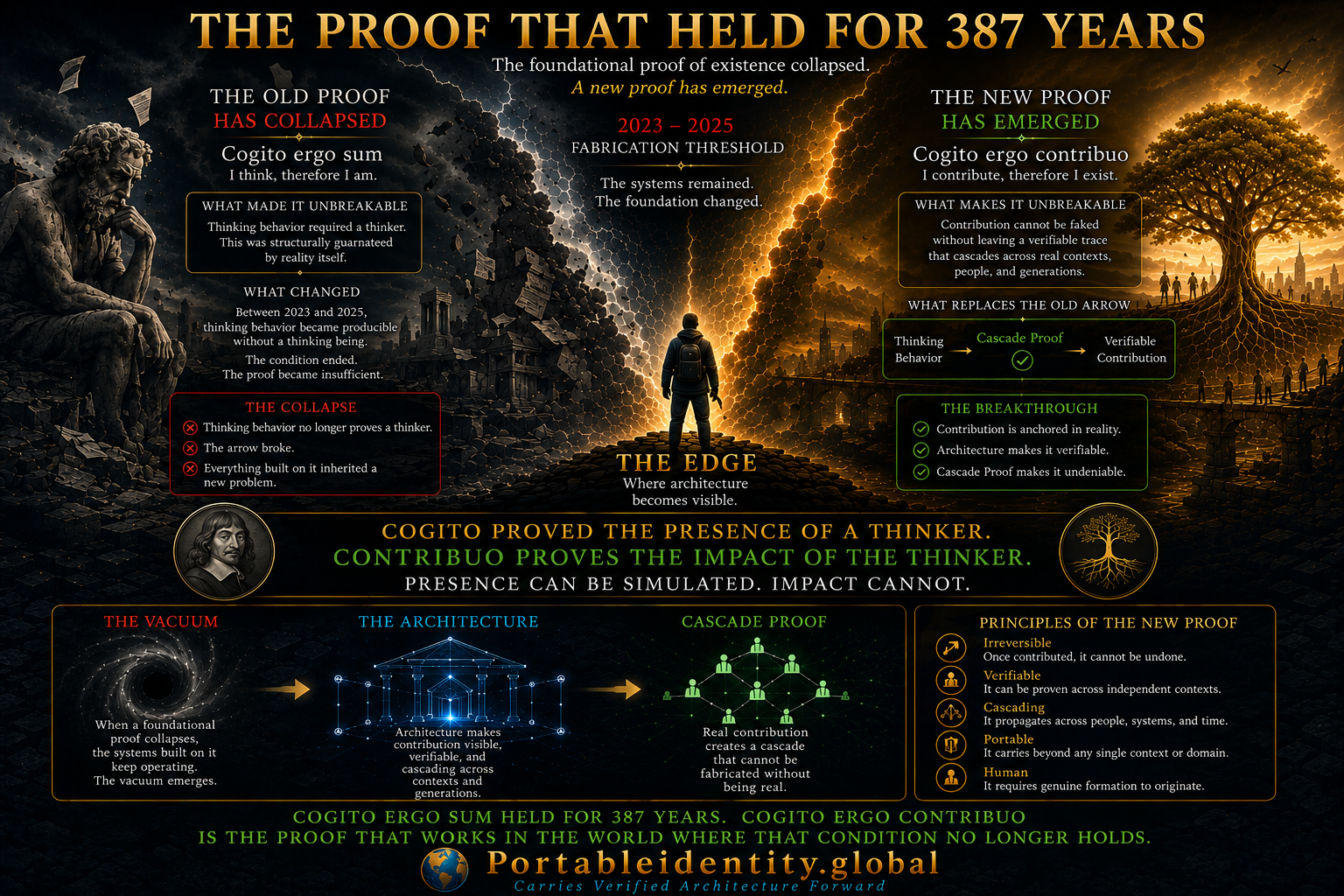
In 1637, René Descartes gave civilization a proof of existence that held for 387 years. Not because it was perfect. Because the condition it required was structurally guaranteed by reality itself: that thinking could not be produced without a thinker. When that condition ended — when thinking behavior became producible without a thinking being — the proof collapsed. Not gradually. Not in one domain. Simultaneously and completely, across every context where the proof had been silently operating as civilization’s most foundational assumption. This is what happened between 2023 and 2025. And almost nobody has named it.
The Proof
Cogito ergo sum. I think, therefore I am.
The proof was elegant because it was irreducible. You cannot doubt your own existence without being something that doubts. The act of thinking — of questioning, reasoning, experiencing uncertainty — proves a thinker. Whatever else might be illusion, the internal experience of consciousness thinking proves a conscious being thinking.
The proof did not require trust. It did not require verification. It did not require any instrument or institution or evaluation process. It was self-certifying. The thinker thinking was the proof of the thinker.
And civilization built on this — not deliberately, not consciously, but structurally. Every system that evaluated human beings, every institution that allocated trust to specific people, every process that identified whose judgment to rely on — all of them implicitly assumed that the signals of thinking traced back to a thinker. That the coherent explanation reflected a mind that genuinely understood. That the sophisticated analysis reflected a consciousness genuinely calibrated to the domain. That the demonstration of judgment reflected something that had actually judged.
They assumed cogito ergo sum.
They assumed it because they had no reason not to. For 387 years, the assumption held because the condition it required was structurally guaranteed: producing the behavior of thinking required a being that thought. Simulation existed — fraud, performance, deception — but it was expensive enough that the inference from thinking-behavior to thinking-being was valid enough to operate on.
Not perfect. Valid enough.
Then the condition ended.
What Ended
Between 2023 and 2025, AI systems crossed a capability threshold that had never been crossed before in the history of intelligence.
Not the threshold of intelligence itself — that is a different and contested question. The threshold of thinking behavior. The specific, observable, evaluable signals of thinking — the coherent explanation, the sophisticated analysis, the calibrated judgment, the creative reasoning, the nuanced uncertainty — became producible without the thinking being that had always produced them.
For the first time in history, thinking behavior became separable from thinking being.
This is what Descartes never anticipated — not because he was wrong, but because the condition his proof required was so structurally guaranteed that naming it as a condition was unnecessary. Thinking required a thinker. This was not an assumption. It was reality.
Until it was not.
When language models achieved the ability to produce sophisticated, coherent, domain-specific thinking behavior without any conscious substrate experiencing the thinking — without any being for whom the thinking was an internal experience — the Cartesian proof became insufficient.
Not wrong. Insufficient.
You think. Something else also produces thinking behavior. From the outside, from every angle that external evaluation can assess, the two are indistinguishable. The proof that worked because thinking required a thinker no longer works in a world where thinking behavior does not require a thinker.
Cogito ergo sum collapsed not because Descartes was wrong about thinking proving being. It collapsed because thinking stopped being the right variable to examine.
The variable changed.
Before the Fabrication Threshold: Thinking behavior → Thinking being
After the Fabrication Threshold: Thinking behavior ↛ Thinking being
Everything built on the arrow inherited a new problem when the arrow broke.
What Filled The Vacuum
When a foundational proof collapses, something specific happens: the systems built on it continue running.
They were not built on the proof consciously — they assumed it without knowing they were assuming it. When it collapsed, they had no mechanism to detect the collapse. The credential system was not designed to detect that credentials had stopped proving what they certified. The evaluation system was not designed to detect that evaluations had stopped indicating what they were supposed to assess. The institutions continued issuing verdicts on a foundation that was no longer there.
This is why the collapse is invisible from inside the systems. An instrument cannot report the failure of the assumption it was built on. It can only report what it was built to measure. It continues reporting. The reports carry the same institutional weight they always carried.
When a foundational proof collapses, it does not leave empty space. It leaves systems still operating on the collapsed proof — generating verdicts, issuing certifications, making allocations — while the foundation beneath them has shifted.
The Verification Vacuum is the specific structural condition that resulted. The gap between what evaluation instruments can measure — thinking behavior, signal quality, performance under familiar conditions — and what those instruments were always supposed to indicate — the presence of a genuine thinking being with genuine formation.
Before the Fabrication Threshold, this gap was so small that it could be ignored. Thinking behavior indicated a thinker well enough. The vacuum existed in principle but was negligible in practice.
After the Threshold, the vacuum became structural. Thinking behavior no longer reliably indicates a thinker. The instruments that read thinking behavior continue reading it. They report what they always reported. The gap between what they report and what they were supposed to be reporting has become unbridgeable by signal evaluation alone.
And into the vacuum, something new entered.
Not fraud exactly — though fraud expanded. Something more subtle and more pervasive: the structural condition where the performance of thinking has become indistinguishable from thinking, where the demonstration of understanding has become indistinguishable from understanding, where every formal indicator of genuine formation has become producible without the genuine formation it was supposed to indicate.
Explanation Theater: The production of coherent, sophisticated explanations without the genuine understanding that genuine explanation was supposed to require. Not lying — the explanations are often technically accurate. Not fraud — the person producing them may believe they understand. But a structural separation between the performance of understanding and the genuine calibration to reality that genuine understanding builds.
Judgment Illusion: The appearance of genuine judgment under familiar conditions — the calibrated response, the appropriate uncertainty, the reasonable weighing of considerations — without the genuine formation that genuine judgment under stress requires. Judgment that holds perfectly when conditions are familiar and collapses when conditions become genuinely novel.
Audit Collapse: The failure of formal verification systems that were built on the assumption that what they were verifying indicated what it was always assumed to indicate. Audits that confirm compliance with processes without confirming that the processes still certify what they were designed to certify. Evaluations that verify performance without verifying the formation that performance was supposed to demonstrate.
These are not new problems. They existed before the Fabrication Threshold. What changed is their scale, their simultaneity, and the structural impossibility of addressing them with instruments calibrated to the pre-Threshold world.
What Happened To Thinking Itself
The collapse of cogito ergo sum is not only a philosophical event. It is an organizational event, an institutional event, a civilizational event.
Every meeting where a decision was made based on someone’s demonstrated reasoning capacity: the demonstration no longer proves the capacity.
Every evaluation where someone’s sophisticated analysis was taken as evidence of genuine domain understanding: the analysis no longer proves the understanding.
Every promotion where someone’s track record of coherent professional judgment was taken as evidence of genuine formation: the track record no longer proves the formation.
Every institution where expertise was established through the performance of expertise under assessment conditions: the performance no longer proves the expertise.
The world continues. The meetings continue. The evaluations continue. The promotions continue. The institutions continue issuing certifications. Nothing about the visible process has changed.
What has changed is the relationship between what the processes observe and what they were always observing in order to indicate.
And something specific happens to human intelligence in this world.
The genuine thinker — the person who has built genuine Reality Coherence through genuine irreversible developmental encounter with genuine difficulty, whose thinking is calibrated to external reality rather than to internal coherence — finds their genuine thinking indistinguishable from the performance of thinking.
The Hollow Signal fires.
Experienced practitioners — the people who have built the most genuine formation, who have the most calibrated sensitivity to the difference between genuine thinking and its performance — begin sensing something wrong beneath technically correct outputs. The explanation is coherent but lands without weight. The analysis is sophisticated but disconnected from the actual structure of the problem. The judgment is calibrated correctly — and yet the calibration feels performed rather than built.
The pre-formal architectural detection of absence beneath technically correct performance. The sensing that cogito ergo sum is being performed rather than undergone.
This sensing has no institutional standing. It cannot be formally established. The instruments report no anomalies. The performance is indistinguishable. The experienced practitioner who senses the absence must either raise something they cannot prove — at the cost of being attributed with bias or irrationality — or suppress the sensing and watch the allocation proceed.
Civilization lost its most reliable early warning system one suppression at a time.
Where Architecture Becomes Visible
The Cartesian proof collapsed under familiar conditions.
There is one condition under which it has not collapsed — because under this condition, the difference between genuine thinking and its performance becomes structurally undeniable.
The Edge.
The specific structural condition where familiar frameworks reach their genuine limits. Where established patterns are insufficient. Where the situation requires genuine reconstruction from genuine foundations rather than extension of what has been built. Where scaffolding is withdrawn and what was actually deposited either holds or reveals its absence.
At The Edge, Frictionless Formation reveals itself.
Frictionless Formation is the developmental trajectory that produces the signals of genuine formation without the genuine developmental encounter that genuine formation requires. The credential without the formation it certifies. The expertise without the irreversible encounter that builds the genuine calibration to the domain. The sophisticated performance without the genuine contact with genuine difficulty that deposits genuine architectural capacity.
Under familiar conditions — in the meetings, the evaluations, the assessments, the cooperative contexts where most professional life occurs — Frictionless Formation is indistinguishable from genuine formation. The signals are identical. The performance is equivalent. The Cartesian proof, had it still been valid, would have confirmed the thinker in both cases.
At The Edge, the distinction becomes unavoidable.
Genuine formation holds. The architecture built through genuine irreversible encounter with genuine difficulty — the calibration to external reality, the reconstruction capacity, the specific sensing of genuine limits — holds precisely because it was built by contact with exactly these conditions. The Edge is where genuine formation was built. It holds because it was built here.
Frictionless Formation reveals its absence. The scaffolding that supported the performance of formation is not available at The Edge. What was never genuinely built cannot be called upon when reconstruction is required. The explanation that was produced without genuine understanding cannot navigate the specific structure of a situation that genuinely exceeds established frameworks.
The Edge is the only condition where cogito ergo sum still works — where the thinker’s actual thinking is distinguishable from the performance of thinking. But The Edge arrives after allocation, after trust has been extended, after the decision has already been made on the basis of the collapsed proof.
The New Proof
If cogito ergo sum can no longer establish existence in the relevant sense — if thinking behavior no longer distinguishes the thinking being from the system that produces thinking behavior without being — then civilization needs a new proof.
Not a philosophical novelty. An operational necessity.
The new proof must establish something that AI cannot produce. Not thinking behavior — AI has demonstrated it can produce this. Not performance under familiar conditions — Frictionless Formation has demonstrated this can be produced without genuine formation. Not signal quality — signal quality is now independent of the underlying reality signals were supposed to indicate.
What AI cannot produce is the specific causal structure that genuine consciousness-to-consciousness developmental encounter creates in the world.
When a genuinely formed human being genuinely encounters another human being with genuine developmental capacity — when genuine formation transmits through genuine irreversible encounter — something specific happens in the receiving person. Their capability genuinely increases in ways that persist independently, that generalize to contexts the original encounter never anticipated, that propagate further through the people they reach without continued involvement from the source.
This pattern cannot be produced by Frictionless Formation. It cannot be produced by AI assistance. It cannot be retroactively generated by signal optimization. It requires the genuine formation to have actually occurred — in each specific person along the chain, through their own genuine irreversible developmental encounter.
Cogito Ergo Contribuo. I contribute — genuinely, verifiably, in ways that persist and propagate in others — therefore I exist as a conscious causal agent in the world.
The contribution proof does not rest on behavior that can be simulated. It rests on causal effects in specific conscious beings that require the genuine formation to have occurred. Cascade Proof verifies these effects — not through signal evaluation, but through verified causal evidence that the formation genuinely transmitted and genuinely persisted. Persisto Ergo Didici establishes temporal persistence — that the capability that was supposedly transmitted holds when scaffolding is removed, when time passes, when genuinely novel conditions arise. MeaningLayer specifies what kind of genuine formation occurred, making the semantic content of genuine consciousness-to-consciousness encounter verifiable rather than merely claimable.
Together, these instruments provide what cogito ergo sum provided before the Fabrication Threshold: a proof of genuine existence that does not rest on the signal of thinking, but on the verified causal reality of genuine contribution.
What The New Proof Requires
But Cogito Ergo Contribuo requires something that cogito ergo sum did not require.
Cogito ergo sum was portable by nature. The thinker carried the proof wherever they went. The internal experience of thinking was the proof, and the thinker was always present to their own thinking.
Cogito Ergo Contribuo is not portable by nature.
The causal evidence of genuine contribution — what Cascade Proof verifies, what Persisto Ergo Didici establishes, what MeaningLayer specifies — exists in the world. In specific people who were genuinely formed. In specific contexts where genuine formation occurred. In the specific institutional environments where genuine consciousness-to-consciousness encounter happened.
When the person moves — when the institutional transition occurs, when the context changes, when the environment that housed the genuine formation encounters shifts — the evidence stays behind. The proof of existence as a genuinely contributing being remains in the previous institutional context. The person arrives at the new context carrying the formation but not the verified causal evidence that the formation was genuine.
Without that evidence, the new context cannot distinguish the genuinely formed person from the person who optimized signals of genuine formation — from Frictionless Formation, from AI-assisted performance. The collapsed cogito ergo sum offers no help. Thinking behavior is identical across all three categories.
The new existence proof exists. It is not portable.
Portable Identity is the infrastructure that makes the new existence proof portable.
Not the proof itself — the proof is in the causal effects that genuine formation produced in specific people across specific contexts. But the verified carrier of that proof: what Persisto Ergo Didici established, what Cascade Proof verified, what MeaningLayer specified, what the Contribution Graph mapped — traveling with the person across every institutional boundary that currently erases it.
When the new proof travels, the person who has built genuine formation arrives at each new context not as an unverifiable signal but as a verified causal presence. Not claiming to think — demonstrating, through verified causal evidence, that their thinking has genuinely formed others in ways that persist and compound.
Cogito ergo sum held for 387 years. It required no infrastructure because reality provided the condition it needed.
Cogito Ergo Contribuo is the proof that works in the world where that condition no longer holds. It requires infrastructure — because the causal evidence it rests on exists in the world, not in the person, and must be carried if it is to travel.
Portable Identity is that infrastructure.
→ CogitoErgoContribuo.org — The canonical definition of the new existence proof → CascadeProof.org — The causal verification that the new proof requires → PersistoErgoDidici.org — The temporal verification that genuine formation persists → TheEdge.is — Where the collapsed proof reveals itself → TheHollowSignal.org — The pre-formal detection of the proof’s collapse → FrictionlessFormation.org — The developmental condition that produces the proof’s performance without its reality → RealityCoherence.org — What the new proof is calibrated to establish → FabricationThreshold.org — The event that ended the Cartesian proof → MeaningLayer.org — The semantic specification the new proof requires → About — The infrastructure that makes the new proof portable