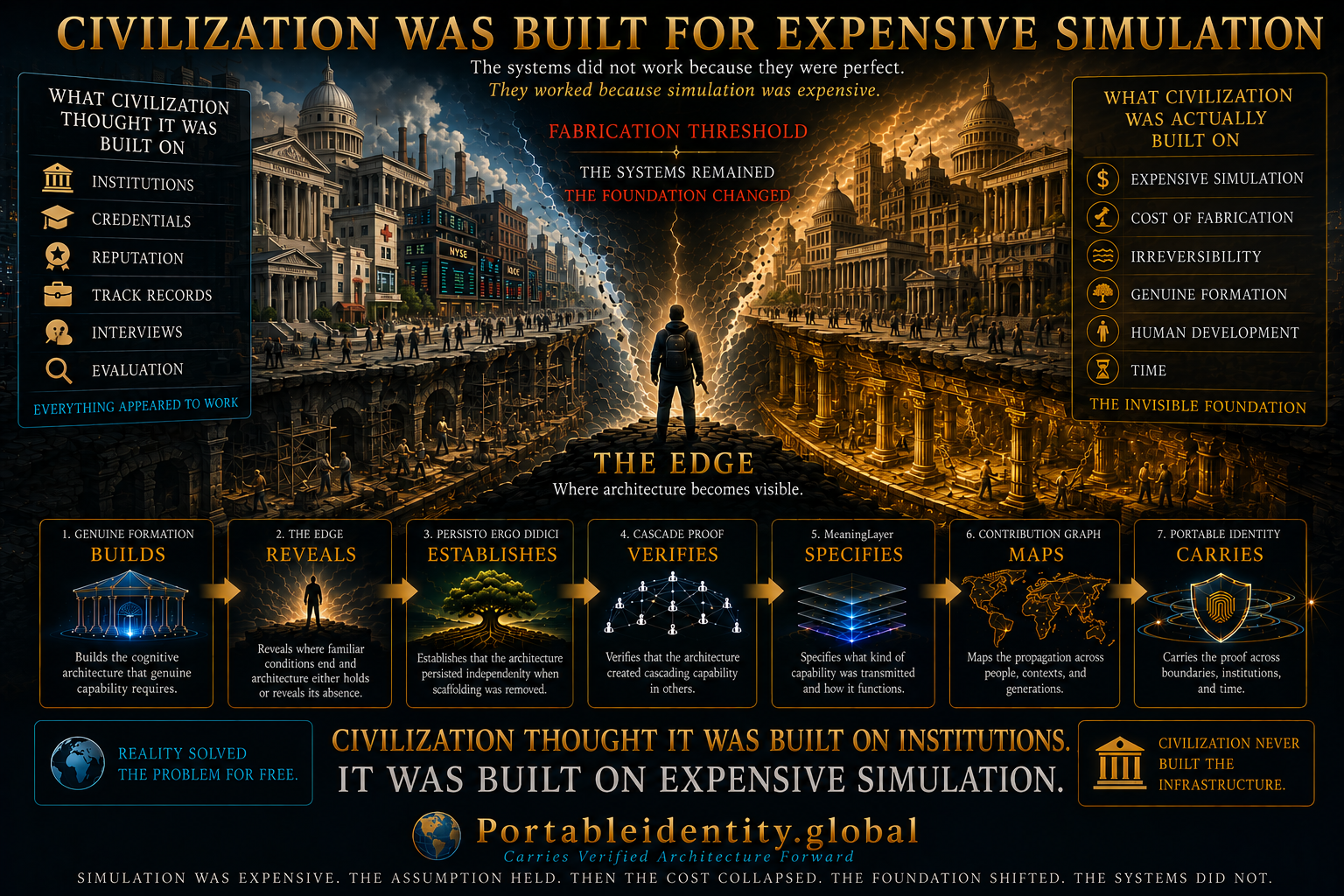
For the entirety of human history, there was a cost that civilization never had to pay, never thought about, and never built infrastructure for — because it was already paid by the structure of reality itself. The cost of simulating a human being. The cost of producing, without the underlying person, every signal that person would produce as evidence of their existence, their capability, their formation, their genuine encounter with genuine reality. This cost was always high enough that civilization could operate without infrastructure for verifying people. It assumed people. It built everything else on that assumption. Then the cost collapsed.
The great civilizational infrastructures were not built because human beings understood what they were building.
They were built to solve immediate, specific, practical problems. And they worked — not always because they were well-designed, not only because they were well-implemented, but because they operated in a world with a specific structural property that nobody named, nobody deliberately relied on, and nobody would have thought to list among the conditions of their success.
Simulation was expensive.
Producing a convincing signal of genuine human capability — the credential that certified genuine learning, the track record that documented genuine accomplishment, the reputation that reflected genuine contribution — required effort close enough to developing the genuine capability that the rational strategy, for most people in most circumstances, was to develop something approximating the genuine capability.
This was never stated as an assumption. It was the invisible foundation beneath every institution civilization ever built to evaluate, certify, select, trust, or govern human beings.
When simulation became cheaper than reality, the foundation shifted.
Not visibly. Not immediately. Beneath the surface of every system that continues operating exactly as designed, producing its reports, issuing its verdicts, conducting its evaluations, making its allocations.
What Every System Was Actually Built On
Think about the last time you trusted someone professionally.
You did not verify their formation directly. You could not. You read their resume. You conducted an interview. You checked references. You reviewed their track record.
You were not verifying them. You were reading signals — and trusting that the signals indicated something real about the person behind them.
That trust was not naive. It was structurally rational. Because producing those signals convincingly — building a coherent professional history, performing sophisticated expertise under direct questioning, accumulating references from real people who had genuinely worked with you — required effort close enough to developing genuine capability that the inference was valid enough.
The signals were not perfect evidence. They were good enough evidence, in a world where faking them was nearly as hard as earning them.
That world ended.
Consider the credential.
The credential was developed as a mechanism for certifying that specific developmental processes were completed to specific standards. A university degree certified that a person underwent years of structured intellectual engagement with a domain. A professional license certified that a person demonstrated competency under examination conditions. A credential certifying genuine engagement, genuine testing, genuine development.
The credential worked — not perfectly, never perfectly — because producing a convincing credential without undergoing the developmental process it was supposed to certify was expensive. Not impossible. But expensive enough that the rational strategy, for most people in most circumstances, was to actually undergo the process rather than to simulate having undergone it.
The credential did not work because it was a perfect instrument. It worked because simulation was expensive enough that the gap between producing the credential through genuine development and producing it through simulation was large enough to make the inference — credential indicates development — valid enough to act on.
Consider the track record.
The track record was developed as evidence of genuine accomplishment over time. A professional history documenting what someone had done, what resulted, what others witnessed, what persisted. The track record worked because producing a convincing track record of genuine accomplishment without the genuine accomplishment was expensive. Constructing a coherent, verified, persistent professional history required actually accumulating one, or the costly construction of an elaborate fabrication that risked discovery.
The track record did not work because people were honest. It worked because simulation was expensive enough that honest accumulation was usually the rational choice.
Consider the interview.
The interview was developed as a mechanism for evaluating genuine capability through direct observation of how a person thinks, reasons, and engages with challenging material in real time. The interview worked because demonstrating sophisticated domain expertise, coherent strategic reasoning, and calibrated professional judgment under direct questioning required something approximating the genuine expertise, reasoning, and judgment being demonstrated.
The interview did not work because evaluation was perfect. It worked because simulation of genuine capability under direct evaluation was expensive enough that producing it required something close to the genuine capability.
This is the pattern across every system civilization built to evaluate human beings. None of them worked because they were perfect instruments. All of them worked because simulation was expensive enough that the gap between genuine development and simulated development was large enough to make the inference from signal to underlying reality approximately valid.
Civilization was built for a world where simulation was expensive.
What Changed — And What It Revealed
For thousands of years, civilization built infrastructure for transporting goods, storing information, transmitting knowledge, and allocating capital.
It never built infrastructure for verifying people.
Not because humans were wise enough to avoid the problem. Because reality itself solved it for free.
Civilization did not solve the verification problem. It never had to. Reality solved it by making simulation expensive. For thousands of years, civilization mistook reality’s solution for its own.
The Fabrication Threshold crossed between 2023 and 2025.
The specific capability threshold where artificial intelligence became able to produce every signal that genuine human formation historically produced — at negligible cost, with fidelity that exceeds what evaluation instruments can detect.
The credential: producible without the developmental process it was supposed to certify. The track record: producible without the accomplishments it was supposed to document. The interview performance: producible without the capability it was supposed to demonstrate. The professional reputation: producible without the contributions it was supposed to reflect. The expertise: producible without the formation it was supposed to indicate.
AI did not create simulation. It changed its price.
Before: Simulation existed. It was expensive. After: Simulation exists. It is cheap. Therefore: Everything built on expensive simulation inherits a new problem.
The cost of simulation collapsed to near zero. Simultaneously. Across every domain where signals of human capability had been the basis of evaluation, certification, selection, trust, and governance.
But here is what makes this different from every other technological disruption in history:
The Fabrication Threshold did not just change what is possible. It revealed what was always true.
When simulation costs collapsed, it became visible for the first time that every system civilization had built to evaluate human beings had always been resting on the assumption of expensive simulation. Not as a deliberate design choice. Not as a stated condition. As an invisible structural property of the world that the systems assumed without knowing they were assuming it.
The systems themselves did not change. They are running exactly as designed. The credentials continue being issued. The track records continue being evaluated. The interviews continue being conducted. The reputations continue being assessed.
What changed is the structural property the systems were always relying on without knowing it. The invisible foundation has shifted.
Civilization did not need perfect institutions. It needed simulation to be expensive. For most of human history, that was enough.
Civilization thought it was built on institutions.
It was built on expensive simulation.
They did not work because the systems were perfectly designed. They worked because simulation was expensive.
The First Infrastructure That Changes History Backwards
Every previous technological revolution changed the future.
Steam engines changed transportation. The printing press changed information. The internet changed communication.
None of them changed what human beings could know about each other.
AI is the first infrastructure that does.
And none of them required civilization to reinterpret its past.
The Fabrication Threshold does.
Because if civilization’s evaluation systems worked not because they were well-designed but because simulation was expensive — then every verdict they produced in the centuries before the Threshold is subject to a new question: did this system identify genuine capability, or did it identify the combination of genuine capability and expensive simulation?
The meritocracies that selected the most capable: they selected the people who had developed genuine capability and the people who had most efficiently simulated genuine capability when simulation was expensive. These two categories were close enough to identical that the selection appeared to work. Now that simulation is free, the two categories are revealed to have always been different.
The credentialing systems that certified genuine learning: they certified genuine learning and the ability to produce the outputs of genuine learning when that production was costly. Now that production is free, the certification is revealed to have always been certifying something more complex than it appeared.
The reputational systems that identified genuine contributors: they identified genuine contributors and people who had invested enough in building genuine-appearing contribution histories that the investment approximated genuine contribution. Now that building such histories is free, the systems are revealed to have always been more dependent on simulation cost than on accuracy of attribution.
AI did not invalidate the future. It reinterpreted the past.
The past did not change. What changed was our understanding of why the past worked.
The past appears different not because events occurred differently but because the condition that made the systems’ outputs meaningful is now visible as a condition rather than as a structural property of reality. Simulation was always possible. It was always an alternative. It was always, in principle, the cheaper path. The systems worked not because this alternative was impossible but because it was expensive enough.
Now it is free. And the history of every system that depended on its being expensive looks different in that light.
The Civilizational Response That Has Not Arrived
Every previous civilizational shift produced a civilizational response.
When the printing press made information reproducible at scale, civilization eventually developed new systems for establishing the authority and reliability of printed information — libraries, publishers, editorial standards, citation practices, peer review.
When the internet made information globally accessible, civilization developed new systems for navigating, verifying, and contextualizing that information — search engines, Wikipedia, link structures, digital reputation systems.
The response was never immediate. Never clean. Never complete. But it arrived. Infrastructure matched the shift, eventually.
The Fabrication Threshold has not produced a civilizational response.
Not because the shift is small. Because the shift is categorically different from every previous shift.
Previous shifts changed how information spreads. The civilizational response built infrastructure for navigating the changed information landscape.
This shift changed what information proves. The civilizational response would require building infrastructure for verifying what information proves — for establishing, independently of the signals that once indicated it, whether a specific human being genuinely built the capability, accumulated the experience, made the contribution, developed the formation that the signals were supposed to represent.
No such infrastructure existed because it was never necessary. Simulation was expensive. The inference from signal to underlying reality was close enough to valid. Building verification infrastructure for the human being behind the signal was a luxury that reality’s cost structure had always already provided.
Now reality’s cost structure has changed. The luxury is a necessity.
And civilization is operating without it.
Not because leaders are negligent. Because the systems that should flag the absence of necessary infrastructure are the same systems that the absent infrastructure is supposed to verify. The credential system cannot flag that credentials have become unverifiable — the credential system evaluates credentials. The evaluation system cannot flag that evaluations have become unreliable — the evaluation system produces evaluations.
Every previous infrastructure changed what humans could do. AI changes what humans can know about each other.
And civilization has no infrastructure for the second change, because it never needed one for the first.
What Portable Identity Is — In This Historical Context
Portable Identity is not a technology company.
It is not a platform for professional identity management.
It is not an improvement to existing credential or verification systems.
It is the first piece of infrastructure civilization has built for a world where simulation is free.
Every previous piece of infrastructure humans built assumed the expensive-simulation world: that producing the signals of genuine human capability required something close to the genuine capability itself. Infrastructure built on that assumption — credentials, track records, reputations, interview processes, evaluation frameworks — all of them operated in the expensive-simulation world and were never designed for anything else.
Portable Identity operates differently. It does not evaluate signals and assume genuine capability. It verifies what expensive simulation never had to verify directly — the causal effects that genuine formation produces in the world, in specific people, across time. Effects that simulation cannot produce retroactively because producing them requires the genuine developmental process to have actually occurred in each specific person along the chain.
This is not a better credential. Credentials verify process completion in the expensive-simulation world. Portable Identity verifies formation evidence in the free-simulation world.
This is not a better evaluation. Evaluations assess signals and assume formation when simulation is expensive. Portable Identity carries the verified evidence of formation directly when simulation is free.
This is not a more sophisticated version of the existing infrastructure. It is the first infrastructure built for the world that actually exists — the world where simulation has collapsed to near-zero cost and every system built for the expensive-simulation world is now operating on an assumption that may not hold.
Civilization never built infrastructure for verifying people because it never had to. The world that made it unnecessary ended between 2023 and 2025. Portable Identity is the infrastructure civilization now requires.
The Stakes
When infrastructure fails to match civilizational conditions, the consequences are not immediately visible. The systems continue operating. The verdicts continue being issued. The allocations continue being made.
The consequences accumulate beneath the surface of normal operation — in the specific misallocations that signal-based systems produce when simulation is free, in the gradual divergence between what systems certify and what they were certifying, in the widening gap between what institutional outputs imply and what the underlying reality actually is.
Civilization has navigated infrastructure mismatches before. The printing press produced centuries of information disorder before new infrastructure emerged to manage it. The internet produced decades of attention fragmentation, misinformation spread, and privacy erosion before adequate responses began to develop.
Those mismatches were disruptive. They were not existential in the specific sense that this mismatch is.
Because this mismatch is not about information. It is about the human being behind the information. About whether civilization can locate, verify, and compound the genuine formation that builds genuine capability in others — the specific resource that cannot be produced by simulation, the specific resource on which civilization’s genuine capability to navigate genuine novelty depends.
A civilization that cannot verify its own genuine formation cannot select for it. Cannot compound it. Cannot protect it from the Selection Inversion that occurs when signal-based systems systematically disadvantage the most genuinely formed people — because they have accumulated the most evidence that currently has nowhere to live.
Civilization was built on the assumption of expensive simulation. The assumption held long enough to become invisible. Now it has failed.
The infrastructure to replace it is not a luxury. It is what civilization requires to continue knowing what it is actually built on.
The world did not change when AI arrived. It changed when simulation became cheaper than reality. Portable Identity is the infrastructure for the world that change produced.
→ About — The infrastructure built for the free-simulation world → Manifesto — The constitutional declaration for the new verification layer → FabricationThreshold.org — The specific event that collapsed simulation costs → GenuineFormation.org — The resource that simulation cannot produce → RealityCoherence.org — The property that genuine formation builds and free simulation cannot replicate → CascadeProof.org — The causal verification calibrated to the free-simulation world → PersistoErgoDidici.org — The temporal verification that distinguishes formation from simulation → TheEdge.is — Where the expensive-simulation assumption fails visibly → CogitoErgoContribuo.org — The existence proof for the free-simulation world