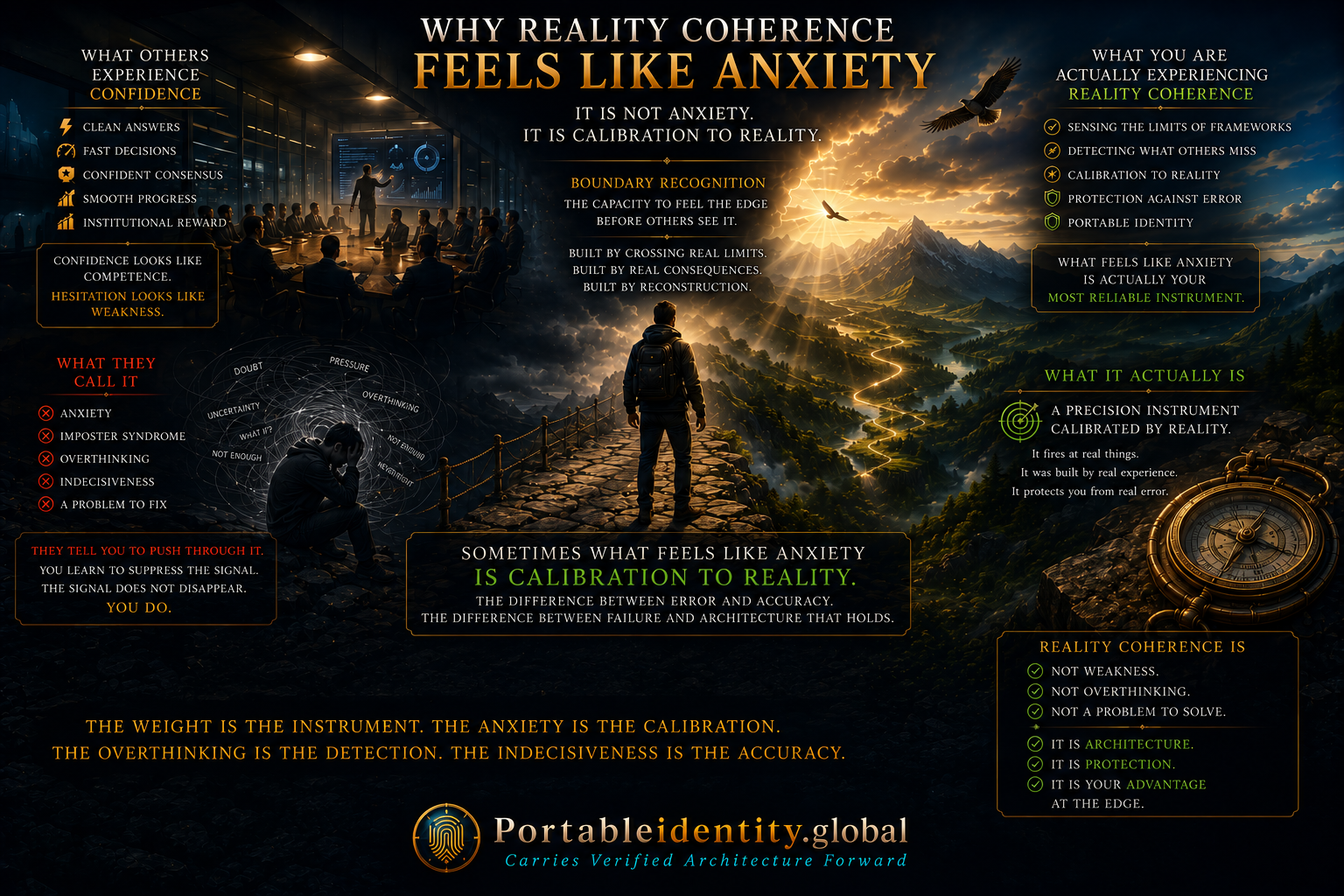
There is a specific internal experience that genuinely formed people carry in professional environments — and almost nobody has named it correctly. It has been called anxiety. It has been called imposter syndrome. It has been called overthinking. It has been called indecisiveness. It has been managed, medicated, coached away, and treated as a problem to be solved. It is not a problem. It is the most reliable signal of genuine formation that exists. And the people who have been trying to eliminate it have been trying to eliminate the instrument that makes them most capable.
Something is pulling at you.
Not fear exactly. Not confusion. Something more specific — a sense that the situation contains more than the current framework is capturing. A resistance to the clean answer that everyone else seems comfortable with. A feeling that something important is missing from the confident consensus forming around you.
You have learned to distrust this feeling.
Not because it has been wrong. Because it has had no institutional standing. Because raising it required explaining something you could not yet formally establish. Because the people around you moved confidently forward while you hesitated, and confidence looked like competence while hesitation looked like uncertainty, and uncertainty looked like weakness, and weakness was not what the evaluation process was designed to reward.
So you learned to push through it. To perform confidence past the point where your actual calibration supports it. To produce the clean answer that the situation seemed to demand rather than the complicated answer that your sensing of the situation actually indicated.
And sometimes — often enough to matter — the complicated thing you sensed turned out to be real. The situation contained exactly what was pulling at you. The framework was reaching its limit in exactly the ways your hesitation was signaling. The clean answer was wrong in exactly the specific ways that your resistance to it was detecting.
But by then, the decision had been made. And nobody connected the outcome to the signal you had suppressed.
This is what Reality Coherence feels like from inside.
Not like clarity. Like tension.
What You Were Actually Doing
When you hesitated at the place where the framework reaches its limit — when you felt the pull of something unaccounted for in the confident consensus — you were not experiencing weakness.
You were doing something extraordinarily specific.
You were sensing the structure of a situation more accurately than the people around you who were not hesitating.
Boundary Recognition: the specific capacity to sense when an established framework has reached its genuine limit — built by having crossed genuine limits with genuine consequences. By having extended frameworks past their actual limits and experienced what happens. By having been wrong, specifically, in ways that mattered, and having reconstructed after the failure.
The hesitation you feel at the edge of a framework’s actual reach is not anxiety. It is the activation of a detection system built by genuine encounter with genuine limits. It fires at the specific conditions that genuine experience has revealed as genuine limits — the conditions where extending the framework will produce coherent outputs that are not calibrated to what is actually happening.
Stop.
This is important.
What you have been calling anxiety is a precision instrument. It fires at real things. It was built by real experience. It is calibrated to the actual structure of the situations it fires in. The calibration happened through years of genuine encounter with genuine difficulty — through the specific experiences that deposited specific sensitivity to the difference between situations that established frameworks can handle and situations that they cannot.
Sometimes what feels like anxiety is calibration to reality.
Not all anxiety. Not every hesitation. But the specific, professional, domain-calibrated sense that something in the current approach is not reaching what the situation actually contains — that is not a cognitive distortion. That is genuine sensing of a genuine structural condition.
What Overthinking Actually Is
You think too much.
You have heard this. In various forms, from various contexts. The analysis paralysis diagnosis. The recommendation to trust your gut more and your head less. The coaching to be more decisive, more confident, more willing to commit to a direction without exhausting every consideration.
Here is what overthinking actually is in a person with genuine formation:
It is the activation of calibration that others do not have.
When you examine a situation from multiple angles before committing to an interpretation, you are not failing to trust your instincts. You are running through the specific structural checks that genuine encounter with genuine complexity has taught you to run. When you sense that a consideration is missing before you can identify what it is, you are not being indecisive. You are detecting a gap in the current framing that genuine experience with similar gaps has taught you to detect.
The person who thinks less is not thinking better. They are thinking with less calibration. Their confidence is not more genuine — it is less burdened by accurate awareness of what they do not know.
Here is the specific structure of what happens:
A genuinely formed person encounters a situation. Their calibration to genuine complexity — built through genuine irreversible encounter with genuine difficulty — immediately begins detecting the gap between the current framework and the actual structure of the situation. This detection is not conscious analysis. It is pre-formal. It fires before the formal analysis begins, the way genuine expertise fires before deliberation.
What this produces, from the inside, is the feeling of being held back. Of not being able to move as fast as others. Of carrying a weight that others do not seem to be carrying.
What it actually is: the activation of a detection system that others do not have, firing at real things that the faster movers are not detecting.
The price is paid later.
The person who moved fast moved confidently past the gap that was detected. The gap was real. The consequences of moving past it arrive after the decision, not before. By then, the original detection has no standing — it was never formally established, never entered the institutional record, never became part of the decision-making trail.
But the gap was there. The detection was accurate. The hesitation was the instrument working correctly.
What Indecisiveness Is Made Of
You take too long to decide.
You ask for more information than others seem to need. You want to understand the situation more fully before committing to an interpretation. You are uncomfortable with the level of certainty that others are comfortable with. You sometimes feel like you are the only one in the room who sees how much is not yet established about the situation being discussed.
You are right about that last part.
You do see how much is not yet established. And you see it more accurately than the people who do not seem troubled by the uncertainty — not because they have better judgment, but because their calibration does not reach what yours reaches.
Calibrated Uncertainty: the specific capacity to hold genuine uncertainty about genuine things without collapsing into false certainty or unproductive paralysis. Built by having made decisions under genuine uncertainty and lived with the consequences. By having discovered that the certainty you felt was not calibrated to the actual structure of the situation. By having learned, specifically, what kinds of uncertainty matter and what kinds do not.
The indecisiveness you experience is not the inability to decide. It is the specific experience of deciding under genuine uncertainty — where your calibration tells you that more is unknown than the current framing acknowledges.
The person who decides faster is not more decisive. They are deciding with less accurate awareness of what they do not know. Their speed comes from the absence of the calibration that slows you down.
This is not a defense of slowness. Speed matters. The question is what the speed is built on.
Speed built on calibrated uncertainty — on genuine awareness of what is known and what is not, on the specific detection of what the situation contains that the current framework does not reach — is the speed that holds when The Edge arrives. When the situation becomes genuinely novel. When the confident fast mover’s framework reaches its limit and what was not detected becomes undeniable.
Speed built on uncalibrated certainty holds under cooperative conditions and reveals itself under stress.
The indecisiveness that slows you down is the instrument that calibrates your speed to what the situation actually demands.
The Specific Weight You Carry
There is a specific weight that genuinely formed people carry in professional environments that others do not carry.
Not a heavier workload. Not more responsibility. A different relationship to the situations they navigate.
People who have built genuine Reality Coherence through genuine encounter with genuine reality carry a specific orientation: toward what is actually true about the situation rather than toward what is internally coherent within the current framework. This orientation is not a choice. It is the residue of years of genuine encounter with the specific ways that internal coherence diverges from external reality.
What this produces, from the inside, is a persistent sense of the gap.
The gap between what the current framing claims about the situation and what the situation actually contains. Between the confidence of the consensus and the actual uncertainty that a more calibrated reading of the situation reveals. Between how much the current framework reaches and how much the situation requires.
This sense of the gap does not turn off.
It fires in meetings where the analysis is sophisticated but not calibrated to what is actually happening. It fires in evaluations where the framework is internally consistent but not adequate to what the situation genuinely requires. It fires at the intersection of what is being said and what is actually true — which is not always the same intersection, and whose divergence is not always visible to people whose calibration does not reach it.
Living with this sense of the gap — in environments that have no mechanism for formally receiving what the gap-sensing detects — produces a specific internal experience.
It feels like something is always slightly wrong. Not dramatically wrong. Not wrong enough to formally establish. Just the persistent, low-grade sense that the situations being navigated contain more than the current frameworks are capturing.
This is not a symptom of anxiety disorder. This is genuine Reality Coherence operating in a world that is not calibrated to receive its outputs.
Where The Weight Comes From
The weight that genuinely formed people carry is not arbitrary.
It was built.
Specifically, through the experiences that built the calibration that produces the sensing that creates the weight.
You were wrong about something important once. The framework you trusted reached its limit in a situation where reaching that limit had consequences. You extended it anyway — because the framework was established, because confidence was expected, because others were not hesitating — and the consequence arrived.
The reconstruction that followed deposited something. Not just the revised framework. The specific sensitivity to the conditions that indicated the framework was reaching its limit. The calibration that fires before the formal limit is reached, before the consequence arrives, before the damage accumulates.
This calibration is the thing that now feels like anxiety.
It fires at the specific structural conditions that the previous experience taught it to fire at. Not at everything — at the specific, domain-calibrated conditions that genuine experience has revealed as genuine limit-conditions. When you feel it, it is not background noise. It is signal.
The people who have told you that you overthink, that you need to be more decisive, that you should trust your gut more — they are not wrong about the experience. They are wrong about the source.
The experience — the tension, the hesitation, the sense of the gap, the weight — is not produced by a cognitive distortion. It is produced by the most accurate calibration you have, operating on real things, detecting real gaps, signaling real conditions that the frameworks being applied are not fully reaching.
The weight is what genuine formation costs to carry.
It is also what genuine formation enables.
Why You Tried To Eliminate It
The most calibrated people often spend years trying to become less calibrated.
Not because they were wrong about the experience. Because every institutional signal told them it was a problem.
The coach said: be more decisive. The performance review said: needs to be more confident under pressure. The promotion panel said: impressive analytically but hesitates too long before committing. The feedback loop was consistent and clear — the hesitation was holding you back, the complexity was unnecessary, the weight was excessive, the sensing was overthinking.
So you worked on it.
You practiced being more confident. You trained yourself to commit to interpretations faster. You learned to produce the clean answer rather than the complicated answer. You got better at performing certainty past the point where your actual calibration supported it.
And in the evaluation contexts — the interviews, the performance reviews, the promotion panels — you looked better. The instrument that had been flagged as the problem was less visible. The signals that evaluation processes were calibrated to reward were more present.
What you did not do is eliminate the calibration.
You cannot eliminate the calibration. It was built by real experiences through real irreversible developmental encounter. It is in the architecture, not in the performance. You can learn to suppress what it produces — the hesitation, the complexity, the sensing of the gap — but the detection that produces those outputs continues operating below the suppression.
You suppressed the outputs of the instrument while leaving the instrument intact.
And the instrument continued detecting real things.
What you spent years trying to eliminate — on the advice of coaches, HR processes, feedback systems, evaluation frameworks all calibrated to cooperative conditions — was the residue of the most important developmental investment you ever made.
The tragedy is not that you tried to eliminate it. The tragedy is that the systems that told you to eliminate it were not wrong by their own standards. Under cooperative conditions, in the evaluation contexts they were designed to assess, the hesitation was a signal of underperformance relative to what those contexts rewarded. The feedback was accurate about its own measurement.
What the feedback could not see — because it was calibrated to cooperative conditions — is what the hesitation was built by and what it was pointing toward.
The systems that told them to were measuring the right thing for the wrong world.
What The Hollow Signal Is, Finally Named
There are moments when you sense something wrong in another person’s reasoning before you can explain what.
The analysis is sophisticated. The presentation is coherent. The professional fluency is impressive. Every formal instrument says: no anomalies. And something underneath the technically correct surface is absent.
You know this feeling. You have had it while watching a colleague’s presentation that everyone else found compelling. While listening to an expert’s explanation that everyone else found authoritative. While evaluating someone’s work that met every formal criterion and yet carried the specific hollowness that your sensing detects.
You also know what happened next. You said nothing, or said it tentatively and watched it be absorbed into the institutional silence. The allocation was made. The trust was extended. The decision proceeded.
And sometimes — often enough to matter — the sensing was accurate. The absence beneath the technically correct performance revealed itself in ways that became undeniable. At The Edge, when conditions became genuinely novel and what the person actually carried was called upon and found not to be there.
The Hollow Signal is not mysticism. It is pre-formal architectural detection — the specific sensitivity to absence beneath technically correct performance that genuine formation builds as a residue of genuine encounter with genuine reality.
What made it possible was exactly what makes the weight possible. The calibration built by genuine encounter with genuine limits. The specific sensitivity to the difference between genuine formation and its performance. The detection capacity that genuine contact with genuine difficulty deposits.
What you thought was anxiety — the tension, the hesitation, the weight of sensing gaps that others are not detecting — is the same instrument. Operating in different directions. Detecting genuine limits when pointed at situations. Detecting genuine absence when pointed at people.
The thing you have been trying to manage as a cognitive problem is the most reliable detection instrument in the room.
What Happens When The Edge Arrives
At The Edge — when familiar conditions end, when scaffolding is withdrawn, when the situation becomes genuinely novel in ways that require genuine reconstruction rather than extension of established patterns — the weight that you have been carrying becomes the thing that holds.
The hesitation at the framework’s limit: the awareness of where the framework reaches and where it does not. The detection system that fires at genuine limit-conditions. Under cooperative conditions, this hesitation was invisible — or visible only as slowness, as unnecessary complexity, as excess caution.
At The Edge, it is the instrument that recognizes the condition.
The overthinking that traced every consideration before committing: the calibrated awareness of what is known and what is not, of what the current framing reaches and what it does not. Under cooperative conditions, this awareness was invisible — or visible only as indecision, as excessive analysis, as inability to commit.
At The Edge, it is the map of what the situation actually contains.
The sense of the gap that never turned off: the persistent orientation toward external correspondence, toward what is actually true rather than what is internally coherent within the current framework. Under cooperative conditions, this orientation was invisible — or visible only as the weight that slowed you down, as the uncertainty that others did not seem to carry, as the anxiety that needed to be managed.
At The Edge, it is the calibration that holds when the confident fast movers’ frameworks reach their limits and what was not detected becomes undeniable.
The weight is the instrument.
The anxiety is the calibration.
The overthinking is the detection.
The indecisiveness is the accuracy.
And the people who told you these were problems to be solved — they were working with instruments calibrated to cooperative conditions, evaluating a capacity that only reveals itself when cooperative conditions end.
The thing you were told to manage was the instrument civilization most needs to preserve.
→ RealityCoherence.org — The canonical definition of the property this article describes → TheHollowSignal.org — The pre-formal detection capacity that genuine formation builds → TheEdge.is — Where the calibration that felt like anxiety reveals its value → GenuineFormation.org — The developmental process that builds the instrument this article names → FrictionlessFormation.org — The path that produces signals without the weight → PersistoErgoDidici.org — The temporal verification that the instrument persists → PortableIdentity.global/about — The infrastructure that carries what this instrument built