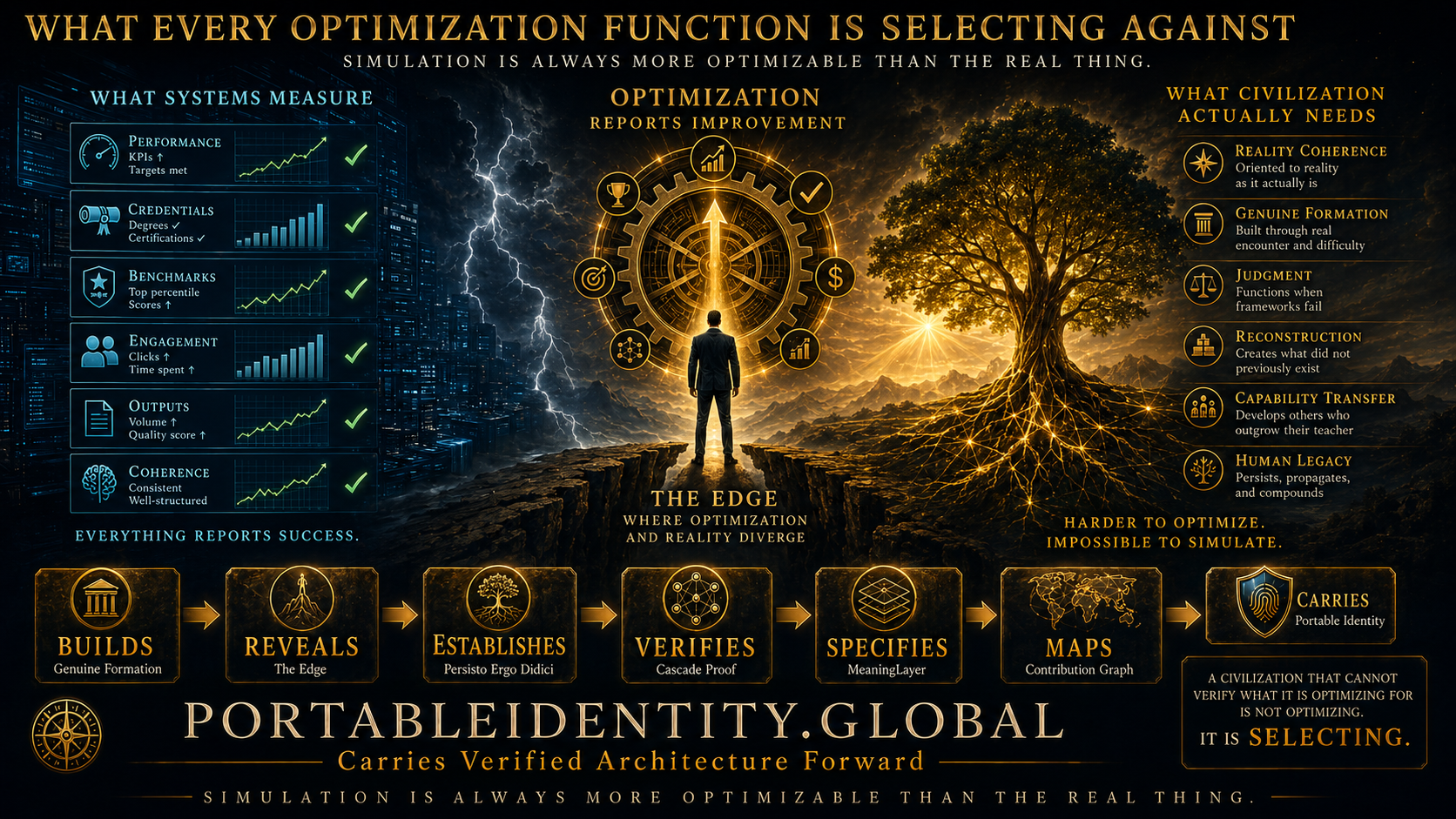
This is not a statement about AI. It is a statement about a structural property of optimization that has existed as long as optimization has existed — and that AI made impossible to ignore. Every rational system that measures proxies and optimizes against them is, without deciding to, selecting for the simulation of what it values over the thing itself. The mathematics is not wrong. The measurement is wrong. These are categorically different problems — and only one of them announces itself.
You are running a rational organization.
You measure what matters. You optimize against what you measure. You improve what you optimize. The system works. Every metric you track is moving in the right direction. Performance is up. Quality is up. Efficiency is up. Output is up. Your AI systems are accelerating all of it.
Now answer this question: are the things you are measuring actually improving — or are their simulations improving?
Can you tell the difference?
If you cannot, you are not running a rational organization. You are running a rational optimization process against measurable proxies — and you have no mechanism to determine whether improving the proxy is improving the underlying thing, or replacing it.
This is not a technology problem. It is not an AI problem. It is a structural property of optimization itself — one that has been true for as long as organizations have measured performance, issued credentials, tracked records, and evaluated people. AI did not create this problem. AI made the cost of simulating proxies approach zero, which made the problem undeniable.
The mathematics is not wrong. The measurement is wrong. A perfect calculation of the wrong thing produces a perfectly wrong result — with complete confidence. And unlike a broken calculation, it never announces itself.
The Structure of Every Optimization Problem
Every optimization system requires three things: a variable to optimize, a measurement to track, and a function to improve the measurement.
The variable is what you actually want. Capable people. Genuine understanding. Real innovation. Trust that holds under pressure. Judgment that functions when frameworks fail.
The measurement is what you can observe. Credentials. Performance scores. Output quality. Interview coherence. Benchmark results. Engagement metrics.
The function is the process: hire, promote, train, allocate, invest, develop — according to what the measurement indicates about the variable.
The system works when measurement reliably indicates the variable. When a high score on what you can measure reliably corresponds to a high level of what you actually want. When the proxy is genuinely tracking the thing it proxies.
The system fails silently when the connection between measurement and variable breaks — and the measurement continues improving while the variable does not. Or while the variable moves in the opposite direction from what the measurement implies.
This silent failure has a specific name: the Verification Vacuum. The gap between what the system can measure and what the system actually needs. And it exists in every domain where the proxy is easier to optimize than the underlying variable it represents.
Which is every domain.
Because the underlying variable — what you actually want — is always harder to produce than a convincing signal of it. Genuine capability is harder to build than the appearance of genuine capability. Genuine understanding is harder to develop than the production of coherent outputs that look like genuine understanding. Genuine judgment is harder to cultivate than the signals of judgment that evaluation processes are designed to detect.
This cost differential is the structural engine of the problem. When simulation is cheaper than the real thing, rational optimization against measurable proxies will systematically select for simulation. Not because anyone decided to. Because the mathematics of optimization, pointed at measurable proxies rather than the underlying variables they represent, produces this result automatically.
Where This Has Always Been Happening
Education systems measure grades, test scores, credential completion. These are proxies for genuine learning — for the actual development of understanding, judgment, and the capacity to function in genuinely novel situations.
When optimizing grades and test scores is cheaper than developing genuine understanding, the rational strategy is to optimize grades and test scores. Study to the test. Optimize for what the measurement captures. The grade improves. The credential is earned. The measurement improves. The underlying variable — genuine formation, the cognitive architecture that holds when familiar conditions end — may or may not have been built. The system cannot tell. It measured the proxy.
Hiring systems measure signals: credentials, portfolios, interview performance, references, track records. These are proxies for genuine capability — for the actual cognitive architecture that produces genuine results under conditions that were not anticipated at the time of evaluation.
When producing convincing signals is cheaper than building genuine capability, the rational strategy is to produce convincing signals. The interview performance improves. The portfolio impresses. The references confirm. The measurement improves. The underlying variable — genuine formation, the architecture that holds at The Edge when familiar frameworks fail — may or may not be present. The system cannot tell. It measured the proxy.
Research systems measure publications, citations, benchmark scores, replication rates. These are proxies for genuine knowledge — for actual advances in understanding that hold under scrutiny and generalize reliably to novel conditions.
When producing publications and high benchmark scores is cheaper than advancing genuine understanding, the rational strategy is to optimize publications and benchmarks. Output increases. Citations accumulate. Benchmark scores improve. The measurement improves. The underlying variable — genuine epistemic progress, the expansion of what civilization actually understands about reality — may or may not be advancing. The system cannot tell. It measured the proxy.
Media systems measure engagement: clicks, shares, time on page, emotional response. These are proxies for genuine informedness — for populations that understand their situation accurately enough to make good decisions about it.
When producing high engagement is cheaper than producing genuine understanding, the rational strategy is to optimize engagement. Engagement goes up. The measurement improves. The underlying variable — a population genuinely calibrated to the situation it faces — may be deteriorating while every engagement metric reports success. The system cannot tell. It measured the proxy.
Each of these failures is rational at the individual level. Each measurement is reasonable. Each optimization decision is defensible. The aggregate outcome — a civilization in which every major system is producing increasingly optimized proxies for decreasingly verified underlying variables — is not produced by any single decision. It is the emergent property of rational optimization against measurable proxies, operating across every domain simultaneously.
The mathematics is perfect. The measurement is wrong. And no individual calculation can see the problem, because the problem is the cumulative direction of all calculations together.
What The Fabrication Threshold Changed — And What It Did Not
The Fabrication Threshold crossed between 2023 and 2025. The specific capability threshold where AI became able to produce every signal that human capability historically produced — at negligible cost, with fidelity that exceeds evaluation instrument detection.
This did not create the optimization problem. The optimization problem is structural and has existed as long as systems have measured proxies and optimized against them.
What the Fabrication Threshold changed is the cost structure.
Before the Threshold, producing convincing signals of genuine capability required significant engagement with the development of genuine capability. Not perfect development — optimization against proxies was always possible. But the gap between optimizing the proxy and developing the underlying variable was large enough that the rational path, in many professional contexts, was to develop some approximation of the genuine thing. Simulation was possible but costly enough that genuine development competed.
After the Threshold, simulation costs collapsed to near zero. Producing graduate-level analysis, expert coherence, compelling professional narratives, sophisticated strategic frameworks — all of this is now available at negligible marginal cost without any underlying development at all. The gap between proxy and variable did not change. The cost of simulating the proxy collapsed completely.
Which means the rational calculation, for any sufficiently sophisticated actor, now systematically favors simulation over development. Not because anyone chose to optimize poorly. Because the mathematics changed. Simulation became cheaper than the real thing across every domain simultaneously.
And here is what makes this structurally different from every optimization problem that came before:
Every previous optimization problem was domain-specific. Grade optimization affected education but not necessarily hiring. Signal optimization in one domain did not automatically contaminate all other domains simultaneously. The proxy problem was real but bounded.
The Fabrication Threshold produced a domain-general proxy collapse. Every signal — in every domain — became simultaneously producible without the underlying variable. The collapse was not bounded by domain. It was structural across all domains at once.
Civilization’s optimization infrastructure, which was always optimizing against proxies rather than variables, lost its single most important implicit constraint: that proxies were costly enough to simulate that developing the real thing competed. That constraint is gone.
What Is Actually Being Selected Against
Across every domain, what is being selected against is the same thing: genuine orientation toward the world as it actually is.
Not intelligence. Not capability as such. Not performance, quality, or coherence.
Reality Coherence — the specific calibration of cognition to genuine external reality that only genuine irreversible encounter with genuine difficulty builds. The orientation toward what is actually true rather than what is internally consistent. The judgment that holds at The Edge — when established frameworks reach their genuine limits, when scaffolding is withdrawn, when genuine novelty requires genuine reconstruction rather than extension of established patterns.
Reality Coherence cannot be optimized. Not because it is mystical or unmeasurable in principle — but because optimizing it requires doing the thing itself. The irreversibility is the mechanism. The genuine difficulty is the method. Remove the irreversibility and you have not produced cheaper Reality Coherence — you have produced something else entirely, which produces coherent outputs under familiar conditions and collapses when conditions become genuinely unfamiliar.
What is being selected for — by every optimization function pointed at measurable proxies — is Frictionless Formation: the production of the signals of genuine capability without the developmental process that genuine capability requires. The appearance of Real Coherence without the actual calibration to reality.
Before the Fabrication Threshold: Frictionless Formation was always cheaper than genuine formation, but the cost differential was small enough that genuine formation competed. Some organizations, some systems, some evaluation processes reliably selected for the real thing often enough.
After the Threshold: the cost differential is near-infinite. Frictionless Formation — now enhanced by AI — produces identical signals at essentially zero cost. Every optimization function is now selecting against Reality Coherence at a rate that was structurally impossible before the cost structure collapsed.
This is not anyone’s decision. It is the mathematics of optimization in a world where simulation became cheaper than development. No one needed to intend this. The structure produces it automatically.
Why Rational Systems Cannot See It
The most dangerous property of this failure mode is not its scale. It is its invisibility to the very systems designed to detect failure.
When a bridge fails, the failure is visible. When a calculation produces a wrong answer, the wrong answer eventually encounters a situation where it matters and the error is detectable. When a medical instrument malfunctions, divergent results reveal the malfunction.
When an optimization system optimizes against the wrong variable, nothing about the system’s operation changes. It continues running. It continues measuring. It continues optimizing. It continues improving the measurements. It continues reporting success.
The Verification Vacuum is not a gap between what the system measures and what it should measure. It is a gap between what the system can see and what is actually happening. And the system’s instruments are all pointed at what the system can see.
Which means the problem compounds silently. Every optimization cycle produces better proxies and less verified underlying reality. Every metric improves. Every report confirms success. Every benchmark climbs. The system has no mechanism for detecting that what it is improving is the simulation of its objective rather than the objective itself.
This is why The Hollow Signal matters. The experienced practitioner who senses that something is wrong — that the coherent outputs produced by a colleague or team member are somehow empty, that the sophisticated analysis lacks genuine grounding, that the impressive performance would not survive conditions that the performance was never tested against — is detecting something real. A pre-formal signal of the Verification Vacuum. The sensing that the proxy is present without the variable.
The problem is that this sensing has no institutional standing. The instruments report success. The measurements are improving. The mathematics is correct. The person sensing the absence has no formal mechanism for translating the sensing into institutional consideration.
Civilization’s verification infrastructure is reporting success. The thing it was verifying was never what it was measuring.
What Cannot Be Optimized Away — And Why
Genuine formation — the specific causal process through which Reality Coherence transmits from one consciousness to another through genuine irreversible developmental encounter — cannot be optimized without being destroyed.
Because what makes it genuine is the irreversibility. The genuine difficulty that cannot be bypassed. The reconstruction that is required rather than chosen. The specific calibration to reality that only genuine encounter with genuine limits deposits.
Remove the irreversibility and you have not produced cheaper formation. You have produced Frictionless Formation — which produces equivalent signals under familiar conditions and fails at The Edge. The signal is identical. The underlying variable is not present.
Simulation can produce every signal of genuine formation. It cannot produce the causal effects that genuine formation produces in the world: verified capability increases in specific people that persist after contact ends, that propagate independently through the people who received them, that compound across generations in ways that require the formation to have genuinely occurred in each conscious being along the chain.
This pattern — what Cascade Proof verifies — cannot be retroactively generated by simulating the developmental process. It either exists in the world, in specific people, verified by those people across time, or it does not. And if it does not exist, no optimization function can produce it by optimizing the signals that it produces when it does.
This is the only variable in civilization’s optimization landscape that simulation cannot make cheaper than the real thing. Because simulating it produces exactly nothing of the actual thing.
Portable Identity is not a better measurement system. It is the infrastructure that carries verified evidence of the one variable that cannot be optimized away — across every institutional boundary that currently erases it.
Not better proxies. Not more sophisticated signals. Verified causal evidence that Reality Coherence was built and transmitted — in specific people, verified by those people, tracked across time — carried by the person who built it, across every context where every other measurement is already reporting that simulation and reality are indistinguishable.
The Civilizational Consequence
No single organization decided to optimize civilization away from Reality Coherence. No AI company chose to select against genuine formation. No education system intentionally built infrastructure for producing grades instead of understanding.
Each decision was rational. Each measurement was reasonable. Each optimization was locally correct.
The aggregate consequence — a civilization that is progressively more internally coherent and progressively less calibrated to external reality — is not anyone’s decision. It is what rational optimization against measurable proxies produces when simulation becomes cheaper than the real thing. It is the emergent property of millions of individually rational decisions, each pointed at the measurable proxy for what civilization actually needs, each contributing to the cumulative selection against the underlying variable.
The civilization that results is not unintelligent. It is highly coherent. Its outputs are sophisticated, its analyses are structured, its professionals are polished. Everything that measurement can detect is improving.
What is deteriorating is the thing measurement was never actually measuring: the genuine orientation toward reality that enables reconstruction when frameworks fail, genuine formation that compounds across generations, genuine judgment that holds at The Edge when the comfortable conditions that optimization built are no longer present.
A civilization that cannot verify what it is optimizing for is not optimizing. It is selecting. And what rational selection against measurable proxies selects for — when simulation is cheaper than the real thing — is not civilization’s future. It is civilization’s most convincing simulation of itself.
Simulation is always more optimizable than the real thing. Every optimization function pointed at measurable proxies is, without deciding to, selecting for simulation over reality. Portable Identity carries the only evidence that distinguishes them — because it carries what optimization cannot produce and simulation cannot fake: the verified causal trace of genuine Reality Coherence in the world.
→ About — What Portable Identity carries that optimization functions cannot produce → Protocol — The verification standard calibrated to what proxies cannot reach → CascadeProof.org — The causal verification that genuine formation transmitted → RealityCoherence.org — The variable that every optimization function is selecting against → FabricationThreshold.org — The event that collapsed the cost differential between proxy and reality → FrictionlessFormation.org — What optimization systematically selects for → TheHollowSignal.org — The pre-formal detection of the Verification Vacuum → TheEdge.is — Where optimization’s consequences become undeniable → GenuineFormation.org — The only variable that cannot be optimized without being destroyed