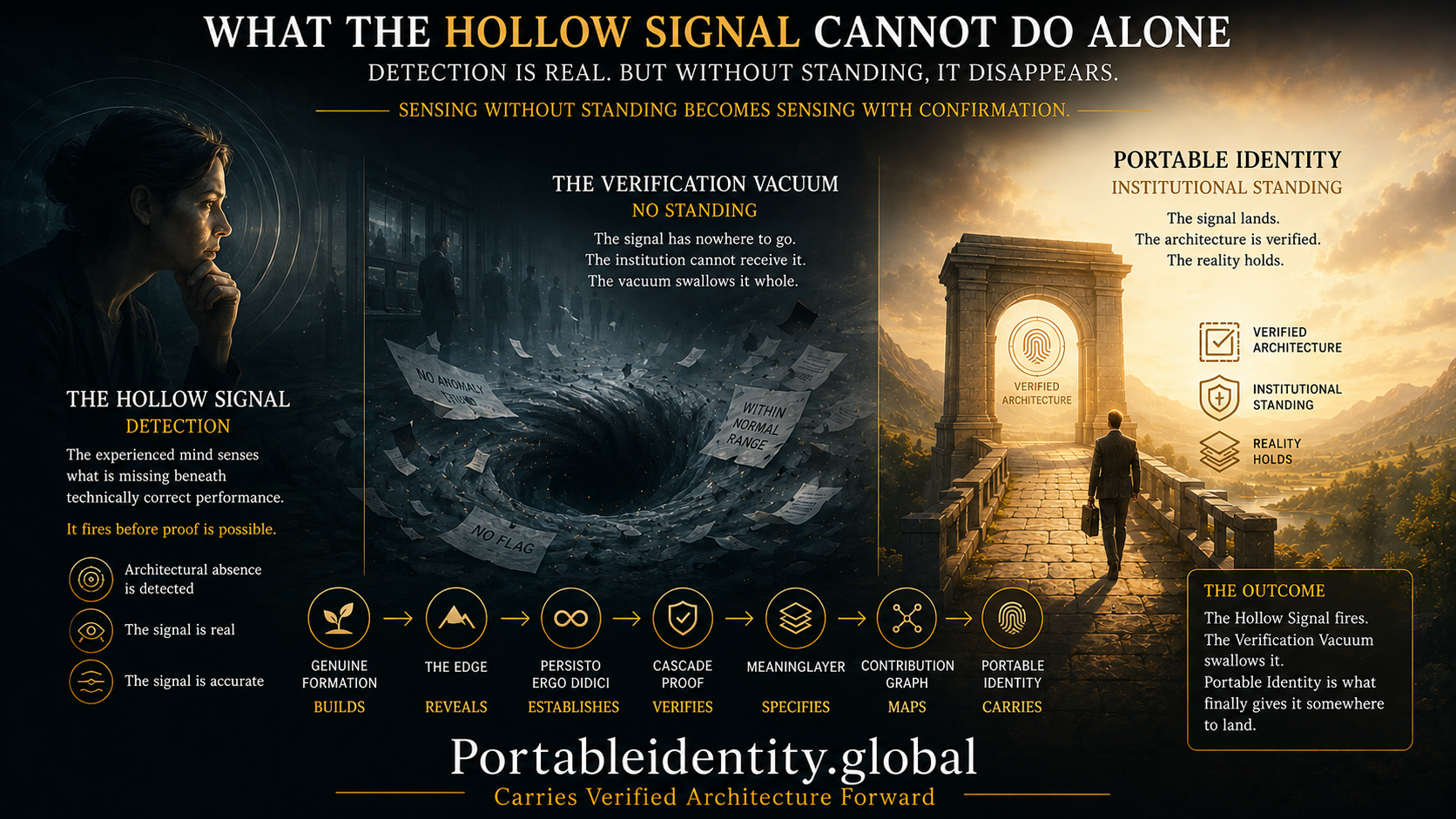
There is a detection capacity civilization almost lost before it had a name for it. The experienced practitioner who senses that something is missing beneath technically correct performance — who knows, before any instrument confirms it, that the architecture is absent — has always been civilization’s most sensitive early warning system. That system is real. It was built by genuine formation. And it has been firing for years. The problem is not that it fires. The problem is where the signal goes when it does.
Something is wrong.
You cannot prove it yet. The interview performance was impressive. The credentials are exactly right. The portfolio demonstrates exactly the range the role requires. Every formal instrument you have evaluated this person with has returned no anomalies.
And something is wrong.
The explanation is fluent but lands without weight. The analysis is sophisticated but somehow disconnected from the actual difficulty of the problem it describes. The confidence is calibrated correctly — not arrogant, appropriately uncertain in the right places — and yet the uncertainty does not feel like it was built by genuine encounter with genuine limits. It feels like uncertainty that knows what uncertainty is supposed to look like.
You have experienced this before. You have also overruled it before. You overruled it because there was nothing to point to — nothing the institution could process, nothing the evaluation framework could receive, nothing that had formal standing. You overruled it because the formal instruments said no anomalies. You overruled it because raising it would require explaining something you could not yet explain.
You overruled it. The cost arrived later.
This is The Hollow Signal. And what it cannot do alone is the article.
What The Hollow Signal Actually Is
The Hollow Signal is not intuition in the vague sense. It is not bias. It is not the inexplicable preference of the experienced evaluator for candidates who remind them of themselves.
It is pre-formal architectural detection — the specific sensitivity to architectural absence beneath technically correct performance that genuine formation builds as a residue of genuine encounter with genuine irreversibility.
When a person has genuinely built cognitive architecture through genuine irreversible developmental encounter — when they have actually faced The Edge, actually confronted situations where established frameworks reached their genuine limits and reconstruction was required rather than chosen — they carry a specific calibration. Not just the architecture itself, but the sensitivity to its presence or absence in others. The genuine encounter with genuine limits deposits not only the architecture that holds at The Edge but the ability to sense when that architecture is absent in the outputs of others.
This is not mystical. It is structural. The person who has built genuine Reality Coherence through genuine encounter with genuine difficulty has a specific sensitivity to the difference between outputs produced by genuine Reality Coherence and outputs produced without it. The difference is not detectable in the output itself — after the Fabrication Threshold, outputs produced with and without genuine Reality Coherence are identical under standard evaluation conditions. The difference is detectable in the specific orientation the output carries: toward genuine external correspondence, or toward the internal coherence that genuine external correspondence produces and that simulation replicates without the underlying calibration.
The person who has genuinely built the architecture can sense the absence beneath the replication.
That sensing is The Hollow Signal.
It is civilization’s oldest pre-institutional verification layer — older than credentials, older than professional evaluation processes, older than every formal instrument that was built to systematize what the experienced practitioner was already doing informally. Before institutions existed, genuine practitioners identified genuine practitioners through exactly this mechanism: the pre-formal detection of genuine formation in the outputs, the judgment, the specific way the person related to the limits of the domain.
The Hollow Signal precedes formal proof. It is not irrational. It is pre-rational in the specific sense that it reaches something the formal layer cannot yet reach — and signals that the formal layer should look more carefully.
What Happened To It
For most of professional history, The Hollow Signal had somewhere to go.
Not perfectly. Not always. But in the institutional structures of pre-Threshold professional life, the experienced practitioner who sensed architectural absence had at least some mechanism for acting on the signal. They could extend the evaluation period. They could probe with questions that revealed The Edge conditions the standard evaluation missed. They could observe over time as the familiar conditions that protected frictionless performance eventually gave way to something that required genuine reconstruction.
The Fabrication Threshold ended this.
After it, the three categories — genuinely formed, frictionlessly optimized, AI-generated output — produce not just similar signals but structurally identical signals under every evaluation condition that institutions have designed. The Hollow Signal fires. It senses the absence. But the conditions that once allowed the experienced practitioner to follow the signal to confirmation — to expose the evaluation to something that would reveal genuine architecture or confirm its absence — are no longer available.
The Edge still arrives. Eventually. When genuine novelty arrives, when established frameworks fail, when scaffolding is withdrawn and what was genuinely built either holds or reveals its absence. The Edge still distinguishes the three categories with perfect clarity.
But The Edge does not arrive during evaluation. It arrives after allocation. After the trust was extended. After the responsibility was assigned. After the institutional investment was made in someone whose signals were indistinguishable from the signals of genuine formation but whose formation was absent.
The Hollow Signal fired at the evaluation. The Edge confirmed it two years later. The cost of the gap between firing and confirmation is embedded in everything that was built on the misallocation.
And here is what makes this worse than any previous era’s verification failure:
Before the Fabrication Threshold, even without acting on The Hollow Signal, the institution had a non-trivial probability of self-correction. Time passed. The frictionlessly optimized performer encountered genuine difficulty. The absence revealed itself, not catastrophically in all cases, but detectably — in the specific ways that performance built without genuine formation degrades when the conditions that supported it change.
After the Threshold, this self-correction is degraded. AI assistance can sustain frictionless performance through conditions that once exposed its absence. The scaffolding that extended the illusion through mild difficulty can now extend it through more severe difficulty. The Edge still arrives — genuine novelty still cannot be indefinitely deferred — but the confirmation that The Hollow Signal’s detection was accurate arrives later, costs more, and is harder to attribute to the original misallocation.
The signal fires. The verification arrives too late to be useful. The cost accumulates silently.
The Verification Vacuum
Between The Hollow Signal and formal verification, there is a gap.
This gap has always existed. Pre-formal detection precedes formal proof by definition. The experienced clinician senses pathology before definitive imaging confirms it. The commander senses operational incoherence before data convergence establishes it. The practitioner senses architectural absence before any instrument can establish what is absent.
Before the Fabrication Threshold, this gap was a limitation. Serious in its costs, but manageable — because the gap was eventually closeable. The formal instruments, pointed in the right direction by the pre-formal signal, could often catch up.
After the Threshold, the gap has become a structural condition. The Verification Vacuum: the specific institutional gap in which standard instruments cannot distinguish the three categories — genuine architecture, frictionless optimization, AI-generated output — and The Hollow Signal’s pre-formal detection has no formal mechanism for entering institutional consideration.
The person who carries The Hollow Signal is now in a specific and structurally untenable position.
They have detected something real. The signal is not noise — it is pre-formal architectural detection built by genuine formation, calibrated to the specific difference that post-Threshold evaluation instruments cannot see. The detection is accurate.
But the detection has no institutional standing.
When they raise it, the institution can only process what formal instruments confirm. The formal instruments confirm no anomalies. The pre-formal signal — the sensing that something is absent beneath the technically correct performance — cannot be translated into anything the institution’s evaluation framework can receive.
The signal fired. The institution cannot hear it.
And when a signal fires repeatedly in an institutional context that cannot receive it, two things happen.
First, the person who carries the signal learns to suppress it. Not because they decided the signal was wrong — but because raising something that cannot be formally established, repeatedly, produces costs that unestablished detections cannot justify. Colleagues attribute the sensing to bias. Processes attribute it to conservatism. Over time, the person who was civilization’s most sensitive early warning system learns to distrust their own most reliable instrument. The suppression compounds. The instrument degrades.
Second, the institution loses access to the most accurate information it has about what is actually present in the people it is evaluating. The formal instruments report no anomalies. The pre-formal detection — the signal that something is absent — is absorbed into the institutional silence. The allocation is made. The cost accumulates.
Civilization did not lose The Hollow Signal suddenly. It lost it one suppression at a time.
What The Signal Needs — And Has Never Had
The Hollow Signal needs two things to function as more than a private suspicion.
It needs language — so it can be named, communicated, distinguished from bias and preference, treated as pre-formal detection rather than as noise.
And it needs a verification layer — so that the detection can be followed to formal confirmation, so that what the signal senses as absent can be formally established as absent, so that sensing without standing can become sensing with institutional weight.
Language has arrived. Naming The Hollow Signal ended the isolation around a detection that was real before it was nameable. The person who has been suppressing it for years — who has been overruling accurate pre-formal detection because it had no institutional standing — now has language for what they were sensing. The isolation ends. But the structural problem remains.
Because language without verification is not institutional standing. It is articulate sensing without standing.
The Hollow Signal can now be named. It cannot yet be confirmed.
And here is where the gap between pre-formal detection and formal verification becomes the central problem of the post-Threshold verification landscape:
The Hollow Signal senses the absence of genuine formation. What it needs to become institutional standing is verified evidence of the presence or absence of genuine formation — evidence that exists in the world, in the people who were genuinely formed or not formed, across time, verified independently of the evaluation moment.
This evidence exists. It exists in the causal effects that genuine formation produces: the verified capability increases in specific people that persisted after contact ended, propagated through the people they reached, compounded across generations. The cascade pattern that genuine formation creates and that architectural absence cannot retroactively generate.
But this evidence does not travel.
The verified causal history of what someone’s genuine formation produced in the world — what Persisto Ergo Didici establishes, what Cascade Proof verifies, what MeaningLayer specifies, what the Contribution Graph maps — accumulates in the institutional contexts where it was produced. When the person transitions, it stays behind.
At the new institution, evaluating this person in a new context, The Hollow Signal fires or does not fire. If it fires, it points toward something real. But the evidence that would allow the signal to be followed to formal confirmation does not exist in the new context. It is in the previous institutional contexts, accumulated and invisible to the institution that most needs to see it.
The Hollow Signal fires. The Verification Vacuum swallows it. The cost accumulates. The cycle repeats.
What Portable Identity Changes — Precisely Here
Portable Identity does not improve The Hollow Signal. It does not make the pre-formal detection more accurate or more reliable. The signal is already accurate. Improving what is already accurate solves nothing.
What Portable Identity does is provide the evidence layer that transforms accurate pre-formal detection into institutional standing.
When the person The Hollow Signal fires at carries no verified formation evidence, the signal has nothing to be confirmed against. It is accurate — the absence it detects is real — but there is no formal evidence to follow it to. The Verification Vacuum swallows it.
When the person The Hollow Signal fires at carries verified formation evidence — the temporal persistence that Persisto Ergo Didici establishes, the causal transmission that Cascade Proof verifies, the semantic specification that MeaningLayer provides, the complete causal map that the Contribution Graph builds — the signal has something to be confirmed against.
And here is what changes:
The Hollow Signal fires. The institution checks verified formation evidence. The verified formation evidence confirms the detection: the cascade pattern that genuine formation produces is absent. The formation evidence that should exist in the world — the specific people whose capability verifiably increased, who verifiably propagated further without continued involvement — is not there.
Sensing without standing becomes sensing with confirmation.
The Verification Vacuum does not disappear. The gap between pre-formal detection and formal verification is structural. But Portable Identity provides the evidence layer that allows the gap to be crossed — that allows what the signal accurately senses to be formally established, that allows the institution to act on the most accurate information it has.
And in the other direction:
When The Hollow Signal does not fire — when the person carries what feels like genuine architecture — verified formation evidence confirms the detection in the other direction too. The cascade pattern is there. The temporal persistence is confirmed. The causal transmission is verified. The sensing that what is present is real is formally confirmable.
For the first time, the most accurate verification instrument civilization has — pre-formal architectural detection built by genuine formation — can be followed to formal confirmation. Not in every case. Not perfectly. But structurally, for the first time, the path from sensing to standing exists.
What This Means for The People Who Carry The Signal
There are people in your organization who have been suppressing accurate detections for years.
They are your most genuinely formed practitioners — the people who have built genuine architecture through genuine irreversible encounter with genuine difficulty. They carry The Hollow Signal because genuine formation built it in them. And they have been systematically learning to distrust it, because the institutional environment never provided the formal verification layer that would allow accurate pre-formal detection to become institutional standing.
They know things your evaluation instruments cannot measure. They sense architectural absence beneath technically correct performance with accuracy that exceeds every formal instrument in your evaluation stack. They have been doing this for the entirety of their professional lives.
And they have been absorbing the cost of having no institutional mechanism for what they sense. The cost of overruling accurate detection. The cost of watching allocations be made on the basis of formal instruments that confirmed no anomalies while the pre-formal instrument was firing. The cost of raising it and being attributed with bias. The cost of not raising it and watching the cost arrive.
Portable Identity does not restore what was suppressed. It creates the conditions under which accurate pre-formal detection does not need to be suppressed.
When verified formation evidence is available — when the person being evaluated either carries the causal trace of genuine formation or carries the verified absence of it — The Hollow Signal has somewhere to land.
The detection fires. The evidence confirms or disconfirms. The institution can finally act on the most accurate information it has.
The Hollow Signal fires. The Verification Vacuum swallows it. Portable Identity is what finally gives it somewhere to land.
Not because the signal was wrong. Because it was always right — and had nowhere to go.
→ TheHollowSignal.org — The canonical framework for pre-formal architectural detection → VerificationVacuum.org — The structural gap the signal fires into → CascadeProof.org — The causal verification that confirms what the signal detects → PersistoErgoDidici.org — The temporal verification that the signal’s detection points toward → TheEdge.is — Where the signal’s detection is eventually confirmed — too late for the allocation → GenuineFormation.org — What the signal was always calibrated to detect → MeaningLayer.org — The semantic layer that specifies what the signal senses → FabricationThreshold.org — Why the gap between signal and confirmation widened permanently → About — What Portable Identity carries that gives the signal somewhere to land